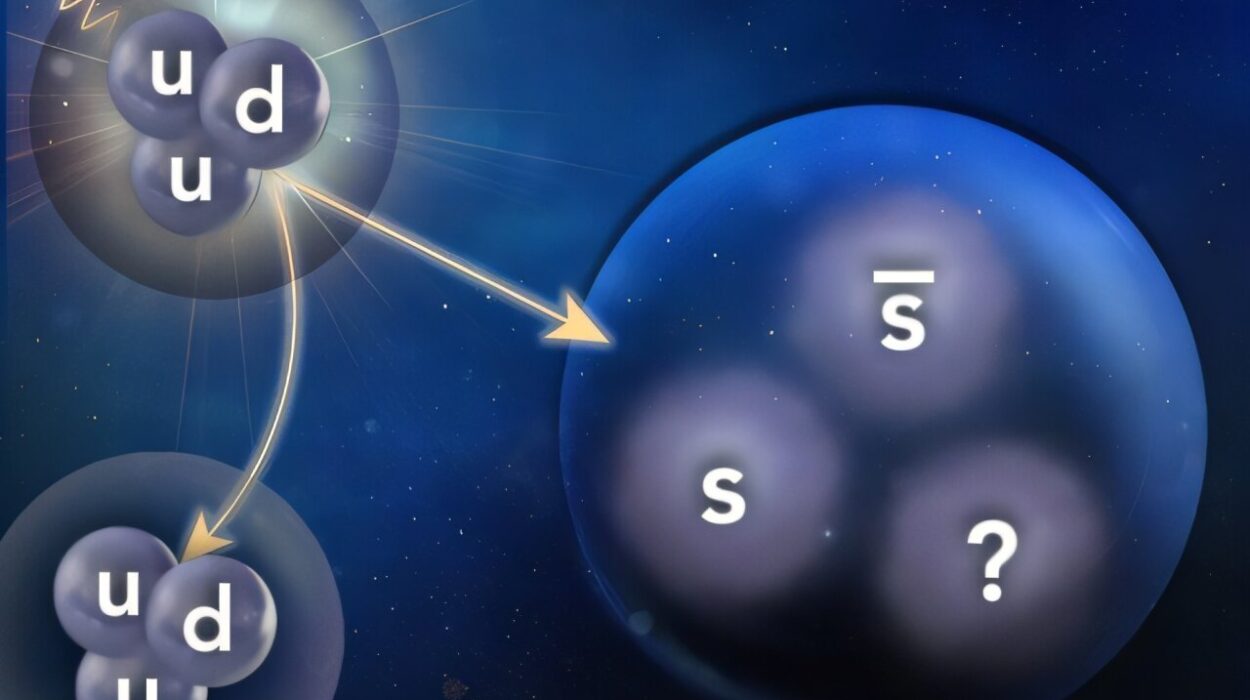
Two Lambda baryons born together in the decay of a J/ψ particle gave physicists a way to use both particles at once, turning their polarization and quantum entanglement into information about a rare weak decay that had been difficult to measure precisely. Using this approach, the BESIII Collaboration has made the first absolute measurement of the branching fraction for the electron mode of Lambda semileptonic decay, measured several of the decay’s internal couplings, and combined the result with lattice QCD calculations to obtain a value of |Vᵤₛ| = 0.2339 ± 0.0041.
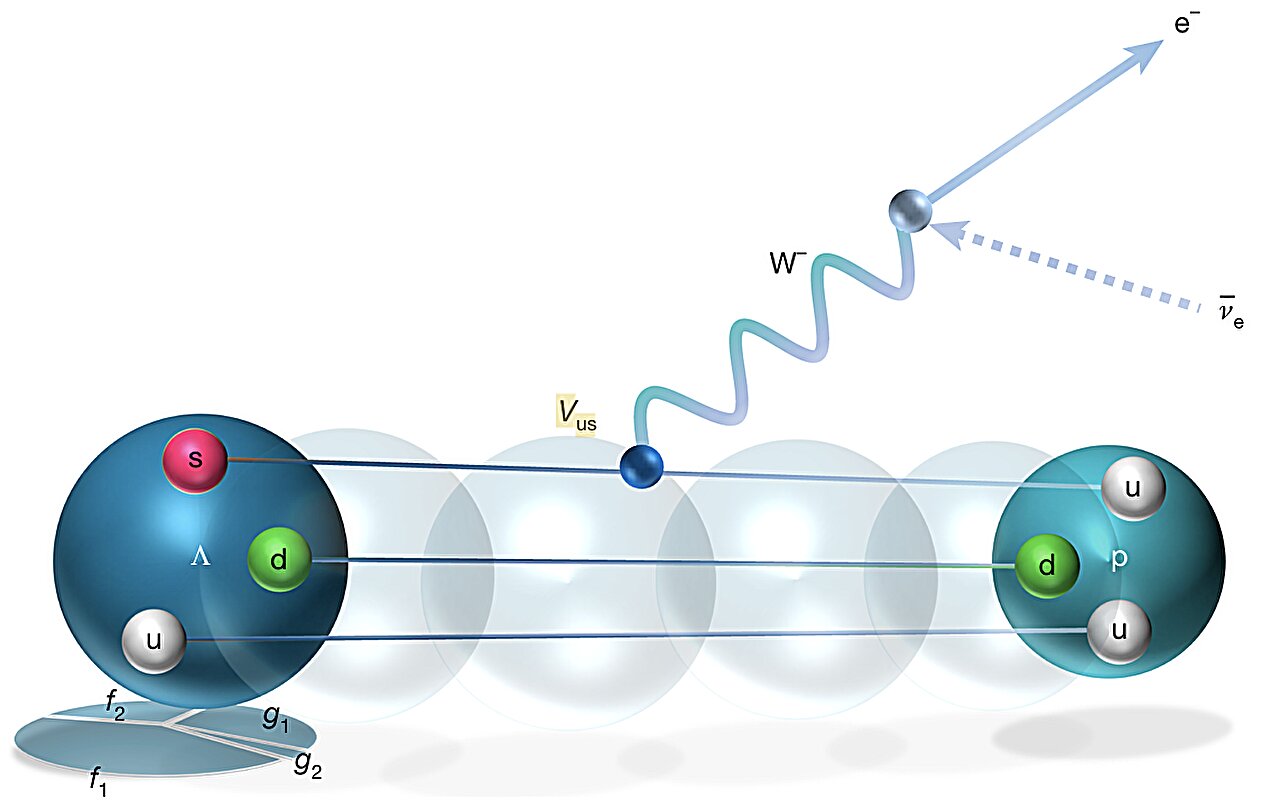
The decay at the center of the measurement is Λ → p e⁻ ν̄ₑ. A strange quark inside the Lambda changes into an up quark through the weak interaction, producing a proton, an electron and an electron antineutrino.
The decay rate depends on |Vᵤₛ|, the Cabibbo-Kobayashi-Maskawa (CKM) matrix element that describes the strength of the transition between strange and up quarks. The CKM matrix is a central part of the Standard Model, and measuring its elements in different ways provides tests of the theory.
Lambda semileptonic decays have long offered a possible independent route to |Vᵤₛ|. But extracting the information is difficult because the decay depends not only on |Vᵤₛ| but also on form factors, quantities that describe how the internal structure of the baryon affects the weak transition.
For an electron mode such as this one, two of the six possible form factors, the scalar and pseudoscalar terms, are strongly suppressed by the small electron-to-hyperon mass ratio. The decay therefore depends effectively on four form factors, along with |Vᵤₛ|. The important quantities include the axial-vector form factor, the weak-magnetism form factor and the weak-electricity form factor.
The vector form factor f₁ is especially important because its value is affected by the difference between strange and down quarks. Approximate flavor SU(3) symmetry provides a reference value, but corrections from breaking that symmetry must be understood for a more precise determination of |Vᵤₛ|.
Lattice QCD offers a way to calculate those form factors from first principles. The BESIII measurement provides experimental information that can be combined with those calculations rather than relying entirely on older phenomenological models.
The Lambda pair provided more than a decay
The measurement used 10.087 billion J/ψ events collected with the BESIII detector. About 1.89 × 10⁻³ of J/ψ decays produce a ΛΛ̄ pair.
The crucial feature is that the Lambda and anti-Lambda are produced together. Their production creates a quantum-entangled pair whose polarization and spin correlations carry information about the production process.
The BESIII analysis used events in which one Lambda underwent the semileptonic decay Λ → p e⁻ ν̄ₑ while the accompanying anti-Lambda decayed through the hadronic channel Λ̄ → p̄π⁺. The charge-conjugate configuration was also included.
This gave the experiment information that would not be available from an isolated Lambda decay. The Lambda’s polarization and the spin correlations between the two members of the pair are determined by two production parameters. Those parameters had already been measured precisely using the same dataset.
As a result, the new analysis could treat the three desired decay couplings as the remaining unknowns: the axial-vector coupling, the weak-magnetism coupling and the weak-electricity coupling.
The full decay was described using seven kinematic variables. Six were helicity angles that specify the directions of the particles in appropriate reference frames, while the seventh was q², the squared four-momentum transfer carried by the intermediate W boson.
The entangled anti-Lambda was particularly useful because it allowed the experiment to reconstruct the semileptonic decay kinematics event by event while also providing information about the polarization and spin correlations of the original pair. The collaboration used an unbinned maximum-likelihood fit that incorporated the multidimensional detection efficiency.
The absolute decay rate was measured directly
The experiment first established the number of semileptonic decays.
The electron and proton from the semileptonic Lambda decay were reconstructed together with the proton and pion from the anti-Lambda decay. Because the neutrino cannot be detected directly, the analysis used the missing energy and momentum of the event. The resulting quantity, Uₘᵢₛₛ, is centered near zero for signal events because the missing particle is the neutrino.
The dominant background came from ordinary hadronic Lambda decay, Λ → pπ⁻. That background produces a differently shaped Uₘᵢₛₛ distribution, allowing the signal and background contributions to be separated with an extended unbinned maximum-likelihood fit.
For the absolute branching fraction, BESIII used a double-tag method. In a double-tag event, one Lambda is reconstructed through the semileptonic decay while its anti-Lambda partner is reconstructed through Λ̄ → p̄π⁺. A single-tag sample, in which only the hadronic side is reconstructed, provides the normalization.
The single-tag sample contained 14.328 million events, with a detection efficiency of 54.09%. The double-tag sample contained 1,854 ± 49 signal events and had a detection efficiency of 8.58%.
Those measurements gave an absolute branching fraction of
B(Λ → p e⁻ ν̄ₑ) = (8.16 ± 0.22 ± 0.15) × 10⁻⁴,
where the first uncertainty is statistical and the second is systematic.
The result agrees with the then-current world average of (8.34 ± 0.14) × 10⁻⁴.
The systematic studies included the number of reconstructed tracks, the Lambda vertex fit, proton and electron reconstruction, the kinematic fit, and the extraction of single- and double-tag yields. For example, the analysis found a 6.81 ± 1.65% correction associated with electron reconstruction and treated the size of that correction as a systematic uncertainty. Alternative descriptions of the Uₘᵢₛₛ background changed the branching-fraction result by up to 0.79%, leading to a 0.80% systematic uncertainty from that fit.
The collaboration also generated 300 simulated signal-like samples with event yields matching those observed in the data. The fitted parameters were consistent with the generated values, with no indication of a systematic bias.
The angular distribution exposed the Lambda’s internal couplings
The branching fraction alone does not determine all of the form-factor information. To extract the couplings, the researchers selected events with |Uₘᵢₛₛ| < 0.02 GeV, leaving 1,791 ± 47 signal events and 207 ± 30 background events.
The seven-dimensional kinematic distribution was then fitted simultaneously.
The first set of results fixed the weak-electricity coupling to zero, as expected in the SU(3)-symmetry limit, allowing more precise determinations of the axial-vector and weak-magnetism couplings. The averaged values were
gₐᵥ = 0.729 ± 0.047(stat) ± 0.048(syst)
and
g_w = 0.89 ± 0.35(stat) ± 0.14(syst).
The weak-magnetism result is consistent with the value 0.97 predicted under the conserved-vector-current hypothesis and also with the earlier experimental measurement of 0.15 ± 0.30.
The analysis then allowed the weak-electricity coupling to vary rather than imposing its SU(3) value of zero. This produced
gₐᵥ² = −0.19 ⁺⁰·⁶⁵₋₀·⁶³,
with the uncertainties dominated by the limited experimental sensitivity.
This is the first measurement of the weak-electricity coupling in Lambda semileptonic decay. The corresponding averaged axial-vector and weak-magnetism couplings in this fit were
gₐᵥ = 0.706 ⁺⁰·⁰⁸⁹₋₀·⁰⁸⁶
and
g_w = 0.77 ⁺⁰·⁵³₋₀·⁴⁹.
These results were consistent with the first set of measurements within their uncertainties and were also compatible with the corresponding lattice QCD calculation cited by the collaboration.
The weak-electricity term is of particular interest because it vanishes in the SU(3) symmetry limit in the absence of second-class currents. The present measurement therefore provides experimental information about a quantity that had previously been inaccessible in Lambda semileptonic decay.
The fit itself was designed to reduce a strong correlation between the axial-vector and weak-electricity couplings. Rather than fitting directly in the standard Weinberg form-factor basis, the analysis first used helicity form factors and then transformed the results into the conventional representation. The paper reports that the axial-vector and weak-electricity couplings otherwise have a correlation of at least 95%.
The researchers also tested the dependence of the form factors on q². Their nominal analysis used a dipole parameterization, while alternative z-expansion descriptions based on a relativistic quark model and on lattice QCD were used to assess systematic effects. Additional systematic studies varied the fit inputs, background estimates and electron-selection requirements.
Two routes to |Vᵤₛ|
With the measured branching fraction and decay couplings in hand, the collaboration extracted |Vᵤₛ| in two different ways.
The first used the SU(3)-symmetry value of the vector form factor, f₁ = −√3/2, together with the measured axial-vector and weak-magnetism couplings. The analysis also set the weak-electricity coupling to zero for this determination.
The resulting value was
|Vᵤₛ|SU(3) = 0.2194 ± 0.0094.
Its uncertainty includes contributions from the branching fraction, the measured form factors, the Lambda lifetime and the radiative correction.
The authors then used a recent lattice QCD calculation that includes SU(3)-breaking effects and provides the relevant form factors with their q² dependence.
That calculation changes the experimental result substantially because the form-factor input is no longer fixed by exact SU(3) symmetry. Combining the BESIII branching-fraction measurement with the lattice form factors gives
|Vᵤₛ|LQCD = 0.2339 ± 0.0041.
The uncertainty is made up of 0.0038 from the BESIII branching-fraction measurement, 0.0004 from the Lambda lifetime, 0.0006 from radiative corrections and 0.0011 from the lattice QCD input.
The lattice contribution accounts for only 7.5% of the total variance in this result. In comparison, when the form factors are not supplied by lattice QCD, the form-factor contribution dominates the uncertainty. The statistical uncertainty from the branching-fraction measurement is now the largest single contribution, at 0.0032.
The collaboration notes that the lattice-QCD-based value is consistent with the CKM unitarity requirement at the 1.4σ level. The paper also reports that it is about two standard deviations higher than the value previously obtained by Cabibbo from the Lambda decay.
The SU(3)-based result, in contrast, is consistent with the CKM unitarity value within 0.9 standard deviations.
An experimental result without choosing a form-factor value
The collaboration also extracted a quantity that does not require a theoretical value for the individual form factors.
Under the assumptions that g₂ is zero and the relevant Φ₂ contribution can be neglected, the decay width is approximately proportional to the square of |Vᵤₛ| multiplied by the dominant combination of the vector and axial-vector form factors.
That allows the experiment to determine the product
|Vᵤₛ|√(f₁² + 3g₁²) = 0.4496 ± 0.0061(stat) ± 0.0041(syst) ± 0.0009(τΛ) ± 0.0011(RC).
The paper describes this as the first experimental determination of this product for any semileptonic baryon decay. Because it does not require an externally supplied theoretical normalization for the form factors, the result is intended as an experimental constraint on calculations of baryon semileptonic decays.
The assumptions behind this quantity are important. The collaboration explicitly sets g₂ to zero and neglects the Φ₂ contribution because its kinematic coefficient is small. It therefore does not represent a completely assumption-free measurement of every form-factor contribution.
A measurement separated from the previous generation
The Lambda semileptonic decay had not received a new experimental determination of |Vᵤₛ| for more than 30 years.
The previous high-statistics measurement of the axial-vector coupling came from a Fermilab fixed-target experiment that observed about 37,000 Lambda semileptonic candidates. Its reported value of gₐᵥ was 0.719 ± 0.016 ± 0.012, while the Particle Data Group average cited in the paper is 0.718 ± 0.015.
The BESIII sample used here is much smaller in terms of the number of semileptonic events. Yet the use of the polarization and quantum entanglement of the Lambda-antihyperon pair gives the analysis additional information from each event.
The collaboration reports that, compared with the Fermilab measurement, its uncertainty on the weak-magnetism coupling is comparable even though the older dataset was approximately 20 times larger. The uncertainty on the axial-vector coupling is about 2.5 times larger in the BESIII result. At the same time, the new method provides a measurement of the weak-electricity coupling that was previously inaccessible in Lambda semileptonic decay.
The paper describes this as the first use of polarization and quantum entanglement in the analysis of baryon semileptonic decays.
The method depends on the fact that the Lambda pair is produced in a correlated quantum state. The production parameters determine the polarization and spin correlations, while the decay of the accompanying anti-Lambda supplies additional angular information. This structure is incorporated into the likelihood rather than treating the Lambda decay as an isolated process.
The analysis therefore combines information at two levels. For an individual event, the accompanying anti-Lambda helps reconstruct the semileptonic decay kinematics. Across the event sample, the correlated Lambda-antihyperon production supplies information about the polarization and spin structure needed to extract the decay couplings.
The BESIII collaboration says the same approach is already being extended to other baryon semileptonic decays. The paper also identifies particle-antiparticle collider facilities, including PANDA and proposed super tau-charm factories, as settings where the method can be applied.
The current measurement does not by itself reach the precision of |Vᵤₛ| determinations from kaon decays. Its |Vᵤₛ| uncertainty remains substantially influenced by the experimental branching-fraction measurement and, when lattice QCD form factors are used, by the lattice input.
But the measurement supplies the absolute Lambda semileptonic branching fraction, several decay couplings, a first weak-electricity measurement for this channel, and an experimentally determined combination of |Vᵤₛ| and the dominant form factors. Together, these measurements provide the quantities used in the paper’s comparison between the Lambda decay, lattice QCD and CKM unitarity.
The study was published in Nature.