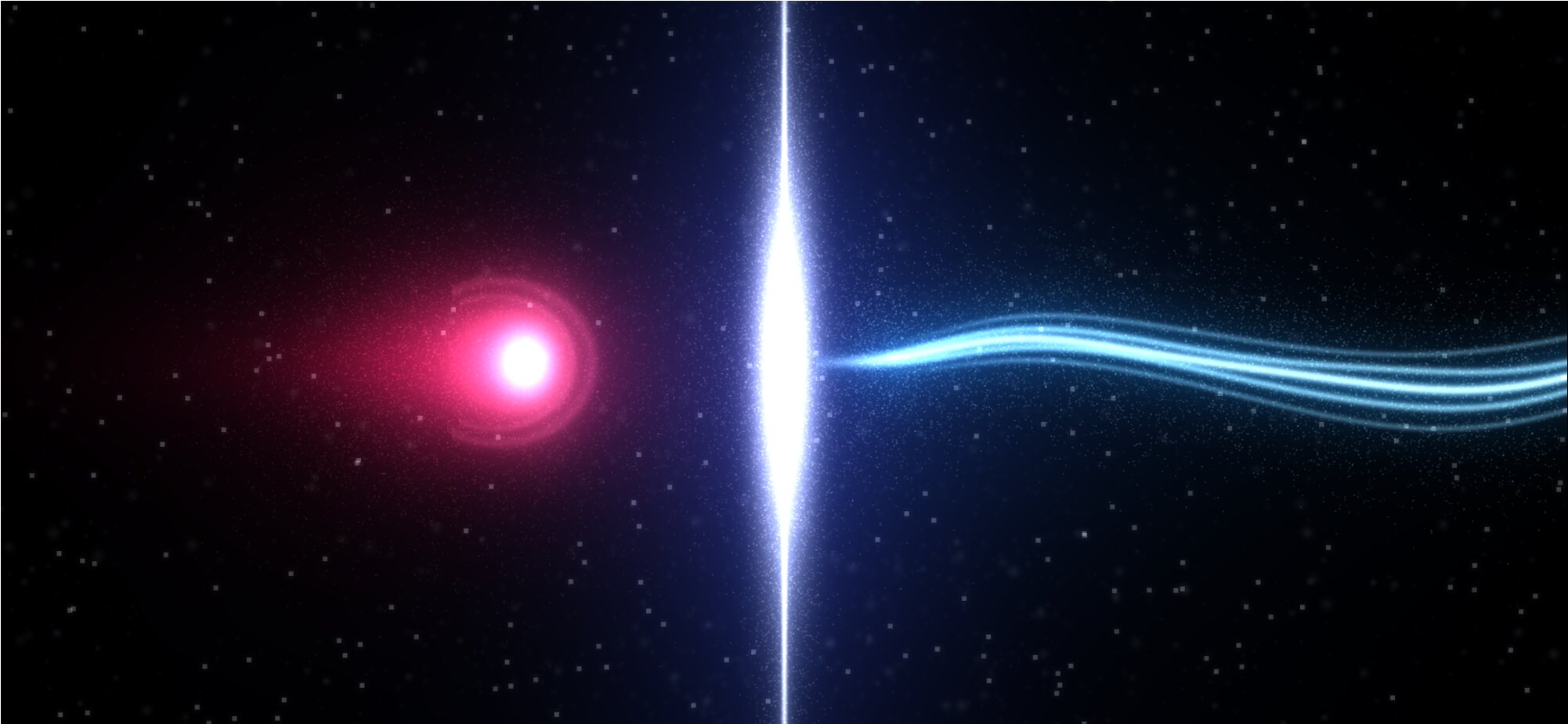
A particle scattering from a special quantum interface does not disappear after all. Instead, physicists have found that it passes through with 100% probability and emerges in a radically different form, attached to an invisible string leading back to the interface.
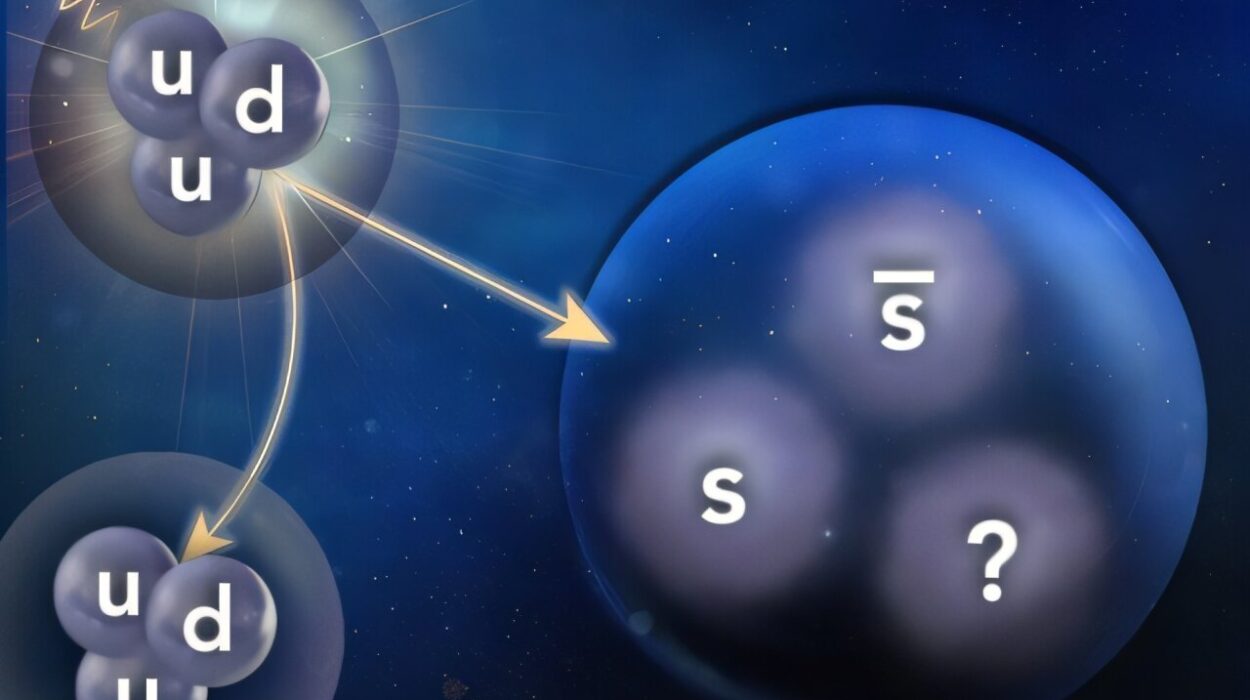
The problem dates back to calculations from the 1980s involving magnetic monopoles. When an electrically charged particle scatters from one of these hypothetical magnetic objects, the outgoing particle appears to disappear from the theory. Later work in quantum field theory suggested that the missing state could exist in unusual, “twisted” sectors that are difficult to describe in ordinary terms.
A team from Ghent University, the University of Cambridge and the University of Oxford has now demonstrated a concrete version of that idea in a quantum spin chain.
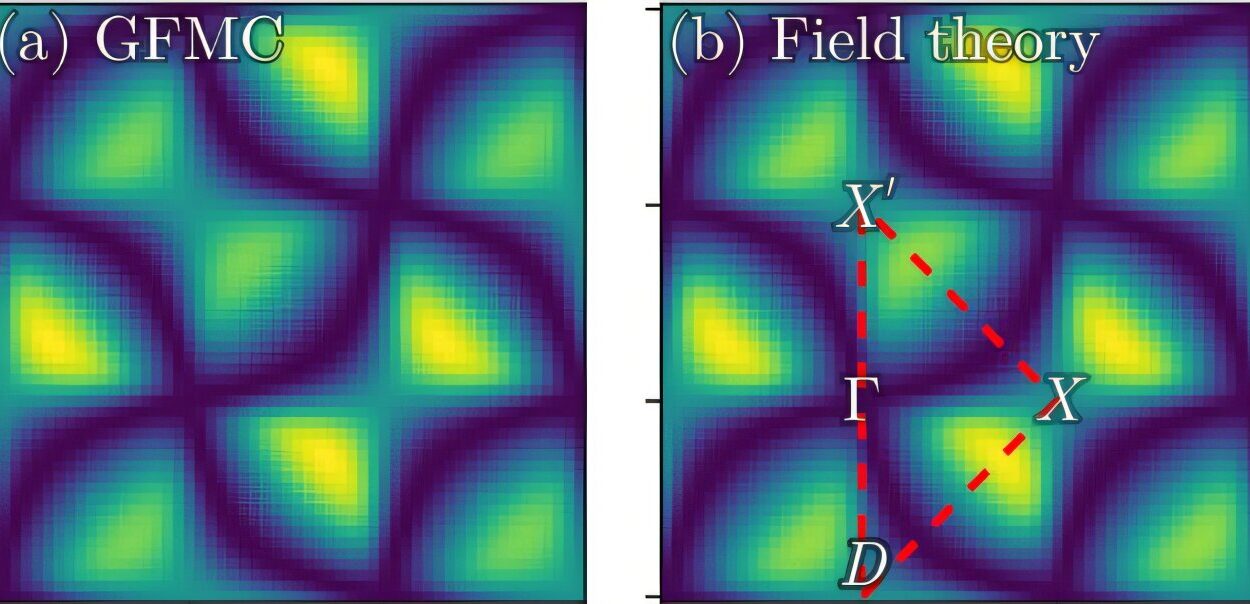
The researchers sent quantum wave packets toward what is known as a duality defect. This is an interface that connects two quantum descriptions representing the same underlying physics. The defect implements Kramers–Wannier duality, a transformation that maps order to disorder.
The wave packet passes through the interface every time. But it does not remain an ordinary particle on the other side.
Instead, it becomes a nonlocal excitation with a string attached to it that extends back to the defect.
“The particle goes through every time—it has no choice, because the defect is topological,” said Frank Verstraete of Ghent University and the University of Cambridge. “But what comes out on the other side is no longer an ordinary particle. It is a nonlocal object—a particle attached to an invisible string that stretches all the way back to the defect.”
A hidden quantum space inside the defect
The result comes from a way of describing quantum matter through entanglement rather than individual particles. Verstraete and his collaborators have developed this approach over two decades using tensor networks.
In that framework, the duality defect can be represented by a mathematical object called a matrix product operator. It forms a one-dimensional strip of entangled tensors.
That strip contains a virtual bond space that is usually treated as mathematical bookkeeping. In this case, the researchers interpret the space as the defect’s own internal quantum state space. Its size represents the number of internal degrees of freedom available to the defect.
“The defect carries a hidden quantum space, and that space dictates both the perfect transmission and the particle’s new identity,” said first author Atsushi Ueda.
The researchers argue that this hidden space provides the mechanism behind both observations: the particle’s guaranteed transmission and its transformation into a string-like excitation.
Turning an abstract idea into a spin-chain model
Dualities are unusual because they cannot simply be applied to individual particles. They apply to the entire quantum system.
“Dualities are strange symmetries: You cannot apply them particle by particle, only to the whole system at once,” said Laurens Lootens of the University of Cambridge.
The new work puts that abstract structure into a simple spin-chain setting. The system can already be simulated on a computer and could also be studied on quantum simulators.
That makes the particle-to-string conversion something that could potentially be observed directly in experiments. The authors point to quantum simulation platforms including cold atoms, trapped ions and superconducting processors.
Paul Fendley of the University of Oxford described the work as giving non-invertible symmetries and duality defects an operational meaning by allowing researchers to send something toward the defect and examine what emerges.
The authors anticipate that experiments with these systems could provide a direct observation of a particle changing its identity as it crosses a topological interface.
The study was published in Nature Physics.