As temperature and magnetic field change, the superconductor K2Cr3As3 does not remain in a single superconducting state. Instead, nuclear magnetic resonance measurements indicate three distinct phases, with the direction of the paired electron spins changing between them and the superconducting gap switching between point-node and line-node structures.
Superconductivity in K2Cr3As3 was already unusual before these measurements. The material belongs to a family of chromium-based superconductors with transition temperatures as high as 8.6 kelvin. K2Cr3As3 itself has a transition temperature of at least 6.2 K under the conditions discussed by the authors and has no detected long-range magnetic order. Its crystal structure consists of double-walled chromium-arsenic subnanotubes running along the crystal’s c-axis.
The material had also shown two clues that its superconductivity might involve an unusual form of electron pairing. Its upper critical field is much higher than the Pauli paramagnetic limit for magnetic fields both parallel and perpendicular to the c-axis. Earlier nuclear magnetic resonance and nuclear quadrupole resonance measurements had found a temperature dependence of the spin-lattice relaxation rate, 1/T1, proportional to T5, consistent with point nodes in the superconducting gap. NMR measurements of the Knight shift had also produced an anisotropic response consistent with spin-triplet pairing.
In ordinary spin-singlet superconductivity, the two electrons in a Cooper pair have opposite spins and a total spin of zero. Spin-triplet pairs instead have total spin one, giving the superconducting state an internal spin degree of freedom. That allows the orientation of the paired spins, and therefore the structure of the superconducting order parameter, to change between different states.
The new measurements were designed to track that internal degree of freedom directly.
NMR tracks the direction of the paired spins
The researchers used ^75As nuclear magnetic resonance on single crystals of K2Cr3As3, measuring the Knight shift at the As2 site with magnetic fields of 3.7, 5.0, 6.0, 7.0 and 10 tesla directed along the crystal’s c-axis. The crystals were grown by a high-temperature solution-growth method.
The Knight shift is sensitive to the local spin susceptibility. For the spin-triplet states considered here, its behavior below the superconducting transition temperature depends on the orientation of the superconducting d(k)-vector, which describes the spin structure of the Cooper pairs. When the d(k)-vector has a component parallel to the applied magnetic field, the Knight shift decreases below the relevant transition. When it is perpendicular to the field, the Knight shift can remain unchanged.
At 10 T, for example, the bulk superconducting transition occurred at 5.3 K. The Knight shift did not begin decreasing at that temperature. Instead, it remained essentially unchanged until a lower characteristic temperature, T* = 4.5 K, and then decreased as the sample was cooled further. The NMR spectra themselves showed the same behavior: the spectral peak stayed at the same position between Tc and T*, then shifted to lower frequency below T*.
The same general behavior occurred at 7 T. The characteristic temperature T* moved upward as the magnetic field was reduced, indicating a change in the d(k)-vector orientation across this boundary. At fields below 7 T, however, the pattern changed again. At 6.0, 5.0 and 3.7 T, T* moved downward as the field was reduced, producing a kink in the phase boundary. The authors interpret this second boundary as separating another superconducting state from the state found at higher temperatures and lower fields.
That left an important question. Was the paired-spin direction simply rotating while the underlying superconducting gap remained the same, or was the material actually changing its superconducting gap structure?
The relaxation rate reveals a second transition
To distinguish those possibilities, the researchers measured the temperature dependence of 1/T1, the nuclear spin-lattice relaxation rate.
This quantity is sensitive to the electronic density of states produced by the superconducting gap. The paper notes that a fully gapped conventional superconductor produces an exponential decrease in 1/T1 below Tc, while a line-node gap gives a T3 dependence and a point-node gap gives a T5 dependence at low temperatures.
The measurements exposed a clear change between those two nodal behaviors.
At 13 T, 1/T1 dropped sharply below the superconducting transition without a coherence peak and followed approximately T3 behavior below about half of Tc. The authors interpret this as evidence for a line-nodal superconducting gap. At 10 T and 6 T, by contrast, 1/T1 changed slope at T* and followed T5 behavior at lower temperatures, indicating point nodes in that regime.
The change becomes especially clear when 1/T1T is plotted against temperature. At 13 T, the quantity drops sharply on entering the superconducting state. At 10 T, it initially follows a similar trend but decreases more rapidly below T* = 4.5 K. At 6 and 5 T, the separation between Tc and T* becomes progressively narrower.
The combination of the two measurements is important. At 10 T, the characteristic temperature identified from the Knight shift coincides with the one identified from the change in 1/T1. That means the change in the d(k)-vector orientation and the change in gap symmetry occur at the same transition there. But at 6 and 5 T, the two transitions separate. The gap structure changes first as the material is cooled, followed at a lower temperature by a reorientation of the d(k)-vector.
That separation is what exposes the third superconducting phase.
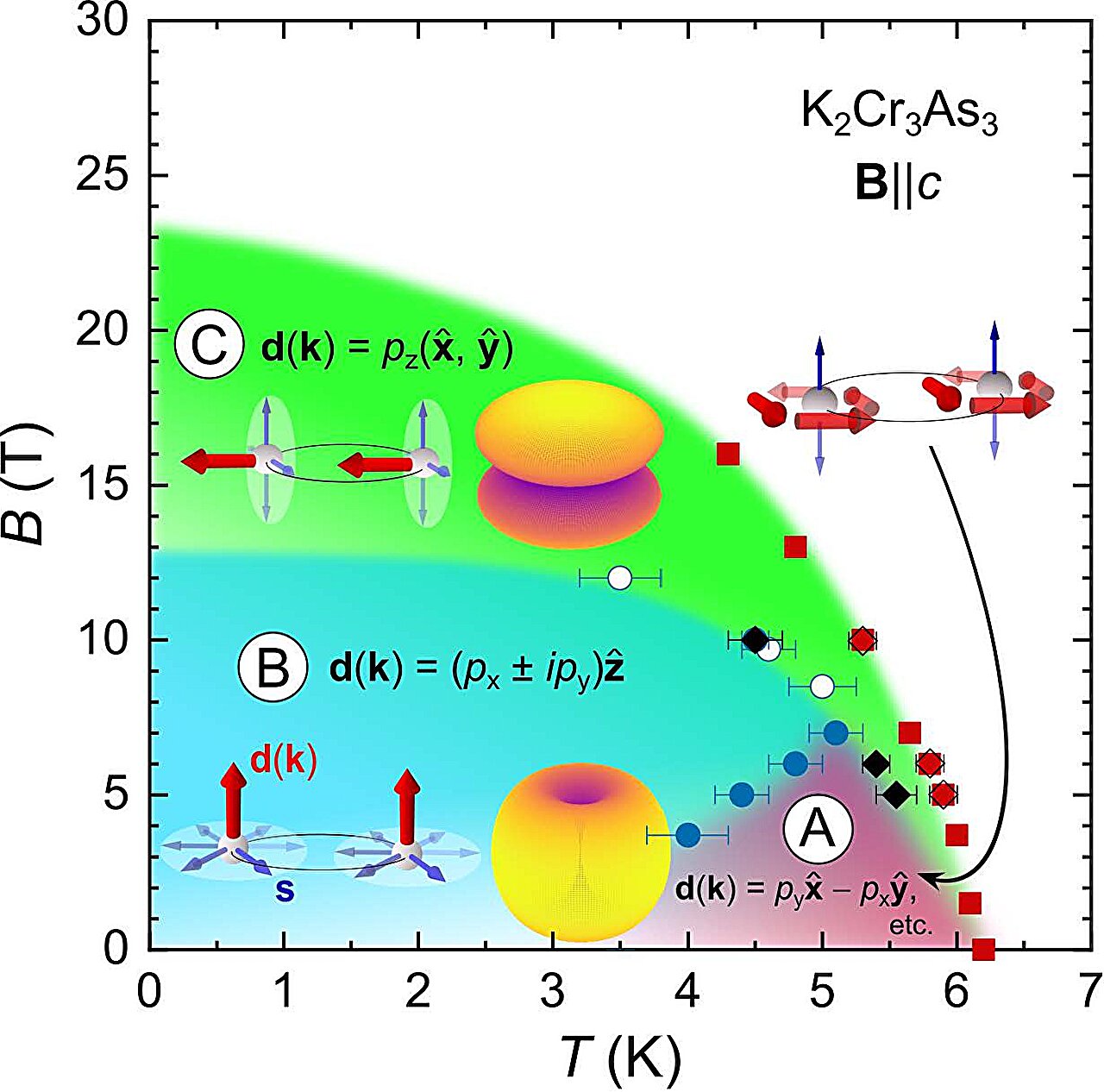
Phase A has point nodes and a helical spin structure
The authors call the high-temperature, lower-field state Phase A.
Its Knight shift does not decrease below Tc when the magnetic field is along the c-axis, while its 1/T1 follows a T5 dependence. Together, those properties are consistent with a group of possible helical spin-triplet states allowed by the crystal’s D3h symmetry. The measurements do not distinguish among three such candidates: A′′1, A′′2 and E′′.
For these states, the d(k)-vector lies in the basal plane, while the paired electron spins are oriented along the c-axis. Their gap has point nodes, and a point-nodal gap function proportional to sin θ fits the measured relaxation data.
The paper treats the A′′1 state, with d(k) = px x̂ + py ŷ, as a representative example. In that state, the d(k)-vector has components proportional to kx and ky, so the magnitude of the gap is proportional to the in-plane momentum and vanishes at the corresponding point nodes. The other two candidate Phase A states have the same gap structure even though their d(k)-vector structures differ.
The authors propose that these helical states can be stabilized by the gain in Zeeman energy when a magnetic field is applied along the c-axis. They also note that nematic interactions such as local strain have been theoretically proposed as another way to promote helical states. These are proposed mechanisms rather than mechanisms directly established by the NMR measurements.
Cooling produces a chiral Phase B
At lower temperatures and in the low-field region, Phase A gives way to Phase B.
Phase B also has point nodes, so the change from A to B is not simply a transition from a nodal to a nodeless state. Instead, the spin configuration changes. The d(k)-vector rotates by 90 degrees, moving from the basal plane in Phase A to the c-axis in Phase B. Because the paired spins lie perpendicular to the d(k)-vector in the configuration described by the paper, the spins in Phase B lie within the basal plane.
The proposed order parameter for Phase B is
d(k) = (px ± ipy) ẑ.
Its gap magnitude has the same angular dependence, proportional to sin θ, as the point-nodal Phase A gap. The end matter identifies this form with the ABM gap associated with superfluid helium-3.
Phase B is also described as chiral and as breaking time-reversal symmetry. The paper cites earlier muon spin rotation and relaxation measurements as support for that time-reversal-symmetry breaking. The authors describe Phase B as a three-dimensional analogue of the superfluid helium-3 A phase.
Thus, as the material is cooled at lower magnetic fields, the measurements indicate a transition from a helical state with one orientation of the paired spins to a chiral state with a different orientation, while the gap retains point nodes.
Higher fields produce a line-nodal Phase C
The third state appears at higher magnetic fields and lower temperatures. The researchers call it Phase C.
Here the Knight shift behavior indicates that the d(k)-vector is oriented in the basal plane rather than along the c-axis. At the same time, 1/T1 changes from the T5 behavior associated with point nodes to T3 behavior associated with a line node.
The proposed order parameter is d(k) = pz(x̂, ŷ), belonging to the E′ representation of the D3h point group. Its gap magnitude is proportional to cos θ, producing a line node in the kx-ky plane. The polar gap function provides a good fit to the 1/T1 data at 13 T.
The fitted gap magnitudes also differ between the regimes. For the line-nodal Phase C, the polar-model fit gives 2Δ0/kBTc = 5.47. The point-nodal fits for the lower-field regimes give values of 6.60 or 6.61.
The resulting phase diagram therefore contains a sequence of changes involving both the spin configuration and the momentum dependence of the superconducting gap. Around 10 T, the change from Phase B to Phase C occurs at the same temperature at which both the Knight shift and relaxation rate change. At lower fields, the gap transition and spin reorientation separate, producing Phase A between them.
Why the spin direction can move with field and temperature
The crystal lacks inversion symmetry and belongs to the non-centrosymmetric D3h point group. That permits antisymmetric spin-orbit coupling, which generally tends to align the superconducting d(k)-vector with the corresponding spin-orbit-coupling g(k)-vector.
But the authors argue that K2Cr3As3 differs from strongly layered systems because its superconductivity is dominated by a three-dimensional γ band. Averaging over this three-dimensional Fermi surface is expected to weaken the directional pinning produced by the spin-orbit coupling. The authors point to the material’s small magnetic anisotropy in the normal state and previous ARPES measurements as support for this interpretation.
They propose that the resulting weak spin-orbit pinning competes with Zeeman energy and orbital effects on comparable energy scales. In that picture, changing temperature or magnetic field can alter the balance and cause the d(k)-vector to reorient. The authors describe this as a proposed interpretation of the phase behavior rather than a direct measurement of those competing energy scales.
For the transition from Phase B to Phase C specifically, the proposed mechanism is a gain in Zeeman energy. In Phase B, the Cooper-pair spins lie in the basal plane. Increasing a field along c can favor a state with spin components along c, producing the Phase C configuration. The authors therefore interpret the B-C boundary as a competition between the force pinning the d(k)-vector and Zeeman energy.
The three phases have different gap structures
Taken together, the NMR results distinguish the phases through two complementary measurements.
In Phase A, the Knight shift remains constant below Tc for B parallel to c, while 1/T1 follows T5. The allowed helical candidates have point nodes and an in-plane d(k)-vector.
In Phase B, the Knight shift decreases below its characteristic transition, indicating that the d(k)-vector has rotated to the c-axis. The gap still has point nodes, with the proposed chiral order parameter (px ± ipy)ẑ.
In Phase C, the d(k)-vector lies in the basal plane and 1/T1 follows T3, indicating a line-nodal gap described by the proposed pz(x̂, ŷ) state. These assignments are summarized by the allowed D3h spin-triplet order parameters in the paper’s Table I.
The authors emphasize that the combination of multiple superconducting phases and changes in the d(k)-vector with temperature and magnetic field would not be expected within a spin-singlet description. They interpret the behavior as a hallmark of spin-triplet superconductivity and as additional evidence for spin-triplet pairing in K2Cr3As3.
The paper also connects the inferred phases with different topological structures. The helical Phase A states are described as topological, with the authors noting that a sufficiently thin film could host gapless counter-propagating Majorana states at its boundary. Phase B is described as a chiral, Weyl state whose vortex cores can host Majorana excitations. These statements follow the theoretical interpretations cited by the authors and are not direct observations of Majorana states in the measurements reported here.
The phase diagram also remains incomplete. The measurements in this work focus on magnetic fields parallel to the c-axis. The authors identify exploring the phase diagram for fields perpendicular to c as a future task, noting that previous NQR relaxation measurements may correspond to that different geometry.
The measured sequence leaves K2Cr3As3 with three experimentally distinguished superconducting regimes: a low-field, higher-temperature helical Phase A with point nodes; a lower-temperature chiral Phase B that also has point nodes; and a high-field Phase C with a line node and a different paired-spin orientation. The authors describe the resulting temperature- and field-dependent evolution of the d(k)-vector and gap structure as evidence for a highly tunable spin-triplet superconducting state.
The study was published in Physical Review Letters.