A pair of phase-locked laser fields can turn ordinary graphene into a transient topological state and then steer electrons through that state with control over the direction of the resulting current. By changing the relative timing of the two fields by half an optical cycle, researchers reversed an all-optical anomalous Hall current, while changing the polarization of the light produced strong circular-dichroic responses and valley-selective currents. The measurements provide evidence that the observed currents arise from the light-dressed, or Floquet, state of graphene and reveal electron dynamics unfolding on sub-femtosecond timescales.
Graphene in equilibrium is a topologically trivial semimetal. Its electronic structure does not have the Berry curvature needed for the effects measured in this experiment.
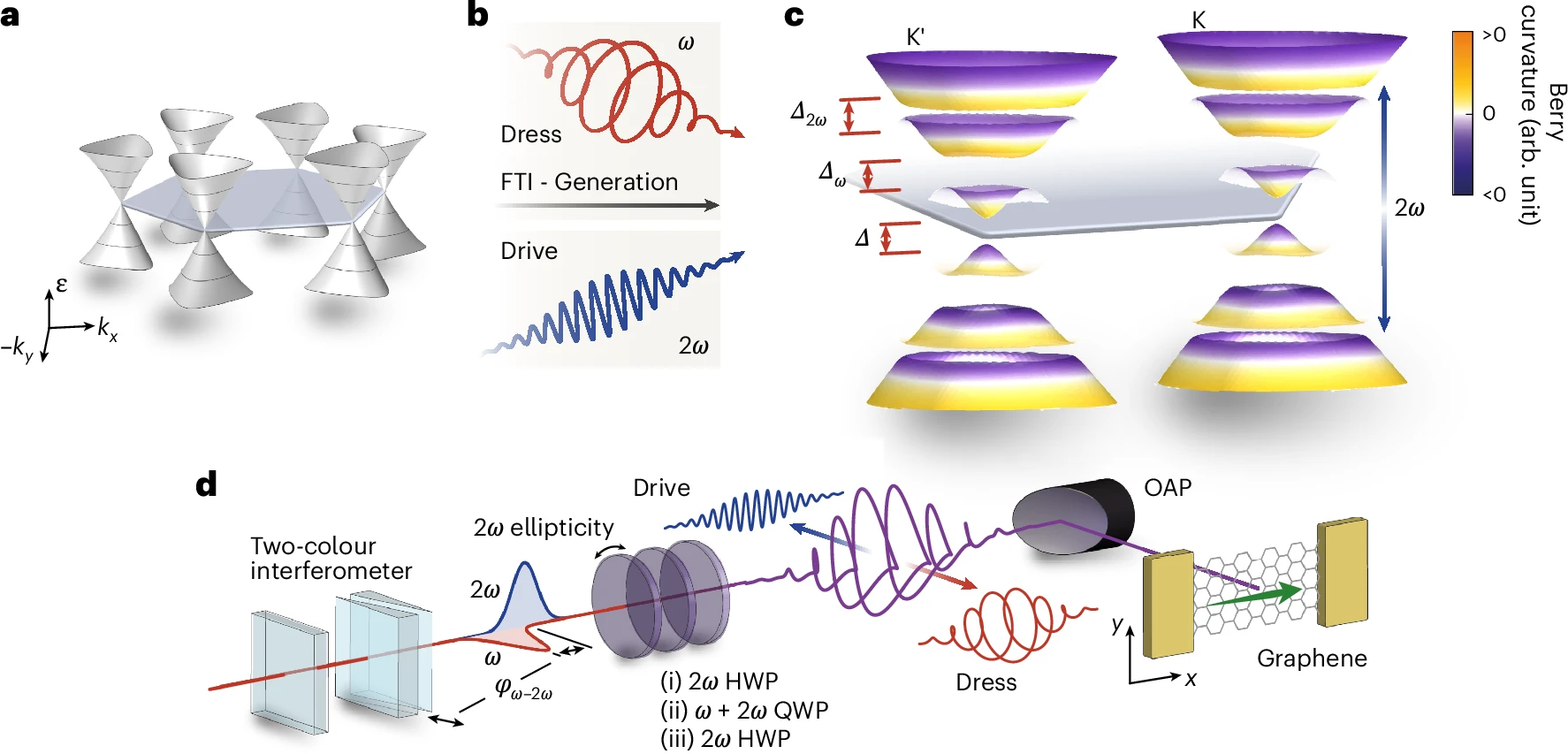
The researchers changed that situation using a strong circularly polarized laser field. They illuminated monolayer graphene with femtosecond pulses centered at a wavelength of 1,550 nanometers, corresponding to a photon energy of 0.8 electron volts. The circular field periodically drives the electrons and creates new, light-dressed electronic states described by Floquet physics.
In this driven state, the graphene bands develop gaps at resonant energies. The circular dressing field also breaks time-reversal symmetry and gives the two graphene valleys, known as K and K′, Berry curvature of the same sign. The resulting light-dressed state is therefore a Floquet topological insulator, or FTI.
The topological state exists only while the material is being driven by the optical field. Rather than applying a conventional direct-current voltage to probe it, the researchers used a second optical field at twice the frequency of the dressing field.
The second-harmonic field had a photon energy of 1.6 electron volts and a central wavelength of 775 nanometers. The two pulses were combined in a phase-stable interferometer, allowing the researchers to control their relative phase, denoted by φω−2ω. They could also independently change the polarization and ellipticity of the second-harmonic field.
That combination gave them two ways to probe the transient state. The polarization of the second-harmonic field could test the symmetry and Berry curvature of the Floquet bands, while its phase relative to the fundamental field could determine which part of the Floquet state’s rapid motion was sampled.
The experiment used an epitaxial monolayer graphene strip measuring 2 by 10 micrometers on silicon carbide, with gold electrodes attached to its short sides. The fundamental field reached 0.27 volts per nanometer at the sample, with the second-harmonic field at three-fourths of the fundamental field strength. The optical cycle was about 5 femtoseconds, shorter than the electronic decoherence time cited for graphene, allowing the experiment to probe the driven system before ordinary decoherence and thermal relaxation became dominant.
Reversing a Hall current with optical phase
One of the clearest signatures appeared when the second-harmonic field was made linearly polarized.
In an ordinary Hall measurement, a magnetic field can deflect moving charges sideways. Here, there was no magnetic field and no direct-current drive. Instead, the Berry curvature of the light-dressed graphene acted on electrons driven by the second-harmonic field.
The researchers oriented that field along the y direction and measured the resulting current along x. The Berry curvature has the same sign at the K and K′ valleys, so electrons driven through the dressed bands acquire a transverse component of motion.
The direction of that current could be controlled simply by changing the relative phase of the two optical fields. When φω−2ω was shifted from 0 to π, the measured current reversed direction.
That phase dependence is important because the relative phase determines which part of the Floquet state’s periodic motion is sampled by the second-harmonic field. The experiment therefore connects the direction of a measurable photocurrent with the sub-optical-cycle motion of the light-dressed electrons.
The authors describe this as an all-optical anomalous Hall effect. Unlike conventional transport measurements, the current is generated and controlled entirely by the optical waveform.
The measurements were compared with ab initio time-dependent density functional theory, or TDDFT, calculations. The calculations reproduced the experimental behavior without including topological edge states. On the conditions used in the experiment, that agreement indicates that edge states were not the main contributors to the measured conductance. Instead, the analysis points to bulk states in the K and K′ valleys.
The calculated current could also be separated into contributions from the two valleys. The researchers found a valley-selective component reaching about 25%, with a maximum valley-current magnitude of 31 picoamps. Thus, although the K and K′ valleys remain energetically equivalent in the driven graphene, the light waveform can produce different current contributions from them.
The polarization of light changes the photocurrent dramatically
The researchers first tested how the helicity, or handedness, of the second-harmonic field affected the current.
With the circular polarization of the fundamental dressing field held fixed, they swept the ellipticity of the second-harmonic field from one circular polarization to the opposite one. The photocurrent was strongly suppressed as the second harmonic changed from matching to opposite helicity.
The suppression approached two orders of magnitude.
The result is different from simply reversing the sign of a current. The magnitude of the response itself changes because the second-harmonic field is probing a light-dressed state whose Berry curvature was created by the fundamental circular field.
The researchers interpret this as photocurrent circular dichroism associated with the Floquet topological state. Their TDDFT calculations reproduced the dependence on the second-harmonic helicity.
The distinction matters because the circular polarization that creates the Floquet state is not the polarization being reversed in this measurement. The fundamental field remains circular in the same direction, while the helicity of the second-harmonic probe is changed.
That makes the measurement a way of probing the symmetry of the already-created light-dressed state rather than simply selecting one graphene valley with the initial light pulse.
A Berry-curvature contribution appears at a one-photon resonance
The researchers then compared two different two-color waveforms to isolate the role of Berry curvature in generating the current.
One waveform was co-rotating, with the circular polarization of the second harmonic matched to the Berry curvature created by the dressing field. The other used co-linear, linearly polarized fields, a configuration in which the relevant Berry-curvature pathway is symmetry-forbidden.
Both waveforms produced similar distributions of excited electrons when the population was plotted against excitation energy. But the corresponding photocurrents were different.
For the co-rotating waveform, 17% of the integrated photocurrent came from the one-photon resonance at ℏω. In the co-linear case, that contribution was less than 1%.
Both configurations also showed excitation above the dominant two-photon resonance. Contributions from resonances above 2ℏω accounted for 5.4% of the current for the co-rotating waveform and 8% for the co-linear waveform. The presence of these higher-order contributions indicated that the response was not adequately described by a simple low-order perturbative picture.
The difference also appeared in the measured power scaling. With the ratio between the fundamental and second-harmonic fields held fixed, a purely perturbative process would give a power-law exponent of 3. Instead, the researchers measured an exponent of 2.649 ± 0.087 for the co-rotating waveform and 2.214 ± 0.065 for the co-linear waveform. The two slopes differed by 4.0 standard deviations.
The authors note that the fitted exponent can vary with field strength and that the available data do not support a well-constrained fit with multiple slopes.
Their Floquet interpretation provides a connection between the extra one-photon current and the Berry curvature of the driven bands. Circular dressing creates Berry curvature at the relevant avoided crossing, allowing a transition pathway that is absent for the co-linear configuration.
In a two-band description, the helicity-dependent excitation contains antisymmetric cross terms involving the x and y components of the transition dipole. Those terms are directly equivalent to the Berry curvature. The result links the additional photocurrent pathway to the local Berry curvature generated by the circular dressing field.
The researchers also compare this behavior with standard two-color coherent-control descriptions. Such perturbative approaches can account for the principal two-photon contribution, they say, but do not capture the full combination of the observed one-photon contribution and non-perturbative power scaling. The Floquet description provides the framework they use to connect these observations.
Phase and polarization provide two independent controls
The experiment next mapped the photocurrent across both the relative phase and the ellipticity of the second-harmonic field.
Three types of optical waveform are particularly useful for understanding the map. When the two circular polarizations have matching helicities, the combined field is co-rotating, or COR. With opposite helicities, it becomes counter-rotating, or CNR. With a linearly polarized second harmonic, the combined waveform has a teardrop-like shape, referred to as TD.
These waveforms produce markedly different current responses.
The COR configuration produced the largest current, reaching about 214 picoamps. For the TD waveform, the current magnitude fell to about 140 picoamps. With the CNR waveform, it fell to a minimum of about 12 picoamps.
Changing the relative phase continuously rotated the combined optical waveform. Experimentally, this appeared as a sinusoidal oscillation of the injected current.
The phase dependence was not simply a change in the amount of light delivered to the sample. It changed which portion of the periodic motion of the Floquet state was sampled by the second-harmonic field. The researchers therefore use the phase-dependent photocurrent as a map of the state’s micromotion.
The calculations again reproduced the principal behavior of the measurements. The small residual current in the CNR configuration was also present in the calculations.
The CNR waveform is especially interesting because its threefold rotational dynamical symmetry suppresses the total injection current. Currents from the different K and K′ regions cancel under the ideal symmetry. Yet the two valleys can still be addressed differently because their orbital character is not equivalent, even though their energies remain equivalent.
That makes it possible to separate valley-selective behavior from the total charge current.
A current can favor one valley even when the total current is small
For the teardrop waveform, the simulations showed that the current could arise predominantly from one valley, producing what the researchers call a valley current.
The CNR configuration takes the idea further. It strongly suppresses the total current while allowing a difference between the populations associated with K and K′.
The calculated valley polarization in the specific CNR case was ηρ = 1%. The paper notes that the small residual total current seen experimentally and in TDDFT is associated with the finite pulse envelope. An ideal Floquet system is perfectly periodic in time, whereas the actual laser pulse has an envelope that turns the field on and off. That breaks the exact time-translation symmetry assumed in the idealized Floquet description.
The researchers also found that changing the phase rotates the symmetry of the combined waveform and changes how the two valleys are addressed. The resulting behavior connects the optical symmetry of the waveform with the momentum-space distribution of excited electrons.
This analysis helps distinguish two related descriptions of the same dynamics. One describes electrons moving through the undressed graphene bands under a rapidly varying optical field. The other describes electrons moving in the transient Floquet bands created by the dressing field. The measurements and simulations show how the two pictures correspond to one another.
The valley-selective dynamics develop within hundreds of attoseconds
To examine that connection more closely, the researchers calculated the conduction-band population across graphene’s momentum space for the counter-rotating waveform.
Two dynamical symmetries dominate the calculated distributions. One is a mirror symmetry combined with time reversal. The other is a threefold rotational symmetry combined with a time translation, which appears specifically for the CNR waveform.
Those symmetries determine which momentum-space populations can produce a net current and which populations must cancel.
The researchers then followed representative electrons near the K and K′ valleys on a subcycle timescale. They calculated the time-dependent interband dipole coupling,
which provides an approximate measure of the instantaneous excitation coupling between valence and conduction bands for a given electron trajectory.
During the central optical cycle, the coupling differs between electrons associated with mirrored points around K and K′. The differences arise from the subfemtosecond trajectories imposed by the combined light field.
The calculated coupling peaks indicate that differences in inter-valley populations begin to develop with a delay of about 340 attoseconds between two corresponding momentum-space points.
That timescale links the direct lightwave picture with the Floquet picture. In one description, the combined waveform causes valley-dependent excitation during individual portions of an optical cycle. In the other, the second-harmonic field samples the phase-dependent micromotion of the Floquet state created by the fundamental field.
The researchers find that the two descriptions give the same underlying dynamics.
What the calculations establish about the measured current
The theoretical analysis was not limited to reproducing the experimental current curves. The researchers also tested which physical ingredients were necessary for the calculated response.
Their TDDFT calculations included the time-dependent electronic structure and light-driven dynamics but did not include edge states. The close agreement with the measurements therefore supports the conclusion that the observed currents do not require contributions from topologically protected edges under these experimental conditions.
The calculations also showed that more than 99.999% of the excitations under typical experimental conditions occupy the first valence and first conduction bands. Together with the absence of a significant difference between full TDDFT calculations and an independent-particle calculation in which the time-dependent Kohn-Sham potential was frozen, this supports the two-band model used for the analytical Floquet treatment.
The authors likewise report that their fully coherent simulations reproduce the experimental behavior, suggesting that electron-phonon scattering does not play a dominant role in the experiment.
There are qualifications to this picture. The role of dissipation from graphene into the silicon-carbide substrate was not resolved and is left for future work. The finite pulse envelope also means that the real system is not perfectly time-periodic, producing the small residual current in the symmetry-suppressed CNR case.
The calculations and measurements therefore support a picture in which the dominant observed response comes from light-driven bulk electronic dynamics in the K and K′ valleys of the transient Floquet state, while some aspects of the real pulse remain outside the idealized periodic description.
The study was published in Nature Physics.