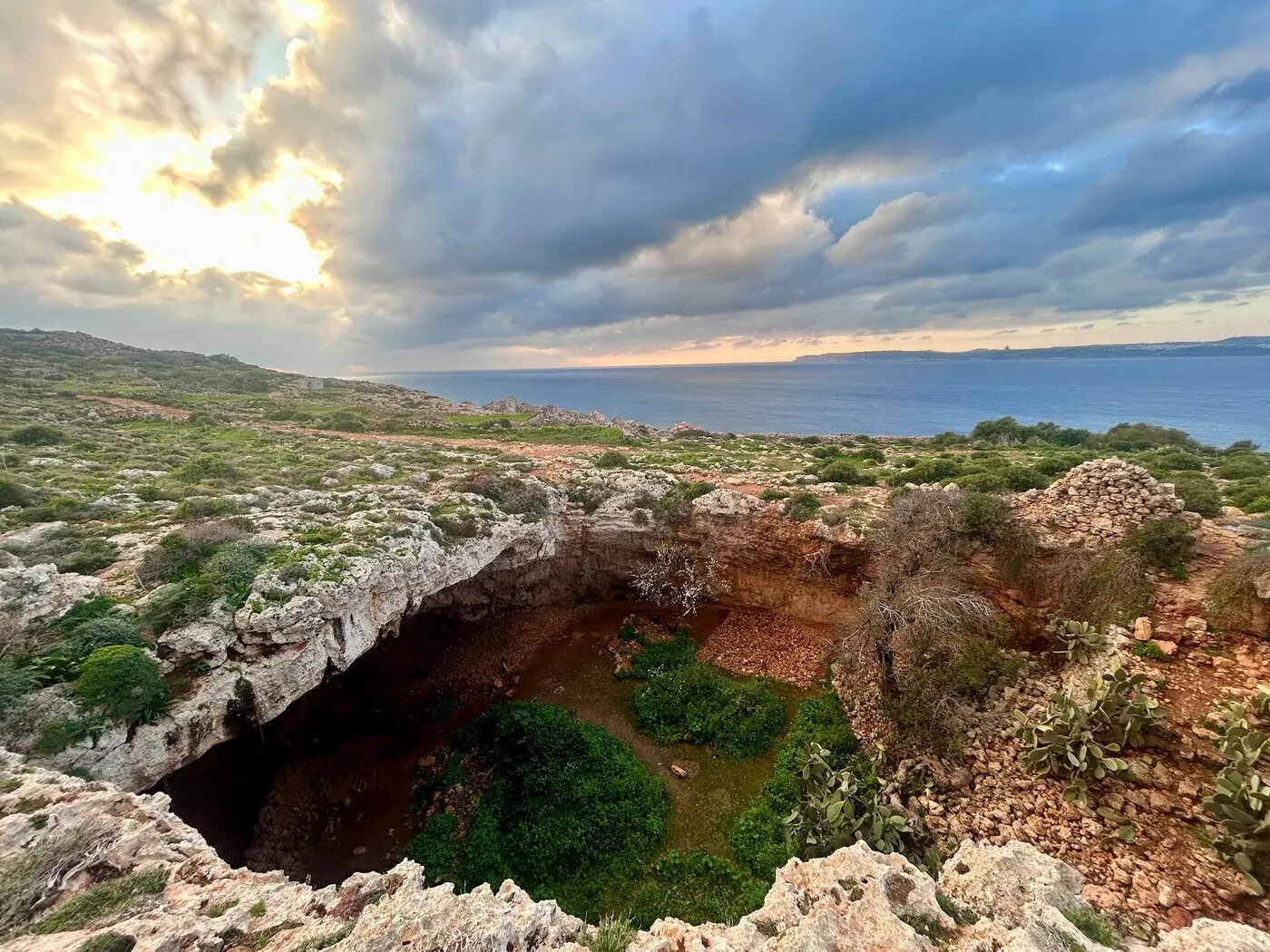
The land bridge disappeared, the island kept getting smaller, and the stretch of open water steadily widened—yet people continued to reach Malta for at least a thousand years. That unlikely persistence is the mystery at the heart of new research, which argues that the island’s Mesolithic inhabitants could not have survived in long-term isolation and instead depended on repeated sea journeys across the central Mediterranean long before sailing technology existed.
For decades, archaeologists generally assumed that many of the Mediterranean’s smaller islands were not permanently settled until farming arrived. Agriculture seemed necessary to support communities in places with limited land, relatively low biodiversity, and restricted natural resources.
Recent archaeological discoveries on Malta complicated that picture by demonstrating that Mesolithic hunter-gatherers occupied the islands for at least a millennium. That immediately raised a difficult question. Were these people the descendants of an isolated population that had become stranded after rising seas separated Malta from Sicily? Or did they continue making long-distance sea crossings over many generations?
A new study tackles that question by combining reconstructions of ancient sea levels, detailed underwater landscape models, high-resolution paleoclimate simulations, and estimates of how many hunter-gatherers different environments could support. The conclusion is striking: after Malta became separated from Sicily, the islands appear to have been incapable of sustaining a viable long-term hunter-gatherer population on their own. According to the authors, the continued human presence instead requires repeated maritime connections with neighboring lands.
An island transformed by rising seas
The researchers reconstructed how the landscape changed from the Last Glacial Maximum, roughly 26,000 to 19,000 years ago, through the early Holocene.
During the coldest part of this period, Malta and Sicily were not separate islands. Lower sea levels connected them as part of a much larger landmass covering roughly 40,000 to 45,000 square kilometers.
That situation changed dramatically as global sea levels rose.
The models indicate that between about 15,500 and 14,200 years ago, the combined landmass shrank substantially. After around 14,200 years ago, the land bridge linking Malta and Sicily disappeared beneath the sea.
Once isolated, Malta changed rapidly. Around 14,100 years ago, the Maltese landmass covered approximately 1,100 square kilometers. Within only a few centuries, by about 13,700 years ago, that had fallen to 561 square kilometers. The land area continued shrinking, reaching about 369 square kilometers shortly before the earliest documented human arrival on Malta around 8,500 years ago. Eventually, Malta, Gozo, and Comino separated into the islands seen today, together covering roughly 316 square kilometers.
The shrinking landscape mattered because less land meant fewer resources capable of supporting human populations.
Estimating how many people the island could support
To investigate whether Malta could sustain an isolated community, the researchers estimated ancient environmental productivity rather than relying only on archaeological evidence.
They reconstructed temperature and rainfall across the region using a high-resolution paleoclimate dataset covering the past 21,000 years at approximately one-kilometer resolution. Those climate values were converted into estimates of terrestrial net primary productivity—the amount of plant growth that forms the foundation of food webs—using the Miami model.
Net primary productivity is commonly used as a measure of an environment’s ability to support hunter-gatherer populations because people relying directly on wild plants and animals ultimately depend on how much biological productivity the landscape can generate.
The researchers then connected those productivity estimates to ethnographic records of recent hunter-gatherer societies. They also incorporated each location’s distance from the coast, using coastal access as a possible indicator of opportunities to supplement terrestrial food with marine resources.
Rather than relying on a single model, they evaluated several versions based on different ethnographic datasets. Some included populations with substantial fishing in their diets, while others focused on groups that depended less on aquatic resources. They also distinguished between environments where plant productivity was mainly limited by rainfall and those limited by both rainfall and temperature.
Using generalized additive models, they generated estimates of ancient hunter-gatherer population density for every time period in the reconstruction.
Malta’s population potential fell below long-term viability
Before Malta separated from Sicily, the connected landmass could theoretically support very large hunter-gatherer populations.
Between about 21,000 and 19,200 years ago, estimated populations ranged from roughly 16,767 to 17,735 individuals under the higher-density model, or about 11,053 to 11,629 under the more conservative rainfall-based model.
As climates changed and sea levels rose, those estimates fluctuated. A notable increase occurred around 14,500 years ago during the Bølling–Allerød interstadial, when improved environmental productivity temporarily raised estimated population sizes without major changes in land area.
Everything changed once Malta became isolated.
Immediately after separation, the predicted population for the Maltese islands fell from approximately 419 individuals to around 319 within only a few centuries under the higher-density model. It continued declining over time, reaching about 206 people by roughly 10,500 years ago.
By around 9,000 years ago, estimated populations had fallen to roughly 170 people, remaining between approximately 144 and 170 individuals afterward. The rainfall-limited models consistently produced even lower estimates, generally between about 90 and 106 individuals during the later period.
The researchers compared these figures with population thresholds discussed in previous work on long-term hunter-gatherer survival.
While the higher estimates approached levels that might permit survival over several generations, they remained far below the much larger populations considered necessary for maintaining long-term demographic viability over centuries. Sicily, in contrast, consistently retained estimated populations numbering in the thousands.
The sea kept getting wider
The changing geography also altered what it took to travel between Sicily and Malta.
Using cost-path analyses based on reconstructed landscapes, the researchers estimated the minimum sea crossings required after the land bridge disappeared.
Immediately following separation, scattered intermediate islands shortened the largest individual water crossing. Around 14,100 years ago, the longest single crossing measured only about 7.5 kilometers, although the total sea journey still reached roughly 12.5 kilometers.
As sea levels continued rising, those stepping stones disappeared.
By approximately 13,300 years ago, intermediate islands no longer significantly reduced the journey.
Around 10,000 years ago, travelers faced minimum total sea crossings of roughly 80 kilometers. By about 8,500 years ago—the period associated with Malta’s Mesolithic occupation—the minimum crossing exceeded 80 kilometers. The total journey later increased to around 86 kilometers and eventually about 88 kilometers.
The study notes that these are minimum distances based on straight-line routes. The calculations do not account for currents or other conditions that might have increased the difficulty of travel.
The evidence points toward repeated voyages
The timing of Malta’s Mesolithic occupation proved central to the researchers’ interpretation.
Archaeological evidence places hunter-gatherers on Malta between roughly 8,500 and 7,500 years ago. By then, according to the models, Malta had already been isolated for thousands of years, its land area had largely reached modern dimensions, and the shortest crossing from Sicily exceeded 80 kilometers.
That sequence makes one explanation unlikely.
If Malta had simply trapped a population when the land bridge disappeared, that isolated community would have needed to survive on an island capable of supporting only around 150 to 170 people for thousands of years before the archaeological record documents Mesolithic occupation.
Instead, the modeling suggests that repeated sea crossings better explain the sustained human presence.
The authors propose that Malta may have been visited seasonally as part of a broader hunter-gatherer network or occupied repeatedly for extended periods rather than continuously supporting a fully self-sustaining resident population.
The estimated population sizes are similar to the size of seasonal foraging groups documented in ethnographic studies rather than entire independent populations.
Marine foods may have helped, but probably not enough
The researchers acknowledge an important limitation in their approach.
Their primary population estimates are based on terrestrial productivity rather than directly modeling marine food production.
However, they attempted to account indirectly for coastal resources in two ways. Distance from the shoreline was included in the statistical models, and alternative models incorporated ethnographic populations with different levels of fishing in their diets.
Archaeological evidence from Malta also informed their interpretation.
Although fish, marine mammals, and shoreline shellfish were present in Mesolithic deposits, the faunal assemblage is dominated by terrestrial resources, especially deer. The persistence of endemic deer populations throughout the Mesolithic and into the Neolithic also argues against heavy overexploitation by a large resident human population.
The researchers conclude that while marine resources may have helped support small groups over shorter periods, they are unlikely to have raised Malta’s carrying capacity enough to sustain the much larger populations needed for long-term demographic stability.
A wider network across the central Mediterranean
The implications extend beyond Malta itself.
The study argues that repeated crossings to Malta fit with emerging evidence for broader maritime mobility linking Sicily, Malta, and North Africa during the terminal Pleistocene and early Holocene.
The authors note that European hunter-gatherer ancestry identified in Epipalaeolithic communities in Tunisia is consistent with the possibility of even longer-distance movements across the central Mediterranean.
They also point to Malta’s prehistoric record, which contains repeated interruptions in occupation even after farming societies appeared, as further evidence that small island populations remained fragile and depended on maintaining connections across the sea.
Rather than representing an isolated destination reached once by chance, Malta may have formed part of a larger network of hunter-fisher-foragers capable of repeated open-water journeys long before the development of sailing technology.
The researchers emphasize that their work provides a quantitative framework rather than the final answer. Their estimates are based on modeled environmental productivity, ethnographic relationships, and reconstructed landscapes, all of which can be refined as new archaeological, environmental, and genetic evidence becomes available.
For now, the models point toward a remarkably persistent pattern: even as rising seas reduced Malta to a small island separated by more than 80 kilometers of open water, people appear to have kept finding their way back.
Publication details
James Blinkhorn et al, Life on the edge: Mesolithic population size and viability on Malta, PNAS Nexus (2026). DOI: 10.1093/pnasnexus/pgag234