Long after a Roman public toilet had fallen silent, someone transformed one of its drainage channels into a carefully built grave for two premature infants, possibly twins. Instead of pointing to abandonment or neglect, the burial tells a far more intimate story: one in which grief, religious belief, practical necessity, and a desire to protect two fragile lives after death may all have converged in Middle Byzantine Ephesos.
The setting could hardly seem more unexpected. Deep within the remains of a Roman Odeion—a building once used for musical and vocal performances in the ancient city of Ephesos, in present-day Türkiye—archaeologists uncovered a small cist grave tucked into an abandoned latrine canal. At first glance, burying newborns in the channel of a former public toilet might appear to suggest disposal rather than respect.
Yet a detailed reanalysis of the burial tells a very different story.
Instead of treating the grave as an archaeological curiosity, researchers combined bioanthropology, archaeothanatology—the study of how bodies decompose within their burial environment—and earlier excavation records to reconstruct both the lives and deaths of the two infants and the decisions made by those who buried them.
What emerged was evidence of deliberate care rather than casual abandonment.
A forgotten burial inside an abandoned building
The grave was discovered during excavations in 2010 within the sacred precinct surrounding the Temple of Artemis at Ephesos. The Odeion itself had originally been constructed during the first century CE before undergoing substantial renovations in the second and early third centuries, including the installation of a latrine with roughly 30 seats.
Centuries later, after fire, abandonment, and the systematic removal of decorative marble, the building entered a long period of decline.
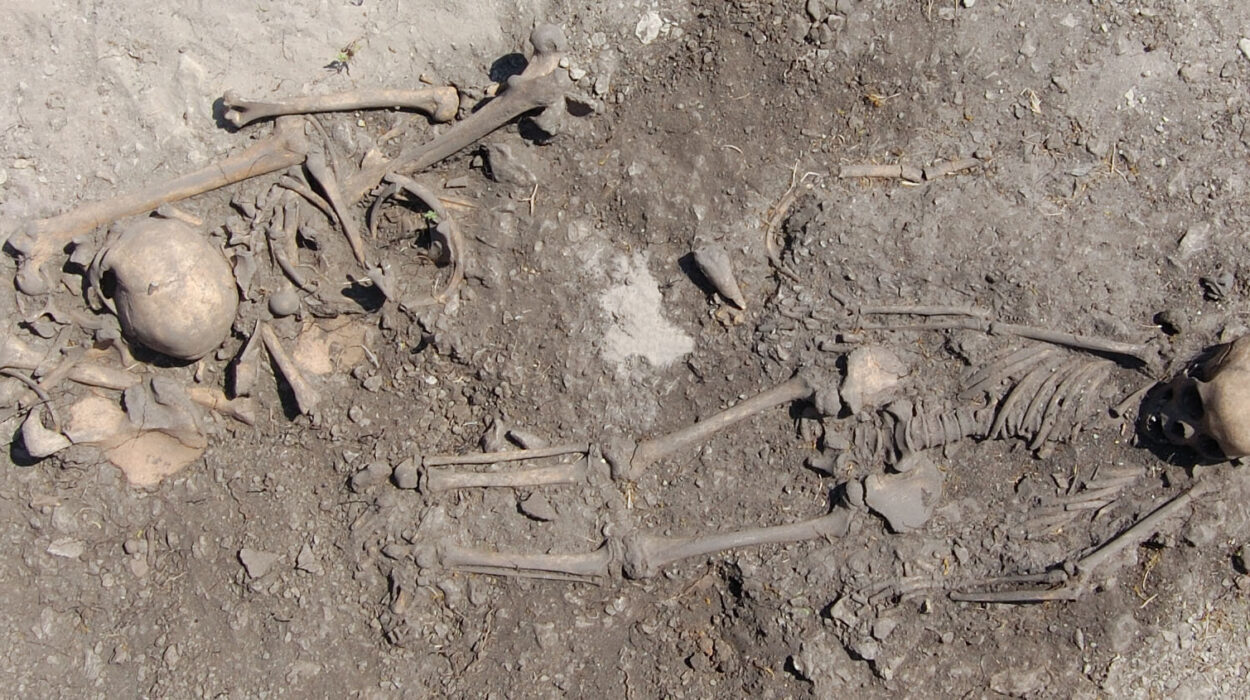
Within one of its former latrine channels, archaeologists found a stone-and-tile cist measuring about 67 by 42 centimeters. Inside lay two perinatal individuals positioned side by side.
Radiocarbon dating placed the burial between 692 and 887 CE, with the highest probability falling between 762 and 887 CE, during the Middle Byzantine period.
The latrine itself had already been abandoned long before the grave was constructed.
Two babies who may have been twins
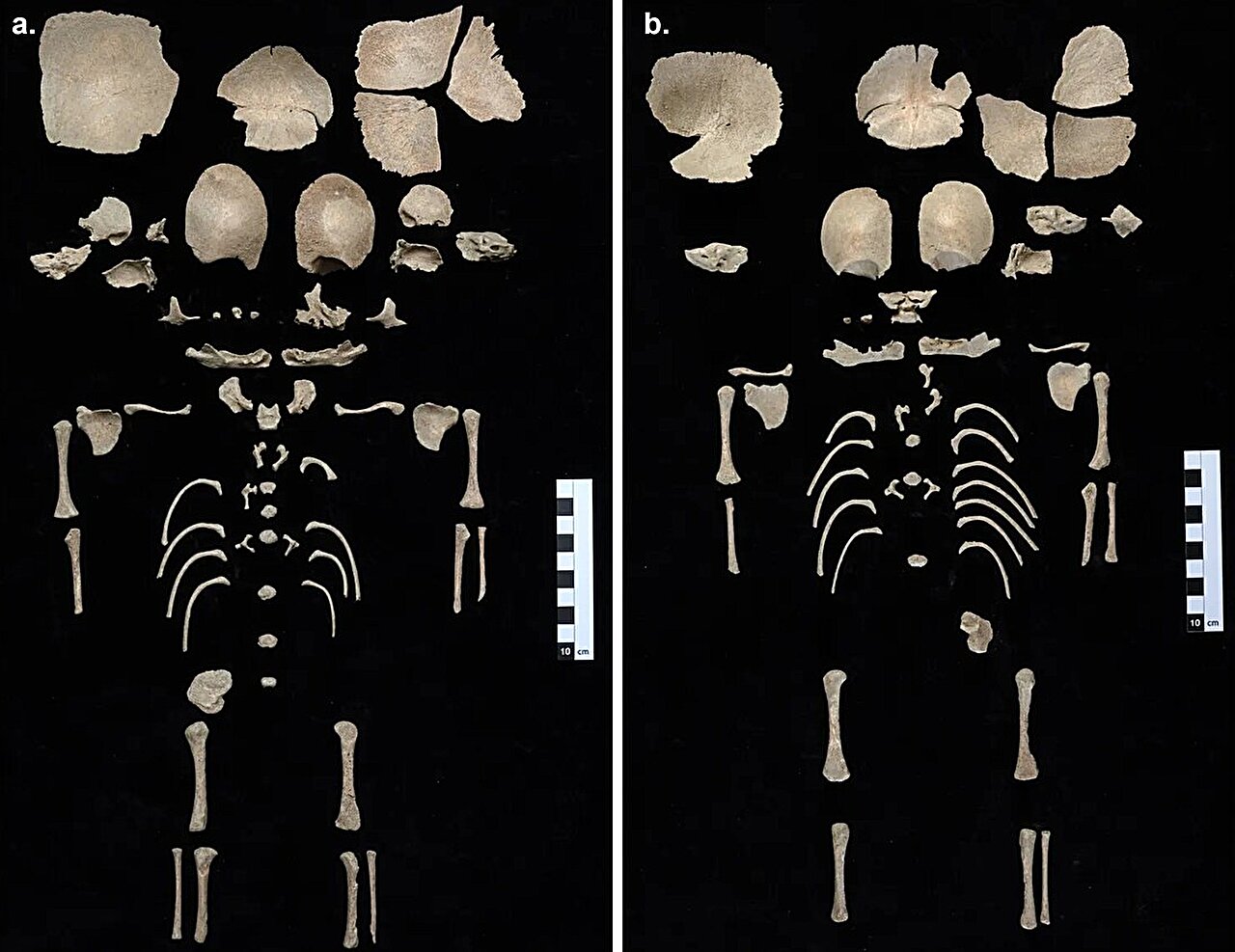
The researchers conducted new biological analyses in 2025, examining the preserved skeletal remains in detail.
Although some tiny bones could not confidently be assigned to one infant or the other because of their similar ages, preservation of most major skeletal elements was good enough to estimate their developmental stage.
Measurements of the best-preserved upper arm bones indicated body lengths of approximately 43 and 44 centimeters.
Using established methods for estimating fetal and perinatal age, the researchers calculated that the infants were about 33 to 34 gestational weeks old—roughly 7½ to 8 months into pregnancy.
Both therefore died before reaching the usual full-term period.
Dental development independently supported an age shortly before full term.
Because destructive analyses such as dental histology and DNA testing were not permitted under local regulations, the researchers could not determine whether the infants died before birth or survived only briefly afterward.
However, based on their skeletal development, they considered it likely that if the babies were born alive, they survived only a very short time.
Their remarkably similar developmental ages raise the possibility that they were twins.
The authors emphasize that this remains only a hypothesis.
Without DNA analysis, twinship cannot be confirmed.
Small differences in body size do not rule out the possibility, since growth differences commonly occur in twin pregnancies.
Searching for clues to their health
Macroscopic examination revealed no evidence of trauma, infection, inflammation, or other obvious skeletal disease.
One unexpected detail did emerge during flotation of sediment collected from the grave.
Researchers identified a tiny 5-millimeter cervical rib, an extra rib associated with the neck.
In adults this variation is often harmless.
In very young individuals, however, previous research has linked cervical ribs to developmental abnormalities, congenital disorders, stillbirth, prematurity, and reduced survival.
The authors stress that the finding does not identify a cause of death.
Instead, it serves as an indicator that at least one infant may have experienced compromised health during development.
They also note how unusual it is to recover such a fragile bone from archaeological contexts.
According to the paper, this represents only the second published archaeological case of a cervical rib identified in a perinatal individual.
No archaeological examples involving possible twins have previously been documented.
Reconstructing the burial itself
The position of the skeletons offered equally important evidence.
The infants had been laid beside one another with their heads oriented generally westward, following the east-west orientation commonly associated with Christian burials of the period, although slightly adjusted to fit the existing canal.
The grave itself was carefully constructed from slabs, roof tiles, and bricks.
Numerous delicate bones—including tiny finger and toe elements that are easily lost if bodies are disturbed—remained in place.
This strongly indicated that the infants had been buried where they were found rather than moved there after decomposition.
When archaeologists opened the grave, they found almost no sediment filling the interior.
This suggested that decomposition occurred largely within an empty space rather than inside tightly packed soil.
Patterns of bone movement also revealed what happened after burial.
Some bones had rotated or shifted in ways consistent with occasional water infiltration into the abandoned canal.
At the same time, the movements remained confined within clear boundaries, leading the researchers to propose that the infants may originally have been wrapped in one or more perishable shrouds.
An iron object recovered near the heads could possibly have served as a pin securing such a wrapping, although this interpretation cannot be confirmed.
Whether both infants shared a single shroud or each had their own remains unknown.
Why bury babies in a former latrine?
This question lies at the heart of the study.
Across the Byzantine world, Christian burials typically featured east-west orientation, simple graves, few grave goods, and bodies placed on their backs.
In many respects, the Odeion burial fits these broader customs.
Its location, however, is extraordinary.
The researchers compared the burial with archaeological examples in which perinatal remains were discarded into sewers or wells without formal graves.
One example from Ashkelon contained nearly 100 perinatal individuals mixed with animal bones and broken pottery.
Another famous case from Athens involved hundreds of infants deposited in a well.
The Ephesos burial looks fundamentally different.
Rather than a collection of discarded bodies, the Odeion grave was intentionally constructed, carefully arranged, and remained undisturbed for centuries.
The abandoned canal may therefore have served an entirely different purpose.
According to the authors, its stone-lined structure could have physically protected the grave.
The location inside the former sacred precinct of the Temple of Artemis may also have retained symbolic religious significance even after the sanctuary had long ceased functioning in its original role.
These interpretations remain hypotheses rather than established facts, but they offer an alternative explanation for why such an unusual place was chosen.
The difficult place of newborns in Byzantine society
The burial also reflects broader social and religious questions surrounding perinatal death.
During this period, baptism strongly influenced where individuals could be buried.
Only baptized people were generally eligible for burial in consecrated cemeteries.
The researchers could not determine whether these infants had been baptized, nor whether they had even survived birth.
Because of that uncertainty, they deliberately refer to them as perinates rather than fetuses.
The authors also describe the complex cultural landscape of the Early and Middle Byzantine periods, when older Roman traditions and Christian beliefs coexisted and sometimes conflicted.
Historical sources describe newborns as occupying a liminal state during the weeks before baptism.
Ideas surrounding purity, ritual, and supernatural danger all shaped attitudes toward very young children.
Within that context, the unusual burial may represent an attempt to balance religious customs, practical realities, and care for infants who occupied an uncertain social position.
The researchers caution that surviving evidence about burial practices for unbaptized infants during this period remains too limited to support firm conclusions.
A grave that remained untouched for centuries
The authors conclude that the burial should not be understood simply as an odd archaeological find.
Instead, it captures a deeply human response to loss.
The careful construction of the shared grave, the deliberate positioning of the two infants, and the apparent effort to place them somewhere protected all point toward intentional funerary care.
Whether the babies were twins remains unresolved.
Whether they died before birth or shortly afterward also remains unknown.
Future analyses, particularly DNA studies and microscopic examination of teeth, could potentially answer some of those questions if they become possible.
Until then, the burial stands as a rare glimpse into how one Middle Byzantine community may have navigated the difficult intersection of biology, religion, grief, and social custom when two very small lives ended before they had truly begun.
More information
Caroline Partiot et al, Peace in Unexpected Places: The Middle Byzantine Burial of Two Perinates, Possibly Twins, in a Latrine Canal of the Odeion in the Artemision of Ephesos, Childhood in the Past (2026). DOI: 10.1080/17585716.2026.2682804