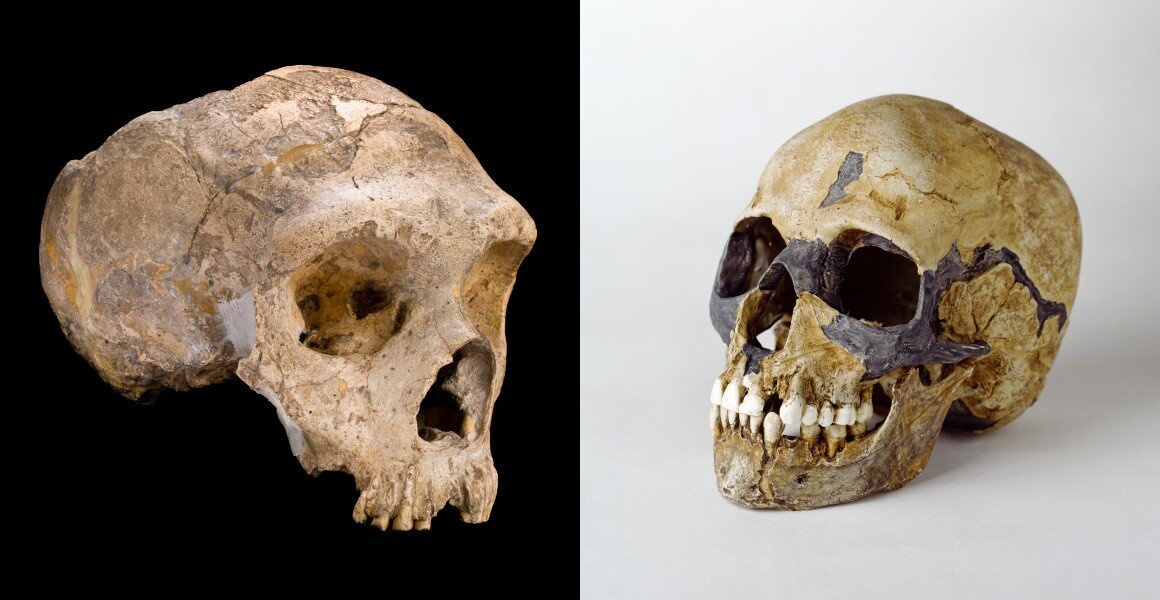
Thousands of years after Neanderthals disappeared, parts of their genetic legacy remain embedded in modern human genomes. Among those surviving fragments, one group of genes stands out dramatically: genes involved in breaking down fats. By combining ancient genomes, modern human DNA, brain lipid measurements, and gene activity data, the researchers traced an unusually strong connection between Neanderthal-like genetic variants and lipid metabolism in people of European ancestry, raising the possibility that these inherited variants became advantageous after modern humans entered landscapes where Neanderthals had long lived.
When modern humans expanded out of Africa roughly 70,000 to 60,000 years ago, they entered regions where Neanderthals had already lived for hundreds of thousands of years. Archaeological and genetic evidence indicates that the two groups coexisted in Europe and Central Asia before Neanderthals disappeared between about 45,000 and 30,000 years ago.
Previous genome studies had already established that people living outside sub-Saharan Africa inherited portions of Neanderthal DNA. Individual genomes were estimated to contain approximately 1% to 4% Neanderthal ancestry.
The question addressed in this research was not whether Neanderthal DNA survived, but whether it survived randomly.
If certain inherited Neanderthal variants consistently disappeared from modern human populations, natural selection may have been removing them. On the other hand, if particular groups of genes accumulated unusually large amounts of Neanderthal-like DNA, those variants might have offered an advantage after modern humans settled outside Africa.
That possibility became the central focus of the investigation.
Searching the entire genome for unusual concentrations
The researchers compared genomes from 11 modern human populations included in the 1000 Genomes Project.
These populations represented three groups with African ancestry, three with East Asian ancestry, and five with European ancestry.
To identify inherited Neanderthal-like genetic variants, the team compared modern human genomes with both high-coverage and low-coverage Neanderthal genomes while using chimpanzee genomes to determine the ancestral state of each genetic site. They analyzed more than 1.15 million genomic positions where Neanderthals and chimpanzees differed.
As expected from previous work, modern populations outside Africa showed greater similarity to Neanderthal genomes than populations with purely African ancestry.
Across the genome as a whole, European and East Asian populations showed remarkably similar levels of Neanderthal-like genetic sites. On average, these sites accounted for about 6.1% in both groups under the study’s statistical measure, while African populations showed much lower similarity.
At first glance, nothing suggested that Europeans had inherited substantially more Neanderthal ancestry than East Asians.
But the picture changed dramatically when the researchers stopped looking at the genome as a whole and instead examined specific biological functions.
One biological pathway stood far above the rest
The team grouped genes according to their biological roles using Gene Ontology classifications and searched for functions that contained unusually high numbers of Neanderthal-like genetic sites.
Most biological categories showed no exceptional pattern.
One did.
Genes involved in the lipid catabolic process—the collection of genes responsible for breaking down fats—contained a striking excess of Neanderthal-like variants in people of European ancestry.
Within these genes, the average frequency of Neanderthal-like sites reached 20.8%, compared with only 5.9% across the genome overall in Europeans.
That represented more than a threefold enrichment.
Importantly, the same pattern did not appear in East Asian populations. Lipid catabolism genes in East Asians contained approximately 6.7% Neanderthal-like sites, essentially matching their genome-wide average of 6.2%.
The researchers identified 498 Neanderthal-like sites across lipid catabolism genes distributed among 23 independent genomic regions. Multiple additional analyses—including bootstrap testing, deeper genome sequencing datasets, different Neanderthal genome assemblies, and filtering designed to eliminate artifacts from ancient DNA damage—all supported the finding.
The inherited variants also carried signatures of natural selection
Finding an unusual concentration of Neanderthal-like DNA alone does not demonstrate that those variants were beneficial.
To investigate whether natural selection might have favored them, the researchers searched for genomic signatures associated with recent positive selection.
They used a method called the Composite of Multiple Signals (CMS), which combines several independent indicators of natural selection, including long stretches of inherited DNA, highly differentiated variants, and genetic changes that have rapidly become common.
The lipid catabolism genes containing Neanderthal-like variants stood out again.
These genes showed significantly stronger signals of recent positive selection in European populations.
Comparable evidence did not appear in African or East Asian populations.
Within the lipid catabolism pathway itself, the strongest selection signals were specifically associated with genes carrying excess Neanderthal-like variants rather than with other lipid-related genes.
Together, these observations were consistent with the idea that these inherited variants may have increased in frequency because they provided some advantage after modern humans settled in Europe.
The study, however, carefully stops short of claiming that this has been proven.
Looking beyond DNA into the chemistry of the brain
If inherited genetic variants truly influenced lipid metabolism, the researchers reasoned that measurable differences should also appear in the molecules produced inside cells.
To investigate this possibility, they analyzed postmortem prefrontal cortex tissue from 14 adult humans representing European, African, and East Asian ancestry, together with tissue from 14 adult chimpanzees, which served as the ancestral comparison.
Using high-resolution mass spectrometry, they detected 4,243 lipid-related mass spectrometric peaks.
Of these, 1,314 peaks could be computationally matched to known lipid compounds belonging to 63 metabolic categories. After removing lower-confidence categories, 16 remained for detailed analysis.
Seven of these metabolic categories were directly connected to lipid catabolism genes according to KEGG pathway annotations.
These seven categories became especially important.
European lipid metabolism showed unusually large divergence
The researchers compared lipid concentrations in modern humans with those measured in chimpanzees.
In Europeans, the seven metabolic categories linked directly to lipid catabolism showed substantially greater divergence from chimpanzees than did the other metabolic categories.
The same pattern was absent in African and East Asian populations.
Bootstrap analyses indicated that this was not driven by one or two unusual metabolites but represented a broader property of the lipid catabolism pathway.
The researchers also examined whether factors such as age, sex, tissue preservation, or postmortem delay could explain the observations and found no evidence that they did.
Environmental differences between populations could not be completely ruled out, but the study design reduced their influence by comparing lipid catabolism pathways with other metabolic pathways within each population. In addition, the European and African samples came from the same region of the United States, while the Asian samples came from central China.
The same pattern appeared in gene activity
Changes in metabolite concentrations often reflect changes in the activity of the genes responsible for producing or processing those molecules.
The researchers therefore measured gene expression using RNA sequencing on the same human brain samples along with six chimpanzee samples.
Each sample produced roughly 15 million sequencing reads, with approximately 85% mapping uniquely to the appropriate genome.
Among genes connected directly to the lipid metabolic categories, expression differences from chimpanzees were greatest in Europeans.
The divergence was intermediate in East Asians and absent in Africans.
Once again, statistical testing suggested that this pattern was robust and could not be explained by differences in sample quality, age, sex, or postmortem delay.
This provided an independent line of evidence pointing toward unusually pronounced changes in lipid catabolism among Europeans.
The strongest signal clustered near gene switches
The researchers also examined where the Neanderthal-like variants occurred within genes.
Genes directly connected to the European-specific metabolic differences contained an even greater proportion of Neanderthal-like sites than lipid catabolism genes overall.
These genes averaged 31.6% Neanderthal-like sites, compared with 20.8% across all lipid catabolism genes.
The locations of these variants were also noteworthy.
Rather than being spread evenly throughout the genes, they tended to cluster near transcription start sites—regions involved in regulating when genes are switched on.
Because gene activity depends heavily on these regulatory regions, the authors suggest that these variants may have contributed to the expression differences observed in Europeans.
However, the study does not establish that they directly caused those changes.
One lipid pathway offered clues but not definitive answers
Among the lipid pathways examined, one molecule—2-lysophosphatidylcholine—received particular attention.
The paper notes that this molecule has previously been implicated in several biological functions, including generation of reactive oxygen species, forms of cell death, and glucose-dependent insulin secretion.
Genes associated with this pathway displayed significant expression differences between Europeans and chimpanzees, matching the observed metabolite differences.
The researchers also found that lipid catabolism genes enriched for Neanderthal-like variants overlapped significantly with genetic variants previously associated in genome-wide association studies with obesity, hypertriglyceridemia, coronary heart disease, triglyceride levels, and cholesterol levels.
The paper notes that frequencies of these conditions have been reported to differ among human populations, although it does not claim that Neanderthal variants are responsible for those differences.
An intriguing hypothesis remains open
The authors propose one possible explanation for the observed pattern.
Neanderthals spent hundreds of thousands of years adapting to environments across Europe and parts of Central Asia before modern humans arrived.
If some of the genetic variants that evolved during that time improved lipid metabolism under those environmental conditions, modern humans who inherited those variants might have gained a selective advantage after interbreeding occurred.
The researchers emphasize, however, that this remains a hypothesis rather than a demonstrated fact.
Their results are compatible not only with genetic introgression from Neanderthals into modern humans but also with an alternative explanation known as incomplete lineage sorting, in which ancient genetic variation predating the split between Neanderthals and modern humans persisted in both lineages independently.
Under that scenario, the same lipid-related variants could have risen in frequency separately in Neanderthals and in European modern humans if both experienced similar selective pressures.
Many questions remain unanswered
The study also cautions against assuming that the observed pattern is uniquely European.
Although no comparable enrichment appeared in the East Asian populations examined, the available genomic data did not include every region once occupied by Neanderthals.
The authors argue that additional genome sequences from a broader range of human populations, particularly from regions overlapping the Neanderthal geographic range, will be necessary to determine how widespread this phenomenon truly is.
They also acknowledge that the biological consequences remain uncertain.
While the research links Neanderthal-like genetic variants with differences in lipid metabolism, brain lipid composition, and gene expression, it does not identify the precise environmental pressures that may have favored these variants or explain exactly how they influenced human biology.
Future studies examining multiple tissues and additional human populations will be needed to understand the functional significance of this remarkable genetic inheritance.
For now, the work paints a detailed picture of one corner of the human genome where the legacy of Neanderthals appears anything but random. Rather than being scattered evenly across our DNA, some inherited fragments became concentrated within a single biological pathway, leaving molecular signatures that are still detectable in lipid metabolism among many people of European ancestry today.
Publication details
Ekaterina E. Khrameeva, Katarzyna Bozek, Liu He, Zheng Yan, Xi Jiang, Yuning Wei, Kun Tang, Mikhail S. Gelfand, Kay Prufer, Janet Kelso, Svante Paabo, Patrick Giavalisco, Michael Lachmann and Philipp Khaitovich. “Neanderthal ancestry drives evolution of lipid catabolism in contemporary Europeans.” Nature Communications, 01 April 2014, DOI: 10.1038/ncomms4584