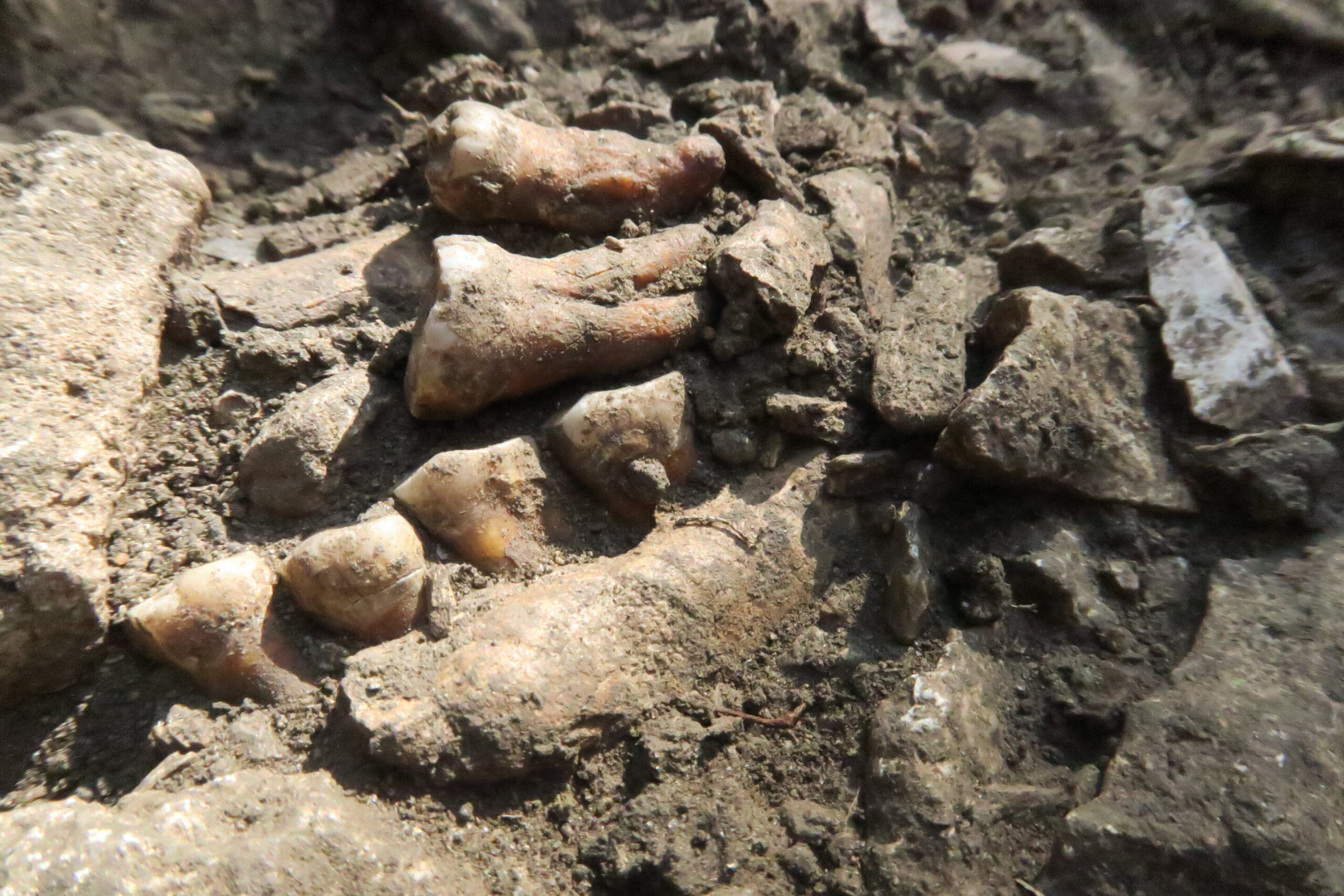
Buried in a rock shelter overlooking the Rhône Valley, the fragmentary remains of a Neanderthal man carried an unexpected genetic history that stretched back far beyond his own lifetime. Instead of belonging to the widespread late Neanderthal population known from Europe, his DNA points to a deeply isolated lineage that may have lived apart for roughly 50,000 years, raising new questions about how Neanderthal societies were organized—and whether that long isolation became one of the hidden vulnerabilities they carried into their final millennia.
The individual, nicknamed Thorin, was uncovered at Grotte Mandrin in Mediterranean France, a rock shelter whose archaeological layers preserve repeated occupations spanning roughly 65,600 to 41,500 calibrated years before present. The site contains more than 60,000 stone tools, around 70,000 animal remains, fireplaces, and human fossils documenting some of the final Neanderthal occupations in the region as well as an earlier visit by modern humans around 54,000 years ago.
Excavations that began uncovering Thorin in 2015 are still ongoing, but enough of the skeleton has already emerged to identify him as one of the most complete Neanderthal individuals discovered in France since 1979. The recovered remains include part of the upper jaw, a fragmentary lower jaw, 31 permanent teeth, and five finger bones from the left hand.
His teeth display classic Neanderthal characteristics, including shovel-shaped front teeth and robust molars. Yet one feature immediately stood out: Thorin possessed two extra lower fourth molars behind the wisdom teeth.
According to the authors, such teeth are extraordinarily rare in living humans, occurring in only about 0.02% of people, and they are not known from other Pleistocene members of the human genus. The cause of these extra molars remains uncertain.
The teeth also reveal a lifetime of heavy use. Extensive wear, thickened root cement, and changes to the jawbone indicate prolonged mechanical stress from chewing or other repeated use of the teeth.
Establishing when Thorin lived
Dating Thorin required several independent approaches because the body is still being excavated and its precise position within the archaeological deposits remains under study.
Radiocarbon dating, uranium-series dating, combined uranium-series and electron spin resonance dating, and Bayesian modeling of the site’s stratigraphy all contributed to the age estimate.
Together, these methods place Thorin within the site’s Post-Neronian II archaeological tradition.
The Bayesian model estimated an age of approximately 51,300 to 48,900 calibrated years before present with 68.2% probability and 52,900 to 48,050 years with 95.4% probability.
However, the authors emphasize that excavation is incomplete. Newly recovered remains from the upper part of layer B2 suggest Thorin could ultimately prove to be closer to 42,000 years old, potentially making him one of the very last Neanderthals in this region. For now, they regard a broader age between roughly 52,000 and 42,000 years as the most cautious interpretation.
Isotopic analyses of carbon, nitrogen, oxygen, and strontium from one of Thorin’s teeth are consistent with an open, cold environment, matching the site’s geological evidence and supporting the proposed Late Pleistocene age.
DNA uncovered a completely unexpected ancestry
The study’s most surprising result came not from the bones themselves but from DNA extracted from one of Thorin’s molar roots.
After multiple rounds of DNA extraction to minimize contamination, researchers reconstructed both his mitochondrial genome and a low-coverage nuclear genome.
Instead of clustering with other known late European Neanderthals, Thorin consistently occupied a much older branch of the Neanderthal family tree.
Multiple independent genetic analyses—including mitochondrial DNA, Y chromosome comparisons, principal component analyses, D-statistics, and demographic modeling—arrived at the same general conclusion.
The best-fitting demographic model estimated that Thorin’s lineage separated from the ancestry leading to the well-known Vindija Neanderthal lineage approximately 102,861 years ago, with a 95% confidence interval of about 100,267 to 105,169 years.
By comparison, other later Neanderthal lineages examined in the study diverged considerably later.
Although Thorin himself lived tens of thousands of years after that split, his population appears to have preserved this ancient ancestry instead of mixing with neighboring Neanderthal groups.
Fifty thousand years with almost no detectable genetic mixing
One of the most striking findings was not simply that Thorin belonged to an older lineage, but that this lineage appears to have remained genetically separate for an extraordinarily long time.
The researchers searched for evidence that Thorin’s ancestors had exchanged genes with neighboring late Neanderthal populations.
They found essentially none.
Despite living in western Europe alongside other Neanderthal populations, Thorin’s lineage appears to have remained isolated for roughly 50,000 years following its divergence.
The study also found no evidence that Thorin had more recent ancestry from modern humans than other western Eurasian Neanderthals.
This allowed the authors to rule out recent interbreeding with the early modern humans known to have briefly occupied Grotte Mandrin around 54,000 years ago.
Instead, the genome points toward a population that maintained remarkable genetic separation despite geographic proximity to other Neanderthal groups.
Signs of life in a very small population
The genome also provides clues about the size of Thorin’s community.
Researchers examined long stretches of identical DNA inherited from both parents, known as runs of homozygosity. These regions accumulate more readily when populations remain small or when close relatives repeatedly contribute to future generations.
Approximately 7% of Thorin’s genome lay within homozygous segments at least 5 million DNA letters long, including about 45 million DNA letters contained in segments exceeding 20 million letters.
The authors interpret these patterns as evidence for recent inbreeding combined with long-term residence in a small, isolated population.
Interestingly, another late Neanderthal from Mezmaiskaya Cave also displayed elevated levels of homozygosity, suggesting that very small population sizes may not have been unique to Thorin’s group.
More than one hidden lineage may have survived
Thorin’s genome also led the researchers to reexamine other Neanderthal individuals.
Their analyses indicate that another French Neanderthal from Les Cottés carries genetic material inherited from an as-yet-unsampled lineage that diverged approximately 89,000 years ago.
This second lineage appears distinct from Thorin’s own ancestry.
Taken together, the authors conclude that Europe during the late Neanderthal period probably contained at least two, and possibly three, genetically distinct Neanderthal lineages.
Some of these populations may have survived side by side for thousands of years while exchanging little or no genetic material.
The low-coverage genome from Gibraltar also shares certain affinities with Thorin, raising the possibility that Thorin’s lineage extended across southwestern Europe, although the authors note that the Gibraltar genetic data remain limited and should be interpreted cautiously.
Cultural separation may have accompanied genetic separation
The archaeological evidence from Grotte Mandrin adds another layer to the story.
Thorin is associated with the site’s distinctive Post-Neronian II stone tool tradition.
According to the authors, these stone technologies differ substantially from both earlier industries at Grotte Mandrin and neighboring Neanderthal traditions elsewhere in France.
Because the cultural differences parallel the newly identified genetic separation, the authors propose that long-term cultural isolation may have accompanied long-term genetic isolation.
Whether these distinctive traditions originated locally or arrived from elsewhere remains unresolved.
The authors suggest that future comparisons with archaeological material from Gibraltar could help determine whether the apparent genetic links were matched by cultural connections.
A different perspective on Neanderthal extinction
The study does not argue that genetic isolation alone caused Neanderthal extinction.
Instead, it challenges the long-standing assumption that Europe’s final Neanderthals formed one broadly connected population.
Previous explanations for Neanderthal disappearance have often focused on external events such as environmental change.
The authors argue that internal features of Neanderthal societies—including population structure, patterns of interaction between groups, and social organization—deserve greater attention.
They note that genetic exchange reflects social relationships rather than simple biological opportunity.
If Thorin’s lineage truly remained isolated for roughly 50,000 years despite neighboring populations, that pattern may point toward social boundaries that limited interaction between different Neanderthal communities.
At the same time, the authors contrast this picture with evidence cited in the paper indicating broader social connections among early modern human populations during similar periods.
They propose that these differences in social organization may have contributed to the differing histories of the two human groups, although they emphasize that this remains an interpretation rather than a demonstrated cause of Neanderthal extinction.
Important uncertainties remain
The researchers acknowledge several limitations.
Thorin’s skeleton is still being excavated, and additional discoveries could refine his precise age within the archaeological sequence.
Because only one genome from this newly recognized lineage is currently available, it cannot fully represent the diversity of the population to which Thorin belonged.
The study also relies on a low-coverage genome, and although the analytical methods performed well in validation tests, the authors caution that estimates of homozygosity could still be influenced by limited genomic coverage.
They conclude that additional Neanderthal genomes from Europe will be needed to determine how widespread Thorin’s lineage was, how many isolated populations existed, and how these communities interacted during the final chapters of Neanderthal history.
For now, Thorin transforms the picture of Europe’s last Neanderthals from one of a largely connected population into a landscape that may have included multiple neighboring communities living surprisingly separate lives for tens of thousands of years before disappearing from the archaeological record.
Publication details
Long genetic and social isolation in Neanderthals before their extinction, Cell Genomics (2024). DOI: 10.1016/j.xgen.2024.100593. www.cell.com/cell-genomics/ful … 2666-979X(24)00177-0