Babies in the ancient Greek colony of Himera in Sicily began receiving foods alongside breast milk as early as three to four months of age, but breastfeeding often continued until they were nearly four years old. The combination of early dietary changes and prolonged nursing suggests that families followed a shared approach to raising children while adapting feeding practices to individual circumstances. Evidence from the remains of 58 children and 27 adult women is now helping researchers reconstruct how infants and young children were fed in this culturally diverse Mediterranean community more than 2,400 years ago.
Himera was founded during the seventh century BC on the northern coast of Sicily. Established by Greek colonists with Dorian and Chalcidian cultural backgrounds, the city developed into a large settlement influenced by Greek, Phoenician, and indigenous Sicilian communities.
During the following centuries, these different populations lived within a complex colonial society. Their interactions shaped local traditions, identities, and everyday practices.
Yet understanding how families raised their children in such an environment has been difficult. Historical writings, artwork, and objects recovered from archaeological sites provide clues about childhood, but they offer an incomplete picture of ordinary family life. Written accounts, in particular, often emphasize wealthy households and places such as Athens rather than representing the full range of ancient communities.
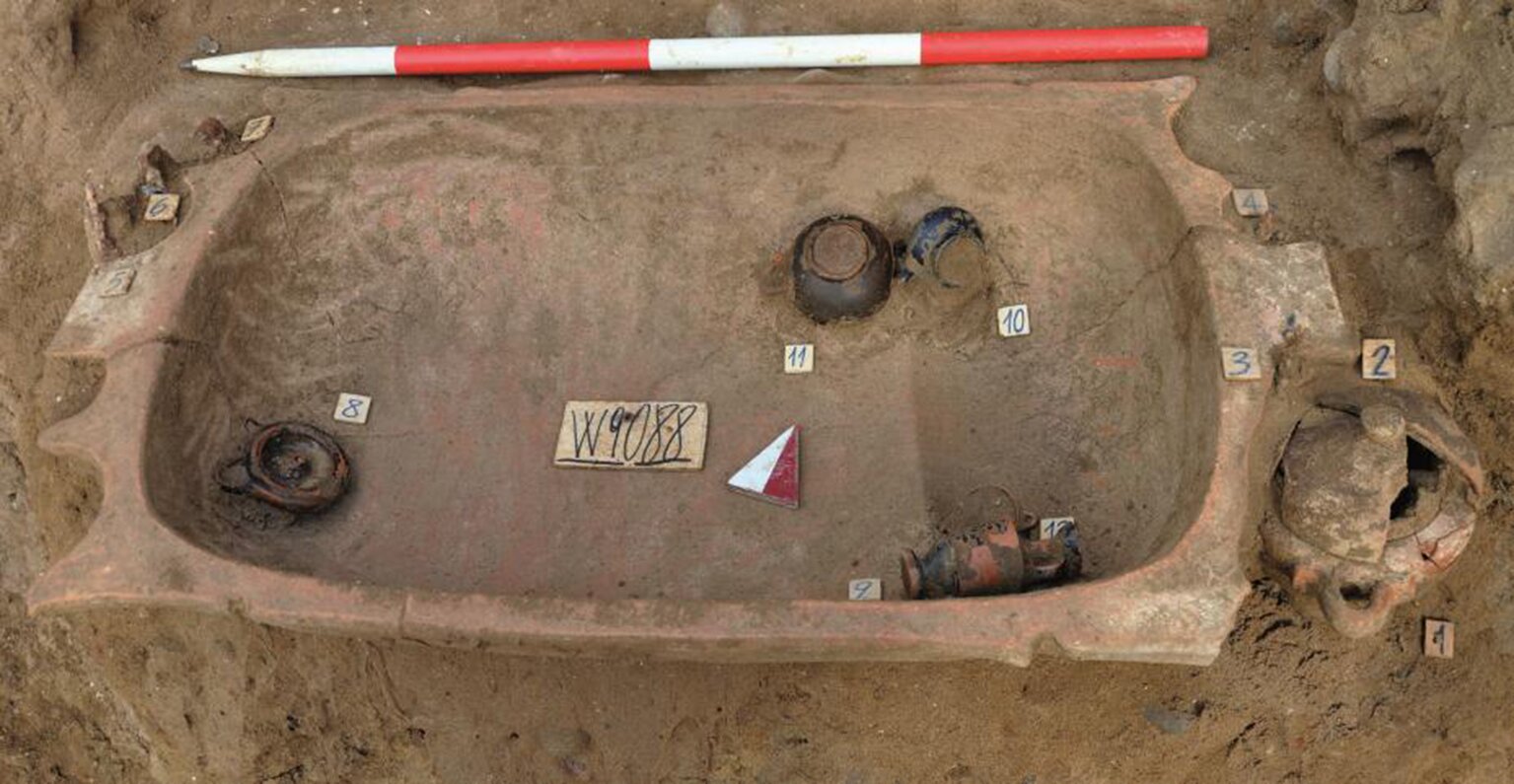
Archaeologists have also recovered nearly 500 small vessels known as gutti from children’s graves at Himera. These objects are sometimes described as baby bottles and raise the possibility that they were associated with infant feeding. However, their presence in adult burials as well suggests that they may have served symbolic or funerary purposes rather than functioning exclusively as feeding equipment.
To investigate actual feeding practices, Laurie Reitsema of the University of Georgia and colleagues turned to the chemical composition of human skeletal remains.
Their research focused on stable isotopes of nitrogen and carbon preserved in bone collagen, a protein that provides information about the foods people consumed during their lives.
Nitrogen isotopes are particularly useful for reconstructing breastfeeding. When an infant consumes breast milk, the nitrogen isotope composition of the infant’s tissues becomes enriched relative to the mother’s tissues. This happens because an infant occupies a higher position in the food chain while consuming milk produced by another human being.
As children begin eating other foods and gradually reduce their dependence on breast milk, their nitrogen isotope values change. Eventually, they approach the values associated with the broader diet of the community.
Carbon isotopes provide additional information about dietary sources, helping researchers distinguish between different kinds of plants and between terrestrial and aquatic foods.
By examining these chemical signatures across individuals of different ages, researchers can reconstruct changes in childhood diets even when the people themselves lived more than two millennia ago.
What the researchers examined
The study included skeletal remains from 58 individuals younger than 18 years and 27 adult women buried in Himera’s Eastern and Western cemeteries.
The Eastern cemetery dates primarily to the seventh through fifth centuries BC, while the Western cemetery dates to the sixth through fifth centuries BC. The individuals considered from the Eastern cemetery belonged to the sixth and fifth centuries BC, making the two groups broadly comparable in chronological terms.
The researchers used the adult women to establish a reference point for interpreting the nitrogen isotope values of breastfed infants.
They also examined the ages of the children using skeletal and dental development. Age estimates were based on evidence including tooth development, tooth eruption and wear, changes in the pubic symphysis, and the closure of cranial sutures.
Of the 58 subadults, 50 were ten years old or younger. These individuals formed the main sample for the statistical reconstruction of weaning.
An important challenge in this kind of research is that bones do not record an individual’s diet at a single moment. Bone tissue gradually remodels, meaning its chemical composition reflects dietary information accumulated over a preceding period.
This becomes particularly complicated in children because bone growth and turnover change as they get older. The relationship between age at death and the period represented by the collagen therefore cannot be treated as constant.
To address this problem, the researchers used a Bayesian statistical approach called the Weaning Age Reconstruction from Nitrogen isotopes model, or WARN.
The model accounts for changing bone turnover rates and uses the isotope values of children and adult females to estimate several aspects of infant feeding. These include the end of exclusive breastfeeding, the end of total breastfeeding, and the nitrogen isotope signature expected from foods consumed during the weaning process.
The distinction between exclusive and total breastfeeding is important. Exclusive breastfeeding means that an infant receives breast milk without other foods. Total breastfeeding covers the entire period during which any breast milk is consumed, even after solid foods have been introduced.
The period between these two milestones represents the transition from an exclusively milk-based diet to a mixed diet.
The researchers also compared Himera with four other ancient Mediterranean populations for which sufficiently comparable bone-collagen isotope data were available.
Before interpreting the results, the researchers assessed the quality of the extracted collagen. They attempted 154 extractions, but 18 individuals did not yield enough collagen for measurement. Of the 136 samples with sufficient collagen, 84, or 62 percent of the original attempts, produced acceptable carbon-to-nitrogen ratios.
Some samples had lower collagen yields than the preferred threshold. However, the researchers retained them because these measurements were not associated with other indicators of chemical alteration in the remains.
Breastfeeding appears to have been universal
One of the clearest observations was that all the sampled infants showed evidence of breastfeeding.
Every individual younger than six months had nitrogen isotope values enriched above the maternal baseline. This pattern indicates that breast milk was part of their diets.
The finding suggests that breastfeeding was a widely shared childcare practice in Himera, rather than something limited to particular families or social groups.
This is important because the existence of a cultural preference for breastfeeding does not necessarily mean every infant in a community received breast milk. Economic circumstances, maternal health, social conditions, and access to alternative caregivers can all influence infant feeding.
The researchers therefore considered the apparent universality of breastfeeding a notable feature of the Himera population.
However, the evidence also requires a distinction between the presence of breastfeeding and its duration. Although all the sampled young infants showed evidence of nursing, the length of time they received breast milk varied considerably.
Solid foods entered the diet within the first months
The Bayesian reconstruction estimated that exclusive breastfeeding at Himera typically ended at approximately 0.3 years, equivalent to around three and a half months.
The 95 percent credible interval extended from birth to 2.2 years, indicating substantial uncertainty around the estimate.
This broad interval is important. The most probable estimate suggests that exclusive breastfeeding generally ended early, but the model does not establish that every infant began consuming other foods at exactly the same age.
The researchers interpreted the results as evidence that supplementary foods were often introduced during early infancy, while breastfeeding continued alongside them.
The distinction matters because introducing solid foods did not mean mothers immediately stopped nursing. Instead, infants could receive a combination of breast milk and other foods for several years.
The study also discusses the possible practical circumstances behind early supplementation.
Ancient Greek medical writers, including Soranus and Galen, recommended exclusive breastfeeding during the first six months, followed by a gradual reduction in breast milk. Their writings post-date Himera, but the authors note that they reflected earlier medical traditions.
The reconstructed timing at Himera suggests that actual feeding practices did not always follow these recommendations.
The researchers discuss women’s responsibilities as one possible explanation. Although Greek social ideals emphasized women’s confinement to the household and their roles in childcare and domestic management, economic circumstances could require women to work outside the home.
Women might work in agriculture, crafts, wool production, and markets. Some also worked as wet nurses, caring for other women’s children.
Other responsibilities included religious activities, family gatherings, washing clothes, collecting water, and assisting husbands in their workshops.
Enslaved women could face additional demands, including nursing infants who were not their own.
These circumstances may have made exclusive breastfeeding difficult to maintain, even when it was culturally valued. The researchers suggest that early supplementary feeding could reflect the practical demands placed on women rather than a lack of interest in breastfeeding.
The isotope evidence, however, cannot identify the specific reason why an individual infant began receiving other foods.
Breastfeeding continued for nearly four years
Although exclusive breastfeeding appears to have ended relatively early, total breastfeeding lasted much longer.
The WARN model estimated that breastfeeding ended at an average age of 3.8 years, with a 95 percent credible interval of 3.0 to 4.7 years.
This means that children typically continued receiving breast milk for several years after supplementary foods entered their diets.
Subtracting the estimated duration of exclusive breastfeeding from total breastfeeding suggests that the transition to a fully non-breastfed diet lasted approximately three and a half years.
In other words, weaning at Himera was not a sudden event. It was a prolonged process in which breast milk and other foods overlapped for much of early childhood.
The estimated duration also exceeds the breastfeeding periods recommended by several ancient medical writers.
Soranus recommended total breastfeeding for approximately one and a half to two years, while Galen recommended around three years. Oribasius, writing in the fourth century AD, recommended approximately two years.
The estimated duration at Himera was also longer than the periods documented in ancient Egyptian wet-nurse contracts, which generally recorded breastfeeding lasting around two years, although some extended to three years.
These comparisons suggest that the feeding practices reconstructed from Himera did not necessarily correspond to the medical recommendations or contractual arrangements preserved in ancient written sources.
The authors propose that the prolonged nursing period may have been supported by social expectations that women devote much of their lives to household responsibilities and childcare.
Nevertheless, the considerable variation in breastfeeding duration suggests that individual circumstances also played an important role.
What children ate as they grew older
The researchers also investigated whether supplementary and transitional foods differed from the typical adult diet.
Previous isotope research at Himera had characterized adult diets as predominantly plant-based, with additional protein from terrestrial animals.
The reconstructed isotope signature of collagen produced entirely from weaning foods was 9.6‰ for nitrogen, with a 95 percent credible interval of 9.2–10.2‰.
This was slightly below the previously reported adult population mean of 10.3 ± 0.9‰.
The difference suggests that the foods introduced during weaning generally produced a lower nitrogen isotope signature than the typical adult diet.
Carbon isotope measurements also indicated that children’s diets differed from those of adults. Subadults had lower carbon isotope values, consistent with a greater contribution from plant foods.
Together, these observations suggest that young children relied more heavily on foods with lower nitrogen and carbon isotope signatures than those characteristic of the adult population.
The findings are consistent with a diet containing cereal-based and other plant foods, although the isotope measurements cannot identify individual dishes or establish the exact ingredients consumed by each child.
Ancient Greek medical writings provide examples of foods recommended during the transition away from breast milk. These included honey, bread, sheep’s or goat’s milk, wine, spelt soup, cereal porridge, and eggs.
Many of these foods fit the general isotope profile reconstructed for the weaning diet at Himera.
However, the researchers do not claim that these particular foods were necessarily consumed by every child. The isotope evidence identifies broad dietary characteristics rather than specific recipes.
Another important observation concerns the age at which children’s diets began to resemble those of adults.
Differences between subadult and adult isotope values remained considerable until approximately nine or ten years of age. After ten, the sampled children fell within the range of adult values.
This suggests that the transition toward an adult-like diet extended well beyond the end of breastfeeding.
The researchers point out that ten years of age does not correspond directly to the five-stage model of childhood described in ancient Greek thought through the writings of Aristotle and Plato. Nevertheless, the dietary shift around this age may have represented a socially meaningful stage in the lives of children at Himera.
The isotope evidence establishes a change in dietary patterns, but it does not reveal exactly how the community understood or marked that transition.
Shared customs with room for individual decisions
One of the central questions behind the research was whether families in Himera followed a consistent community approach to infant feeding or made largely independent decisions.
The results suggest that both patterns existed.
Several observations point toward shared customs. All sampled infants showed evidence of breastfeeding, and the population displayed a recognizable weaning curve, with nitrogen isotope values generally declining as children grew older and consumed more foods other than breast milk.
However, the pattern was not uniform. Exclusive breastfeeding and total breastfeeding varied considerably, and the isotope values indicate differences in the foods introduced during childhood.
This combination suggests that families followed broad community expectations without adhering to a single rigid timetable.
The researchers interpret this as a flexible cultural norm. Different families could follow similar overall practices while adjusting the timing and details of feeding according to their circumstances.
The cemeteries at Himera are believed to contain individuals from different social backgrounds, including freeborn and enslaved people, wealthy and poor households, and people with Greek and indigenous Sicilian connections.
The researchers found no reason to believe their sampling strategy systematically favored one particular social group.
Consequently, the broadly similar feeding patterns across the sampled children suggest that some aspects of childcare may have been shared across the city’s culturally diverse population.
That does not mean every household followed identical practices. Rather, the variation in the isotope evidence indicates that individual differences existed within a recognizable community pattern.
Greek colonies shared similar weaning patterns
To understand whether Himera’s feeding practices were distinctive, the researchers compared its results with those from other ancient Mediterranean communities.
The strongest similarity emerged with Apollonia Pontica, another Greek colony, located on the Black Sea coast in present-day Bulgaria.
The two communities showed remarkably similar estimates for exclusive breastfeeding, total breastfeeding, and the overall transition to other foods.
At Apollonia Pontica, exclusive breastfeeding ended at an estimated 0.4 years, compared with 0.3 years at Himera.
Total breastfeeding lasted an estimated 4.3 years at Apollonia Pontica, compared with 3.8 years at Himera.
Both populations also showed evidence that children’s supplementary and childhood diets contained a smaller contribution from animal protein than adult diets.
The similarities are particularly interesting because the two colonies developed in different geographical and cultural environments.
Himera had Dorian and Chalcidian cultural roots and maintained connections with Greek communities in Sicily, Phoenicians, and indigenous Sicilians.
Apollonia Pontica was established by colonists from Miletus in Ionia and maintained connections with Greek communities in Asia Minor and the Balkans, as well as indigenous Thracian populations.
Despite these differences, their reconstructed weaning patterns were remarkably alike.
The authors suggest that this similarity may reflect shared childcare traditions across Greek territories. However, they emphasize that more comparable studies are needed before establishing how widespread such practices were.
A small amount of additional evidence comes from Hellenistic-period burials at Thessaloniki. Two individuals appear to have been weaned by two years of age, while another continued breastfeeding until approximately three and a half years.
These observations resemble the patterns at Himera and Apollonia Pontica, although the Thessaloniki sample is extremely limited and uses tooth dentine rather than bone collagen. Its results therefore cannot be directly compared using the same WARN approach.
Roman communities followed different patterns
The comparison with Roman-era populations revealed greater variation.
The researchers examined three Roman sites: Isola Sacra in Italy, Leptiminus in present-day Tunisia, and Quarto Cappello del Prete near Rome.
Their reconstructed breastfeeding estimates differed substantially.
At Isola Sacra, exclusive breastfeeding ended at an estimated 0.2 years, and total breastfeeding ended at 1.2 years.
At Quarto Cappello del Prete, exclusive breastfeeding lasted an estimated 1.9 years, while total breastfeeding ended at 3.6 years.
Leptiminus produced estimates of 2.4 years for exclusive breastfeeding and 5.2 years for total breastfeeding. However, the model’s joint probability value for this population was 0.0011, below the recommended cutoff of 0.0025. The researchers therefore regarded its results as unsuitable for reliable interpretation.
These differences suggest that infant feeding practices varied considerably among Roman communities.
The researchers note that Rome itself appears to have had relatively abrupt weaning between approximately one and two and a half years, broadly consistent with the medical recommendations of Soranus.
Provincial Roman communities, however, sometimes maintained breastfeeding for three or four years.
One possible interpretation is that urban populations were more influenced by elite medical recommendations, while provincial communities retained longer-established feeding traditions. The authors present this as a possible explanation rather than a demonstrated cause.
The comparison also highlights a distinction between Greek and Roman cultural settings. Himera and Apollonia Pontica displayed similar prolonged breastfeeding patterns, while the Roman sites showed a wider range of feeding trajectories.
Nevertheless, the available comparisons are limited to a small number of archaeological populations, and the researchers caution against treating them as representative of all Greek or Roman communities.
What the bones cannot tell us
The findings provide detailed evidence about ancient infant feeding, but several limitations remain important.
First, the study relies on cross-sectional skeletal remains. The researchers examined different individuals who died at different ages rather than following the same children throughout their development.
Consequently, the reconstructed feeding trajectories represent population-level estimates rather than complete individual histories.
Second, the sample consists of children who died before adulthood. Their feeding experiences may not perfectly represent those of children who survived.
The researchers recognize that feeding practices could potentially have influenced survival, creating a problem when reconstructing ordinary childhood behavior from skeletal remains.
They also note that surviving children alone would not provide a complete picture of the population. Both survivors and non-survivors are important for understanding childhood in the archaeological record.
Third, the broad credible interval for exclusive breastfeeding means its precise duration remains uncertain. Although the most probable estimate is approximately three and a half months, the evidence does not support assigning one fixed weaning age to all families.
Finally, stable isotope measurements cannot identify the exact foods consumed by individual children or explain why particular families made different feeding decisions.
The results establish broad dietary patterns, but the social and personal circumstances behind each decision remain difficult to reconstruct.
The researchers suggest that future work using tooth-based isotope analysis could help investigate the biological consequences of different weaning trajectories. Their proposed research would focus on individuals who survived childhood, providing another perspective on the relationship between early feeding and later development.
The study also places the findings within the demographic history of Himera. A separate analysis of 2,865 subadult burials documented comparatively low infant and childhood mortality at the site relative to other prehistoric and historic European populations. The authors note the coexistence of this demographic pattern with prolonged breastfeeding, but the present research does not establish that breastfeeding caused the lower mortality.
For now, the evidence from Himera points to a distinctive combination of early supplementary feeding, prolonged breastfeeding, and considerable variation in individual childhood diets. Families appear to have shared broad expectations about infant care while retaining flexibility in how they raised their children.
The study was published in European Journal of Archaeology.