More than 3,500 years ago, trees growing in what is now Türkiye recorded subtle changes in atmospheric carbon that can still be detected in their annual rings. By matching those patterns to trees with known calendar dates, researchers have established a precise timeline for ancient Anatolian wood and found strong evidence supporting one of the leading chronologies of Mesopotamia. The results also connect an ancient Babylonian astronomical record to a massive volcanic eruption in Alaska, helping narrow down when some of the region’s most important historical events took place.
The question of exactly when ancient Mesopotamian kings ruled has remained unresolved for decades. Although the region left behind extensive written records, including king lists, administrative documents, royal inscriptions and astronomical observations, historians have struggled to establish a definitive calendar timeline for the second millennium BCE.
The disagreement is not simply about a few individual rulers. Different chronological frameworks place important events as much as 150 to 230 years apart. Those differences affect how historians connect the histories of Mesopotamia, Anatolia, the Levant and Egypt.
A new approach using individual tree rings, high-precision radiocarbon measurements and evidence preserved in polar ice cores now provides a stronger way to distinguish between these competing timelines.
The research, led by Charlotte Pearson and colleagues, establishes a calendar-dated Anatolian tree-ring chronology extending from 2072 BCE to 744 BCE. When the researchers combined this record with archaeological evidence and evidence of ancient volcanic activity, the results strongly favored the middle–low chronology of Mesopotamia.
Why the dates of Mesopotamian kings remain disputed
One of the central chronological problems concerns the relationship between the Old Assyrian Revised Eponym List, known as the REL, and the king lists of the First Dynasty of Babylon.
The REL records a sequence of annually named officials and provides a chronological framework for the Assyrian trading period. It contains a 255-year sequence that can be connected to Babylonian history through the overlapping reigns of Šamši-Adad I of Assyria and Hammu-rabi of Babylon.
The broader historical record spans approximately 380 years, but its exact placement on the calendar has remained uncertain.
Several competing chronological systems have been proposed. The high, or long, chronology places events earliest. The low, or short, chronology places them considerably later. Between them are two middle chronologies, known as middle-high and middle–low.
These alternatives are based partly on interpretations of astronomical observations, including records of the movements and visibility of Venus.
The problem is that the historical records establish relationships between rulers and events more securely than they establish the exact calendar years in which those events occurred.
Researchers have therefore sought independent scientific evidence that can connect archaeological objects and buildings to specific years.
Tree rings offered a promising opportunity.
Ancient trees provide an independent calendar
Trees generally produce one growth ring each year. The width and other characteristics of these rings can preserve information about growing conditions, while the wood also contains carbon incorporated from the atmosphere during growth.
By comparing patterns of ring widths between trees, dendrochronologists can connect sequences from different archaeological sites. This process is known as cross-dating.
When two trees share matching patterns of growth, their overlapping sequences can be aligned, even if the trees came from different locations or lived centuries apart.
However, establishing an exact calendar date requires connecting the archaeological tree-ring sequences to a continuous reference chronology that ultimately reaches trees with known dates.
That has been difficult in Anatolia because researchers do not yet have an uninterrupted regional tree-ring sequence connecting all the ancient archaeological material to modern trees.
The researchers addressed this problem using a different feature preserved in the wood: radiocarbon.
Radiocarbon, or carbon-14, is a naturally occurring radioactive form of carbon. Its abundance in the atmosphere changes over time, and trees incorporate atmospheric carbon as they grow.
Consequently, each annual ring preserves information about the atmospheric radiocarbon level during the year in which it formed.
Most conventional radiocarbon dating measures carbon from material accumulated over multiple years. This produces an average that can obscure relatively small annual changes.
The researchers instead measured carbon-14 in individual tree rings.
These annual measurements can reveal fine-scale changes in atmospheric radiocarbon. When the same patterns appear in trees with known calendar dates and trees whose dates are uncertain, they can help establish where the unknown sequence belongs.
Unlike conventional tree-ring cross-dating, this approach does not depend on matching regional climate-driven growth patterns.
It is particularly useful when the atmospheric radiocarbon record contains recognizable changes that can be matched across geographically separated tree-ring sequences.
Building a reference chronology from 735 radiocarbon measurements
The researchers first constructed a high-resolution radiocarbon reference record using 735 measurements from tree rings with established dendrochronological dates.
The samples came from several geographically separated sources, including British oak, German oak, North American bristlecone pine, and pine from the Austrian and Italian Alps.
All the new measurements were produced at ETH Zürich.
Using a single laboratory was important because small differences between laboratories can introduce offsets into radiocarbon measurements. By keeping the reference measurements within the same laboratory, the researchers could reduce uncertainty associated with differences in measurement procedures.
They also investigated whether geographical factors, including latitude, altitude and growing location, produced systematic differences in radiocarbon values.
The comparison revealed measurable offsets between some groups of trees.
For example, British oak and North American bristlecone pine showed a weighted mean radiocarbon offset of 5.8 years, based on 153 paired measurements. British and German oak showed an offset of 7.0 years, based on 41 pairs. British oak and Alpine pine showed a much smaller offset of 0.1 years.
These differences matter because even relatively small regional variations can affect the alignment of annual radiocarbon records.
The resulting reference curve had a mean uncertainty of 15.3 radiocarbon years.
Although that uncertainty is expressed in radiocarbon-age units rather than calendar years, the detailed pattern of annual changes provides information that can be used to identify the calendar position of another tree-ring sequence.
The researchers then used this reference to test the dating of archaeological wood from several Anatolian sites.
A distinctive carbon shift anchors the Gordion trees
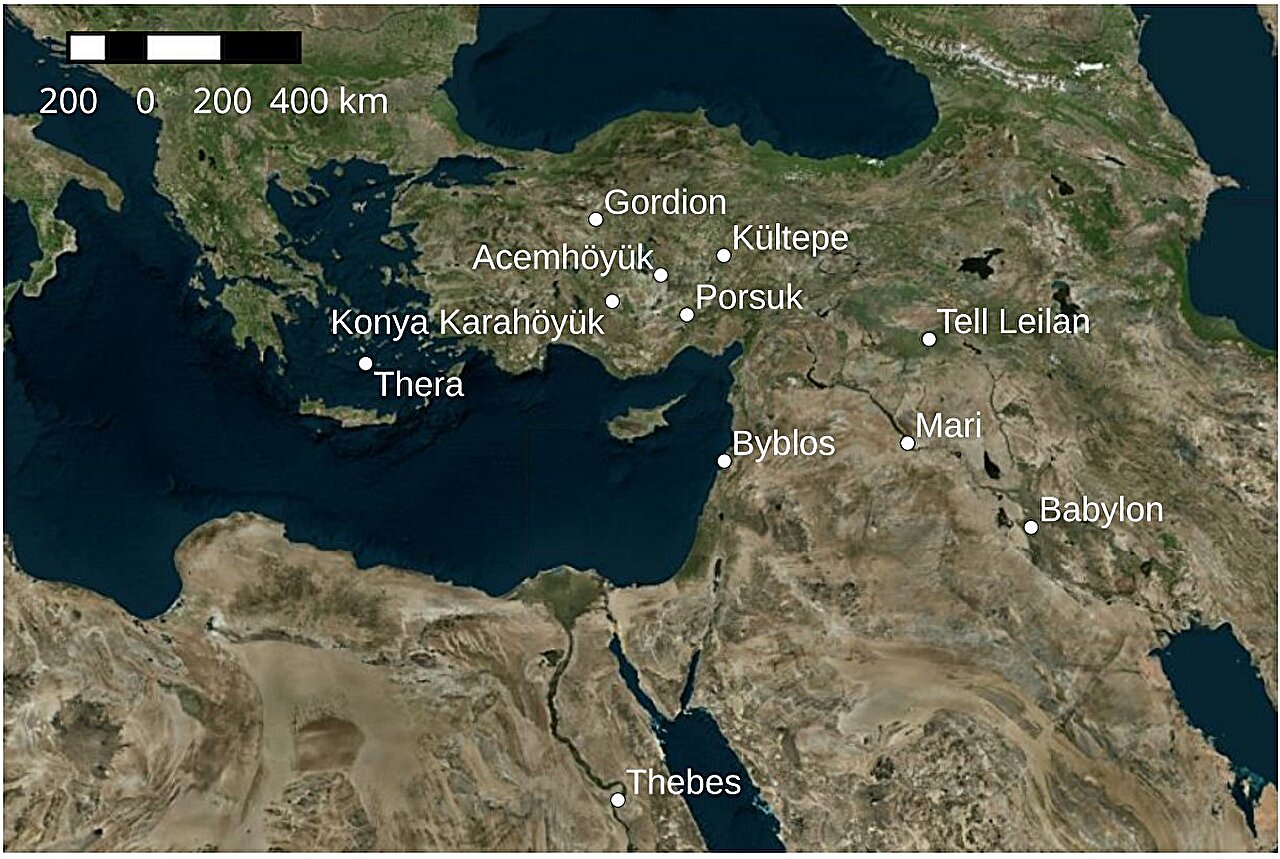
The first major test involved trees from Gordion, an important ancient settlement in Anatolia.
A previous investigation had measured radiocarbon in 186 individual tree rings from the site and suggested that the end of the wider Gordion chronology could be placed around 745 BCE, with an uncertainty of approximately one year.
However, the proposed dating had been questioned, making an independent test important.
The researchers selected 24 consecutive annual rings from the Gordion sequence. They targeted a relatively small radiocarbon excursion around 1530 BCE that had not previously been clearly resolved.
To improve measurement precision, they produced at least two radiocarbon measurements for each ring, resulting in 49 analyses.
They then compared the measurements with the new reference curve.
The strongest alignment occurred around a rapid change in atmospheric radiocarbon between 1532 and 1531 BCE.
This distinctive annual shift provided a calendar anchor for the Gordion sequence. The researchers calculated a radiocarbon offset of +8.80 ± 4.9 radiocarbon years between the Gordion samples and the reference data.
The terminal ring analyzed was placed at 1512 BCE with a 94.5% probability. The wider probability range also included 1513 BCE.
With this calendar anchor established, the researchers could place the end of the complete Gordion tree-ring chronology at 744 BCE.
This confirmed and refined the earlier proposed date of 745 ± 1 BCE.
The result was important because Gordion was not an isolated record. Its tree-ring sequence was connected to other archaeological wood sequences across Anatolia.
If those connections were reliable, anchoring Gordion would also help establish calendar dates for trees from sites more directly associated with the Assyrian trading network.
Testing the connections between archaeological sites
The researchers next examined whether the tree-ring sequences from Gordion, Porsuk and Acemhöyük were genuinely connected.
This was important because previous researchers had questioned some of the cross-dating relationships, particularly the connection between Gordion and Porsuk.
The team tested these relationships independently using radiocarbon measurements.
For Porsuk, they examined 45 consecutive tree rings and obtained 61 new radiocarbon measurements.
The resulting sequence was compared with the calendar-dated reference record using Bayesian statistical analysis. This method allowed the researchers to estimate the most probable calendar position while accounting for uncertainty in the radiocarbon offset.
The analysis indicated an offset of +12.20 ± 6.3 radiocarbon years.
The last measured ring was placed between 1696 and 1683 BCE at 95% probability, with the 99% probability interval extending from 1697 to 1683 BCE.
Within that broader interval, the years 1688 to 1683 BCE accounted for 92.9% probability.
This result was consistent with the independent tree-ring cross-dating, which placed the corresponding ring at 1684 BCE.
In other words, two different approaches, one based on atmospheric radiocarbon and the other on patterns of tree growth, pointed to the same period.
The researchers then tested the connection between Porsuk and Acemhöyük.
For Acemhöyük, they used high-precision radiocarbon measurements from groups containing between three and nine annual growth rings. These measurements were matched against the same reference curve.
The results indicated no discernible radiocarbon offset, with an estimated value of 0.00 ± 6.0 radiocarbon years.
The last measured sample, containing three combined tree rings, was placed between 1809 and 1801 BCE at 99% probability.
This was consistent with the corresponding tree-ring dates from Gordion and supported the connection between the archaeological sequences.
The statistical cross-dating results also supported the links among the sites. The reported t-scores were 6.30 for Gordion and Porsuk, 5.76 for Porsuk and Acemhöyük, 10.84 for Acemhöyük and Konya Karahöyük, 8.77 for Kültepe and Konya Karahöyük, and 6.16 for Acemhöyük and Kültepe.
Together, these results strengthened the case that the separate archaeological tree-ring records belonged to one interconnected chronology.
The researchers also recalibrated previously published multiyear radiocarbon measurements using their more detailed reference data. This provided additional support for the placement of the Acemhöyük sequence.
One particularly important improvement concerned the radiocarbon calibration record between approximately 1920 and 1810 BCE. The researchers added 242 continuous annual radiocarbon measurements for this interval, whereas only 18 radiocarbon determinations underlay the corresponding portion of the IntCal20 calibration curve.
The additional measurements offered a more detailed representation of atmospheric radiocarbon variation during this period.
The combined Anatolian tree-ring chronology could now be placed securely between 2072 and 744 BCE.
This established a calendar framework that could be used to investigate archaeological wood from sites connected through tree-ring cross-dating, including Kültepe and Konya Karahöyük.
Palace construction dates challenge the competing chronologies
With the Anatolian tree-ring sequences anchored to calendar years, the researchers could turn to the archaeological evidence most directly connected to the Assyrian chronology.
Two sites were particularly important: Kültepe, ancient Kaneš, and Acemhöyük, ancient Purušhv anda.
Both were major centers in the Old Assyrian trading network connecting Anatolia and Mesopotamia.
Their archaeological remains contain buildings constructed using timber that can be connected to the newly dated tree-ring sequences.
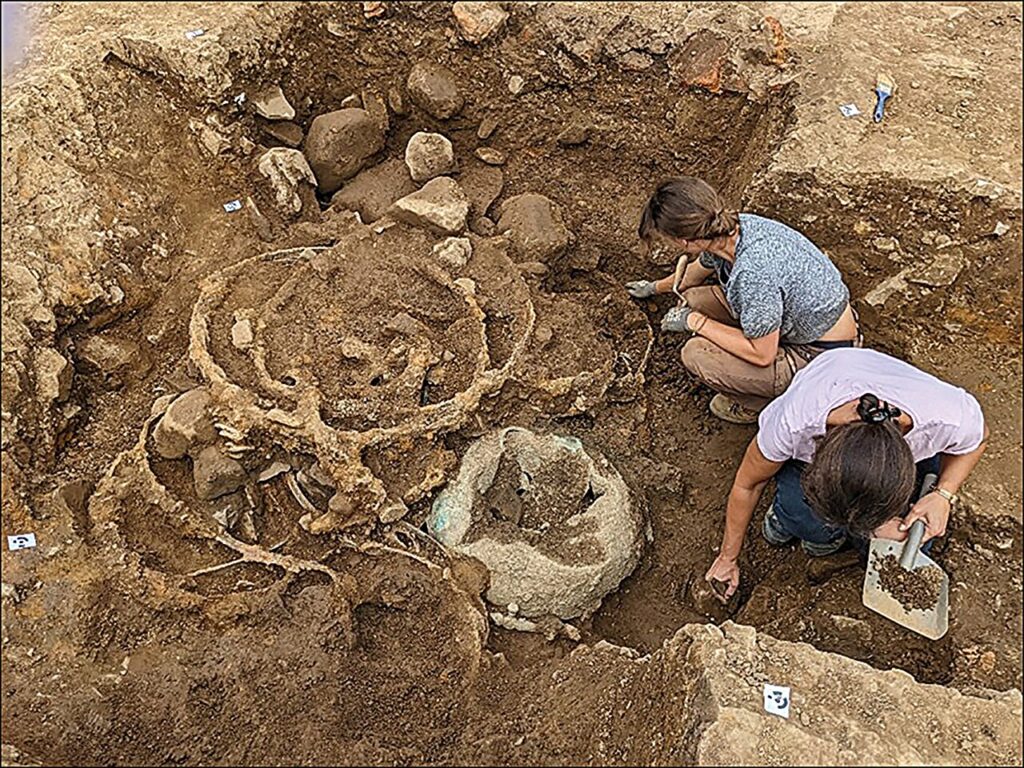
At Kültepe, researchers examined timbers from the Waršama Palace.
The analysis included 19 timbers from eight different parts of the palace, including three preserved in foundations beneath the floors.
These timbers showed strong tree-ring cross-matching. Several retained bark or their intact outermost growth edges, providing particularly useful evidence for determining when the trees were cut down.
The preserved outer edges indicated felling around 1837 or 1836 BCE.
The presence of bark is especially important because bark represents the outer boundary of a tree’s growth. Once a tree dies, this outer material can deteriorate or detach. Its preservation therefore helps establish how close the cutting date was to the tree’s final year of growth.
The researchers interpreted the clustering of the felling dates and the archaeological context as evidence that the logs were probably used within approximately a year of being cut.
This places an important constraint on the construction date of the Waršama Palace.
The archaeological evidence also provides a connection to specific years in the REL chronology.
Documents associated with the area before the palace include references to REL years 80 to 110. A loan document predating REL year 125 was also found sealed beneath the palace foundations.
These findings establish that REL year 125 must have occurred before the timber cutting around 1836 BCE.
The middle chronologies fit this evidence much better than the competing alternatives.
Under the middle–low chronology, REL year 125 falls within approximately three years of 1836 BCE.
The middle-high chronology also remains possible based on the archaeological evidence, although the researchers could not reliably distinguish between the two middle alternatives using the palace evidence alone.
The low chronology places REL year 125 around 1780 BCE.
That creates a problem. For this chronology to work, the trees cut around 1836 BCE would have needed to remain unused for decades before being incorporated into the palace.
The researchers considered this explanation improbable, particularly because the site contains extensive evidence of burning.
It would also require the construction of the Waršama Palace and the Sarıkaya Palace at Acemhöyük to have occurred within a couple of years of one another, despite evidence in the REL chronology indicating a gap of at least 40 years between the two construction phases.
The high chronology presents a different difficulty. It would require the preserved timber from both sites to be roughly 60 years older than the corresponding construction phases, even though the archaeological evidence does not indicate intervening material that would explain such a delay.
The Sarıkaya Palace provides a second independent constraint
At Acemhöyük, the researchers examined timber from the Sarıkaya Palace.
Several trees showed strong cross-matching, and some of the preserved timbers retained their bark edges.
Two particularly important timbers, identified as ACM-48 and ACM-49, formed part of a foundation course along the palace’s northern wall.
Their growth sequences, together with eight other strongly matched trees, ended at a bark-edge date of 1778 BCE.
The researchers interpreted the clustering of these dates as evidence that the trees were likely cut from the same forest and used close to the time of felling.
The archaeological evidence provides an additional connection to Assyrian history.
A large number of clay bullae bearing seal impressions associated with Šamši-Adad I were recovered from rooms inside the Sarıkaya Palace. Particularly important were finds from Room 6, which preserved evidence of the relationship between the palace and the Assyrian ruler.
Šamši-Adad I ruled Aššur during REL years 165 to 197.
The presence of these objects therefore helps establish the historical position of the palace within the Assyrian chronology.
The tree-ring evidence places the initial construction of the Sarıkaya Palace around 1778 BCE, approximately 58 years after the Waršama Palace timber-cutting date of 1836 BCE.
That interval agrees with the archaeological and historical evidence connecting the two sites.
The researchers also identified 1778 BCE as the initial construction date for Hatipler Tepesi at Acemhöyük.
Taken together, the two palace sequences provide an important independent constraint on the chronology.
They strongly favor a middle chronology over the high and low alternatives.
However, the eight-year difference between the middle-high and middle–low placements was too small to resolve confidently using the remaining uncertainties in the Assyrian archaeological sequence.
To distinguish between those two possibilities, the researchers turned to evidence from Babylon.
A Babylonian record connects Venus observations to an Alaskan volcano
The Babylonian king list is linked to the Assyrian chronology through the overlapping reigns of Šamši-Adad I and Hammu-rabi.
This connection offers another way to test the competing chronological frameworks.
One particularly useful source is the collection of astronomical observations known as the Venus tablets of Babylon.
These records describe the visibility of Venus during the reign of Ammi-Saduqa, a Babylonian king who ruled after Hammu-rabi.
Previous research had proposed that some of the recorded changes in Venus visibility might have been caused by a major volcanic eruption.
The basic idea is that a large eruption can inject sulfur into the atmosphere, where it forms sulfate aerosols. These particles can reduce the amount of sunlight passing through the atmosphere and create a haze.
Such atmospheric changes can affect the visibility of astronomical objects, including Venus.
The earlier proposal suggested that unusually high atmospheric extinction during years 12 and 13 of Ammi-Saduqa’s reign reflected a volcanic haze.
If the proposed connection was correct, the dates of those observations could be compared with independently dated volcanic eruptions.
The researchers used high-resolution ice-core evidence to investigate this possibility.
Polar ice preserves chemical traces of past volcanic eruptions. When volcanoes release large amounts of sulfur into the atmosphere, sulfate can eventually be deposited in ice sheets.
These deposits provide a way to identify the timing and relative magnitude of ancient eruptions.
The researchers compared the Venus observations with reconstructed stratospheric aerosol optical depth, a measure of how strongly airborne particles reduce the transmission of sunlight.
The ice-core records provided a particularly useful independent chronological reference because the timing of major volcanic sulfate deposits can be constrained to approximately two years.
The comparison produced a striking result.
Only the middle–low chronological placement aligned the periods of unusually high Venus extinction with a major volcanic eruption.
That eruption was Aniakchak II, which occurred in Alaska in 1627–1628 BCE.
It is now recognized in the study’s ice-core evidence as one of the five largest volcanic eruptions of approximately the last 4,000 years.
The eruption was large enough to have produced a substantial atmospheric haze capable of affecting observations from distant regions.
The researchers further compared the estimated atmospheric effects inferred from the Babylonian Venus observations with the aerosol optical depth and duration associated with four other very large eruptions.
The estimates were comparable, adding support to the proposed volcanic explanation.
The agreement does not independently prove every detail of the historical Venus observations. However, it provides a separate line of evidence that favors the middle–low chronological placement.
The researchers also noted that this chronology receives support from other astronomical arguments.
Egyptian historical records provide another chronological check
The researchers examined whether the preferred Mesopotamian chronology was consistent with historical relationships involving Egypt.
An important connection involves Neferhotep I, an Egyptian king associated with Thebes, Yantin-‘Ammu of Byblos and Zimri-Lim of Mari.
Yantin-‘Ammu appears on a stela from Byblos alongside Neferhotep I. He is also mentioned in the royal archives of Mari, which largely date to the reign of Zimri-Lim.
The connection to Mesopotamia comes through the history of Mari.
Zimri-Lim occupied Mari after the death of Šamši-Adad I, during the period associated with Hammu-rabi’s 17th or 18th regnal year.
Hammu-rabi eventually destroyed Mari in his 32nd year, corresponding to REL year 212 or 213.
Under the middle–low chronology, Hammu-rabi’s 32nd year falls around 1754 BCE.
This date is close to the historically proposed dates for Neferhotep I, approximately 1749 BCE or within a range of 1742–1731 BCE.
The agreement provides another interregional chronological connection supporting the middle–low framework.
The researchers therefore did not rely on a single archaeological site, astronomical observation or scientific dating method. Their conclusion emerged from the convergence of tree-ring measurements, palace construction evidence, historical relationships and volcanic records.
The tree rings also preserve a record of ancient climate
Although the main purpose of the research was to resolve chronological questions, the newly anchored tree-ring sequence also provides a detailed record of past environmental conditions in Anatolia.
Because the chronology is resolved to individual calendar years, researchers can investigate when particular periods of unusual tree growth occurred.
The study identifies an unusually dry period at Gordion extending from 1228 to 1188 BCE.
It also establishes a more concentrated multiyear drought between 1194 and 1192 BCE.
The latter period occurred just two years before the Hittite capital of Hattusa was sacked and burned.
The researchers note that earlier investigations of tree-ring widths and stable isotope patterns from Gordion had suggested evidence of drought and crop failure that might have contributed to the collapse of the Hittite Empire.
The new chronology places the unusually dry conditions in exact calendar years, making it possible to compare them more precisely with historical records and other environmental evidence.
However, the chronological overlap does not establish that drought caused the destruction of Hattusa or the collapse of the Hittite Empire.
The authors describe the new dating as a way to investigate potential human–climate relationships alongside other, lower-resolution environmental evidence.
The study also identifies several other useful calendar dates from the interconnected Anatolian tree-ring records.
At Porsuk, the construction of the inner postern of a Hittite city wall is dated to 1608 BCE, while the outer postern construction is dated to 1577 BCE.
At Konya Karahöyük, the last measured tree ring dates to 1762 BCE.
The construction of the Midas Mound Tumulus at Gordion is dated to 744 BCE.
These dates demonstrate that the new chronology is useful beyond the specific question of Mesopotamian kingship.
What the new chronology establishes
The central result is that the middle–low chronology is the best-supported framework for Mesopotamia during the period examined, approximately 2000 to 1500 BCE.
The researchers place the fall of Babylon around 1587 BCE.
This provides a more firmly anchored chronological connection between Mesopotamia, Anatolia, northern Syria, Egypt and the wider eastern Mediterranean.
The study also establishes a calendar-secured Anatolian tree-ring record extending from 2072 to 744 BCE.
That record offers an independently dated reference for archaeological wood from interconnected sites and provides annually resolved information that can be used in future archaeological and environmental investigations.
There are important boundaries to the conclusion.
The study strongly supports the middle–low chronology for the period it investigates, but it does not establish that every chronological question concerning ancient Mesopotamia has been resolved. The authors specifically recommend continued careful reassessment of other chronological interpretations beyond the period addressed by their evidence.
The study was published in PNAS.