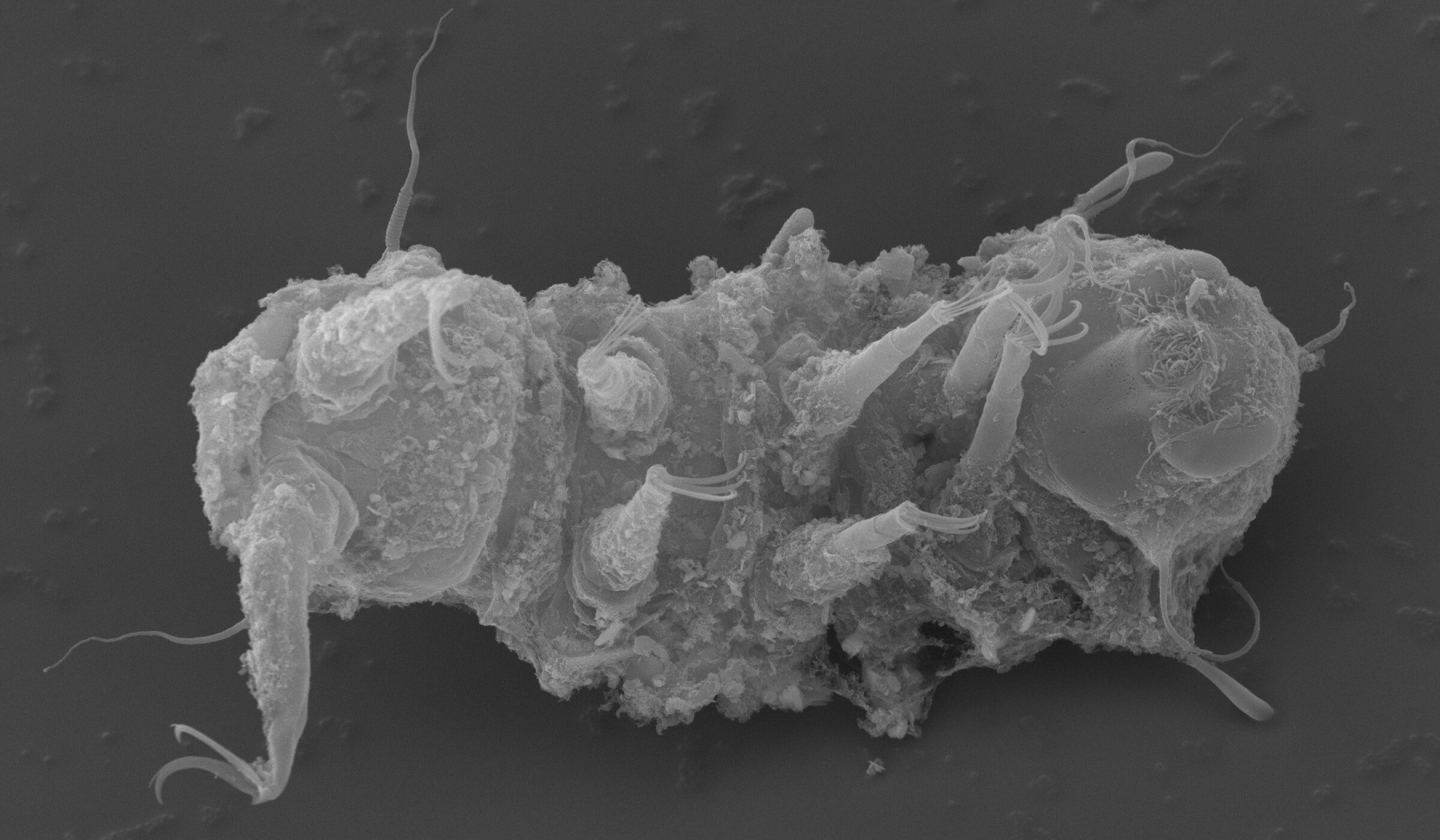
Among fragments of coral, shells and other biological material on the summit of a tropical Atlantic seamount, scientists found a surprisingly varied community of microscopic marine tardigrades. The survey identified 20 tardigrade taxa, compared with just two at a nearby deep-sea reference site, and uncovered two previously unknown species with unusual anatomical features. One has rare reproductive spines extending outside its body, while the other retains a combination of juvenile-like characteristics even as an adult.
The discoveries come from Senghor Seamount, an underwater mountain in the Cape Verde region of the eastern tropical Atlantic. Its summit lies only about 100 meters below the ocean surface, making it a relatively shallow habitat surrounded by much deeper seafloor.
Although tardigrades are often associated with moss, freshwater and terrestrial environments, many species live in marine sediments. These animals belong to a remarkably diverse group of microscopic invertebrates, and marine species can possess elaborate body structures, sensory organs and protective plates.
The researchers investigated this largely unexplored marine habitat and documented its tardigrade community. Their findings include not only two formally described species but also several other specimens that may represent species not previously recognized by science.
The contrast between the seamount and the deep-sea reference site is particularly striking. However, the researchers caution that differences in sampling effort prevent a reliable statistical comparison of their biodiversity.
Searching the sediments of an underwater mountain
Senghor Seamount is part of the Cape Verde archipelago region. Like other seamounts, it rises above the surrounding ocean floor, creating a distinct underwater landscape.
Its summit supports sediments made largely of coarse carbonate material derived from biological remains, including fragments of corals, echinoderms, bryozoans and mollusks. This differs considerably from the fine sediment, or ooze, found at the deep-sea reference site.
Seamounts are considered potentially important habitats for small marine organisms. Their underwater topography influences local water movement and the distribution of organic material. Previous investigations of Atlantic seamounts have also documented diverse communities of marine tardigrades.
Yet Senghor Seamount had not previously received a dedicated investigation of its marine tardigrade fauna.
To examine the community, the researchers used sediment samples collected during the September 2009 expedition of the research vessel Meteor. The samples came from the summit plateau and a deep-sea reference station approximately 100 kilometers north of the seamount.
The team selected eight sediment samples from different locations and depths. Seven came from the seamount, including sites on its central summit and northwestern section. Their depths ranged from approximately 101 to 383 meters. The remaining sample came from the reference station at a depth of 3,293.9 meters.
For each sample, researchers collected the upper 5 centimeters of sediment and preserved it in formaldehyde at a final concentration of approximately 8 percent.
They then separated the tiny animals from the sediment using density-gradient centrifugation with colloidal silica. The resulting material was passed through a sieve with a mesh size of 40 micrometers, and the samples were stained with Rose Bengal to make the organisms easier to locate and identify.
The researchers sorted the extracted animals under stereo microscopes. They examined tardigrade anatomy using light microscopy, including differential interference contrast imaging, and scanning electron microscopy.
These techniques provided complementary views of the animals. Light microscopy allowed the researchers to examine internal and external structures, while scanning electron microscopy helped resolve fine details of their body surfaces, appendages and claws.
Measurements were taken only when the relevant anatomical structures were sufficiently intact to avoid recording dimensions from damaged specimens.
Twenty taxa on the seamount, compared with two in the deep sea
The investigation recovered and examined 219 marine tardigrade individuals from the eight selected samples.
Of these, 212 came from Senghor Seamount. Three additional seamount specimens were too deteriorated for identification beyond the broader group Heterotardigrada.
The researchers identified 20 tardigrade taxa on the seamount, representing several families. Some could be assigned to recognized species, while others could only be identified to a genus, family or subfamily.
The family Halechiniscidae was the most abundant, accounting for 52.6 percent of the seamount’s tardigrades. It included several different groups, among them Chrysoarctus, Dipodarctus, Halechiniscus and Quisarctus.
Styraconyxidae accounted for 26.3 percent of the specimens, while Tanarctidae represented 13.9 percent. Stygarctidae, the family containing both newly described species, accounted for 6.7 percent. Batillipedidae was the least represented family, at 0.5 percent.
The identified fauna included three established species: Chrysoarctus briandi, Quisarctus armatus and Raiarctus colurus.
Other specimens belonged to groups such as Angursa, Batillipes, Chrysoarctus, Dipodarctus, Halechiniscus, Raiarctus and Tanarctus.
The researchers also recognized several groups that could represent previously undescribed species. These included representatives of Florarctinae, Angursa sp., Dipodarctus aff. subterraneus, Raiarctus aff. variabilis and Tanarctus sp.
However, these specimens were not sufficiently well preserved for the researchers to produce reliable formal descriptions. Their potential status as new species therefore remains unresolved.
The reference station presented a very different picture. Only seven tardigrades were recovered there, representing two taxa: six specimens of Angursa abyssalis and one unidentified Angursa.
This produced a clear difference in the observed number of taxa: 20 on the seamount compared with two at the deep-sea site.
Nevertheless, the comparison requires an important qualification. The seamount was represented by seven samples, whereas the reference area was represented by only one. The number of individuals recovered also differed substantially.
The researchers explicitly state that these unequal sample sizes make it impossible to draw statistically significant conclusions about the difference in biodiversity.
In other words, the survey documents a much richer observed assemblage on Senghor Seamount, but it does not establish how much of that difference reflects genuine ecological conditions rather than differences in sampling.
A tardigrade with unusual reproductive spines
Among the specimens collected from Senghor Seamount, one of the most distinctive belonged to a previously unknown species of the family Stygarctidae.
The researchers named it Megastygarctides hekatae.
Its most unusual feature is found in its reproductive anatomy. The female possesses two oval structures called seminal receptacles, which are connected to reproductive ducts. These ducts extend outside the body as two short, hollow spines with small hooks on their lower sides.
Seminal receptacles are reproductive structures associated with receiving and storing sperm. Their shape and arrangement can provide important characteristics for distinguishing closely related marine tardigrade species.
The outward-projecting spines in M. hekatae are particularly unusual. Similar genital structures had previously been reported in only one other tardigrade species, Megastygarctides christinae.
This anatomical resemblance helped the researchers recognize the relationship between the two species, but several other features distinguish them.
The new species was described from two adult females collected at the central summit of Senghor Seamount, at a depth of 102.4 meters. One was designated as the holotype, the specimen that serves as the primary reference for the species description. The other became the paratype.
The holotype measured 193.3 micrometers in body length, while the paratype measured 185.6 micrometers.
Like other members of its genus, the animal has an armored body divided into distinct cuticular plates. Its body covering includes a cephalic plate, three main body plates, three accessory plates and a caudal plate.
The head also has a ventral cephalic plate, an anatomical feature that contributes to its identification.
Its sensory structures are equally distinctive. The animal possesses several pairs of hair-like sensory appendages called cirri, as well as clavae, which are specialized sensory organs.
One particularly prominent structure is cirrus E, a long sensory appendage arising from the rear part of the body. It measures between 61 and 64.5 micrometers in the two specimens.
The researchers also documented the animal’s claws, which are equipped with dorsal spurs. The claws on the fourth pair of legs are the largest, measuring 18.7–19.5 micrometers. Those on the first, second and third pairs are progressively shorter.
The combination of its body plates, sensory structures, reproductive anatomy and claw characteristics provides a detailed morphological profile of the species.
How the new species differs from its closest relative
The closest morphological comparison is Megastygarctides christinae, previously described from the Arabian, or Persian, Gulf.
Both species possess well-developed body plates, a ventral cephalic plate and the unusual genital spines associated with their reproductive systems.
However, the researchers identified several differences that support treating them as separate species.
One important distinction concerns their primary clavae, sensory structures located on the head. Those of M. hekatae are more elongated than the corresponding structures in M. christinae.
Another difference involves cirrus E. In the new species, it measures 61–64.5 micrometers, compared with 36–43 micrometers in M. christinae.
The two species also differ in their protective body plates. M. hekatae lacks the second accessory plate located between the first and second main body plates in M. christinae.
Their claws provide another useful distinction. Those of the new species are noticeably longer across all four pairs of legs.
| Anatomical feature | M. hekatae | M. christinae |
|---|---|---|
| Cirrus E | 61–64.5 µm | 36–43 µm |
| Leg I claws | 14.4–16.5 µm | 9–10 µm |
| Leg II claws | 13.9–14.5 µm | 9–11 µm |
| Leg III claws | 14 µm | 10–12 µm |
| Leg IV claws | 18.7–19.5 µm | 12–13 µm |
The reproductive structures also differ. Although both species have genital spines, those of M. hekatae are shorter. Its seminal receptacles are more elongated, and the arrangement of the anus and gonopore also differs.
These anatomical distinctions are particularly relevant because reproductive-system characteristics are considered important for identifying species of marine armored tardigrades.
The researchers consider the differences sufficient to distinguish the new species, even though they have not yet examined a male specimen of M. hekatae.
They also suggest that M. hekatae and M. christinae probably represent sister species belonging to a tropical lineage. This is a proposed evolutionary relationship based on their morphological similarities, rather than a relationship established through genetic analysis.
At the time of the description, M. hekatae was also the deepest-recorded species in its genus, with its type specimens collected at approximately 100 meters below sea level.
The researchers chose the name hekatae in reference to Hekate, a goddess in ancient Greek mythology. The name also relates to the Greek numeral for 100, reflecting the approximate depth of the species’ type locality.
An adult tardigrade retaining juvenile-like features
The second new species presented a different anatomical puzzle.
Named Parastygarctus potercha, it is notable for its unusually small body and reduced number of claws, features that the researchers interpret as evidence of paedomorphosis.
Paedomorphosis occurs when an organism retains certain characteristics associated with an earlier developmental stage even after reaching sexual maturity.
In the new species, the most immediately recognizable feature is its unusual claw arrangement.
Many related armored marine tardigrades have four claws on each of their first three pairs of legs. P. potercha, however, has only three claws on each of those legs and just two on each of its fourth pair.
The researchers consider this combination unique within the genus.
The holotype was an adult female measuring just 69 micrometers long and 21 micrometers wide. It was collected from coarse biogenic sand at a depth of 102.4 meters on the central summit of Senghor Seamount.
Despite its small size and reduced claw numbers, the specimen possessed a female gonopore and seminal receptacles, providing evidence that it had reached reproductive maturity.
Its body is covered by an armored cuticle divided into a cephalic plate, three main body plates, two intersegmental plates and a caudal plate.
Each of the three main body plates has two pairs of lateral spine-like projections. A smaller anterior projection arises from the ventral side, while a larger posterior projection arises from the dorsal side.
The rear body plate has three pairs of projections. These include lateral spines, dorsolateral projections bearing cirrus E, and another pair of spine-like projections at the posterior end.
The head also carries sensory appendages and clavae. Its primary and secondary clavae are oval and supported by short stalk-like structures.
The first three pairs of legs terminate in three claws. The outermost and middle claws have additional dorsal filaments. The fourth pair carries two larger claws, also equipped with dorsal filaments.
Its female reproductive system consists of small, sac-like seminal receptacles connected to short, curved ducts.
The anus is located 6 micrometers behind the gonopore in the holotype.
The researchers examined 11 additional specimens, including males, females, juveniles and individuals whose sex could not be determined. These specimens generally matched the holotype’s morphology.
The males were slightly larger than the females and had a shorter distance between the anus and gonopore, approximately 4 micrometers.
Their examination also revealed a male gonopore formed as a broad tube with an oval opening.
Across the measured specimens, body length ranged from 52.5 to 89.3 micrometers, with a reported mean of 70.5 micrometers and a standard deviation of 11.3 micrometers.
This variation provided additional information about the species’ morphology, although the researchers did not conduct a developmental study to establish how its unusual characteristics arise.
Why the researchers describe it as paedomorphic
The reduced claw numbers and small body size led the researchers to consider whether P. potercha retains juvenile-like characteristics into adulthood.
Paedomorphosis had previously been discussed in several marine tardigrades, including members of the genus Parastygarctus.
The researchers identify P. biungulatus as the closest comparable example within the genus. Both species exhibit a combination of small body size and reduced claw numbers.
However, the new species does not fit the most straightforward pattern of paedomorphosis.
Some previously discussed species retain a larval arrangement of only two claws on all legs. P. potercha has three claws on each of its first three pairs of legs and two on its fourth pair.
The authors therefore do not rely on claw numbers alone.
They also point to the animal’s small body size and unusually subtle seminal receptacles compared with those of other members of the genus.
Together, these features support their interpretation that the species exhibits paedomorphic characteristics.
The finding is based on comparisons of adult and juvenile morphology. The study does not establish the developmental mechanism responsible for the reduced structures, nor does it explain why these characteristics evolved.
The species name reflects this unusual appearance. Potercha comes from Ukrainian folklore, where the term refers to the ghost of a dead, unbaptized child. The authors selected the name in reference to the species’ juvenile-like appearance.
A possible biodiversity hotspot, but an incomplete picture
The two new species add to the diversity documented on Senghor Seamount, but the broader ecological picture remains uncertain.
The researchers place their findings within a growing body of work examining marine tardigrades on underwater mountains.
Previous investigations have documented diverse tardigrade communities at locations including Faroe Bank, Condor Seamount, Great Meteor Seamount and Princess Alice Bank.
Faroe Bank, in particular, has a substantial record of marine tardigrade diversity, with 35 recorded species. By comparison, four tardigrade taxa had been reported from Princess Alice Bank in the study cited by the authors.
Senghor Seamount’s 20 recorded taxa therefore represent a relatively rich observed assemblage.
The authors suggest that the comparatively high species counts at Faroe Bank and Senghor Seamount, relative to some reported Atlantic deep-sea records, may support the hypothesis that seamounts serve as biodiversity hotspots for marine tardigrades.
But they emphasize that the available evidence is insufficient to establish a general ecological pattern.
The number of investigated seamounts remains limited, and the number of samples examined at different locations varies. These differences can influence how many species are detected.
The deep sea itself is also poorly studied in terms of tardigrade diversity. The researchers point out that deep-sea communities may contain a broader range of species than currently recognized, including groups beyond the genera traditionally associated with deep-sea environments.
Consequently, an apparent difference between seamounts and surrounding deep-sea plains could partly reflect uneven sampling rather than a true difference in biodiversity.
The Senghor comparison illustrates this problem particularly clearly. Although the researchers recovered 20 taxa from the seamount and only two from the reference station, the latter was represented by just one sediment sample.
The available data therefore cannot determine whether the difference reflects habitat conditions, the amount and type of sediment sampled, or other factors.
The researchers also found no basis for establishing a consistent relationship between tardigrade diversity and latitude, water depth or sediment characteristics across the seamounts investigated in previous studies. Such relationships may exist, but the available observations are too limited to demonstrate them.
Two new species expand the identification keys
Beyond describing the two species, the researchers updated the identification tools used to distinguish members of their respective genera.
These tools are important because many marine tardigrades share broadly similar body plans, while differences in their plates, sensory structures, reproductive anatomy and claws can be essential for identifying individual species.
The updated key for Megastygarctides incorporates M. hekatae, bringing the genus to seven recognized species.
Its identification relies partly on the shape of the primary clavae, the presence or absence of epicuticular fibrils and the morphology of the reproductive structures.
In the updated key, M. hekatae is distinguished from M. christinae by its more elongated primary clavae, shorter genital spines and bean-shaped seminal receptacles, compared with the longer genital spines and oval seminal receptacles of its closest relative.
The revised key for Parastygarctus brings the genus to eight recognized species.
Here, claw number provides an especially useful identification feature. The new species can be separated from P. biungulatus by having three claws on legs I–III rather than two, as well as differences in the length and shape of the posterior spines on the caudal plate.
The researchers also deposited the examined specimens in the Tardigrada collection of the Senckenberg Natural History Museum in Frankfurt, Germany. The collection includes the prepared microscope slides and scanning electron microscopy specimens, allowing the descriptions to be examined against the original material.
All occurrence records were additionally submitted to the Global Biodiversity Information Facility.
The investigation thus provides a first detailed account of the marine tardigrade fauna of Senghor Seamount, while documenting two species whose distinguishing characteristics are now incorporated into the taxonomic identification of their genera.
The study was published in ZooKeys.