On a remote island at the southern end of Argentina, archaeologists have uncovered wooden shipwreck remains alongside the traces of what may have been a temporary camp used by shipwreck survivors in the 19th century. The discoveries, made at Franklin Bay on Isla de los Estados, include sections of wooden hulls, an iron chain, everyday personal belongings, and pieces of nautical equipment. Together, the finds point to a possible connection with the 1873 wreck of the schooner brig Espora, commanded by Argentine sailor Luis Piedra Buena. But the relationship between the surviving shipwreck structures and the people who occupied the nearby hillside remains uncertain, leaving archaeologists with several questions about what happened after the vessel was lost.
Isla de los Estados lies off the southern coast of Argentina, separated from the mainland by the Strait of Le Maire. Since the early 17th century, the island has formed part of an important sailing route connecting the Atlantic and Pacific oceans and linking harbors across Patagonia.
Its position made it relevant to maritime activities, but sailing around the island was challenging. Franklin Bay, where the recent archaeological discoveries were made, has a steep, cliff-lined coastline exposed to strong southwesterly winds.
Historical records point to a long history of seafaring activity around the island, including shipwrecks. Yet much of its maritime archaeological heritage remains poorly investigated.
By the early 1870s, the island had been granted to Luis Piedra Buena, a prominent Argentine sailor involved in commercial, national sovereignty, and humanitarian activities in Patagonia. However, no permanent settlement had been established there.
One of the most notable events associated with Piedra Buena was the loss of his schooner brig Espora in 1873. During a campaign to exploit penguins for oil, Piedra Buena and his crew lost the vessel. They subsequently built another boat, a cutter named Luisito, and sailed to Punta Arenas, Chile.
The fate of the Espora and the circumstances surrounding the crew’s survival have been documented in historical accounts. However, the exact location of the wreck and the archaeological evidence associated with the castaways have remained subjects of investigation.
Franklin Bay is considered a likely location for the accident based on Piedra Buena’s account and other documentary evidence, although there is no general agreement about the identification of the wreck site.
Three sections of wooden hull emerge from the shoreline
In January 2026, an interdisciplinary archaeological team visited Isla de los Estados as part of an ongoing project investigating the island’s maritime history.
The expedition travelled to San Juan de Salvamento, Cook Harbour, and Franklin Bay aboard the sailboats Pampa Mía and Galileo, with support from the Argentine Navy.
At Lacroix Inlet, within Franklin Bay, the researchers concentrated on three objectives: examining previously reported wooden shipwreck remains, surveying the shallow-water inlet and its changing tidal zones, and searching the surrounding landscape for evidence of temporary human occupation.
On-foot surveys revealed three separate structures containing wooden hull remains. The researchers recorded their positions, photographed and measured the visible materials, made drawings, and assessed their archaeological characteristics.
They also used a drone to document the landscape and examine the spatial relationship between the different archaeological locations.
Two of the structures were identified along the southern part of the inlet.
The first, designated BF010, lies near the entrance to the inlet in the intertidal zone, the area alternately covered and exposed by changing tides. It consists of the lower portion of a vessel’s hull, accompanied by an adjacent iron chain designated BF009.
The second structure, BF005, is located slightly above the high-tide line during a quadrature tide, a tidal condition associated with relatively small differences between high and low water levels. Unlike BF010, this structure preserves hull remains at approximately the height of a vessel’s deck.
The third structure, BF004, consists of a small section of wooden hull on the northern side of the inlet.
These discoveries are important because the remains may represent more than one vessel. Their precise identities have not yet been established.
The BF010 and BF005 locations had also been partially investigated in earlier work, including research by personnel from the Ushuaia Maritime Museum and archaeologists from the Austral Center of Scientific Research (CADIC-CONICET).
During the 2026 expedition, the team carried out additional recording, dug test pits, and collected timber samples. The researchers intend to examine the vessels’ construction features, dimensions, functions, dates, and possible origins to determine whether the structures belong to separate shipwrecks.
One particularly interesting detail is the preservation of BF005 at deck height. This surviving section includes structural elements such as a clamp, beam, and knee, which are components of a wooden vessel’s framework.
These construction details may help archaeologists understand how the vessel was built and whether the different wooden structures came from the same ship.
For now, the available evidence does not establish the identity of any of the three structures.
A hillside camp contains everyday objects and nautical equipment
The shipwreck remains were not the only important discoveries at Lacroix Inlet.
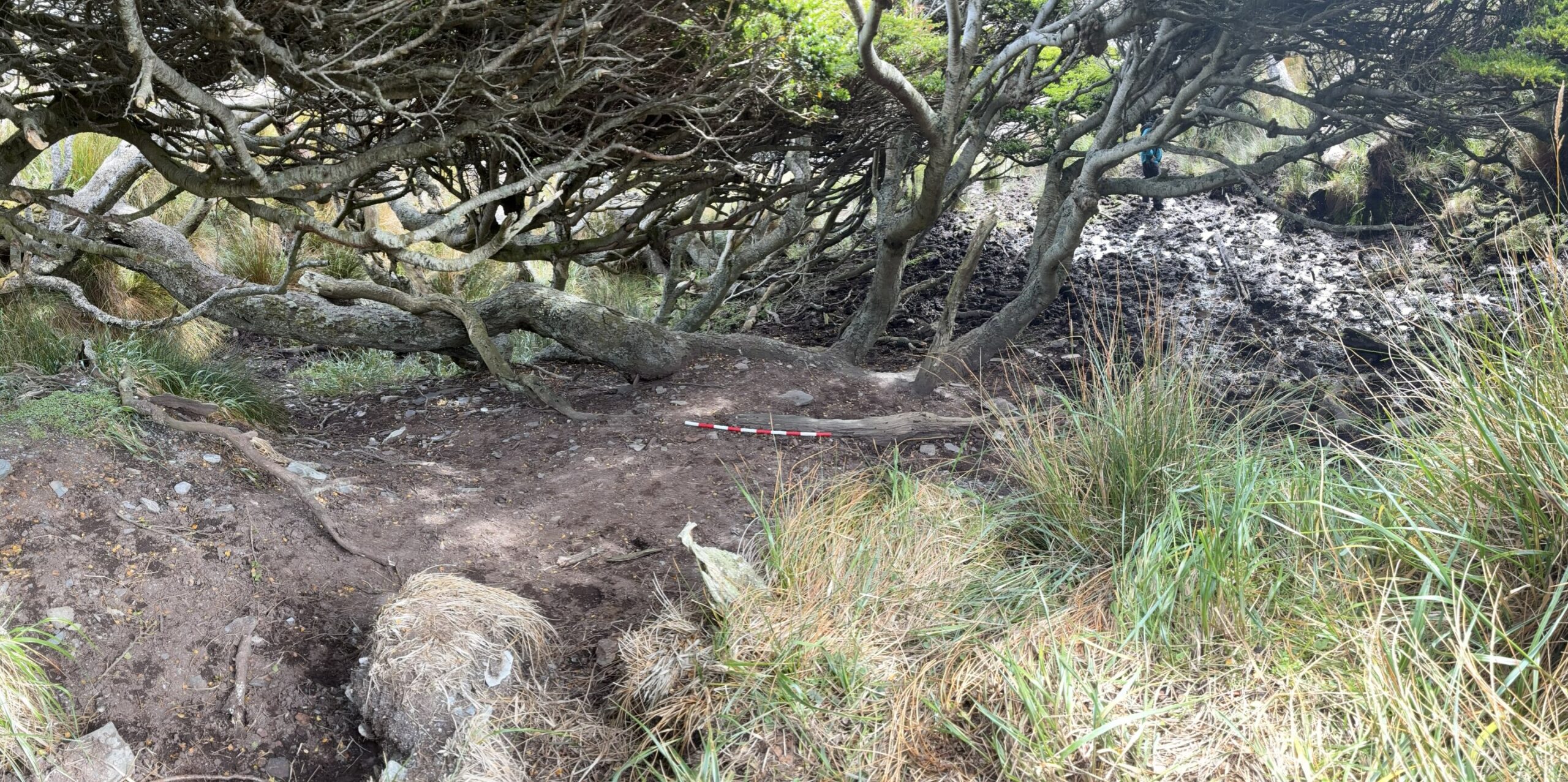
About 150 meters from each of the two southern shipwreck structures, archaeologists identified another site, designated BF008. It lies on the lower slope of a steep hill, more than 12 meters above sea level, beside a small stream.
The location and archaeological materials suggest that people occupied this area for a relatively short period.
Unlike the wooden hull structures along the shoreline, BF008 contains objects associated with everyday activities, personal belongings, and maritime equipment.
Among the finds were glass beads, ceramic buttons of the Prosser style, and corrugated galvanized metal sheets. The researchers describe the artefacts as European or creole in character.
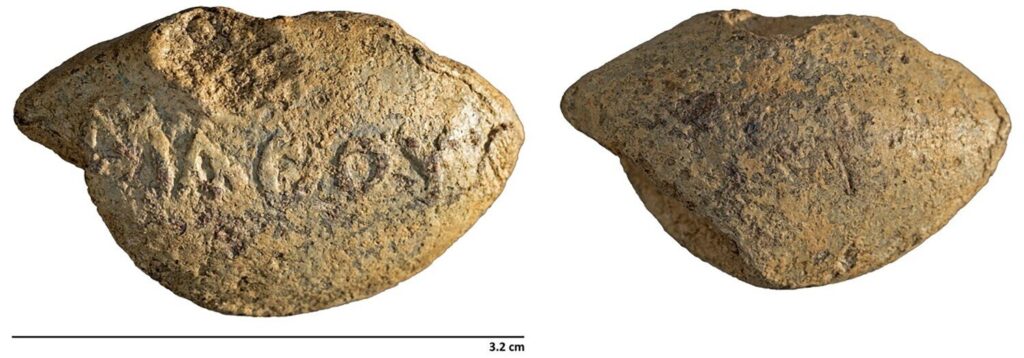
The collection also included two particularly interesting nautical objects: a deck prism and a small rudder hinge made from a non-ferrous metal.
A deck prism is a glass fitting used to bring natural light into the interior of a vessel. Before electric lighting became available, such devices helped illuminate spaces below deck by directing daylight through an opening in the deck.
The rudder hinge, meanwhile, is a component associated with the mechanism that supports and connects a ship’s rudder.
The presence of these objects alongside ordinary personal and domestic items gives the site a distinctly maritime character.
The researchers collected a selection of diagnostic artefacts for further examination to better understand the nature of the occupation.
The position of BF008 is also noteworthy. Its location beside a stream, on elevated ground and approximately equidistant from the two southern shipwreck structures, suggests a possible relationship between the camp and the maritime remains.
However, the researchers have not established who occupied the site or how long they stayed there.
Could the camp be connected to the crew of the Espora?
The possible connection between BF008 and the 1873 wreck of the Espora is one of the central questions raised by the discoveries.
Historical accounts describe how Piedra Buena and his crew survived the loss of their schooner brig by constructing the cutter Luisito and sailing to Punta Arenas.
The Espora was formerly known as Nancy. It was a 157-ton brig with one deck, built in Maryland, United States.
The archaeological evidence from Lacroix Inlet offers a possible opportunity to investigate what happened at the wreck location and how the castaways used the surrounding landscape.
The researchers consider the location of the temporary occupation and the nature of its material remains consistent with a connection to the nearby shipwreck structures and, potentially, the Espora and its crew.
Nevertheless, this identification remains provisional.
An important complication concerns historical descriptions of how extensively the Espora was dismantled after the accident.
Accounts by Piedra Buena and other historical sources do not provide a consistent picture of how much of the vessel was taken apart. The archaeological remains now offer an opportunity to examine those descriptions against physical evidence.
For example, BF005 preserves a section of hull at deck height. This is an important observation because the surviving structure does not fit straightforwardly with expectations that the vessel had been extensively dismantled.
The researchers also point out that they have not found traces of a shipyard at Lacroix Inlet.
Historical accounts describe Piedra Buena establishing a shipyard to construct the Luisito after the Espora was lost. Yet no archaeological evidence of such a facility has been identified during the investigations so far.
The absence of identified shipyard remains does not establish that construction took place elsewhere. It means that the archaeological evidence currently available has not confirmed the location of the reported activity.
These differences between historical descriptions and surviving structures make the identification of the vessels particularly challenging.
Further investigation will be needed to determine whether the wooden remains belong to the Espora, another vessel, or multiple shipwrecks, and whether the hillside occupation can be directly associated with the castaways.
What the archaeological evidence can establish
The researchers adopted a largely non-invasive approach during the initial investigation. Rather than undertaking extensive excavation, they prioritized recording visible remains, documenting their positions, and collecting selected samples and artefacts for further analysis.
This approach allowed the team to examine the relationship between the shoreline structures and the possible occupation site while preserving much of the archaeological context.
The island’s isolation and its status as a protected nature reserve have also contributed to the preservation of archaeological remains. At Franklin Bay, these conditions provide an opportunity to investigate maritime accidents and short-term human occupations in a landscape that has experienced relatively little disturbance.
The researchers place the investigation within an emerging field of archaeological research focused on temporary camps associated with maritime accidents in Patagonia. Similar short-term occupations have recently been investigated in continental Patagonia, although this remains a developing area of study.
The discoveries at Lacroix Inlet provide evidence of at least one 19th-century maritime accident associated with a temporary occupation. However, the identity of the vessel or vessels and the movements of the people who occupied the site remain unresolved.
The wooden hull sections, iron chain, deck prism, rudder hinge, and everyday objects offer different pieces of evidence that archaeologists can examine together. Determining their dates, origins, construction characteristics, and archaeological relationships will be essential to establishing whether they belong to the same historical event.
For now, the possible connection to Piedra Buena’s Espora remains an important but unconfirmed interpretation. The ongoing investigation is intended to clarify the relationship between the shipwreck remains and the hillside occupation, as well as the circumstances surrounding the people who once stayed at Lacroix Inlet.
The study was published in Antiquity.