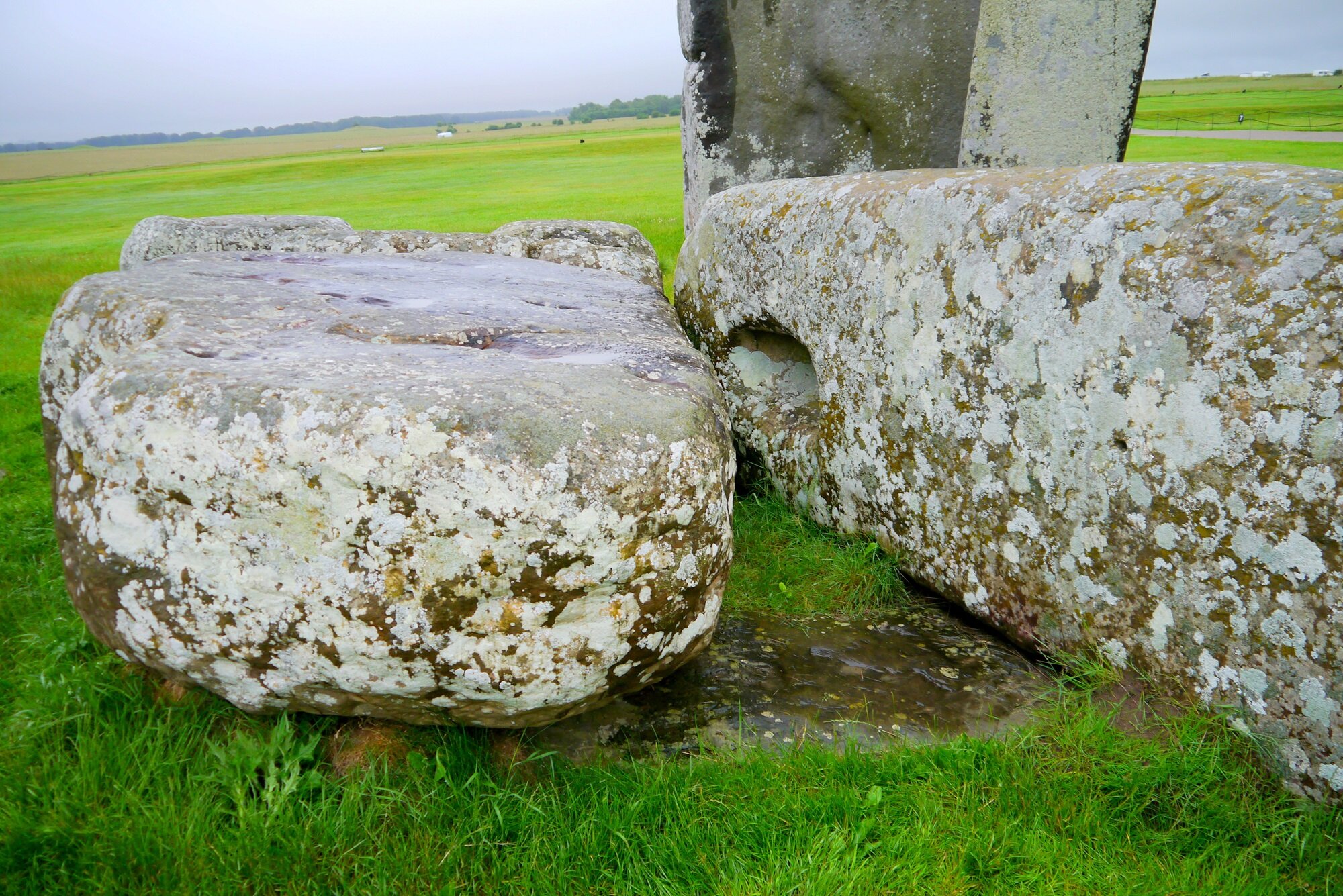
The Altar Stone lies beneath two massive fallen stones at Stonehenge, its broad sandstone surface mostly hidden from view. The roughly six-ton block has a geological identity unlike the other stones traditionally grouped with Stonehenge’s bluestones. For more than a century, researchers have tried to trace it to the rocks from which it came. New analyses have narrowed the search, ruling out several proposed regions in Britain, but they have not identified a source. Instead, the stone’s combination of minerals, chemical signatures and ancient grains presents a more complicated picture than any single clue can explain.
Stonehenge contains two main groups of stones: the larger sarsen stones and the smaller stones traditionally known as bluestones. Many of the bluestones are volcanic rocks or dolerites that can be linked to outcrops in the Mynydd Preseli area of West Wales, about 225 kilometers (140 miles) from the monument.
The Altar Stone is different. It is a well-sorted sandstone, made mostly of fine and very fine grains and held together by calcite, a mineral form of calcium carbonate. It is also the largest of the stones previously classified as bluestones. Because its composition is so different, researchers have argued that it should no longer be included in that group.
The block measures approximately 4.9 meters long, 1 meter wide and 0.5 meters thick. Its estimated weight is about six tonnes. It now lies horizontally, mostly beneath two fallen sarsen stones known as 55b and 156. There is no clear evidence of whether it originally stood upright or when it became part of the monument.
Its present position also makes geological investigation difficult. Only three relatively small areas of one surface are exposed, and the surrounding stones and vegetation partly obscure them. Researchers cannot take a fresh sample directly from the Altar Stone in place.
Instead, the latest investigation combines measurements made on the exposed stone with laboratory analyses of museum specimens and fragments, known as debitage, that have been confidently attributed to it. The researchers brought together earlier mineral and age measurements with new analyses of the sandstone’s composition, mineralogy, chemical characteristics and isotopes.
The aim was not simply to find a rock that resembles the Altar Stone in one respect. A convincing source would need to match several characteristics at once.
The exposed surface preserves clues about the original sandstone bed
One of the few places where the stone can be examined is an exposed area researchers call Area B. Low-angle lighting in 2024 made subtle features on its surface easier to see, allowing the team to recognize it as a bedding plane: a surface that formed between successive layers of sediment as the sandstone was deposited.
The surface contains small ripple-shaped structures arranged in a consistent direction. These are known as unidirectional climbing ripples. Under the microscope, some of the internal layers are marked by concentrations of opaque and translucent heavy minerals, which are denser than the main sand grains.
In places, the ripple forms appear slightly convex upward. The researchers interpret this shape as evidence of rapid net accumulation of sediment. Other areas show slight overturning, which they interpret as sediment slumping while it was still being deposited, possibly on slopes that had become too steep.
These observations help reconstruct the dimensions and formation of the original sandstone bed. If the exposed surface is indeed a bedding plane, the bed must originally have been at least 0.5 meters thick. Its tabular shape must also have extended sideways for at least 4.9 meters.
The features do not, however, identify a particular river, lake or other depositional environment. They provide evidence about how sediment accumulated and moved, but the observations do not establish a unique setting in which the sandstone formed.
The researchers also found no evidence of cleavage, a fabric that can develop when rocks are deformed under pressure. The alignment of some mineral grains and the thin layers visible in the sandstone are interpreted as features formed during sediment deposition rather than later tectonic deformation.
Under the microscope, the stone is a fine- to very fine-grained, well-sorted sandstone. Its weathered surface is light brownish-grey, while a freshly cut surface is light bluish-grey.
A mineral mixture that helps distinguish the stone
The sandstone’s grains preserve information about the rocks from which its sediment originally came. As rocks erode, fragments and individual minerals are carried away and deposited elsewhere. Their proportions and combinations can therefore provide clues to the geological regions that supplied the sediment.
In the Altar Stone, quartz is the dominant detrital mineral. Measurements of the samples found that monocrystalline quartz accounts for approximately 54.4–56.4% of the measured area. Plagioclase feldspar makes up about 11.45–11.76%, while muscovite, a sheet-like mica mineral, accounts for around 2.41–2.73%. Biotite is present in smaller amounts, and potassium feldspar is particularly scarce.
The stone also contains a small variety of rock fragments. These include rounded grains of chlorite-rich mudstone, siliceous fragments resembling chert, material from acidic volcanic rocks, and fragments containing quartz with chlorite or white mica. Very rare grains preserve textures associated with graphic granite or ribbon-like quartz.
Although these fragments form only a minor part of the sandstone, their presence adds to its geological fingerprint. A potential source rock must account not just for the abundant quartz and feldspar but also for these less common components.
The sandstone contains another important group of minerals known as heavy minerals. These are relatively dense grains that can survive transport and become concentrated in sediment. Their combination is often useful in distinguishing sediment derived from different source regions.
Among the minerals identified in the Altar Stone are titanium oxides, apatite, tourmaline, ilmenite, chrome spinel, zircon, rutile and garnet. The proportions of these minerals are particularly important because some proposed source regions contain very different heavy-mineral mixtures.
The presence of chrome spinel, including chromite, is one of the most useful clues. The researchers measured a chrome spinel-to-zircon index, or CZi, of 36–39 in the three analyzed samples. This index describes the relative abundance of chrome spinel compared with zircon in the heavy-mineral assemblage.
That value contrasts sharply with measurements from several regions previously considered possible sources.
Chrome spinel rules out several proposed regions
The original suggestion that the Altar Stone came from West Wales dates back to 1923, when geologist Herbert Thomas proposed a source in the Cosheston succession of the Old Red Sandstone. That interpretation remained influential for decades.
Later analyses, however, found that the Altar Stone did not match the mineralogical and geochemical characteristics of the West Wales rocks. The new study adds further evidence against that region.
In samples from the Lower Old Red Sandstone of Pembrokeshire, the average chrome spinel-to-zircon index is just 0.2, based on 32 samples. The Altar Stone’s value of 36–39 is dramatically higher. Its heavy-mineral composition therefore does not match the West Wales rocks originally proposed as its source.
The same mineral provides a challenge to the idea that the stone came from much of the Orcadian Basin in northeastern Scotland. Samples covering the Lower, Middle and Upper Old Red Sandstone of Orkney have an average CZi of 1.3. Samples from the Tarbat Peninsula in the Inner Moray Firth have an average of 1.4.
The scarcity of chrome spinel appears to be a regional characteristic. Measurements from Foula and Shetland also show low values, while the mineral has not been recorded in the Old Red Sandstone of the offshore Clair Field.
The Altar Stone’s much higher index therefore makes West Wales and large parts of the Orcadian Basin poor matches.
But this does not eliminate every possible Scottish source. The researchers emphasize that modern heavy-mineral data are largely missing from some intervening areas, including parts of the Old Red Sandstone between the Scottish Midland Valley and the Anglo-Welsh borderland. Those regions cannot be ruled out using chrome spinel evidence alone.
The mineral also occurs in some older sedimentary rocks in the Southern Uplands of Scotland and western Ireland. Those rocks initially remain candidates based on their heavy-mineral composition, but other evidence makes them unlikely. The Altar Stone lacks signs of the cleavage associated with low-grade metamorphism, and its clay minerals indicate that it has not experienced the same degree of thermal alteration expected in those rocks.
Ancient crystals point to a broad geological source
A separate line of evidence comes from the ages of tiny mineral grains embedded in the sandstone. Zircon, rutile and apatite can preserve information about the geological events that formed the rocks from which they were eroded.
Researchers can measure radioactive isotopes in these minerals to estimate their ages. These ages do not necessarily reveal when the sandstone itself formed. Instead, they record the histories of older rocks that supplied the grains.
Earlier work used the ages of zircon, rutile and apatite from Altar Stone fragments to argue for a source in northeastern Scotland. In particular, a 2024 study identified similarities between the Altar Stone’s mineral ages and those found in the Old Red Sandstone of the Orcadian Basin.
The new investigation examines those age patterns alongside the other mineralogical and chemical evidence.
Combining previously published zircon measurements from several Altar Stone fragments produces a dataset of 46 grains with less than 10% discordance, a measure of how closely the isotope measurements agree with the expected age relationships. The grains span a wide age range, from approximately 472 million to 2.853 billion years.
Two broad groups dominate. One cluster falls between about 1 billion and 1.2 billion years old, while another spans roughly 1.5 billion to 2 billion years. A smaller but significant group of grains is older than 2.5 billion years.
Early Paleozoic zircons are comparatively scarce. Only two near-concordant measurements fall in this age range, at 472 ± 23 million and 484 ± 23 million years.
The overall pattern is important, but it has a limitation: 46 zircon grains are fewer than the number recommended for a robust provenance study. The researchers therefore caution against treating the age distribution as a uniquely identifying signature.
The age pattern does help rule out some possibilities. The Cosheston Subgroup in West Wales, for example, has a markedly different zircon population. Its grains are dominated by Early Paleozoic ages, with a smaller Neoproterozoic group and relatively few grains in the age ranges that dominate the Altar Stone. This difference reinforces the conclusion that the Mill Bay Formation of the Cosheston Subgroup is not the source.
The zircon data also contain no ages attributable to the Variscan mountain-building event of the Carboniferous and Permian periods. The researchers use this absence to rule out late Carboniferous to Triassic sandstones in south-central Britain, which contain substantial numbers of zircons from that event.
Rutile and apatite tell a somewhat different part of the story. Their grains are predominantly mid-Ordovician in age. Earlier researchers interpreted these ages, together with the zircon data, as evidence for a source in the Orcadian Basin.
But the zircon pattern is not exclusive to Orkney or Caithness. Similar age distributions occur in the Old Red Sandstone of the Tarbat Peninsula in the Inner Moray Firth and in basal Lower Old Red Sandstone sequences in northernmost Scotland. The same broad pattern can therefore fit more than one region.
A further complication comes from a separate Altar Stone fragment called S45. A later analysis obtained only 12 zircon dates considered suitable for interpretation. Although the overall age range resembles that of other Altar Stone fragments, the Early Paleozoic grains appear more common. The researchers stress that 12 measurements are not enough to draw meaningful conclusions about how closely this sample’s age distribution matches the other fragments.
The youngest reported zircon from S45 is about 389 ± 4 million years old, in the Middle Devonian. The authors advise caution about using this single age to assign the sandstone’s depositional age because contamination or disturbance of the uranium-lead isotope system could affect the result.
Together, the age measurements support a Laurentian contribution to the heavy minerals, but they do not identify one specific source region. The researchers also note that older grains can be recycled from earlier sedimentary rocks into younger deposits, adding another reason why mineral ages must be interpreted alongside other evidence.
The clay minerals challenge an origin in Orkney and Caithness
The sandstone’s clay minerals provide another way to assess its history. Some clay minerals change as rocks are buried and heated over geological time. Their composition can therefore help indicate how much thermal alteration a sedimentary rock has experienced.
The Altar Stone contains illite, chlorite and a mixed-layer mineral made of illite and smectite. The mixed-layer mineral has about 20% expandable smectite layers. The samples also contain an ordered mixture of chlorite and smectite, identified as a dioctahedral form of tosudite, along with kaolinite.
The proportion of expandable layers matters because it changes with increasing thermal maturity. As sedimentary rocks experience greater heating and burial, mixed-layer illite/smectite generally becomes less expandable and more illite-rich.
The Old Red Sandstone of the Orcadian Basin shows a wide range of thermal maturity. The rocks of Caithness and Orkney generally record higher thermal grades than those in parts of the Moray Firth.
In Caithness and Orkney, the expandable component of mixed-layer illite/smectite is less than 10%. That contrasts with the approximately 20% measured in the Altar Stone. On this evidence, the researchers exclude those areas as likely sources.
Parts of the Moray Firth could be more compatible with the Altar Stone’s clay mineralogy. But the heavy-mineral evidence, particularly the scarcity of chrome spinel in the regional rocks, argues against those areas as well.
The clay minerals also help assess possible sources in Scotland’s Midland Valley. The Stonehaven and Arbuthnott groups have thermal maturity characteristics that do not match the Altar Stone. The Strathmore Group has a more comparable clay mineralogy, but its available zircon-age data differ from the Altar Stone’s.
Tosudite adds another detail to the comparison. The mineral is known from parts of the Old Red Sandstone in Scotland, including the Strathmore Group, and has also been reported from the Welsh borderlands. But its occurrence in the Altar Stone does not establish a match with either region. The way it occurs in the sandstone, and the other mineral and age evidence, must also be considered.
The Southern Uplands of Scotland and equivalent rocks in western Ireland are also poor candidates. Although their sandstones can contain chrome spinel, the Altar Stone’s clay assemblage and lack of cleavage indicate that it has not undergone the low-grade metamorphism characteristic of those successions.
Barium reveals an unusual cement in the sandstone
The Altar Stone has another distinctive chemical feature: an unusually high concentration of barium.
Portable X-ray fluorescence measurements, which estimate the chemical composition of a material by detecting the characteristic X-rays emitted by its elements, recorded barium concentrations ranging from approximately 1,000 to 5,500 parts per million. The average was about 2,758 parts per million.
The researchers link much of this barium to baryte, a mineral made of barium sulfate. Unlike the sand grains that formed the original sediment, baryte is part of the material that later filled spaces between the grains as the sandstone changed underground.
Baryte is dispersed through the Altar Stone, sometimes occurring as coarse pore-filling cement. Its distribution is patchy, which helps explain why barium readings vary across different parts of the stone. Barium also varies alongside strontium.
Regional stream-sediment chemistry offers a way to compare the stone’s high barium content with potential source areas. The researchers identify localized barium anomalies associated with Old Red Sandstone areas south of the Inner Moray Firth, in the Lanark Basin, north of the Fintona Basin in Northern Ireland, and in West and South Wales and Somerset.
These regional patterns are useful clues, but the available map is not detailed enough to identify or exclude individual rock outcrops. Barium may also have been dispersed from historic mining areas, complicating the interpretation of some anomalies.
The chemical measurements require additional care because some readings were taken from wet surfaces. Water can weaken the X-ray signals used to measure lighter elements, so certain readings from wet surfaces were excluded from the compiled results.
The amount of calcium detected on the exposed Altar Stone surface is also lower than in the fragments taken from museum collections. The authors interpret this difference as a consequence of weathering, which can remove some of the calcite cement from exposed surfaces. The fragments and the monument stone may also have experienced different histories of exposure and burial.
How the sandstone was cemented underground
The mineral grains in the Altar Stone did not remain loosely packed after deposition. Over time, minerals formed within the spaces between them, binding the grains together and changing the sandstone’s structure.
The dominant cement is calcite. It occupies approximately 14.69–19.71% of the measured sample area, although it is not distributed evenly. Some zones are more strongly cemented and resist weathering better than surrounding areas.
The researchers also identified smaller amounts of several other minerals involved in the sandstone’s later history. These include quartz overgrowths, pore-filling kaolinite, baryte and a minor earlier generation of dolomite cement.
The sequence of these minerals helps reconstruct the changes the sandstone experienced after deposition.
Kaolinite occurs as well-formed plate-like crystals that fill some of the pore spaces. It accounts for about 2.47–3.05% of the measured area in automated mineral analyses, or approximately 3.5–3.8% by weight in X-ray diffraction measurements. The authors suggest that some of this kaolinite may have formed early, potentially as potassium feldspar dissolved during the initial stages of burial.
A small amount of dolomite appears to have formed before the dominant calcite cement. The sandstone then underwent compaction as the weight of overlying sediment pressed the grains together. Evidence includes bent and splayed mica grains and quartz grains with straight or slightly curved contacts.
Baryte cement formed after this compaction, followed by the dominant calcite cement. The calcite filled much of the remaining pore space and helped produce the tightly cemented stone visible today.
The researchers also analyzed the stable oxygen and carbon isotope composition of the calcite. Oxygen isotope values ranged from −10.84 to −11.04‰, while carbon isotope values ranged from −7.99 to −8.48‰.
The isotope measurements, together with the textures seen under the microscope, support the interpretation that the dominant calcite cement formed during burial. The oxygen values are too negative to indicate that the calcite formed solely from surface-derived water, although the authors do not rule out that such water may have contributed to the fluids before they evolved underground. The carbon values indicate a source of carbon associated with organic matter.
The authors find no clear textural evidence for later cement formation from surface water, either in the original depositional setting or after the stone became part of the Stonehenge landscape.
Isotope measurements narrow the comparison, but leave gaps
The researchers also measured strontium and neodymium isotope ratios in two samples, MS1 and MS2. These isotopes can help compare the geological sources of sediment because different source rocks may have distinct isotope characteristics.
The two Altar Stone samples plot close together, with only limited variation in their strontium and neodymium isotope ratios.
The authors compared these results with published measurements from Carboniferous sandstones in southern Britain and with available neodymium data from parts of the Old Red Sandstone in Scotland.
The Altar Stone samples differ from the main Carboniferous sandstone groups in the comparison. Their isotope characteristics overlap more closely with the available Old Red Sandstone neodymium data. However, the researchers point out that corresponding strontium measurements are missing for those Old Red Sandstone regions, preventing a more complete test.
The available isotope evidence therefore makes an Old Red Sandstone source more likely than a Carboniferous source, but it does not establish a specific location.
A possible comparison also comes from the Clifton suite, a group of chrome-spinel-bearing Carboniferous sandstones in the Pennine Basin. These rocks contain chrome spinel and have a Laurentian geological source, making them relevant to the comparison. But their zircon-age pattern differs from that of the Altar Stone, particularly because the Clifton suite contains a large Early Paleozoic group. The researchers note that the presence of chrome spinel and a Laurentian source alone cannot establish a match.
No examined source matches the full fingerprint
The difficulty in locating the Altar Stone is that several different geological characteristics must be explained together. A region might contain rocks with a similar zircon-age pattern but lack the right heavy minerals. Another might have a compatible clay assemblage but differ in its chemistry or petrography.
The researchers tested these combinations against proposed source regions across Britain.
West Wales is ruled out by the mineralogical, chemical and zircon-age evidence. Earlier work examined 58 samples from the Anglo-Welsh Basin, covering South Wales, the Welsh borderlands, the West Midlands and Somerset. Most were excluded on geochemical grounds, and the remaining few differed from the Altar Stone in their mineral composition.
The Old Red Sandstone of mainland Orkney has also been excluded by earlier mineralogical and chemical comparisons. The new study extends the challenge to much of the wider Orcadian Basin. Its low chrome spinel abundance and, in Caithness and Orkney, its clay mineral characteristics do not match the Altar Stone.
Parts of the Moray Firth remain more compatible with some individual characteristics, including clay mineralogy and zircon ages. But their heavy-mineral assemblages are inconsistent with the Altar Stone’s high chrome spinel content.
In the northeastern Midland Valley, the Stonehaven Group has a zircon-age spectrum broadly similar to the Altar Stone. Yet the overlying Old Red Sandstone groups have different age patterns, and the available clay-mineral evidence rules out some of these successions. The Strathmore Group has a more compatible clay assemblage, but its zircon data do not match.
The researchers also consider the possibility of a source among older sedimentary rocks in the Southern Uplands or western Ireland. Chrome spinel occurs in some of those rocks, but their metamorphic characteristics and clay mineralogy do not fit the Altar Stone.
Some areas remain difficult to assess because the necessary comparative data have not been collected. In particular, there are major gaps in modern heavy-mineral and zircon-age measurements from parts of the Old Red Sandstone between the Scottish Midland Valley and the Anglo-Welsh borderland. These gaps prevent the researchers from ruling out every possible source in those regions.
The study’s conclusion is therefore not that the Altar Stone came from a newly identified part of Britain. It is that the available evidence can eliminate several proposed regions, while none of the examined outcrops has yet been shown to match the stone’s complete combination of geological characteristics.
The researchers also emphasize the limits of the material available for analysis. The Altar Stone itself cannot be sampled directly, and only three small areas of its surface are exposed. The laboratory work depends on fragments attributed to the stone, while some of the regional comparisons rely on sparse or incomplete datasets. The zircon sample is smaller than recommended for provenance analysis, and the barium map cannot resolve individual outcrops.
For now, the Altar Stone’s precise geological origin remains unknown. Its sedimentary structures, mineral grains, clay assemblage, chemical composition and isotope measurements provide a detailed set of characteristics against which potential source rocks can be tested, but no examined location has yet produced a complete match.
The study was published in the Journal of the Geological Society.