Pebbles carried into caves, fossils carefully preserved on stone handaxes, and old tools reshaped without losing their weathered surfaces may hold clues to a deeply personal behavior among ancient humans: keeping objects as reminders of the past. Some people living around 500,000 years ago may have collected and preserved distinctive stones and other objects not merely for their practical use or appearance, but because they were connected to particular places, events, and personal experiences. Researchers propose that these early keepsakes may have served as physical anchors for personal memories, potentially contributing to the evolution of autobiographical memory — the ability to recall events from our own lives.
The idea comes from a review article that brings together archaeological evidence and theories from psychology, neuroscience, and evolutionary biology. Rather than reporting a new excavation or experiment, the authors develop a hypothesis about why some ancient people collected objects that appear to have had little practical value, or treated old tools in ways that preserved traces of their earlier lives.
Their proposal centers on a distinction between collecting something because it is useful and keeping it because of what it reminds you of. A stone might be valuable because it can be turned into a cutting tool. But someone might also carry a particular stone home because it came from a memorable place. In the second case, the object’s importance lies partly in its connection to a personal experience.
The researchers argue that this kind of collecting may have become a regular feature of human life during the Middle Pleistocene, around 500,000 years ago. They call the resulting pattern a “souvenir niche.” If the practice became widespread and routine, they suggest, it may have changed the demands placed on human memory over generations.
Stones that seem to have been kept for more than their usefulness
The archaeological record contains several kinds of objects that could fit this interpretation. Some ancient people transported fossils, shells, unusual stones, crystals, and other distinctive materials away from the places where they occurred naturally. These objects do not always show clear signs of having been used as tools.
At Qesem Cave in Israel, for example, people brought small, rounded, colorful pebbles into the cave beginning about 400,000 years ago. The cave was used by humans for roughly 200,000 years, and the collected pebbles appear to have had no practical function. The researchers suggest that their appearance may have made them attractive as personal keepsakes, although the archaeological evidence cannot establish exactly why they were collected.
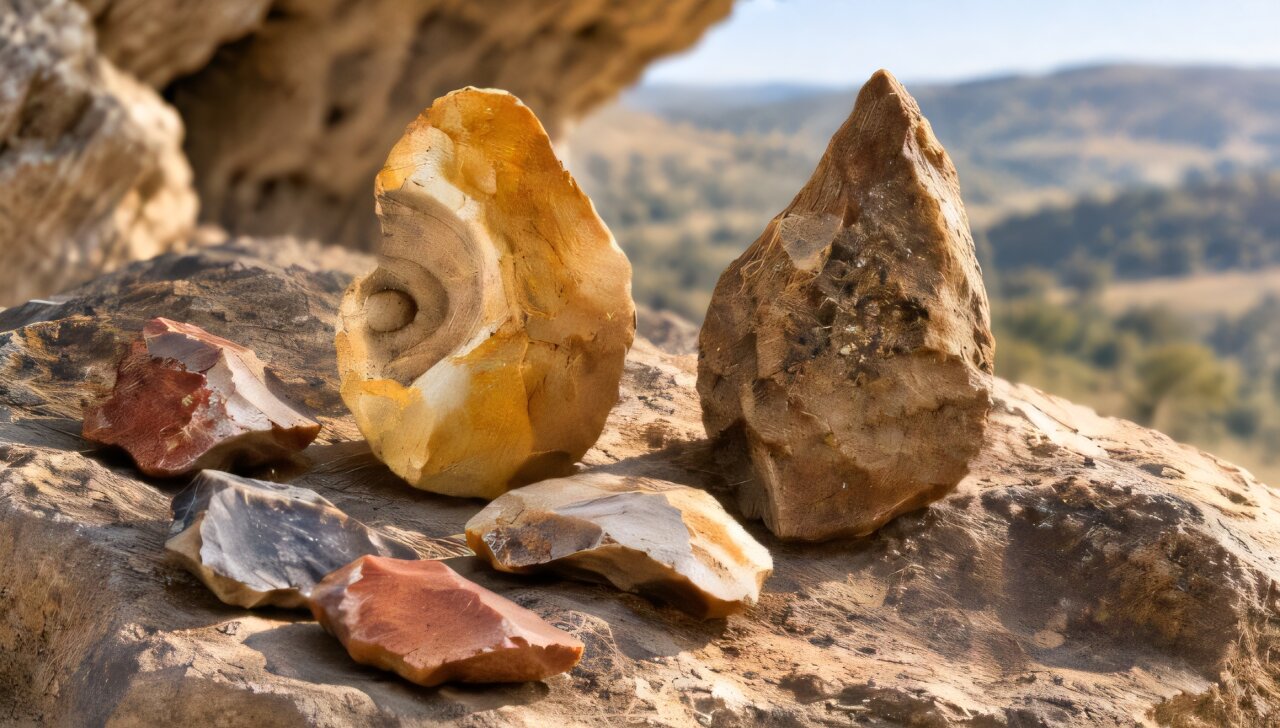
Other examples come from the Sakhnin Valley in the Lower Galilee of Israel. There, researchers examined more than 200 Acheulean handaxes and identified about 10 shaped around fossil imprints or unusual geological features in the original flint. These features were left visible on the faces of the tools, where they could be seen and touched.
The choice is notable because the unusual inclusions made the flint harder to work. The researchers report that such nodules were generally avoided in the production of other handaxes from the same landscape. Yet in these examples, the distinctive features were deliberately retained.
The handaxes were likely functional tools. The proposed keepsake value does not depend on the entire object being useless. Instead, it may have come from preserving a particular feature that had no practical role in cutting or shaping. The fossil imprint or geological pattern could have connected the handaxe to a specific outcrop in the valley.
That connection matters to the authors’ argument. A fossil-bearing stone could serve as a reminder of the place where someone found it, even if nobody else understood why that particular object was worth keeping.
Old tools with their earlier surfaces still intact
A second line of evidence comes from stone tools that had already been made, used, and discarded before being collected and worked again.
Flint gradually develops a weathered surface, or patina, after exposure to environmental conditions. Archaeologists can sometimes distinguish this older surface from the fresh edges produced when a tool is reshaped. In some Middle Pleistocene assemblages, researchers have identified tools with two distinct patinated histories: an older surface preserved alongside newer areas created during later work.
At sites including Revadim and Jaljulia, as well as Qesem Cave, some old flint objects appear to have been collected and lightly reshaped. The later work often involved making small changes to an edge while leaving much of the original surface and its visible scars intact.
This treatment differs from simply recycling an old piece of flint as raw material. When people recycle stone, they may break it down or reshape it extensively to make something new. In the examples discussed by the authors, however, the older form and weathered surface were often preserved even as the cutting edge was refreshed.
Wear traces examined under magnification indicate that the second phase of use was generally light. The researchers interpret this pattern as consistent with the objects being curated rather than intensively reused.
The preserved surfaces may have made the tools distinctive. Their colors and patinas reflected the environmental conditions in which the flint had previously lain. By keeping those surfaces visible, a person could retain a physical trace of an object’s earlier history.
The authors build on previous archaeological interpretations that describe such pieces as memory objects. They suggest that the contrast between old, weathered surfaces and fresh edges could have made the objects especially useful as reminders of where they came from and what had happened to them.
But an old tool is not automatically a souvenir. It might have been collected because suitable raw material was scarce, because it was convenient to reuse, or because its appearance was attractive. The authors argue that the repeated preservation of old surfaces, alongside evidence of light reshaping, makes a mnemonic interpretation plausible in at least some cases. It does not prove that this was the original purpose.
A personal memory, not necessarily a shared symbol
The researchers distinguish their proposal from explanations that treat unusual objects mainly as symbols of group identity, social rank, or shared cultural meaning.
A personal keepsake does not need a common meaning understood by everyone. A stone can remind one person of a particular place or event even if another person sees nothing special in it. Its connection to the past comes from the history of the individual who kept it, not from an agreed social convention.
The authors identify several characteristics that would help distinguish a genuine keepsake from an object collected for other reasons.
First, it should be connected to a particular experience involving a person, place, or event. Second, it should be retained over time rather than quickly discarded, traded, or used up. Third, its owner should invest effort in acquiring, transporting, or maintaining it. And finally, the owner should return to it or handle it in ways connected to its personal history.
These behaviors are difficult to establish from archaeological objects alone. An excavated stone cannot tell researchers what its owner remembered, whether it was handled repeatedly, or whether it was kept for sentimental reasons. Even so, the authors argue that patterns of transport, long-term retention, and selective preservation can help identify objects that may have had a role beyond immediate practical use.
The distinction also helps explain why a keepsake need not be completely nonfunctional. A handaxe could cut or scrape while also reminding its owner of a particular landscape. Its practical and personal roles would not necessarily conflict.
How an object might help someone remember the past
The central psychological idea behind the proposal is that objects can support autobiographical memory.
Autobiographical memory involves recalling events from one’s own life, including where and when something happened and what it was like to experience it. It also includes personal stories learned from others and incorporated into one’s sense of identity.
Remembering an event is not simply retrieving a perfect recording. Memories are reconstructed, and people can sometimes confuse something they experienced with something they imagined, heard about, or inferred later. Psychologists call the ability to identify where a memory came from source monitoring.
The authors propose that a personal keepsake could help with both remembering and checking the source of a memory.
Imagine finding a distinctive stone in a place you had visited before. Its shape, color, texture, and other features might bring back details of that location or the experience of finding it. Holding and examining the object could provide several kinds of sensory information at once, helping the person reconstruct the memory.
The object could also provide a material connection to the event. A remembered place might become confused with an imagined scene, but a stone actually carried away from that place offers an additional piece of evidence that the person was there.
The researchers describe this as a form of authentication. They do not mean that an object can prove a memory is completely accurate. A keepsake cannot independently certify every detail of a recollection. Instead, it may narrow the range of plausible explanations by providing a durable physical trace connected to an earlier experience.
This is especially important because the proposed function goes beyond using an object as a simple reminder. A keepsake might help its owner assess whether a memory came from a real experience rather than imagination or secondhand information.
From personal memories to social relationships
Although the proposed meaning of a keepsake is personal, the authors suggest that its effects could extend into social life.
Remembering who helped you, where an agreement was made, or what happened during an earlier encounter can matter when maintaining relationships. People also need to keep track of exchanges, alliances, and obligations involving particular individuals and places.
A reliable reminder of a past event could help someone recall the details of a relationship or an experience that might otherwise become difficult to remember. The authors suggest that this could have been useful in situations where people needed to judge the credibility of their own memories and make decisions involving cooperation or reciprocity.
The object would not have to be shown to anyone else to serve this purpose. Its value could lie in helping its owner remember and evaluate a personal experience. That memory might then influence how the person behaved toward others.
The authors distinguish this private function from the public role of heirlooms and other objects that communicate shared histories or support claims to identity, status, or resources. An object could serve both purposes, but their hypothesis focuses on the personal connection.
They also suggest that keepsakes may have had emotional value. Objects associated with important people or experiences can help regulate mood as well as prompt memories. Such emotional significance could have encouraged people to keep returning to particular objects, making the practice more persistent.
Why the authors think souvenir keeping may have emerged around 500,000 years ago
The proposed timeline is based on archaeological examples that the authors place in the terminal Lower Palaeolithic and Middle Pleistocene, beginning around 500,000 years ago. They acknowledge that evidence for routine possession of objects with possible sentimental or mnemonic value during the earlier part of human evolution is limited.
The authors also offer a possible ecological explanation for why the practice may have become more common in some regions around this time.
In the Levant, the body size of animals available as prey declined over the course of the Pleistocene. The elephant, which had provided a large and dependable food resource, disappeared from the region around 400,000 years ago. This period also coincided with major changes in human populations and the end of the long-lasting Acheulean technological tradition.
Hunting smaller, more evasive, and more numerous animals may have required different strategies and movement across new territories. The authors suggest that these changes could have disrupted established relationships between people and familiar landscapes.
In their proposed explanation, keeping objects from particular places may have helped people maintain personal connections to landscapes they could no longer rely on in the same way. A stone from a location or a tool preserving the features of its source could serve as a physical reminder of an earlier experience there.
This is an ecological hypothesis, not an established explanation for the archaeological pattern. The authors propose that researchers should investigate whether the appearance of possible keepsakes tracks changes in prey availability across different places and periods. The current evidence does not demonstrate that the disappearance of large animals caused souvenir keeping to emerge.
What animal collecting can and cannot tell us
The authors also consider whether other animals collect objects in ways that resemble human souvenir keeping.
Many animals use environmental features as memory aids. Some birds store food or protect tools, while other species collect materials for nests or mating displays. These behaviors can involve remembering locations and retaining objects, but the objects serve practical or reproductive functions.
The familiar idea that magpies collect shiny things, for example, is not supported by the study the authors discuss. Research on wild Eurasian magpies found no attraction to shiny objects. The birds were instead wary of metallic items.
Other examples include corvids that cache food or safeguard tools, bowerbirds that collect decorations for mating displays, and woodrats that accumulate materials in their nests. Cats carrying prey home and animals burying objects can also be understood in terms of food transport or storage rather than sentimental collecting.
Experiments have found that some great apes show interest in unusual objects. Orangutans and chimpanzees, for instance, have been observed showing attraction to odd objects or crystals. But the studies discussed by the authors did not demonstrate that the animals kept these objects as reminders of particular personal experiences.
The researchers therefore propose a more demanding behavioral definition of a souvenir. An individual would need to keep a particular object safely over a long period, avoid discarding or exchanging it for food, and return to engage with it in ways specific to that object and its history.
Detecting such behavior would require following a known individual and a known object over months. The authors acknowledge that this kind of evidence may be difficult to obtain, which leaves open the possibility that some animals could display behaviors that have not yet been recognized.
How keeping objects might have influenced the evolution of memory
The most far-reaching part of the proposal concerns how a cultural habit could influence biological evolution.
The authors suggest that if people routinely used keepsakes to support memory, individuals who were better at combining information from objects with their own recollections might have gained an advantage in certain social situations.
Over many generations, that advantage could have influenced natural selection on the brain systems involved in autobiographical memory and source monitoring. The authors describe this possible feedback between cultural behavior and biological evolution as gene–culture coevolution.
The idea builds on research showing that learning and practicing tool use can be associated with changes in brain structure and organization. The authors point to studies of toolmaking and tool-use training in humans and other primates as examples of how culturally acquired skills can affect the brain.
They propose that routine interaction with keepsakes might have created a similar developmental demand. People would repeatedly connect objects with specific experiences, use those objects to retrieve memories, and assess whether their recollections matched the available physical evidence.
If this practice became stable across generations, the authors suggest, it could have favored inherited cognitive abilities that made it easier to integrate internal memories with external cues.
They do not argue that keepsakes created autobiographical memory or the sense of self on their own. Nor do they suggest that every curated stone tool or unusual object served as a memory aid. Their proposal is that souvenir keeping may have been one influence among several contributing to the development of these abilities.
What evidence could test the idea?
The authors outline several ways to distinguish their hypothesis from alternative explanations, including collecting for aesthetic reasons, saving raw materials, or practicing particular forms of toolmaking.
Archaeologists could reexamine old stone tools to determine whether their surfaces preserve evidence of deliberate curation. They could study wear traces, residues, microscopic polish, and the sequence of patina formation to establish how objects were handled and whether they were lightly reshaped while retaining earlier features.
The locations where objects were found could also matter. If possible keepsakes were repeatedly associated with hearths or places where people returned over time, that pattern might support a different interpretation from objects found mainly on toolmaking floors or in raw-material caches. Spatial analysis could help test whether the objects were associated with domestic or commemorative contexts.
Researchers could also investigate whether people in different societies use personal keepsakes to check memories in situations where the accuracy of a past event matters. Such cross-cultural work could examine whether objects are especially useful for remembering relationships, places, and obligations.
Developmental studies could explore whether caregiver–child practices involving personal objects help children connect people, places, and events in memory. Behavioral experiments could compare how well people recall personal experiences and distinguish remembered from imagined events when they have access to keepsakes versus comparable objects without personal significance.
The researchers also propose studying whether learning to use keepsakes as memory aids produces measurable changes in the brain over time. Such work could test whether repeated engagement with these objects affects neural systems involved in memory and source monitoring.
Finally, computer simulations could examine whether memory supported by personal tokens might help stabilize alliances or cooperation enough to create evolutionary advantages. These models would not prove that the process occurred in the past, but they could help establish whether the proposed mechanism is plausible under specified conditions.
Each approach addresses a different part of the hypothesis. Archaeological research could strengthen or weaken the case that ancient people deliberately curated particular objects. Experiments and developmental studies could test whether keepsakes actually support the memory functions the authors propose. Evolutionary models could examine whether those benefits might have been strong enough to influence selection over long periods.
The authors emphasize that the proposal remains open to being disproved. The archaeological objects do not preserve the thoughts of the people who carried them, and their personal meanings cannot be read directly from stone surfaces. The evolutionary pathway linking keepsake keeping to changes in memory also remains to be tested.
The hypothesis is not that every old tool was a souvenir, or that personal objects alone produced the human sense of self. It is that some objects may have served as durable reminders of individual experiences, and that a routine practice of keeping them could have supported memory and the evaluation of personal history.
The study was published in Evolutionary Anthropology: Issues, News, and Reviews.