One by one, people were buried in cemeteries beside the Angara River roughly 5,500 years ago, and when researchers recovered ancient DNA from their teeth, a striking pattern emerged: members of the same families had died within a remarkably short span, many of them children, while the remains carried genetic traces of an early form of Yersinia pestis. The evidence offers an unusually detailed glimpse of what a lethal plague outbreak looked like in a mobile hunter-gatherer society long before the great plague epidemics of recorded history.
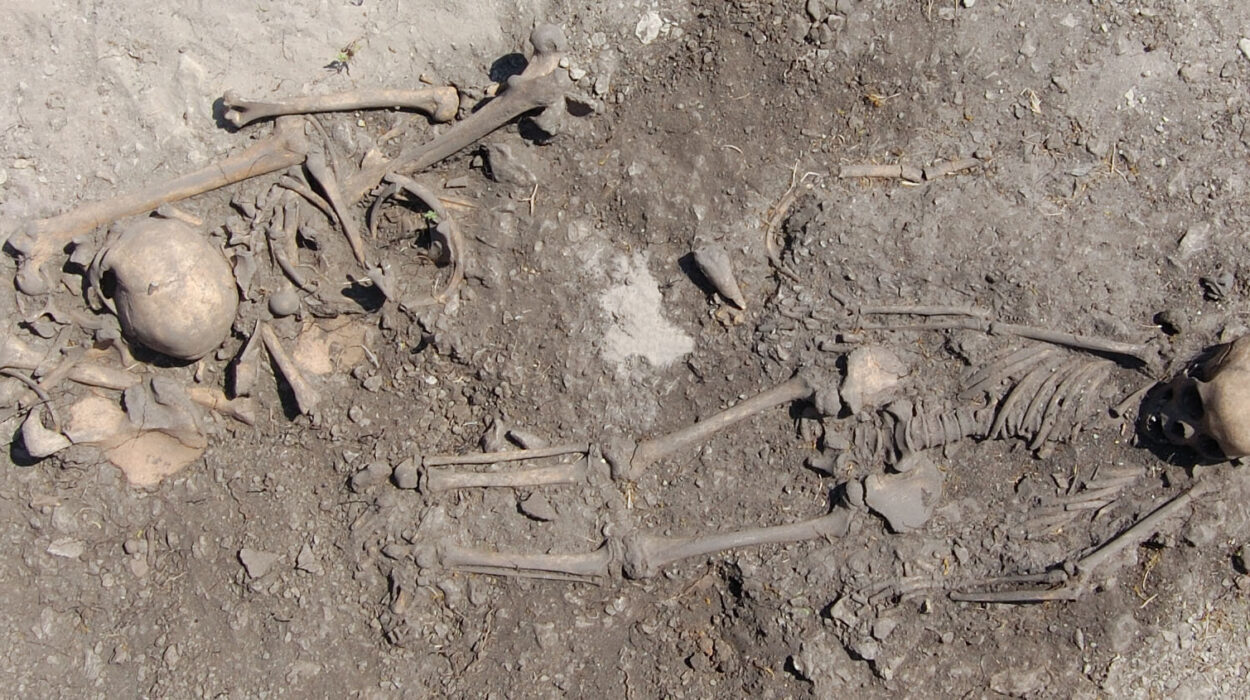
The story begins not with a written account of disease, but with a group of cemeteries in the Cis-Baikal region of southeastern Siberia.
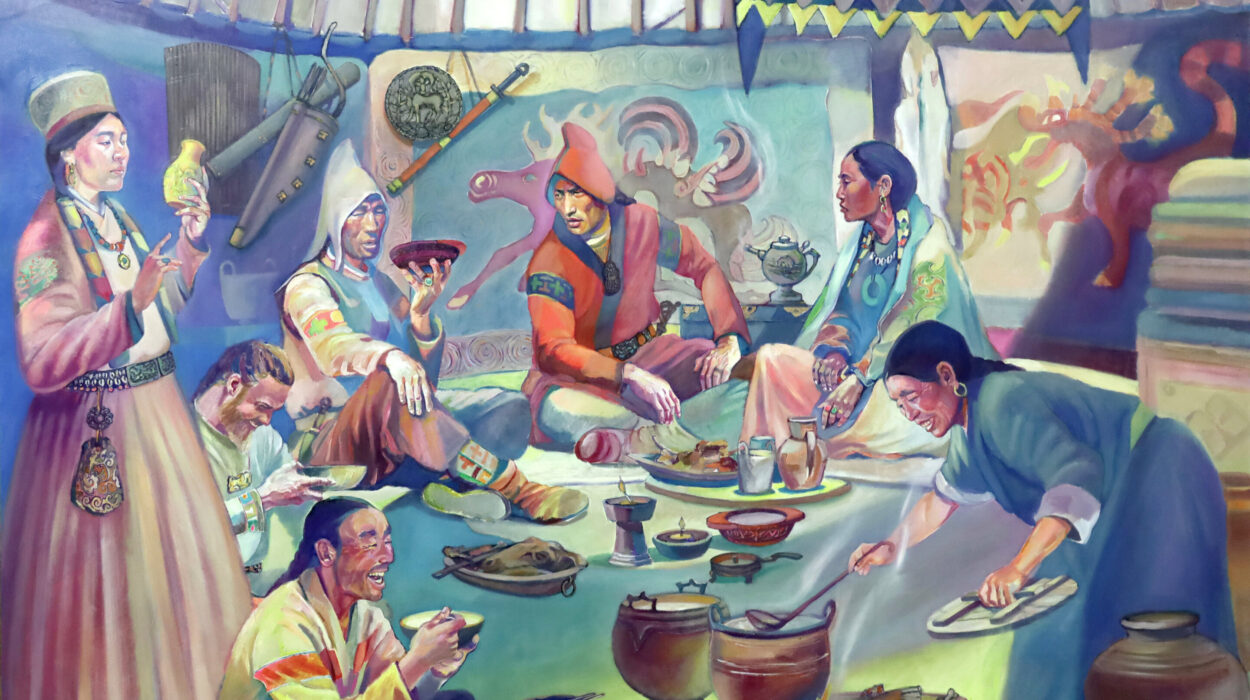
The communities who used these burial grounds lived around Lake Baikal and along the Angara River during the Middle Holocene. Archaeologically, they are classified as Late Neolithic hunter-gatherers, although they remained dependent on hunting and gathering rather than domestic agriculture. Their mortuary traditions, genetic relationships and remains have created an unusually detailed archaeological record of life in the region.
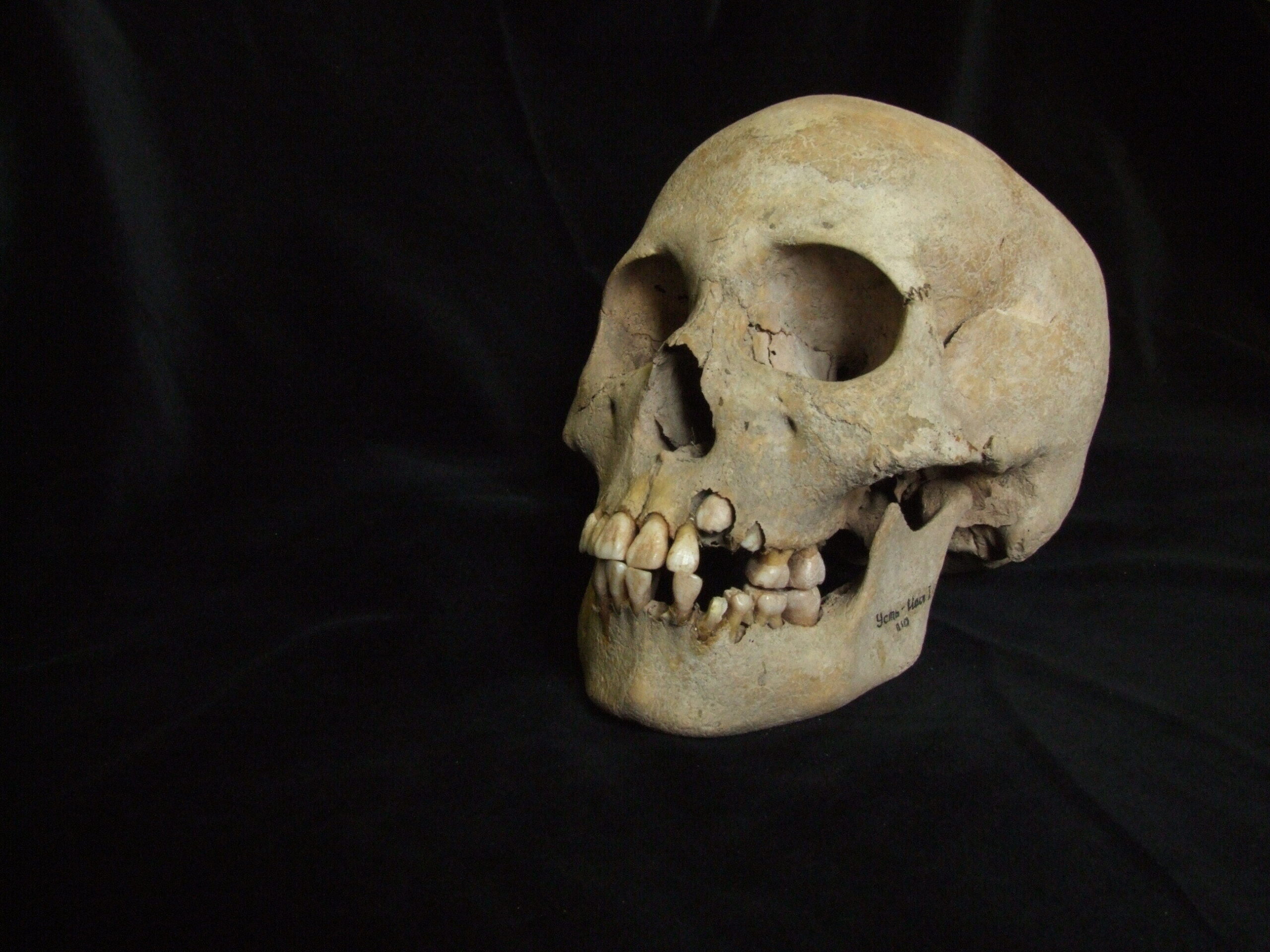
Researchers examined ancient DNA from 46 individuals buried at four cemeteries: Ust’-Ida I, Shumilikha, Bratskii Kamen and Serovo. The samples came from dental cementum, the mineralized tissue surrounding tooth roots, and were screened for traces of ancient pathogens.
The result was striking.
DNA from Yersinia pestis was detected in 18 individuals, producing an overall plague detection rate of 39% among the Late Neolithic individuals examined. The infections were not spread evenly through time. Instead, they clustered into two distinct phases, separated by roughly four to six centuries. The first phase dates to approximately 5,520–5,265 calibrated years before present, while the second falls within a broader modeled range of 5,315–4,235 years before present, with the highest-likelihood portion of that second range around 5,050–4,850 years ago.
The four affected cemeteries all lie along the Angara River, which drains Lake Baikal. Cases from Bratskii Kamen occur in both phases, while Shumilikha, Ust’-Ida I and Serovo contribute cases across the outbreak sequence.
The pattern was more than a collection of isolated infections.
At Ust’-Ida I, where the largest number of affected individuals was found, 11 of 31 sequenced individuals, or about 35%, carried detectable plague DNA. Across the other cemeteries, researchers identified one high-coverage plague genome from Shumilikha, four lower-coverage genomes from Bratskii Kamen and one medium-coverage genome from Serovo.
Ancient DNA can disappear from human remains over time, so a positive result is not equivalent to a complete census of everyone who was infected. The researchers explicitly note that ancient pathogen screening can produce false negatives. Even so, the concentration of positive individuals across these cemeteries provides a remarkable signal of plague activity.
The next question was much harder: Were these people dying from the infections, or had they merely carried the bacterium?
The answer was buried in the ages of the dead
The researchers turned to the demographic record preserved in the cemeteries.
At Ust’-Ida I and Bratskii Kamen—the two sites with multiple plague detections—the distribution of ages at death looked markedly different from other hunter-gatherer cemeteries in the Cis-Baikal region.
Deaths were heavily concentrated among children, with a mortality peak between approximately 7.5 and 11 years of age. In comparative analyses of other mid-Holocene hunter-gatherer cemeteries in the region, these two sites stood out because of their unusually high proportion of childhood deaths. The difference was statistically significant under the study’s null model of mortality profiles.
At Ust’-Ida I, mortality was particularly low in the 20–25-year range. At Bratskii Kamen, no deaths were recorded between 20 and 35 years of age within the analyzed Late Neolithic assemblage. The sex distribution, however, did not show the same distortion: among the relevant individuals, there were 22 XY and 24 XX individuals.
That age pattern is difficult to explain as a simple reflection of the normal population structure.
The researchers considered several possibilities. Adults might have survived earlier infections and developed some protection, although that explanation would require recurring outbreaks that the available evidence cannot establish. Different age groups might also have encountered infected animals at different rates because of differences in their activities or responsibilities. But the authors note that there is little comparable evidence for unusually high childhood exposure to marmots, and other Baikal hunter-gatherer cemeteries do not show the same pattern.
Another possibility is biological vulnerability.
Children before puberty can differ from adults in their immune responses, and the researchers discuss evidence that children can be particularly susceptible to infection by Gram-negative bacteria. The ancient bacterial genomes also contain a genetic feature that could potentially have contributed to the severity of infection in younger people, although the authors emphasize that its actual effect requires functional studies.
The evidence therefore does not establish exactly why children died at such high rates.
But the demographic pattern, combined with the pathogen DNA and closely clustered dates, gives the researchers a much stronger basis for interpreting these infections as lethal outbreaks rather than harmless or incidental infections.
Families appear to have been caught in the same wave
The most revealing evidence comes from the relationships among the dead.
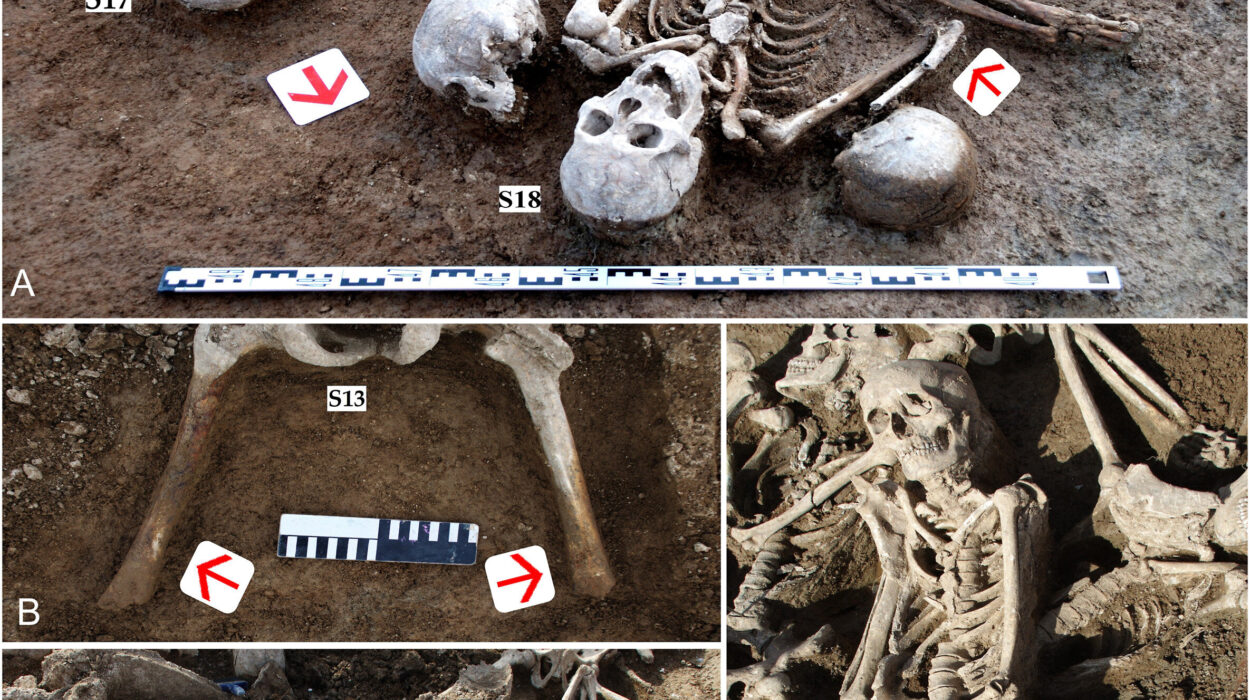
The researchers reconstructed biological kinship using ancient genomes. At Ust’-Ida I, many individuals belonged to familial groups, including siblings and cousins. At Bratskii Kamen, similar relationships were identified. The team then compared those genetic relationships with estimated ages at death and radiocarbon dates.
At Ust’-Ida I, the dates associated with the early plague phase are exceptionally tightly clustered. The modeled ranges for plague victims indicate that many deaths occurred within a period of only a few decades. The similarity of their plague genomes is consistent with infections belonging to a single outbreak or a very short-lived sequence of transmission.
The ages of relatives reinforce the picture.
A parent–child pair, for example, could consist of an adult estimated at 35–50 years old and a child estimated at 12–15 years old, a combination compatible with both dying during the same episode. Among siblings, the age differences are also generally consistent with deaths occurring at roughly the same time. The largest inferred age gap between siblings was nine years, with an intermediate sibling between them.
The researchers found many sibling and cousin relationships but surprisingly few parent–offspring relationships within the affected pedigree groups. Only one parent–offspring relationship was identified among them.
That absence itself becomes informative when combined with the rest of the evidence.
If a cemetery contains several members of the same extended families who died within a narrow period, and many of those individuals carry the same pathogen, the simplest explanation is not merely that the bacterium existed somewhere in the environment.
The deaths were occurring within connected social groups.
The pattern is consistent with disease spreading between people who were in close contact with one another. The authors therefore interpret the genetic and archaeological evidence as supporting human-to-human transmission, while also recognizing that the original source of infection was probably zoonotic.
The first infection may have come from an animal
The likely starting point lies outside the human cemetery.
The modern plague ecology of the Baikal region centers on marmots, and the researchers identify wild marmot populations as the probable source of the initial zoonotic spillover that introduced the ancient plague strains into these hunter-gatherer communities.
That interpretation fits the archaeological and ecological setting.
Marmot hunting and use are documented in the broader prehistoric record of the region. The paper notes evidence for marmot procurement in earlier hunter-gatherer contexts, including marmot teeth used as grave goods in Early Neolithic Kitoi burials. Such teeth have not been found in the Late Neolithic graves considered in this study, so the evidence does not establish that the individuals studied here were specifically hunting or eating marmots.
The authors nevertheless argue that a local animal reservoir provides the most plausible explanation for how these ancient plague strains entered the human population.
Once infection had entered a community, however, the pattern of deaths suggests that transmission was no longer simply a series of independent animal-to-human events.
The clustering among relatives points toward transmission within human social networks.
The researchers particularly consider respiratory spread as a possible mechanism. They note that the ancient strains lacked the ymt gene associated with flea survival and the flea-mediated bubonic form of plague. Human-to-human transmission involving infectious droplets or aerosols is therefore consistent with the evidence, although the study does not directly reconstruct the precise route used in every infection.
This distinction is central to understanding what happened at Baikal.
The outbreak does not appear to have required the later evolutionary machinery associated with classic flea-borne bubonic plague.
The bacteria were missing one of plague’s most famous tools
The genetic evidence presents a paradox.
The people were apparently dying in substantial numbers from infections caused by Y. pestis, yet the bacteria lacked genetic components associated with the later bubonic form of the disease.
The Baikal strains do not contain ymt, which encodes Yersinia murine toxin, or the YpfΦ prophage. The researchers state that the absence of these virulence-associated elements would prohibit the manifestation of bubonic plague as it is understood from later strains.
That finding is important because earlier prehistoric plague strains had left scientists uncertain about how dangerous they actually were.
Genetic evidence alone had indicated that some early forms of Y. pestis lacked important virulence factors. Without a clear connection between infection and death, it remained difficult to determine whether these ancient strains caused serious disease or whether their presence in human remains represented relatively mild infections.
The Baikal evidence changes that calculation.
Here, pathogen DNA is found alongside tightly clustered deaths, unusual mortality profiles and familial groups whose members appear to have died within the same generation. The authors argue that these independent lines of evidence together demonstrate that early plague could be lethal even before the genetic evolution associated with flea-borne bubonic transmission.
The implication is not that the Baikal strains were identical in behavior to later plague bacteria.
They were not.
Instead, the findings indicate that the pathogen could cause severe mortality through a different epidemiological pathway.
A mysterious gene may help explain why children were hit so hard
The genomes contain another clue.
The researchers identified ypm, a gene encoding the YPM superantigen, within the Baikal plague strains. The gene is also found in modern Yersinia pseudotuberculosis and in some previously identified early plague strains.
The Baikal version is particularly close to ypmA, one of three known modern Y. pseudotuberculosis variants. It differs from ypmA at only three nucleotide positions. Two of those changes alter the resulting amino acid sequence: one changes isoleucine to arginine and another changes glycine to glutamate.
YPM has the ability to interact with components of the human immune system and promote T-cell activation and the release of proinflammatory cytokines. The paper discusses inflammatory complications associated with YPM activity and notes that some such complications predominantly affect children today.
The ancient strains also carry a distinctive genetic arrangement around the ypm locus.
The researchers identified 10 open reading frames surrounding the locus that occur in the ancestral form of plague but are absent from later forms. The surrounding region resembles an unstable part of the Y. pseudotuberculosis genome. The Baikal strains therefore combine a ypm gene similar to ypmA with a surrounding genetic region resembling one associated with the more divergent ypmB variant.
The authors describe this combination as previously unobserved and propose that it might reflect local adaptation to marmots and other rodent hosts rather than humans. They also suggest that the unusual arrangement could influence gene regulation, including ypm transcription.
But this is where the evidence reaches its limit.
The researchers cannot determine from ancient DNA alone whether these genetic features actually made the bacteria more dangerous to children. They explicitly state that functional studies are needed to assess their effects.
The gene is therefore a possible piece of the explanation, not a demonstrated cause of the childhood mortality pattern.
The plague strains reveal something about the bacterium’s origin
The ancient genomes also move the evolutionary history of Y. pestis backward.
The researchers constructed phylogenies using the new Baikal genomes alongside previously available ancient and modern strains. The Baikal strains occupy a position ancestral to the currently known clade of Y. pestis genomes. Their emergence therefore constrains the timing of the bacterium’s evolution.
The phylogenetic analysis places the emergence of Y. pestis as a clonal species somewhere between the lineage leading to Y. pestis and the most recent common ancestor of available Y. pestis genomes.
The authors estimate a lower bound with a mean date of approximately 5,709 years ago, revising an earlier divergence estimate of roughly 4,810–5,122 years ago. They conclude that the evolution of Y. pestis from a variant of Y. pseudotuberculosis must have occurred before approximately 5,700 years ago.
That makes the Baikal strains particularly important.
They are not simply early examples of a familiar pathogen. They occupy a very early position in the evolutionary history of plague, close in time to the divergence between Y. pestis and Y. pseudotuberculosis.
The researchers suggest that this may indicate relatively rapid diversification as the bacterium moved into rodent hosts from one or more other animal hosts associated with the Y. pseudotuberculosis group. But they also caution that ancient genome data alone may not be sufficient to resolve every question about the boundaries and evolutionary relationships within the Yersinia pseudotuberculosis species complex.
The evolutionary picture is therefore becoming clearer in one respect and more complicated in another.
The bacterium was already capable of causing lethal outbreaks thousands of years ago, but its transition into the form associated with later plague epidemics was still underway.
Two outbreaks separated by centuries tell a larger story
The first Baikal outbreak was not an isolated moment in the region’s history.
The researchers identify two phases of plague infection separated by approximately four to six centuries. The first dates to roughly 5,500 years ago, while the second occurred later. The genetic differences between the strains in the two phases are small but detectable, and the authors interpret them as consistent with separate zoonotic spillovers from a local animal reservoir.
That interpretation is significant because the two outbreaks do not appear to represent one uninterrupted epidemic lasting centuries.
Instead, the evidence is compatible with plague disappearing or becoming undetectable in the human population and later returning through another introduction from an animal reservoir.
The communities themselves were highly mobile.
Genetic analysis indicates recent shared ancestry among individuals buried at cemeteries as far as 340 kilometers apart along the Angara River. The researchers infer very low levels of inbreeding and estimate a large effective population size of approximately 18,219 individuals, with a 95% confidence interval of 9,445–42,062, based on runs of homozygosity. These findings are consistent with highly mobile, exogamous hunter-gatherer groups.
That mobility provides an important context for disease transmission.
The communities were not densely packed agricultural settlements. They were hunter-gatherer groups moving through a large landscape, connected by biological kinship and by the Angara River.
Yet significant plague outbreaks still occurred.
That challenges a long-standing assumption about the conditions necessary for major prehistoric zoonotic epidemics.
The outbreak did not wait for farming
The Baikal evidence arrives at a particularly important point in the chronology of plague.
Earlier discussions of prehistoric plague had focused heavily on Neolithic farmers and the changes associated with agriculture, including increasing population density and altered relationships between people, animals and landscapes.
The new evidence shows that lethal plague outbreaks were already occurring among hunter-gatherers in southeastern Siberia before the disease appears in the Neolithic farming populations emphasized by earlier studies.
That does not mean agriculture played no role in later plague history.
It means that agriculture was not a necessary prerequisite for a significant zoonotic outbreak.
The Baikal communities remained hunter-gatherers, and their cemeteries were used by relatively mobile populations. Yet the archaeological and genetic evidence indicates that plague could spill over from wildlife, move through human social networks and produce concentrated mortality.
The finding therefore complicates interpretations that connect major prehistoric plague outbreaks primarily to the demographic and ecological transformations associated with farming.
It also changes how the demographic consequences of early plague should be understood.
The affected Baikal cemeteries show that children and adolescents could bear an unusually large share of mortality, rather than the greatest burden necessarily falling on adults engaged in food production. The researchers emphasize that this mortality pattern contrasts with expectations from the so-called Neolithic epidemiological transition model.
The disease was capable of devastating a community without first requiring an agricultural population explosion.
The graves also preserve evidence of the people who survived
There is another human dimension hidden in the burial record.
If many members of a family died during an outbreak, someone still had to bury them.
The researchers note that survivors must have existed to carry out the characteristic mortuary practices at the cemeteries. The co-interment of relatives, grave treatment and evidence that deaths occurred across a sequence of related individuals suggest that the communities continued to care for their dead even while disease was killing members of their own families.
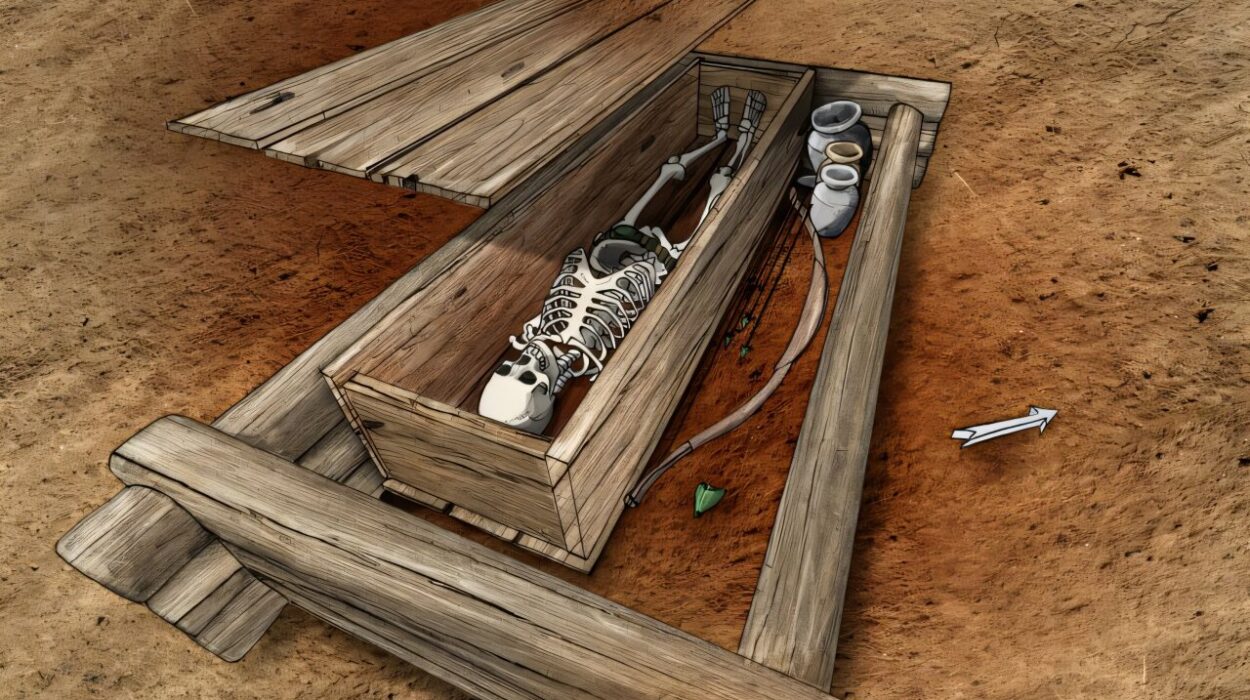
At Ust’-Ida I and Shumilikha, burials followed the Isakovo mortuary tradition, in which bodies were typically oriented parallel to the river and graves could contain objects such as clay vessels, stone arrowheads and bone or antler points. Bratskii Kamen and Serovo belonged to the Serovo mortuary tradition, which commonly placed bodies perpendicular to the river and included different kinds of grave goods.
The presence of these established burial practices during the plague phases matters because it demonstrates continuity of social behavior amid mortality.
The cemeteries were not simply mass graves created by an anonymous catastrophe.
The dead remained embedded in social relationships.
That is particularly visible in the genetic pedigrees. Relatives who died around the same time could be identified even though the people themselves lived thousands of years ago and their communities left no written record.
Their genomes effectively restore some of the relationships that the burial ground had preserved.
The timing of deaths is what makes the case unusually strong
Ancient pathogen DNA can establish that a person was infected, but infection alone does not necessarily establish that the pathogen caused death.
This study approached the problem differently.
The researchers combined several independent forms of evidence: ancient Y. pestis genomes, radiocarbon dates, biological kinship, age-at-death estimates and mortality profiles.
At Ust’-Ida I, the radiocarbon dates of early-phase plague victims cluster within a narrow period. The plague genomes are closely related. Families appear to have died within a single generation. And the overall cemetery contains an unusually high proportion of children.
The same broad pattern appears at Bratskii Kamen, another cemetery with multiple plague detections.
The combination makes a chance association increasingly difficult to sustain.
The authors therefore argue that the outbreaks caused acute mortality, with children aged roughly 8 to 11 years particularly affected.
This is one of the study’s most important contributions.
The question surrounding early plague was not simply when Y. pestis existed.
It was what the bacterium actually did.
The Baikal cemeteries provide an answer through the pattern left behind by the people who died.
But the study cannot reconstruct every infection
The evidence is powerful, but it is not complete.
Ancient DNA preservation is uneven. A person who was infected may leave no detectable pathogen DNA, meaning the 39% detection rate cannot be interpreted as the true proportion of everyone who was infected. The researchers explicitly discuss the problem of false-negative detection in ancient plague studies.
The second outbreak is also less precisely dated than the first because it relies on only two direct dates. That is why its modeled range has a long tail, even though the highest-likelihood portion falls around 5,050–4,850 years ago.
The exact transmission route is likewise uncertain.
The evidence is consistent with human-to-human transmission and particularly with respiratory spread, but the researchers cannot directly observe how any individual became infected. The probable origin in wild marmots is an interpretation based on the regional ecology and the evolutionary evidence rather than a direct identification of the animal that infected any particular person.
And while the age distribution strongly indicates unusual childhood mortality, its biological explanation remains unresolved.
The researchers discuss prior exposure and immunity, differences in behavior and exposure, and age-related differences in immune response. None can be singled out as the demonstrated cause. The possible role of the unusual ypm locus also remains a hypothesis requiring functional testing.
Those uncertainties do not weaken the central evidence.
They define its boundaries.
A disease that once seemed tied to later societies was already killing hunter-gatherers
For decades, the ancient history of plague has been reconstructed from fragments: a pathogen genome here, a burial there, a genetic mutation that appeared at a particular point in evolutionary time.
The Baikal cemeteries provide something different.
They preserve a moment when disease, family relationships and mortality intersect.
The people buried there were members of mobile hunter-gatherer communities living around Lake Baikal thousands of years before modern medicine and written epidemiology. Some were children. Some were their relatives. Several carried the same ancient pathogen. Their radiocarbon dates and genetic relationships indicate that many died within remarkably short periods, and the age-at-death profiles show that children were disproportionately represented among the dead.
At the same time, the bacteria themselves preserve an earlier stage of plague evolution.
The Baikal strains are ancestral to the known clade of ancient and modern Y. pestis, lack the ymt and YpfΦ elements associated with later bubonic plague, and carry an unusual version of the ypm region that may preserve clues to the pathogen’s early biology.
The result is a picture of plague before it acquired all of the genetic characteristics associated with its later history.
It was already capable of causing lethal outbreaks.
It could move through human communities.
And it could strike people who lived far from the agricultural societies that have often dominated explanations of prehistoric epidemic disease.
The oldest victims leave a warning about how little a pathogen needs
The deepest significance of the Baikal evidence is not simply that plague is older than previously recognized.
It is that the conditions required for a serious outbreak may have been much less restrictive than once assumed.
These were mobile hunter-gatherers rather than dense agricultural populations. Their communities were spread across a large landscape. Yet a pathogen emerging from a local wildlife reservoir appears to have entered those communities, circulated among connected people and produced concentrated mortality within families and across cemeteries.
The researchers argue that this demonstrates that increased population density, animal domestication and the broader lifestyle changes associated with the Neolithic transition were not necessary conditions for significant zoonotic outbreaks.
The graves make that conclusion tangible.
A child buried beside relatives. Another family group affected. A cemetery in which mortality suddenly shifts toward young people. Ancient DNA from teeth revealing the same pathogen. Radiocarbon dates compressing the deaths into the same narrow span.
Each piece of evidence is incomplete on its own.
Together, they form the outline of an outbreak that unfolded about 5,500 years ago.
And the bacterial genomes add an evolutionary dimension to the same story. They place the emergence of Y. pestis before approximately 5,700 years ago, while showing that an early form of the pathogen could be deadly even without the genetic machinery associated with later flea-borne bubonic plague.
The people buried along the Angara River left no written description of the disease moving through their families. They left no account of who became sick first or how frightened the survivors may have been.
What they left instead were teeth, bones, graves and DNA.
Thousands of years later, those fragments have become enough to reconstruct the outline of a catastrophe: an ancient pathogen emerging from the wildlife environment, reaching hunter-gatherer communities, passing through human relationships and killing people at an especially high rate when they were still children.
The outbreak happened long before the plague epidemics that would become famous in later history.
But the evidence from Lake Baikal shows that the pathogen did not need cities, farms or large populations to become deadly.
It already knew how to find a community.
Publication details
Ruairidh Macloud, Lethal plague outbreaks in Lake Baikal hunter-gatherers 5,500 years ago, Nature (2026). DOI: 10.1038/s41586-026-10540-5. www.nature.com/articles/s41586-026-10540-5