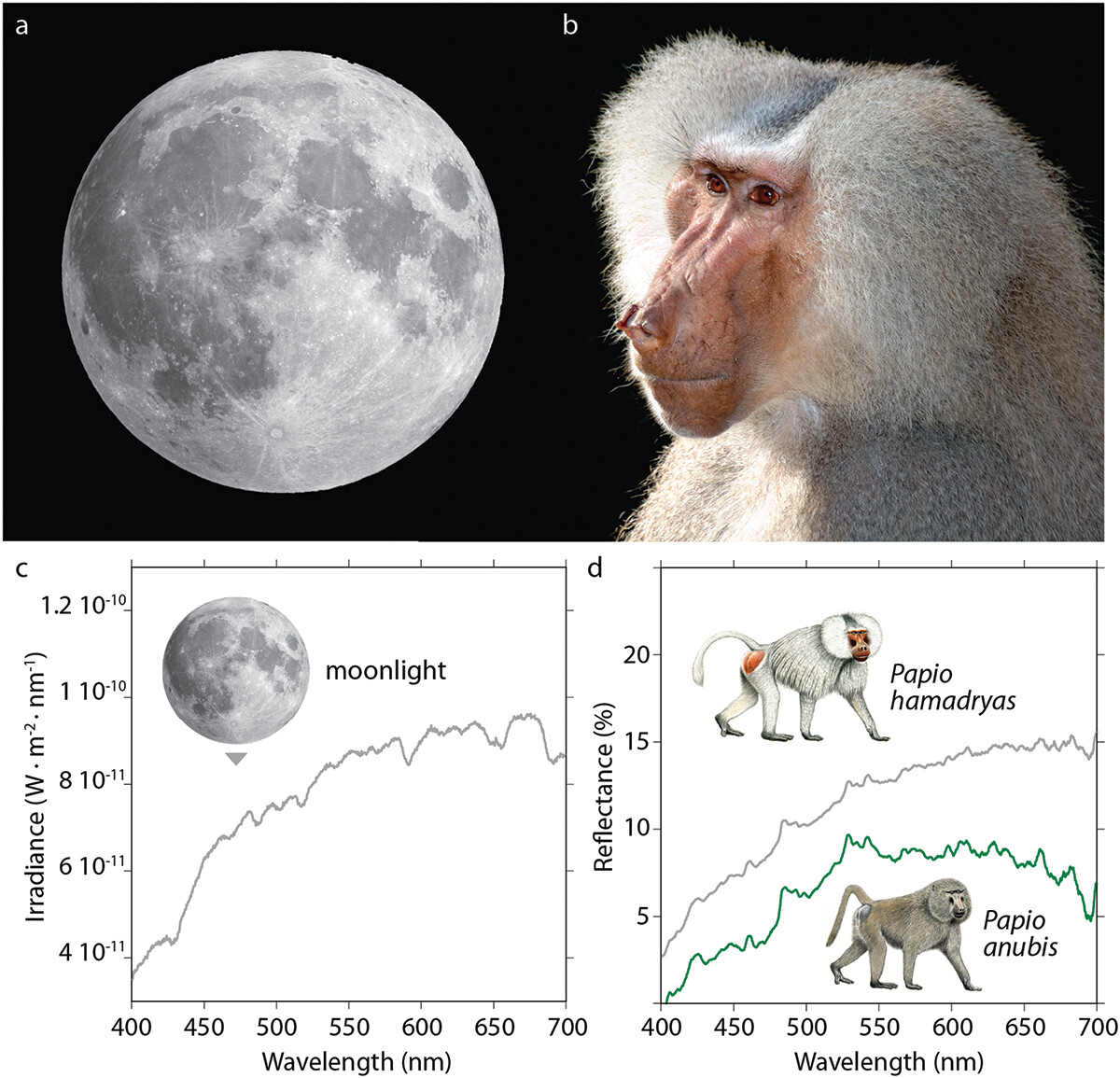
The gray fur of the sacred baboon reflects visible light in almost the same way as moonlight, according to new spectroscopic measurements that could help explain one of ancient Egypt’s oldest religious mysteries. By comparing the optical properties of moonlight with the hair and feathers of animals linked to the god Thoth, scientists found that the sacred baboon’s distinctive silver-gray coat—and the brilliant white plumage of the sacred ibis—closely match the color profile of lunar light, offering a fresh scientific explanation for why these two species became divine symbols thousands of years ago.
For generations, historians have puzzled over one of the most unusual choices in the ancient Egyptian pantheon. Thoth, the god associated with wisdom, writing, magic, cosmic order, and the moon, appeared in two animal forms: the sacred ibis and the sacred baboon. The ibis has long seemed like the easier of the two to understand. Its long curved beak resembles a crescent moon, and its striking black-and-white plumage has often been interpreted as echoing the changing phases of the lunar cycle.
The baboon, however, has remained far more difficult to explain.
Unlike jackals, cattle, falcons, crocodiles, and many other animals represented in Egyptian religion, baboons did not naturally inhabit Holocene Egypt. Yet archaeologists have recovered hundreds of baboon skeletons and mummies from temples, tombs, and sacred sites, demonstrating that the animals were imported through long-distance trade networks and held exceptional religious importance. Even more curious, Egyptians had access to two different baboon species—olive baboons (Papio anubis) and sacred baboons (Papio hamadryas)—but only one became the physical manifestation of Thoth.
The new study explores whether the answer may have been visible all along.
An old linguistic clue inspired a new scientific test
The investigation grew from recent scholarship examining the ancient Egyptian name for Thoth. Earlier linguistic work proposed that the deity’s name traces back to words meaning “white” or “bright thing” and connects with ancient Afroasiatic descriptions of lunar brightness rather than simply the moon itself.
That idea raised a simple but testable question.
If the ibis was associated with Thoth because its bright plumage resembled moonlight, could the sacred baboon have been chosen for exactly the same reason?
Rather than relying on artistic impressions or historical interpretation alone, the researchers turned to spectroscopy—a technique that measures how light behaves. Instead of asking whether the animals merely looked moon-colored to the human eye, they asked whether the light reflected from their bodies actually shared the same spectral characteristics as moonlight.
Measuring the color of moonlight itself
Although people often think of moonlight as fundamentally different from sunlight, the two are surprisingly similar in color. Moonlight is essentially sunlight reflected from the Moon’s surface, making it roughly 500,000 times dimmer but still carrying a comparable visible-light spectrum.
For the comparison, the researchers used previously recorded measurements of moonlight collected under carefully documented observing conditions. The spectrum came from observations made when the Moon was 91% full and 57 degrees above the horizon, producing a detailed record of how much light was emitted across visible wavelengths.
That spectrum served as the benchmark against which the animals would be measured.
Hair and feathers became the key evidence
The team examined museum specimens from the American Museum of Natural History, analyzing hair from six sacred baboons and six olive baboons, along with plumage from five sacred ibises.
Using a spectrometer equipped with a fiber-optic probe, they measured light reflected from standardized regions of the animals’ bodies across wavelengths visible to humans. Multiple measurements were collected from each specimen to capture natural variation.
The comparison revealed a striking contrast between the two baboon species.
Hair from the olive baboon produced a broad reflectance peak between 525 and 650 nanometers before declining at longer wavelengths. To human vision, this spectral shape corresponds to greenish tones, matching the animal’s common name.
The sacred baboon, however, behaved very differently.
Its forehead hair reflected roughly 65% more light than that of the olive baboon. More importantly, its reflectance curve closely followed the same smooth pattern seen in moonlight, with both peaking between 600 and 700 nanometers. To human observers, that combination appears as shades of gray or silver.
The resemblance extended beyond overall brightness to the shape of the spectrum itself.
Male sacred baboons shine even brighter
The researchers found that mature male sacred baboons possess especially remarkable coats.
As males mature, they develop long gray shoulder mantles, white cheek ruffs, and silver-gray facial hair that distinguish them from females and young animals. Individual hairs contain alternating gray bands, creating the grizzled appearance familiar from photographs of adult males.
Measurements of these prominent features revealed extraordinary brightness.
The silver-white cheek ruffs and shoulder mantles reflected substantially more light than the fur of other monkey species familiar to ancient Egyptians, including grivet monkeys and patas monkeys. Their maximum reflectivity even exceeded that measured previously in golden lion tamarins, a species already recognized for exceptionally bright fur.
The authors argue that this unusually luminous silver coloration may explain why not just the species, but specifically adult males, became associated with Thoth.
The sacred ibis completes the lunar pattern
The second animal linked to Thoth proved equally revealing.
Spectral measurements of the sacred ibis showed that its bright white chest feathers produced a reflectance profile that was likewise indistinguishable from moonlight.
That result ties together two animals that have often been explained through different symbolic traditions.
Instead of requiring separate reasons for each sacred species, the findings support a single visual theme: both the baboon and the ibis possess body coloration that mirrors the appearance of lunar light.
The researchers argue that this shared optical signature strengthens the idea that color itself played a central role in assigning divine status to these animals.
Ancient observations may have reinforced the symbolism
The paper also revisits historical accounts describing how sacred baboons behaved during unusual celestial events.
A fifth-century collection known as Hieroglyphica describes captive baboons reacting dramatically when the Moon entered conjunction with the Sun, lowering themselves to the ground, refusing food, and appearing distressed as darkness overtook the sky.
Modern behavioral observations provide an intriguing parallel.
Studies of captive sacred baboons during solar eclipses have documented abrupt reductions in normal activity, increased vigilance, huddling behavior, and occasional vocalizations. Modern researchers interpreted these behaviors as signs of anxiety, echoing descriptions recorded many centuries earlier.
Ancient Egyptian texts also portray baboons producing ecstatic vocalizations directed toward the rising sun. According to the paper, Egyptians believed this mysterious “language” expressed communication with the gods, helping explain why baboons acquired such profound religious importance beyond their physical appearance alone.
The authors even note that this symbolic connection may clarify another longstanding puzzle: the use of baboon-headed stoppers on canopic jars representing Hapi, the divine guardian of the lungs. Because Egyptians understood that lungs were essential for speech, baboons—already associated with sacred vocalizations—may have served as appropriate protectors.
Solving only part of an ancient mystery
The study does not claim that moon-colored fur alone explains every aspect of Thoth’s symbolism.
Instead, the researchers argue that the optical evidence strengthens a growing interpretation built from archaeology, linguistics, and Egyptian religious history. Their measurements provide an objective test of an idea that had previously rested largely on historical reasoning.
Many relationships between Egyptian gods and their animal forms remain uncertain. Some associations, such as jackals with cemeteries or cows with fertility, seem relatively straightforward. Others continue to resist easy explanation.
Thoth’s dual embodiment has long belonged to the latter category.
By demonstrating that both sacred baboons and sacred ibises reflect light in ways nearly indistinguishable from moonlight, the new work offers a rare scientific contribution to an ancient cultural question. It suggests that careful observation of the natural world—including subtle differences in the colors of animal fur and feathers—may have influenced one of history’s most enduring religious traditions, preserving in silver hair and white plumage a visual echo of the Moon itself.
More information
Nathaniel J. Dominy et al, Moonlight and the apotheosis of sacred baboons, Time and Mind (2026). DOI: 10.1080/1751696x.2026.2696260