A mummified young girl believed to have lived nearly 2,000 years ago has been recovered from an ancient stone grave exposed when water levels fell unusually low at a reservoir near Russia’s Sayano-Shushenskaya Dam.
Researchers from St Petersburg’s Institute of History of Material Culture found the grave while examining land that is normally underwater. The ground had been submerged since the 1980s, but an unusually low reservoir level exposed it last month.
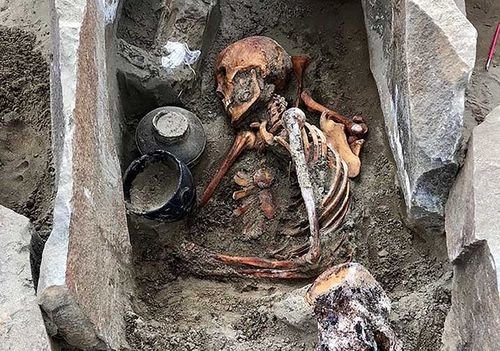
Inside the stone gravesite were the remains of a young girl. Initial examination found patches of skin and soft tissue, along with pieces of cloth that appeared to be silk.
Several objects had also been placed in the grave. They included a belt decorated with beads and a jet buckle, a vase resembling vessels associated with the Huns of the period, ceramic utensils and a birch-wood box containing a small mirror.
The researchers believe the girl lived almost 2,000 years ago.
The objects point to a possible Hun connection
The clothing and objects have led the archaeologists to suggest that the girl may have been a nomadic Hun and possibly someone of high status. They say she could have belonged to the nobility.
The researchers also found what appeared to be a funeral meal inside the vase. A sack containing pine nuts had been placed on the girl’s chest.
The Huns lived in parts of what are now China and Siberia almost 2,000 years ago. They were migratory, and earlier studies have indicated that they mixed with local populations.
That evidence leaves the girl’s origins as an open question. The objects provide clues, but the researchers say more work is needed to determine where she came from and how she became mummified.
The remains survived decades underwater
The condition of the burial raises another question. The grave and its contents remained submerged beneath the reservoir for more than 30 years before the unusually low water level exposed them.
The recovered remains and artifacts have now been removed from the gravesite and taken to a suitable location for further study.
Researchers will examine the mummy and objects to learn more about the girl’s origins and the circumstances of her mummification. They also plan to investigate how the remains and other materials survived decades beneath the reservoir.