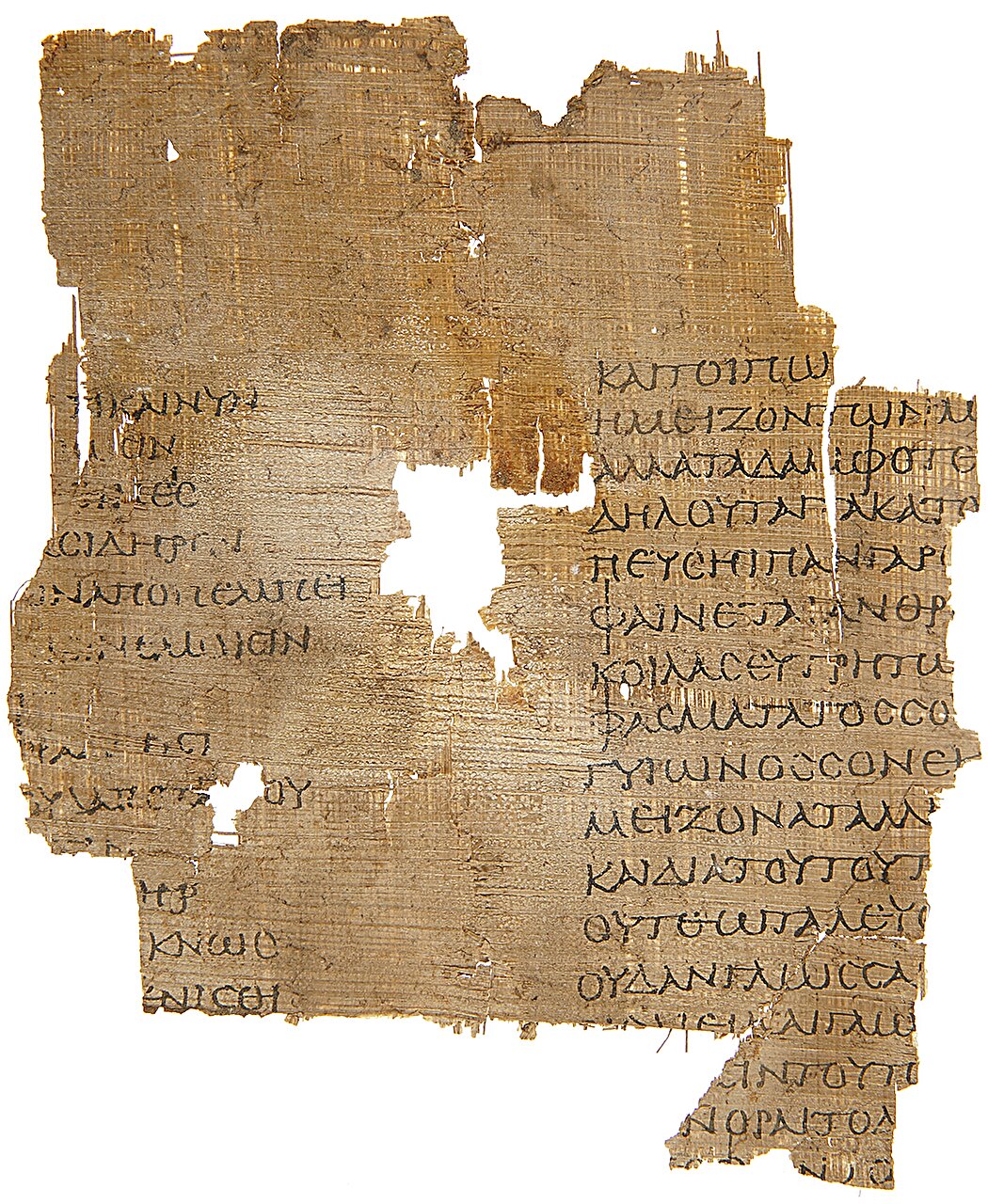
For centuries, Empedocles was known largely through what other ancient writers chose to quote or describe. Now, a papyrus kept in Cairo has given scholars 30 verses from his Physica that had never been published, including passages on vision and how the senses perceive the world.
Nathan Carlig, a papyrologist at the University of Liège, identified the text as part of Empedocles’ Physica while examining papyrus P. Fouad inv. 218 in the archives of the French Institute of Oriental Archaeology in Cairo.
The fragment is about 2,000 years old. It is also the only known copy of the Physica. Other fragments from the same scroll are preserved in Strasbourg.
That makes the text unusual for the study of Empedocles. Until now, knowledge of his work had come entirely from indirect evidence, including quotations, summaries and references in writings by later authors such as Plato, Aristotle and Plutarch. Those sources can preserve pieces of an earlier work, but they do not provide the original text itself.
The newly identified verses therefore give researchers direct access to a portion of Empedocles’ writing.
The verses concern vision and sensory perception
The newly published passage focuses on Empedocles’ theory of particle effluvia and on sensory perception, especially vision.
Reading the verses has also allowed scholars to identify connections with several later works. The analysis points to a probable direct source for a passage by Plutarch, who lived in the second century CE. It also identifies connections with a dialogue by Plato and a text by Theophrastus, an Aristotle’s disciple, both dating to the fourth century BCE.
The study also detects previously unnoticed echoes of Empedocles in the work of the comic poet Aristophanes and the Latin philosopher Lucretius.
The findings suggest that Empedocles may be considered a precursor of atomist philosophers, particularly Democritus of Abdera.
An original text changes what can be known
The difference between an original fragment and later references is central to the discovery. When an ancient author’s work survives only through quotations or summaries, researchers have to reconstruct the original from what other writers chose to preserve.
P. Fouad inv. 218 instead provides part of Empedocles’ own text. The newly available verses can therefore be examined alongside the passages in later authors that appear to preserve or reflect his ideas.
The first edition, translation and commentary on the 30 verses have been published in L’Empédocle du Caire, edited by Nathan Carlig, Alain Martin and Olivier Primavesi.
Carlig describes the search for such lost ancient texts as comparable to the work of Renaissance humanists who searched European libraries for manuscripts that had disappeared from circulation. Since the late 19th century, papyrologists have pursued a similar search through surviving papyrus texts.
He calls this, borrowing Peter Parsons’ phrase, a “second Renaissance” of ancient literature.
The newly published fragment provides material for reassessing Empedocles’ doctrine and his place in Greek philosophy, including his relationships with philosophers who came before and after him.