Roughly 34 million years ago, a rodent living in what is now southern Thailand reached a body size rarely seen among early members of its evolutionary group. With an estimated body mass of around 30 kilograms, it was far larger than previously described Asian relatives, challenging the idea that exceptionally large rodents were primarily a later development in South America. Its remains consist of just two teeth, but their unusual size and distinctive structure provide evidence that rodent gigantism had emerged much earlier than the fossil record had clearly documented.
The animal, named Yakamys sirindhornae, lived during the late Eocene, approximately 35.1 million to 33.7 million years ago. It belonged to Ischyromyidae, an early family of rodents that was once widespread across North America, Europe and Asia.
Although rodents eventually evolved into some of the largest mammals ever known within their group, most remained relatively small or medium-sized throughout their evolutionary history. Exceptional body size emerged independently in only a limited number of lineages.
The most spectacular examples are much younger than Yakamys. They include giant rodents from the Neogene and Pleistocene of South America, such as Josephoartigasia monesi and Phoberomys pattersoni.
The discovery of Yakamys adds a substantially older example to this evolutionary history. It provides evidence that an early rodent lineage had already evolved exceptionally large body size by the late Eocene, tens of millions of years before the major diversification of giant South American caviomorph rodents.
The fossils were recovered from the Bang Mark locality in Thailand’s Krabi Basin. The researchers identified the animal from an exceptionally large lower second molar and an associated fragment of a lower incisor. Together, these remains preserve enough anatomical information to distinguish the animal from previously described Paleogene ischyromyids.
Two teeth reveal an unusually large early rodent
The most important fossil is a right lower second molar, measuring 11.56 millimeters in length and 11.27 millimeters in width.
Those dimensions are exceptional among known Paleogene ischyromyids. Before Yakamys was described, the largest known Asian members of the family were considerably smaller.
The lower incisor provides a second important piece of evidence. It measures 11.23 millimeters across its buccolingual diameter and 9.22 millimeters across its mesiodistal diameter.
The two teeth were recovered close to each other in the same fossil-bearing layer. The researchers provisionally assigned them to the same animal species because of their exceptionally large dimensions and shared geological occurrence.
However, their association is not established through a complete skeleton. The fossils represent separate dental specimens, and the researchers’ identification relies on the available anatomical and geological evidence.
The molar itself has a moderately high crown and a roughly square outline when viewed from above. Its chewing surface contains several rounded cusps, a feature known as a bunodont molar pattern.
Its internal arrangement also differs from that of other early rodents in the same family.
One particularly distinctive feature is the short, isolated anteroconid, a small cusp near the front of the tooth. It is separated from neighboring structures rather than forming part of a continuous ridge along the front of the molar.
Another ridge, called the metalophulid II, extends only partway across the chewing surface and stops before reaching the metaconid, one of the major cusps.
The molar also lacks two structures found in several other ischyromyids: the mesoconid and the hypoconulid. Its entolophid, a ridge connecting parts of the chewing surface, is divided into two branches.
These features form a distinctive combination that separates Yakamys from the previously described species considered in the study.
The researchers also compared its molar with those of Hulgana, Eosischyromys, Asiomys and other Paleogene rodents from Asia, as well as the North American species Manitsha tanka.
The differences are particularly striking when considering the size of the teeth.
Hulgana, previously regarded as the largest known Asian ischyromyid, had molars measuring less than half the length and width of those of Yakamys.
The comparison with Manitsha tanka is also informative. This Oligocene rodent from North America was among the few previously documented examples of exceptionally large body size among Paleogene rodents.
Its lower second molar measured approximately 8.2 by 8.9 millimeters. The corresponding tooth in Yakamys measured 11.56 by 11.27 millimeters.
Despite their similarly exceptional size, the two animals also had noticeably different molar structures. Manitsha had a more complete metalophulid II, a relatively shorter trigonid and a more strongly developed entolophid.
The comparison suggests that large body size among early ischyromyids was not associated with one uniform dental arrangement.
Estimating body mass from fossil teeth
Because no complete skeleton of Yakamys is available, its body mass cannot be measured directly. The researchers instead estimated its size using relationships between tooth dimensions and body mass in living rodents.
This approach is based on allometry, the study of how different body measurements relate to overall body size.
Certain dental dimensions tend to increase with body mass, allowing researchers to use fossil teeth to estimate the size of extinct animals. However, these relationships vary among species and groups, so estimates from isolated teeth carry considerable uncertainty.
The researchers applied seven published allometric equations developed from measurements of living rodents.
Two models used the lower incisor’s dimensions, while five used measurements of the lower second molar. Each equation was applied separately, producing a range of estimated body masses.
The results varied considerably.
BODY-MASS ESTIMATES FROM THE SEVEN MODELS
| Dental measurement or predictor | Estimated mass |
|---|---|
| Incisor anteroposterior diameter | 47.25 kg |
| Incisor transverse diameter | 28.24 kg |
| Molar maximum width | 28.60 kg |
| Molar length and width | 41.54 kg |
| Molar maximum width | 29.04 kg |
| Molar maximum width | 25.24 kg |
| Molar maximum length | 21.43 kg |
The seven estimates ranged from 21.4 to 47.3 kilograms. Their mean was 31.6 kilograms, while their median was 28.6 kilograms.
The researchers used approximately 30 kilograms as a rounded central estimate, representing the midpoint between those two summary values.
This figure is not the result of a single regression equation, nor is it a formal confidence estimate. It is a convenient summary of the different model predictions.
The uncertainty becomes even more apparent when the prediction errors associated with the individual equations are included. The resulting lower and upper bounds span approximately 10.8 to 69 kilograms.
That broad range reflects differences among the predictive models and the uncertainty inherent in estimating the mass of an extinct animal from isolated teeth. It should not be interpreted as a single statistical confidence interval.
Even with these qualifications, the estimates consistently identify Yakamys as substantially larger than previously described Paleogene ischyromyids.
The important finding is therefore not that the animal weighed exactly 30 kilograms, but that its dental dimensions indicate an exceptionally large body size for an Eocene member of this early rodent family.
Enamel structure helps identify the animal
The researchers also examined the microscopic structure of the lower incisor to establish the animal’s taxonomic identity.
Rodent incisors have specialized enamel, and the arrangement of its microscopic components can provide useful information for distinguishing evolutionary groups.
The researchers prepared a longitudinal section of the fossil tooth and examined it using scanning electron microscopy. They also used high-resolution X-ray micro-computed tomography to produce a three-dimensional digital reconstruction of the dental specimen.
The incisor revealed an unusual combination of size and enamel thickness.
Despite its enormous dimensions, the enamel layer measured only about 235 micrometers thick.
The researchers identified two main regions within the enamel, known as the portio externa and portio interna. The outer region accounts for approximately 20–25% of the total enamel thickness.
Within the inner region, the researchers observed structures called Hunter–Schreger bands. These are arrangements of enamel prisms that form recognizable patterns when examined in cross-section.
In Yakamys, the bands are nearly straight, with an inclination of approximately 2–10 degrees. They extend from the enamel–dentine junction toward the boundary between the inner and outer enamel regions, where they locally divide or merge.
Another important feature involves the inter-prismatic matrix, the material surrounding the enamel prisms.
Its crystallites form thin sheets oriented parallel to the prism axes. These sheets create a continuous, branching network around the prisms, producing a sheath-like arrangement.
Together, these characteristics correspond to a pauciserial Hunter–Schreger band pattern.
This microscopic organization is consistent with the enamel structure previously reported in Ischyromyidae. It therefore provides additional evidence supporting the classification of Yakamys within the family.
The enamel findings are particularly useful because the available fossil material is so limited. The researchers could examine not only the overall dimensions of the tooth but also its internal microscopic organization.
Large body size appeared early in rodent evolution
The evolutionary significance of Yakamys becomes clearer when its age and classification are considered together.
Ischyromyids were among the earliest major evolutionary radiations of rodents. Their fossil record extends back to the late Paleocene of North America, followed by a broader geographic distribution that included Europe, Asia and Africa during the Eocene.
Despite this widespread distribution, exceptionally large members of the family have been rarely documented.
Before the discovery of Yakamys, Manitsha tanka, which lived during the Oligocene in what is now South Dakota, was one of the few recognized examples of an unusually large Paleogene ischyromyid.
The new Thai fossil pushes the documented occurrence of exceptional body size in this early rodent group further back in time.
This is important because the best-known examples of rodent gigantism belong to much later evolutionary lineages.
The South American giant Josephoartigasia monesi, for example, lived during the Plio-Pleistocene. Its original body-mass estimate exceeded 1,000 kilograms, although subsequent research revised that estimate substantially downward, to approximately 350 kilograms.
Another giant, Phoberomys pattersoni, from the late Miocene, was initially estimated to weigh between 436 and 741 kilograms. Later estimates placed it at approximately 220–280 kilograms.
These animals belonged to a different rodent lineage from Yakamys. Their enormous size therefore does not represent a direct continuation of the evolutionary history documented by the Thai fossil.
Instead, Yakamys demonstrates that substantial body-size increases had already occurred in an early rodent lineage long before the diversification of the giant Neogene caviomorphs of South America.
The discovery also adds to the known morphological diversity of early ischyromyids. Its distinctive molar structure differs not only from that of smaller Asian relatives but also from that of the similarly large North American Manitsha.
However, the precise evolutionary relationships of Yakamys remain unresolved. The researchers emphasize that a single lower molar and an associated incisor do not provide enough anatomical information for a formal phylogenetic analysis.
In particular, similarities between Yakamys and another ischyromyid, Hartenbergeromys, cannot yet establish whether the two were closely related or independently developed similar dental features.
A more comprehensive collection of fossils and a broader analysis of anatomical characteristics will be needed to investigate those possibilities.
Another unusually large rodent may have lived in Myanmar
The Thai discovery also draws attention to an unresolved fossil from neighboring Myanmar.
The researchers mention an isolated rodent incisor from the Pondaung Formation, a late middle Eocene fossil deposit in Myanmar. The specimen is considerably larger than the incisors of previously described rodents from the region.
However, this fossil material has not yet been formally described or taxonomically identified. Its evolutionary relationships remain uncertain.
Its large dimensions alone cannot establish that it belonged to an ischyromyid or that it was closely related to Yakamys.
The specimen nevertheless raises the possibility that exceptionally large rodents were present in Southeast Asia even earlier than the Thai animal.
Several explanations remain possible. The Myanmar fossil could represent an early occurrence of large body size within Ischyromyidae, an independent increase in body size in another rodent lineage, or part of a broader pattern of Eocene rodent diversification.
The available evidence cannot distinguish between these possibilities.
For now, Yakamys remains the most securely documented exceptionally large ischyromyid from Eocene Southeast Asia.
What the fossil deposits reveal about its habitat
The remains of Yakamys were recovered from a clay layer intercalated within the main coal seam of the Krabi lignite mine.
The fossil-bearing deposits are assigned to the late Eocene based on their mammalian assemblage and reverse magnetic polarity, identified as Chron 13r.
The specimens came from lacustrine clay deposits, indicating that the animal lived in a landscape that included lake-associated environments.
However, the geological setting does not establish that Yakamys was semi-aquatic.
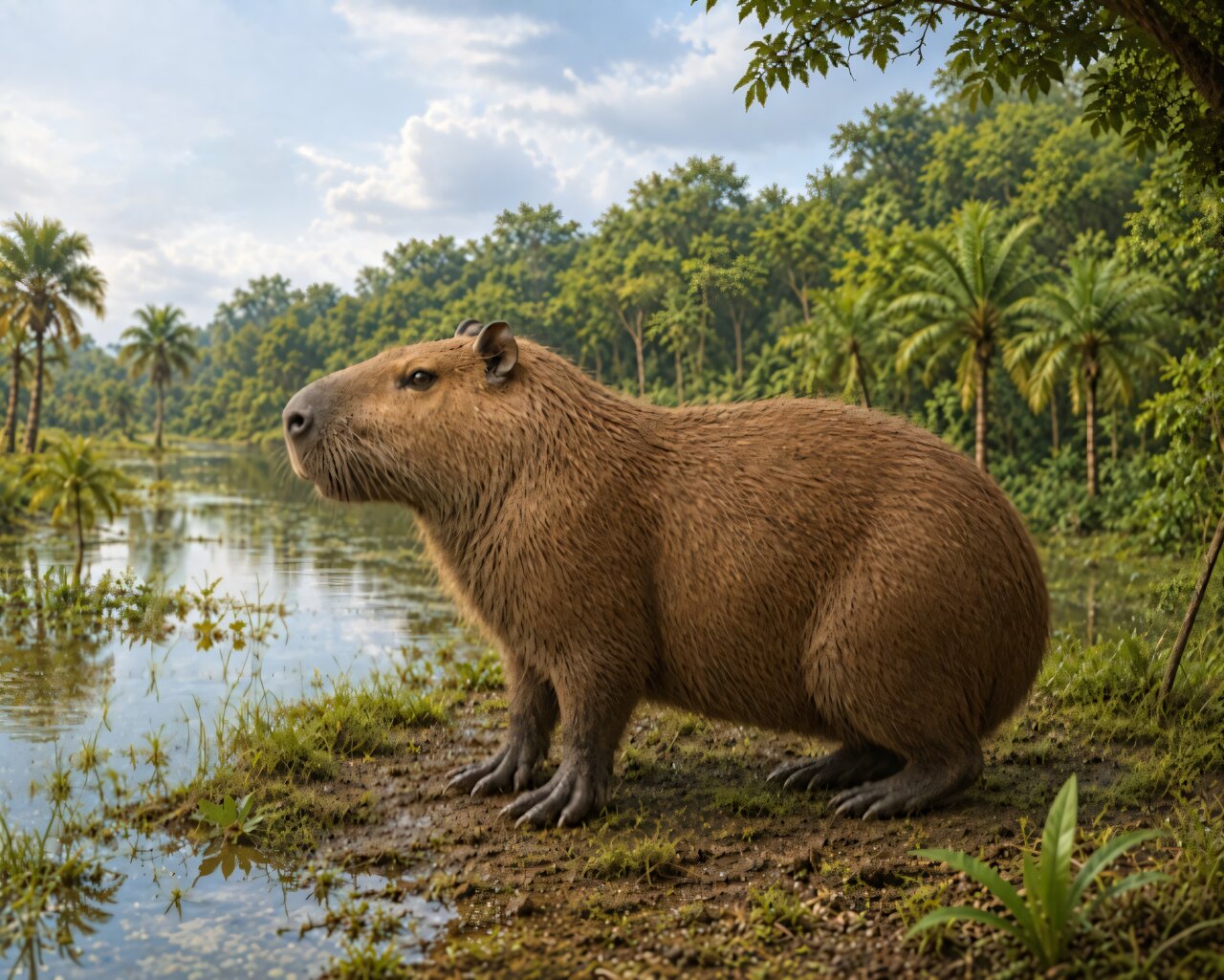
The researchers discuss the possibility that lake-margin habitats formed part of its ecological setting. They note that such an interpretation could be broadly comparable to the ecology of the living capybara, a large rodent associated with aquatic environments.
A similar ecological hypothesis has also been proposed for the giant North American ischyromyid Manitsha tanka.
One possible explanation is that access to abundant food resources around lake margins could have influenced the evolution of large body size. But the available fossils do not provide enough evidence to test that idea.
The researchers also consider whether ecological release on an island might explain the animal’s size. Island environments are often discussed in connection with unusual body-size evolution among mammals.
However, neither the paleogeographic setting of the Krabi Basin nor its associated mammalian fauna provides evidence that the region was an island environment at the end of the Eocene.
Consequently, island-associated ecological release cannot readily explain the large size of Yakamys.
Its moderately high-crowned molar offers another possible clue. Greater crown height may have helped the tooth withstand wear, but the functional significance of this feature and its relationship, if any, to body size cannot be established from the available material.
More complete fossils, particularly skull and postcranial remains, would be necessary to investigate its feeding adaptations, locomotion and possible association with aquatic habitats.
For now, the two teeth from southern Thailand provide the clearest evidence: an exceptionally large member of an early rodent family was already living in Southeast Asia during the late Eocene, approximately 34 million years ago.
The study was published in Scientific Reports.