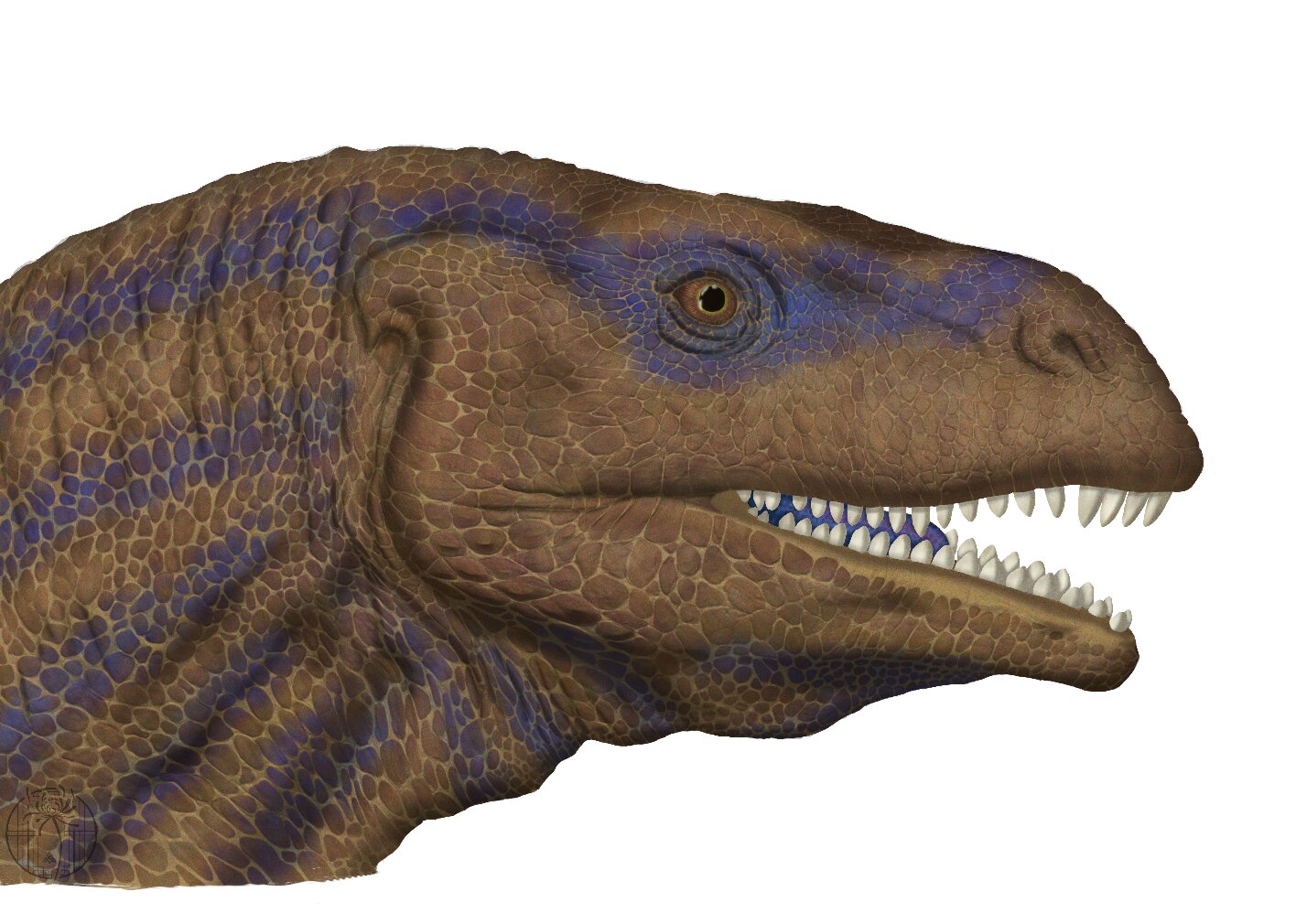
A dinosaur that lived in what is now South Africa roughly 220 million years ago had already reached an estimated body mass of about 400 kilograms, yet its bones suggest it was still relatively young and actively growing. The animal, named Nyana rooiwalensis, was not a fully grown giant. It was a juvenile sauropodomorph whose unusually large size for its developmental stage offers clues to how rapid growth evolved in the group that eventually produced the enormous long-necked sauropods. Its fossil also preserves an exceptionally complete skull, giving scientists a rare opportunity to examine the anatomy of an early sauropodomorph from southern Africa.
The specimen comes from the lower Elliot Formation in South Africa’s Eastern Cape Province, a fossil-rich geological unit that preserves animals from the Late Triassic and Early Jurassic. Although sauropodomorph fossils are abundant in these rocks, they are usually isolated bones or partial skeletons. Skull material is much less common, particularly in the older, Late Triassic layers.
The discovery of Nyana adds a new species to that record. More unusually, its remains include a nearly complete, partly articulated skull, along with fragments of the backbone and limbs. The skull is missing its frontmost portion, but much of the braincase and palate remains, as do parts of the structures associated with the tongue and the bony plates that supported the eye.
The combination of skull anatomy, limb measurements and microscopic evidence from the bones allowed the researchers to investigate several aspects of the animal’s biology. Most strikingly, those different lines of evidence point to a dinosaur that was large for its age but had not finished growing.
A rare skull from the Late Triassic of South Africa
The fossil was collected in 2018 near Qhemegha Village in South Africa’s Eastern Cape Province. It came from the upper half of the lower Elliot Formation, about 140 meters above the contact with the underlying Molteno Formation. The surrounding rocks belong to the Scalenodontoides Assemblage Zone. Correlations with dated volcanic ash layers elsewhere in the region place the fossil in the Norian–Rhaetian stages of the Late Triassic.
The animal lived during a period when sauropodomorph dinosaurs were diversifying. This group included relatively early forms that often walked on two legs, as well as the later sauropods, whose members included some of the largest land animals known. The evolutionary relationships among the early members of the group remain difficult to resolve, partly because well-preserved skulls are scarce.
In southern Africa, the Late Triassic record had previously provided only limited skull material from sauropodomorphs. The dinosaur Mbiresaurus raathi, from Zimbabwe, is represented by several skull bones, while Kholumolumo ellenbergerorum, from Lesotho, is known from a pair of bones behind the eye. Neither provides the same breadth of cranial information as the Nyana specimen.
The fossil assigned to Nyana rooiwalensis is catalogued as BP/1/8468. It represents a single individual rather than a collection of bones from several animals. Its remains include a partial articulated skull, fragments of both upper jaws, the rear half of the right lower jaw, four neck vertebrae, two back vertebrae, parts of the sacrum and tail, and portions of the forelimbs and hindlimbs. A hand bone and claws are also preserved.
The front of the skull is incomplete, but the surviving parts include the braincase, which enclosed the brain and housed important structures associated with the senses. Much of the palate, the bony structure forming the roof of the mouth, is also preserved. These elements provide anatomical information that is difficult to obtain from isolated teeth or limb bones.
To examine the skull in detail, the researchers used high-resolution synchrotron X-ray imaging at the European Synchrotron Radiation Facility in Grenoble, France. Unlike an ordinary photograph, this technique allows scientists to examine internal structures without cutting through the fossil. The scan produced three-dimensional images at a resolution of 20 micrometers, allowing the team to study the shapes and connections of bones that would otherwise be difficult to inspect.
The researchers combined these digital images with photographs and measurements of the preserved postcranial bones. They then compared the anatomy with that of other sauropodomorphs to determine which features distinguished the fossil and where it might fit in the dinosaur family tree.
A distinctive combination of skull features
The skull contains several features that help distinguish Nyana from other early sauropodomorphs. One particularly notable feature is the number of tooth sockets preserved in its upper jaw.
The incomplete maxilla, the bone that forms much of the upper jaw, preserves at least 23 tooth sockets, or alveoli. Many early-branching sauropodomorphs have between 14 and 20 in this bone. A few other species have similarly high counts, including Coloradisaurus, Riojasaurus and Plateosaurus, but the researchers distinguish Nyana through a combination of other anatomical characteristics.
The count also comes with an important qualification. The maxilla is incomplete, and the animal was not fully grown. Tooth numbers can increase during development in some sauropodomorphs, so the preserved 23 sockets may not represent the animal’s final total. The researchers suggest that Nyana may have had a comparable or even higher number of upper-jaw teeth as an adult, but the fossil cannot establish that.
Other differences occur around the skull’s openings and the bones surrounding the brain. The postorbital, a bone behind the eye socket, has a distinctive arrangement of processes that extend toward neighboring skull bones. Its proportions and shape help separate Nyana from several other sauropodomorphs, although the researchers note that these features can change as an animal grows.
The braincase provides another useful point of comparison. Its bones preserve the passages and openings associated with cranial nerves, blood vessels and the inner ear. The inner ear is especially informative because its semicircular canals are involved in sensing head movements and maintaining balance.
In Nyana, the reconstructed inner-ear canals are relatively long from front to back and short from top to bottom. This differs from the proportions described in Massospondylus, Sarahsaurus and later sauropods, whose semicircular canals are comparatively shorter from front to back and taller vertically. The difference adds to the anatomical evidence that Nyana represents a distinct species.
The fossil also preserves parts of the hyoid apparatus, a collection of bones and cartilage-related structures associated with the tongue and throat. A partial rod-shaped element interpreted as part of the hyoid lies near the lower jaw. Other preserved pieces resemble the second ceratobranchials, paired elements that form part of the hyoid apparatus in some dinosaurs.
The identification is not completely certain. The researchers note that the preserved structures could represent other elements of the apparatus, but their shape and position are consistent with the proposed interpretation.
Another unusual feature is the preservation of scleral ossicles. These are small bones that formed a supporting ring within the eye. At least 34 separate ossicles are present, although they are disarticulated and no longer sit in their original position. Some overlap to form part of a curved structure, providing evidence of the bony eye ring.
Together, the braincase, palate, jaw fragments, hyoid elements and scleral ossicles make the specimen particularly informative. They provide a much broader view of the skull than is available for most Late Triassic sauropodomorphs from southern Africa.
The bones record an animal that was still growing
The most revealing evidence about Nyana’s age comes from the internal structure of its bones.
Bone tissue changes as an animal grows. Under a microscope, scientists can examine the arrangement of bone cells, blood-vessel channels and growth marks to assess whether an animal was growing rapidly, whether its growth had slowed, and how far it had progressed toward skeletal maturity.
One useful feature is a line of arrested growth, or LAG. These lines form when bone growth temporarily slows or stops. They can provide clues about an animal’s growth history, although the number preserved in a fossil does not always give a complete record. Later bone remodeling can erase or obscure earlier marks.
The researchers examined the microscopic structure of Nyana’s limb bones. The tissue showed dense blood-vessel channels extending through much of the outer bone, along with evidence of new bone being deposited near the surface. These features indicate that the animal was actively growing when it died.
At least one clear growth-arrest line was identified, with a possible second line near the outer surface. The bone cortex, the dense outer layer, was relatively thin, and its outer surface had a crenulated, or wavy, appearance. The skull also had open sutures between several bones, while the vertebrae lacked fusion between their neural arches and centra. These features provide additional evidence that the skeleton had not reached maturity.
The researchers interpret the animal as a juvenile to late juvenile. They also caution that the number of growth lines may be incomplete. Secondary remodeling and expansion of the marrow cavity can remove earlier growth marks, so the specimen may have been at least in its third year of growth.
The proportions of the skull support this assessment. In young dinosaurs, the eye socket tends to be relatively large compared with the overall skull. As an animal matures, the orbit becomes proportionally smaller. The base of another skull opening, the antorbital fenestra, also tends to lengthen during development.
Although parts of the Nyana skull are missing, the preserved proportions resemble those seen in juvenile, subadult and adult specimens of Massospondylus carinatus, as well as an adult Mussaurus patagonicus. Taken together with the bone tissue and unfused skeletal joints, the comparisons support the interpretation that BP/1/8468 belonged to a relatively young animal.
But this was no small juvenile.
A juvenile with an estimated mass of about 400 kilograms
The researchers estimated Nyana’s body mass by comparing its limb measurements with growth information from other sauropodomorphs, particularly Massospondylus and Mussaurus.
One important measurement was the circumference of the femoral shaft, the main portion of the thigh bone. In Nyana, this measured 194 millimeters near the upper end of the bone. The measurement is not directly equivalent to the minimum mid-shaft circumference commonly used in some comparisons, so the researchers considered that difference when assessing its size.
Even so, the measurement indicates a remarkably large individual for the juvenile growth stage suggested by the bone tissue. Using growth curves derived from Massospondylus and Mussaurus, the researchers estimated that Nyana weighed approximately 400 kilograms.
That estimate places the animal in a size range comparable to an adult Massospondylus carinatus or a subadult Mussaurus. The largest known adult Massospondylus specimen used in the comparison has an estimated body mass of about 543 kilograms. The subadult Mussaurus specimen has an estimated mass of approximately 400 kilograms.
Other juvenile Massospondylus specimens provide a striking contrast. Individuals with five to eight growth-arrest lines have estimated body masses ranging from 37 to 91 kilograms. Based on femoral circumference or growth-line counts, Nyana was more than four times the size of juvenile individuals of Massospondylus and Mussaurus used in the comparison.
The researchers describe it as one of the largest juvenile dinosaurs known from the Late Triassic.
The estimated mass is not a direct measurement of the fossil animal. It depends on comparisons with other species and on growth curves developed from their preserved remains. Those comparisons provide a way to estimate the size of an extinct animal, but they cannot establish its exact weight.
The researchers also used the growth curves to consider how large Nyana might have become. Extrapolating from those comparisons suggests that a fully grown individual could have reached a body mass of several tonnes. That possibility remains an estimate rather than a demonstrated adult size, because the known specimen is juvenile and no adult Nyana skeleton has been identified.
The combination of a large estimated body mass and evidence of continued growth is central to the study. It suggests that substantial body size had already been reached before this animal approached skeletal maturity.
What the limbs suggest about its posture
The preserved limb bones also offer some information about how Nyana moved, although the available material limits how confidently its posture can be reconstructed.
The researchers compared the shaft circumferences of the proximal ulna, a forearm bone, and the proximal femur. The resulting ratio was 0.86, which falls within the range reported for bipedal sauropodomorphs such as Lufengosaurus and Plateosaurus.
This comparison is consistent with Nyana being bipedal, meaning that it walked on its hind legs. However, the researchers emphasize that the available limb material is insufficient for a robust quantitative reconstruction of its posture. The ratio provides supporting evidence, not a complete picture of how the animal stood or moved.
That distinction matters because sauropodomorphs evolved a range of body sizes and locomotor forms. Some early members were relatively small and bipedal, while later lineages included much larger animals with different proportions and, in some cases, four-legged locomotion. The Nyana specimen adds a large-bodied juvenile to the evidence available for understanding those early variations.
Its place in the dinosaur family tree remains uncertain
The researchers also used the fossil’s anatomical features to investigate its evolutionary relationships. They compared hundreds of skeletal characteristics across a broad selection of sauropodomorphs and used a computer-based phylogenetic analysis to identify trees that best fit the observed distribution of those features.
The initial analysis produced six most parsimonious trees, each requiring 1,741 evolutionary steps under the method used. A more extensive search produced at least 10,000 trees, exceeding the program’s storage capacity. The strict consensus of the initial results was poorly resolved, meaning that it could not establish clear relationships among many early-branching sauropodomorphs.
The researchers therefore used additional procedures to identify taxa whose unstable positions were obscuring the broader pattern. After removing several such taxa from the reduced analysis, they obtained a more resolved set of relationships.
Even then, Nyana did not settle into a single position.
In some of the resulting trees, it appears closely related to Sarahsaurus aurifontanalis, an early sauropodomorph known from western North America. In others, it is recovered as the sister taxon of the South African dinosaur Ngwevu intloko. The analyses also differ over whether Nyana belongs within Massospondylidae or branches off earlier within a broader group called Massopoda.
These alternatives are not minor details. They change how scientists would interpret the animal’s evolutionary history and its relationship to other dinosaurs.
The support for many branches in the analysis is low. Bremer support values range from 1 to 3 for most nodes, while bootstrap support is also limited. These measures indicate how consistently particular relationships appear under different analytical tests. Low support means that the available anatomical evidence does not strongly resolve many of the relationships.
The alternative placements are supported by different combinations of skeletal features. Similarities between Nyana and Sarahsaurus include aspects of the upper jaw, the bone behind the eye, the rear of the braincase and some vertebral and limb characteristics. Other features support a position within Massospondylidae, while a smaller set of characters is consistent with an earlier-branching position outside that family.
The uncertainty is especially relevant because Nyana is a juvenile. Some skull features change as sauropodomorphs mature, and the researchers acknowledge that the shape of its postorbital and other cranial proportions may have changed during later growth. The incomplete skull also limits the number of anatomical characters that can be assessed.
The fossil nevertheless adds a substantial set of cranial observations to a part of the sauropodomorph family tree where well-preserved skulls remain uncommon.
Possible links between southern Africa and North America
One of the evolutionary possibilities raised by the analysis is a close relationship between Nyana and Sarahsaurus, which lived in what is now the western United States during the Early Jurassic.
If that relationship is correct, the two dinosaurs would represent a connection between early sauropodomorph lineages in southern Africa and western North America. The researchers discuss this as a possible biogeographic link, but its interpretation depends on where Nyana ultimately belongs in the family tree.
If it is a massospondylid, it would represent the first Triassic member of that group recovered from South Africa. That placement would suggest that massospondylids were present in southern Gondwana during the Late Triassic, before their later distribution across Pangaea in the Early Jurassic.
If Nyana instead belongs outside Massospondylidae as an early-branching massopodan, the relationship with Sarahsaurus would point to a broader distribution of that lineage before the massospondylid radiation.
The researchers also note that the fossil record of these animals is sparse. Related dinosaurs may have lived in other regions without yet being discovered or recognized. For now, the proposed connection is a possibility supported by one of the alternative phylogenetic arrangements, not a settled account of how the animals were distributed.
What its size adds to the story of sauropodomorph growth
The estimated size of Nyana also raises questions about how body size and growth strategies evolved among early sauropodomorphs.
Many sauropodomorph lineages eventually included animals weighing more than a tonne. Some early members, however, remained in smaller body-size ranges. The researchers compare Nyana with massopodans and sauropodomorphs whose estimated adult masses reach or exceed that threshold, as well as with massospondylids, whose reported body masses fall roughly between 170 and 500 kilograms.
If Nyana belongs within Massospondylidae, its large estimated body mass could indicate that animals exceeding one tonne evolved more than once within the broader group. The authors discuss this possibility alongside differences in growth and posture among sauropodomorph lineages.
If it instead branches outside Massospondylidae near Sarahsaurus, the comparison suggests substantial differences in body size among closely related early-branching massopodans. The estimated mass of Sarahsaurus is approximately 170 kilograms, considerably below the estimate for the juvenile Nyana.
Either interpretation depends on the unresolved phylogenetic position of the South African dinosaur. The fossil does not by itself establish how many times large body size evolved or exactly when rapid growth first appeared. But its combination of juvenile bone tissue and a body mass estimate of about 400 kilograms is consistent with rapid growth strategies having arisen early in sauropodomorph evolution.
The specimen also leaves important questions open. Its adult body size is unknown, its complete tooth count cannot be established from the incomplete upper jaw, and the available limb material does not allow a definitive reconstruction of its posture. Additional fossils, particularly more complete skeletons and individuals at different growth stages, would help test the interpretations proposed from this single specimen.
For now, the known Nyana rooiwalensis remains a single large juvenile from the Late Triassic of South Africa, preserved with one of the most informative sauropodomorph skulls yet recovered from the region.
The study was published in Royal Society Open Science.