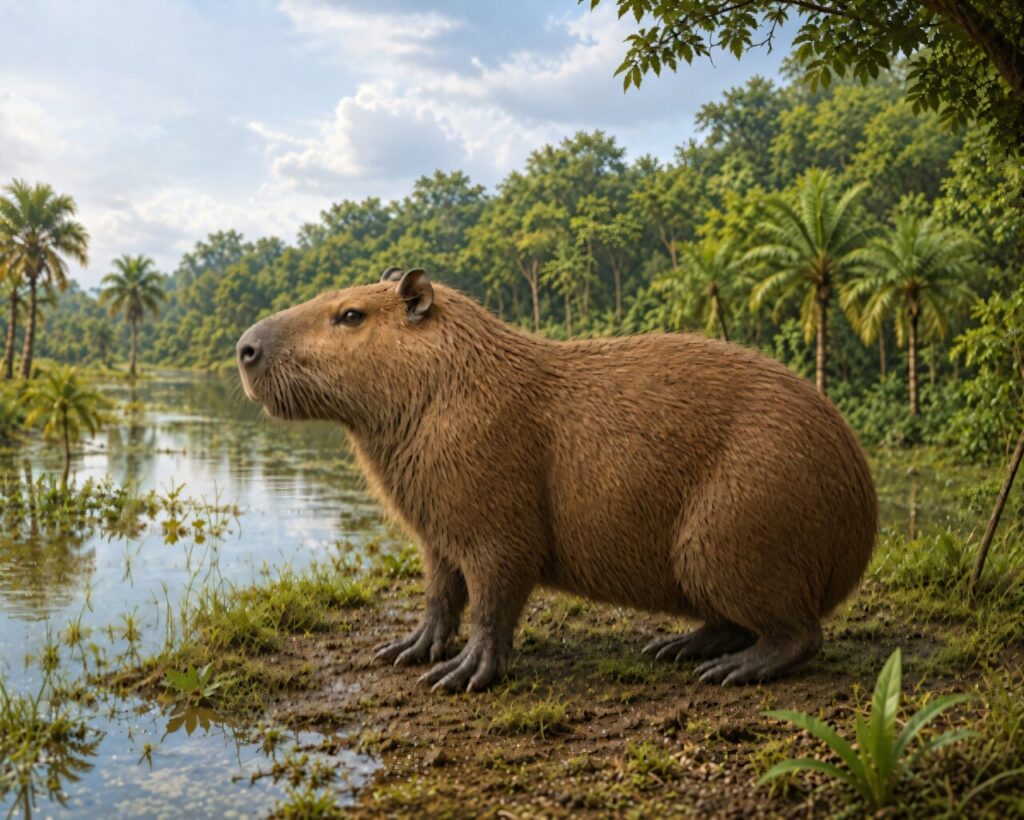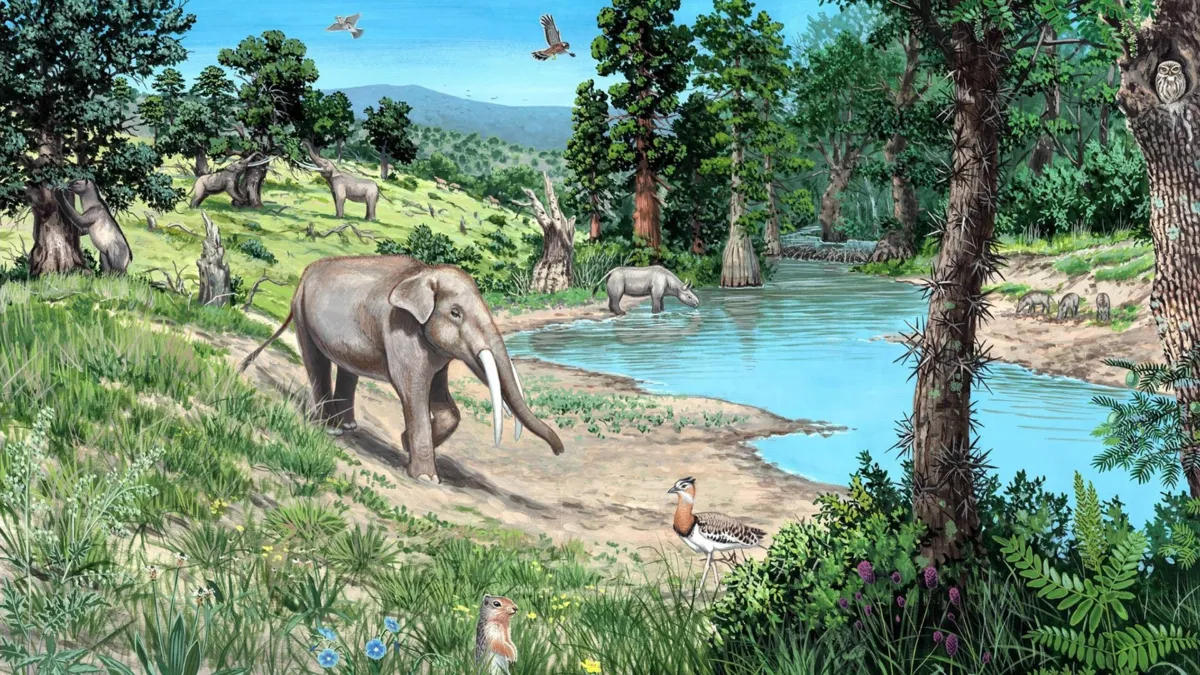
For millions of years, Europe’s temperate landscapes may have been shaped less by uninterrupted forests than by a constantly shifting mixture of trees, shrubs, grasslands and open woodland. Elephants, rhinoceroses, wild cattle and other large herbivores helped maintain this patchwork by grazing, browsing and disturbing the ground. The disappearance of much of this wildlife near the end of the last Ice Age coincided with a major change in vegetation, allowing trees to spread into landscapes that had previously remained more open.
The idea challenges a long-standing view of Europe’s natural forests. For generations, ecologists have generally treated dense, closed-canopy woodland as the dominant natural vegetation of the continent before humans began clearing land for agriculture. Under this interpretation, open grasslands and lightly wooded landscapes were largely products of human activity, particularly farming, livestock grazing and forest clearance.
But a growing body of evidence suggests that this picture may be incomplete.
In a comprehensive review of Europe’s vegetation history spanning approximately 23 million years, researchers brought together fossil evidence, ancient environmental DNA, chemical signatures preserved in animal remains, plant records and the habitat preferences of living species. Their central argument is that the continent’s humid-temperate regions were predominantly characterized by heterogeneous woodland–grassland mosaics, rather than uniformly dense forests.
The authors argue that large herbivores were probably among the most important forces maintaining this structure, alongside climate, fire and local environmental conditions.
They propose calling this long-standing ecological system the temperate mosaic woodland biome.
The distinction is important because a landscape containing trees is not necessarily a closed forest. It can contain substantial woodland alongside grasslands, scrub, scattered trees and dense forest patches. These different environments can exist within the same broader landscape, creating a much more varied pattern of vegetation than a continuous canopy.
The researchers suggest that this kind of landscape characterized Europe’s temperate regions through the Miocene, Pliocene and Pleistocene, despite substantial changes in climate and the species living there.
A landscape shaped by millions of years of herbivory
The review examines the vegetation history of Europe’s humid-temperate zone across three major geological periods.
The Neogene, covering approximately 23 million to 2.58 million years ago, includes the Miocene and Pliocene. It was a crucial period during which many of the tree and animal lineages found in Europe today originated.
The Pleistocene, extending from 2.58 million to approximately 11,700 years ago, brought repeated cycles of glaciation and warmer interglacial conditions.
The researchers then examine the Holocene, beginning approximately 11,700 years ago, when human activities increasingly transformed European ecosystems.
One of the central questions is whether forests were naturally dense across these periods or whether large areas remained open despite climates capable of supporting extensive tree growth.
Large herbivores are particularly relevant to this question because their effects extend well beyond the plants they consume.
Animals such as elephants, rhinoceroses, horses, cattle and deer can influence vegetation through grazing, browsing, trampling, seed dispersal and digging. Grazing removes vegetation near the ground, while browsing affects shrubs and young trees. Trampling and rooting disturb the soil, creating patches where new plants can establish.
Together, these activities can prevent vegetation from developing into an uninterrupted canopy.
The scale of prehistoric herbivore communities was also considerably different from that of modern Europe.
The researchers cite estimates suggesting that large-herbivore biomass in pre-Homo sapiens humid-temperate Europe reached approximately 10–20 tonnes per square kilometer. By comparison, present-day estimates range from 0.12 to 2.2 tonnes per square kilometer, with an average of approximately 0.8 tonnes.
That difference provides a possible explanation for why modern forests can look substantially different from the landscapes in which many European species evolved.
The review also emphasizes the role of predators. Large carnivores can influence which herbivores dominate a landscape and how their grazing pressure is distributed. Their effects may therefore reinforce the spatial variation created by herbivores themselves.
Fossils from the Miocene reveal a landscape with open patches
The earliest part of the review examines the Miocene and Pliocene, when Europe’s climate was generally warmer than today.
During much of the Miocene, humid conditions and relatively stable precipitation could have supported extensive forests. Average precipitation in the region is estimated at approximately 1,200 millimeters per year.
Traditional interpretations of fossil pollen records have often suggested that forests dominated these landscapes.
However, pollen records can be misleading when used alone to reconstruct vegetation structure. Different plants produce and disperse different quantities of pollen, meaning that the proportion of pollen from a particular tree does not necessarily correspond directly to its actual abundance in the landscape.
The researchers therefore compare pollen evidence with plant fossils, animal remains, chemical measurements and other indicators.
Some of these records point toward substantially more open vegetation than traditional reconstructions suggest.
Fossil pollen and plant macrofossils reveal the presence of numerous light-demanding plants throughout the Miocene and Pliocene. These include members of genera such as Armeria, Artemisia, Linum, Plantago, Potentilla and Sanguisorba.
Many of these plants require sunlight or disturbed conditions and are unlikely to persist indefinitely beneath an undisturbed, densely closed forest canopy.
Shrubs were also common in the fossil record.
The researchers note that some traditional pollen-based reconstructions indicate only approximately 5–10% open vegetation during parts of the Miocene. Other records, however, indicate considerably greater openness, including estimates of around 20% vegetation cover by open habitats in some periods and approximately 30% toward the end of the Miocene in certain records.
The evidence therefore does not point to one uniform vegetation structure. Instead, it suggests substantial variation across locations and periods.
Charcoal provides another clue
The researchers also examined microscopic charcoal particles preserved in sediments around the western Black Sea.
These particles can help distinguish between different types of vegetation and fire activity.
In landscapes with relatively continuous tree canopies, fires can burn through the crowns of trees, producing substantial amounts of woody charcoal. In more open woodlands, fires are more likely to spread through the continuous vegetation layer beneath separated tree crowns, producing more charcoal from grasses and other herbaceous plants.
The Miocene and Pliocene records examined in the review contained approximately 70–100% charcoal derived from forbs and graminoids, the broad groups that include many herbaceous plants and grasses.
The authors interpret this pattern as evidence of surface fires and open woodland, where a developed herb layer existed beneath a discontinuous tree canopy.
However, the charcoal evidence comes from a limited number of records, so it cannot establish the vegetation structure of the entire region independently.
Animal teeth preserve evidence of ancient diets
Another important source of evidence comes from the teeth of fossil herbivores.
The researchers discuss stable carbon isotope measurements, which can provide information about the vegetation consumed by ancient animals.
They also examine dental wear. Different foods leave different patterns on teeth, allowing researchers to distinguish between animals that mainly browse leaves and shrubs, those that graze grasses, and those that consume a mixture.
These approaches are useful because different feeding strategies can indicate the vegetation available to herbivore communities.
During the Middle and Late Miocene, carbon isotope measurements from herbivore tooth enamel generally fell between the values associated with grasslands and those associated with closed-canopy forests.
The researchers interpret this as evidence of landscapes containing both woody vegetation and more open herbaceous habitats.
Similar patterns appear in the Pliocene, particularly between approximately 4.9 million and 2.5 million years ago.
Dental wear studies also reveal considerable dietary diversity.
One analysis of the Late Miocene Pikermian fauna in Greece identified approximately 31.2% grazers, 42.9% mixed feeders and 25.9% browsers.
That distribution resembles modern open woodlands in Africa and India more closely than either a predominantly grassy savanna or a closed-canopy forest.
A study of Middle Miocene France reconstructed the vegetation as approximately 21% grassland, 68% open woodland and 11% closed-canopy forest.
Other findings complicate the picture. Some Middle Miocene communities were dominated by browsers, suggesting substantial woody vegetation, while other studies indicate greater grazing activity and more open conditions.
A Europe-wide analysis also suggested that the proportion of grazers and mixed feeders increased toward the end of the Late Miocene.
The authors associate this change with increasing dryness during the Messinian Salinity Crisis, approximately 5.8–5.33 million years ago, which may have encouraged more savanna-like vegetation.
These differences are important. They show that the ancient landscape was not static and that local climate, soil conditions, fire and herbivore communities could produce very different vegetation structures.
Nevertheless, the combined evidence supports the presence of substantial open woodland throughout much of the Neogene.
The last warm period offers a particularly important comparison
The Pleistocene brought repeated cycles of cold glacial conditions and warmer interglacials.
For the researchers, one period is especially important: the Eemian interglacial, approximately 130,000–115,000 years ago.
The Eemian was the most recent warm period before the major Late-Pleistocene losses of Europe’s large herbivores. Its temperatures were similar to pre-industrial conditions, with somewhat higher precipitation.
This makes it a useful comparison for understanding what European vegetation might have looked like under a climate broadly similar to the modern one, but before large-scale human transformation.
Traditional pollen-based reconstructions have frequently described the Eemian as a period dominated by dense forest.
The vegetation changed throughout the interglacial. Pine and birch were prominent during its cooler beginning, followed by oak and hazel, and later hornbeam and spruce during warmer conditions.
These successive stages have often been interpreted as different phases of forest development.
However, a reanalysis of corrected pollen records produces a substantially different picture.
The analysis, covering 34 sites across humid-temperate Europe from Great Britain to Poland, estimated that approximately 60% of the region was covered by open woodland during the first half of the Eemian. During the second half, the estimated proportion was approximately 34%.
Completely open vegetation accounted for another 19% during the first half and 16% during the second.
Closed-canopy stands represented approximately 22% of the region during the first half, increasing to 49% during the second.
These estimates suggest that open woodland was widespread even during a warm interglacial when climatic conditions could support dense forests.
The corrected pollen approach is important because it accounts for differences in pollen production and considers the light requirements of the trees and shrubs represented in the records.
The researchers also note that local estimates of openness did not correlate closely with regional estimates. This suggests that the landscape contained a complicated arrangement of vegetation patches rather than a simple, uniform transition between forest and open country.
The plants beneath the trees tell a similar story
Evidence from herbaceous plants provides another indication of how much light reached the ground during the Eemian.
The researchers examined pollen records from 34 sites and compared plants associated with open or semi-open conditions against those capable of surviving in the shaded environment of mature forests.
Across the records, light-demanding plants represented an average of 78% of the combined light-demanding and shade-tolerant groups.
The remaining 22% consisted of shade-tolerant plants.
Approximately 16.51% of the recorded taxa in the combined groups were associated with disturbed soil.
This is important because the presence of light-demanding plants does not necessarily mean that the landscape was entirely treeless. Many such species can grow in open woodland, woodland edges and clearings.
Their widespread presence nevertheless indicates that the vegetation could not have consisted entirely of densely shaded forest.
The researchers also examined fossil animal communities.
Ground squirrels, European hamsters, hares, steppe lemmings and numerous bird species associated with open or semi-open habitats were present during the Eemian.
The presence of these animals provides another indication that grasslands and open woodland patches remained available even during the warmest parts of the interglacial.
Large herbivores were probably maintaining the openings
If the Eemian climate could support extensive closed-canopy forests, something else may have helped maintain the widespread open woodland.
The researchers argue that large herbivores provide the most convincing explanation.
Several other potential drivers appear less capable of explaining the full pattern.
Neanderthals were present in Europe, but their relatively low population densities make continent-wide vegetation changes caused by their activities unlikely. Fire activity also appears to have been limited during the Eemian, based on the available evidence.
In contrast, multiple indicators point toward abundant large herbivores.
One particularly useful indicator comes from dung-associated beetles. These insects depend on animal dung, making their fossil abundance a potential measure of past herbivore activity.
In Great Britain, dung-associated beetles were substantially more common during the Last Interglacial than during the early Holocene. A considerable proportion of Eemian sites fell into the highest category of dung abundance.
Modern comparisons show that similar beetle communities are associated with landscapes supporting sustained, high densities of large herbivores rather than lightly grazed environments.
The researchers compare these local fossil records with independent estimates of prehistoric herbivore biomass across Europe.
Together, the estimates converge on approximately 10–20 tonnes of large-herbivore biomass per square kilometer during the Last Interglacial.
This is considerably higher than the biomass found in most present-day European landscapes.
Plant evidence also supports the interpretation.
The abundance of plants associated with disturbed soil suggests that vegetation was repeatedly disturbed. The dominance of light-demanding herbaceous species indicates that sufficient sunlight reached the ground to support a substantial herb layer.
Ground squirrels, which depend on relatively low vegetation maintained by grazing in modern environments, provide an additional ecological indicator.
Taken together, these findings support the interpretation that large herbivores were a dominant force maintaining open and structurally varied vegetation during Pleistocene interglacials.
The evidence does not establish that herbivores were the only influence. Rather, the authors argue that their effects, interacting with environmental conditions, provide the most plausible explanation for the widespread openness.
The Ice Age landscape was not necessarily treeless
The review also challenges another traditional interpretation of European vegetation history.
The Last Glacial Maximum, approximately 26,500–19,000 years ago, has commonly been reconstructed as a period dominated by extensive, relatively uniform tundra and steppe vegetation.
In this picture, cold and dry conditions pushed most trees and temperate-climate plants into southern refuges, leaving much of Central and Northern Europe largely treeless.
However, evidence from ancient DNA, plant fossils, pollen and animal remains suggests a more complicated landscape.
Ancient environmental DNA recovered from sediments indicates that glacial vegetation across Eurasia included substantial numbers of herbaceous plants, particularly forbs, rather than being dominated exclusively by grasses.
Pollen and macrofossil records also indicate that woody vegetation persisted in parts of Britain, the Netherlands, Germany, Poland and the Czech Republic.
Some studies have identified tree pollen proportions reaching as high as 80% at locations near the edge of the glacier.
The authors caution that these particular estimates rely on uncorrected pollen records, which can overstate or distort the apparent abundance of trees.
Nevertheless, other evidence supports the persistence of trees during the coldest periods.
Tree population genetics and climate-based modelling suggest that some species could have survived in Central Europe rather than retreating entirely to the traditional southern refuges.
The researchers cite an estimate suggesting that approximately 80% of the species currently present in the Carpathian Basin may have been capable of surviving the Last Glacial Maximum locally.
Stable carbon isotope measurements, however, indicate that the broader mammoth-steppe landscape remained predominantly open.
At many sites, the isotope evidence also records local tree cover, suggesting that woodland patches existed without necessarily forming extensive dense forests.
Other fossil records support this interpretation.
Small-mammal communities in southern Poland indicate a relatively stable mosaic woodland landscape across the past 300,000 years, despite repeated glacial cycles.
The presence of tree-dependent mammals, birds and a tree-specialized beetle also suggests that wooded habitats persisted during the Last Glacial Maximum.
Particularly striking is evidence for the continued presence of temperate-climate animals.
Hippopotamus remains from southern Germany have been dated to approximately 30,000 years ago, while the genetic history of the common grass snake suggests that populations survived in Germany during the Last Glacial period.
These observations do not mean that the glacial landscape resembled a modern temperate forest. Much of the mammoth steppe was open, and the climatic conditions were extremely different from those of interglacials.
Instead, the evidence suggests that some woodland elements survived within a much more open and heterogeneous landscape than the traditional treeless-steppe interpretation implies.
Mammoths may have helped keep trees from spreading
The authors also examine whether large herbivores influenced vegetation during glacial periods.
Trees growing under cold conditions faced considerable environmental stress. Low atmospheric carbon dioxide concentrations may have restricted their growth, potentially making them more vulnerable to herbivore pressure.
Estimates from Siberian permafrost suggest mammoth densities of approximately one animal per square kilometer during the Last Glacial Maximum.
A German sediment record using dung-associated fungi also indicates herbivore densities comparable to those associated with later Holocene livestock populations.
The researchers highlight an important pattern in Central Europe: tree expansion appears to have begun before climatic warming and coincided with the disappearance of mammoths.
They suggest that large herbivores may previously have limited tree establishment, keeping vegetation more open than climate alone would have allowed.
Another example comes from Siberia.
Ancient environmental DNA records indicate that the vegetation shifted from forb dominance toward graminoid dominance around the end of the last glacial period. This change appears to have been decoupled from climatic change and coincided with the disappearance of mammoths, steppe bison and woolly rhinoceroses.
The authors interpret this as evidence that large herbivores helped maintain forb-rich vegetation.
Plant extinctions have also been associated with the disappearance of the mammoth-steppe ecosystem.
However, the relationship between herbivore losses and vegetation change remains an interpretation supported by several converging records, rather than direct experimental proof of a single mechanism.
Living species retain clues to Europe’s ecological past
The researchers extend their analysis beyond fossils by examining the habitat preferences of modern European species.
The reasoning is that many living plants and animals evolved long before recent human transformations and persisted through multiple glacial and interglacial cycles.
Their ecological requirements may therefore retain information about the environments in which their ancestors evolved.
The analysis includes vascular plants, mosses, liverworts, butterflies, bees, grasshoppers, bush crickets, birds, mammals, amphibians and reptiles.
The results reveal a striking preference for open and semi-open environments among many species associated with Europe’s temperate climate.
Among lowland vascular plants native to the European temperate forest region, approximately 82% prefer open or semi-open canopy conditions.
The pattern is even more notable among plants particularly associated with the humid-temperate climate. Approximately 78% of these species prefer semi-open to open conditions.
These species account for 484 plants, or 29.3% of the entire lowland, non-wetland species pool examined.
Mosses and liverworts show a similar pattern, with approximately 57.3% of species preferring open or semi-open conditions.
The authors argue that these preferences are difficult to explain simply by suggesting that open-habitat species arrived from colder steppe regions after humans cleared European forests.
Many of the plants originated before the Holocene, and their associations with open environments are not restricted to species that could have recently expanded from steppe habitats.
Insects also depend heavily on open woodland
Butterflies provide particularly clear evidence of the importance of vegetation mosaics.
Among the butterfly species examined, 112 were associated with both open vegetation and forest, while 30 were found only in grasslands.
Only six species were classified as exclusively associated with forests.
Even these forest-associated butterflies generally prefer edges, canopy openings or forest roads rather than deeply shaded forest interiors.
Wild bees show an even stronger association with open environments.
The researchers identified 112 species associated with both open and semi-open habitats, 90 associated exclusively with grasslands and 13 associated only with semi-open environments.
Only two species were associated exclusively with forests.
Another important finding concerns nesting sites. Approximately 206 wild bee species in the dataset require bare soil, which provides suitable places for nesting.
This requirement is relevant to the role of large herbivores because trampling and other ground-disturbing activities can create exposed patches of soil.
Grasshoppers and bush crickets also show strong associations with well-lit vegetation. The analysis identified 32 species preferring full-light conditions, compared with four preferring light conditions and two preferring half-light.
Ten species were also associated with bare soil.
Forest animals often need openings, too
The pattern extends to vertebrates.
Many European mammals traditionally associated with forests, including red deer, roe deer, wild boar and brown bears, use forest openings and grasslands rather than depending exclusively on dense canopy.
Predators also frequently use semi-open environments.
The review notes that badgers are often more abundant in open habitats, wildcats are associated with forest–grassland edges, and lynx use clearings where roe deer are more abundant.
Bird communities likewise benefit from vegetation variation. Species richness often peaks near forest edges and declines toward forest interiors.
The only bird endemic to Europe’s humid-temperate zone, the aquatic warbler, depends on grazed or mowed sedge-reed wetlands. Its populations decline rapidly when reedbeds become too dense.
Among the birds examined, 109 species were associated with combinations of open, semi-open and forest habitats. Only six were classified as exclusively forest-associated, while just one was restricted to completely open vegetation.
The mammal results were even more striking.
Sixty-six species could use open, semi-open and forested environments. Five were associated only with open and semi-open habitats, while 12 occupied combinations of semi-open, open or forest environments.
One mammal species was associated exclusively with open habitats, and none was classified as exclusively dependent on forests.
All the amphibians and reptiles examined could be found in open or semi-open vegetation as well as forests, although many depend on relatively well-lit areas within woodland.
These findings need some qualification. The habitat assessments for animals are often based on expert classifications and may not accurately distinguish species specialized in woodland edges from those that genuinely tolerate a broad range of conditions.
The authors therefore caution that the animal data cannot always establish precise habitat specialization.
Fungi and lichens add another dimension
The researchers also examine fungi and lichens, which provide additional evidence that biodiversity in temperate Europe is not concentrated exclusively in dense forests.
Soil DNA records indicate that the combined richness of several major fungal groups is highest in grasslands rather than forests.
These groups include ectomycorrhizal fungi, arbuscular mycorrhizal fungi, plant pathogens and saprotrophic fungi.
Ectomycorrhizal fungi, which form relationships with tree roots, are individually most diverse in forests. However, their richness declines as understory vegetation becomes denser.
The researchers also point to the exceptionally high diversity of epiphytic lichens in grazed woodlands of the Romanian Carpathians.
These lichens depend on trees but also benefit from the relatively open conditions of grazed woodland.
The combined evidence suggests that many temperate European species are adapted not to a single vegetation type but to landscapes containing a range of canopy conditions.
The disappearance of megafauna changed the vegetation
The transition toward the Holocene brought a major change in Europe’s large-herbivore communities.
Between approximately 40,000 and 15,000 years ago, nearly all European large herbivores weighing more than 300 kilograms disappeared or became severely restricted.
The researchers identify 11 extinct species out of the 15 large herbivores historically associated with Europe’s humid-temperate zone.
These included straight-tusked elephants, several rhinoceros species, hippopotamuses, aurochs, European water buffalo, steppe bison, giant deer and wild horses.
The losses were strongly associated with the expansion of Homo sapiens, although the precise causes and timing varied among species.
The European bison survived, but its population also declined dramatically, particularly from approximately 15,000 years ago.
By the beginning of the Holocene, large-herbivore populations had fallen substantially.
This was accompanied by changes in vegetation.
The authors describe the resulting landscape as a mixture of different ecological developments.
Reduced grazing and browsing pressure allowed tree densities to increase in some regions. At the same time, increased burning, probably associated with human activities, maintained or expanded open vegetation in other areas.
Evidence from fossil beetles in Britain and small mammals in southern Poland indicates a substantial increase in woodland-associated communities compared with the Last Interglacial.
In southern Poland, small-mammal communities that had been dominated by non-forest species for more than 300,000 years shifted toward forest-associated species.
Hazel also became common, although its abundance was lower than during the Last Interglacial. The researchers interpret this as evidence of open woodland combined with lower herbivore pressure.
Fire became increasingly important as a vegetation-shaping force.
Microcharcoal records indicate increased burning, while the appearance of more fire-adapted plants suggests that human activities helped establish new disturbance regimes.
Some open-habitat species nevertheless survived continuously. These included European hamsters, several butterfly and beetle species, and numerous grassland plants.
The researchers therefore do not describe the Holocene as a complete disappearance of open woodland and grassland.
Rather, they argue that the balance of ecological processes changed, producing vegetation that differed from the earlier herbivore-dominated system.
Livestock partly restored an older ecological process
Beginning approximately 7,000 years ago, the Neolithic introduction of domestic livestock brought large grazing animals back into many European landscapes.
Cattle, sheep, pigs and other livestock performed some of the ecological functions previously provided by wild herbivores.
Archaeological and historical evidence indicates that livestock grazed not only grasslands but also woodlands, often throughout the year.
In many areas, grazing densities reached levels comparable to estimates for prehistoric large-herbivore communities.
This extensive use of the landscape helped maintain open woodland, grassland and other semi-open environments.
The researchers point to fossil beetle records from Britain as evidence of this partial ecological recovery. Tree-associated and open-habitat beetle communities returned to levels comparable to those recorded during the Last Interglacial.
Traditional grazing systems also helped maintain structurally diverse landscapes, some of which survive in parts of Eastern Europe.
The review identifies these traditionally managed woodlands and grasslands as among the closest modern examples of the heterogeneous vegetation that may have characterized prehistoric Europe.
However, the return of livestock did not recreate the original ecosystem completely.
Agriculture introduced additional disturbances, including mowing, plowing, burning and other forms of land management.
Human activities also altered the movement of plants and animals.
The authors suggest that livestock-mediated seed dispersal helped restore some of the dispersal functions once performed by wild herbivores. Trade, travel and the transportation of fodder and livestock may also have contributed to the spread of plant species.
Plant diversity began increasing again around the onset of the Neolithic, with particularly rapid increases during and after Roman times.
Nevertheless, the resulting landscapes were already shaped by a different combination of ecological forces.
Why the ancient mosaic remains difficult to reconstruct
Despite the convergence of evidence, the researchers emphasize that many aspects of the temperate mosaic woodland biome remain poorly understood.
One major uncertainty concerns the exact arrangement of vegetation.
The available records indicate the presence of open woodland, grassland, scrub and closed-canopy patches, but they cannot always establish how these habitats were distributed across individual landscapes.
Another unresolved issue is how herbivory interacted with other environmental processes.
Variation in soil, topography and water availability, collectively described as geodiversity, may have helped determine where trees grew and where open vegetation persisted.
The researchers suggest that these environmental differences interacted with grazing and browsing to create fine-scale variation in vegetation.
Large herbivores may also have influenced soil conditions, nutrient cycling, litter accumulation and local microclimates through their feeding and movement.
However, the precise contribution of these processes to the ancient European landscape remains uncertain.
The review also identifies important limitations in the available evidence.
Pollen records can be biased by differences in how plants produce and disperse pollen. Carbon isotope measurements depend on the vegetation consumed by particular animals and cannot always provide a complete picture of the surrounding landscape.
Dental wear measurements also have limitations. Animals that browse forbs can sometimes produce wear patterns resembling those of animals feeding on woody vegetation, while tooth-crown height is influenced by factors other than diet.
Ancient environmental DNA provides valuable information about past plant communities, but differences in DNA preservation and amplification can distort estimates of the relative abundance of plant groups.
The authors therefore stress the importance of combining independent evidence rather than relying on any single proxy.
Their review is a synthesis of existing research, based on semi-targeted literature searches and comparisons across multiple periods and regions. It does not represent a new continent-wide field experiment or a single standardized statistical reconstruction of vegetation over 23 million years.
The conclusions consequently depend on the quality, geographic coverage and interpretation of the underlying fossil and ecological records.
The researchers also acknowledge that some of the evidence comes from outside the precise humid-temperate region being examined, particularly records from the mammoth-steppe landscape and microcharcoal deposits around the Black Sea.
These records provide useful comparisons but require caution when applied to the European temperate zone.
The authors identify further research combining fossil evidence, ancient DNA, isotope measurements and observations from traditionally grazed woodlands as an important way to understand how these ecosystems functioned.
They also point to modern sites where large herbivores have been reintroduced as opportunities to investigate the ecological effects of grazing under contemporary conditions.
The evidence assembled in the review suggests that Europe’s temperate vegetation history was characterized by a long-lasting mixture of open woodland, grassland, scrub and dense forest patches. The authors describe this system as the temperate mosaic woodland biome, with large herbivores playing a central role in maintaining its structure. They also emphasize that the precise mechanisms governing its spatial organization and long-term functioning remain incompletely understood.
The study was published in Biological Conservation.