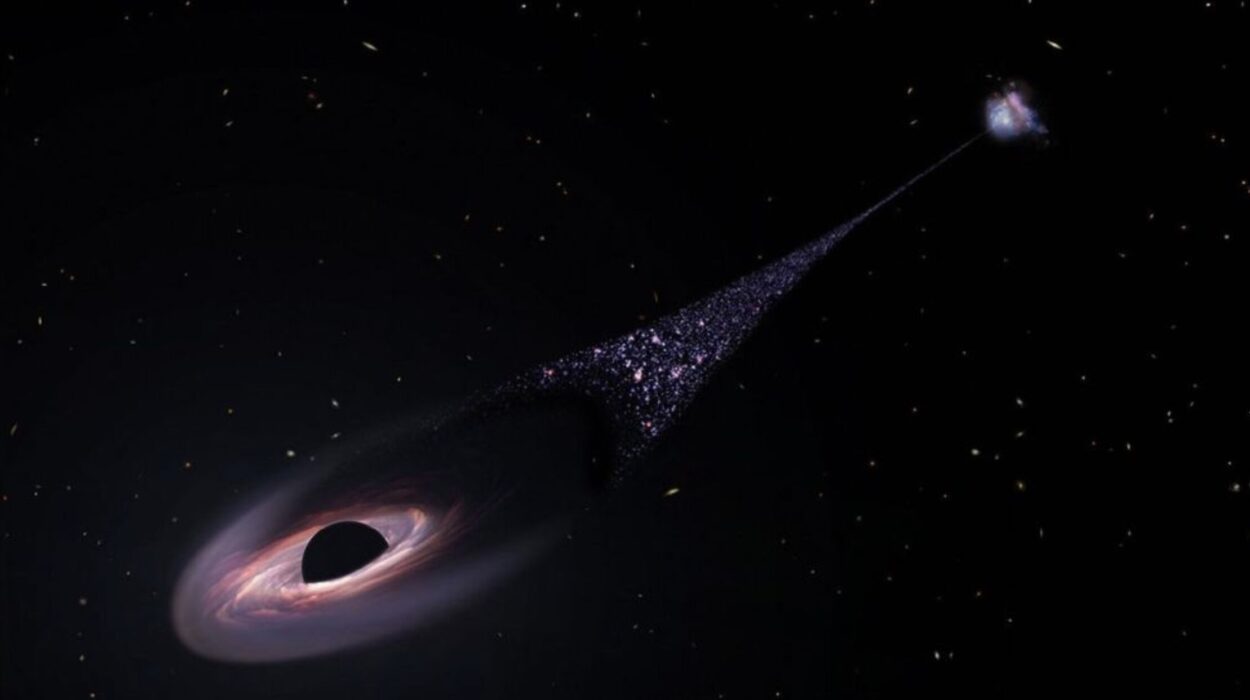
In the crowded, radiation-bathed neighborhoods of the early universe, enormous stars can grow from collapsing gas and then become black holes weighing hundreds of thousands of Suns. In new cosmological simulations, those black holes rapidly gain more mass, briefly pass through a dense, obscured phase resembling the mysterious “little red dots” seen by the James Webb Space Telescope, and develop into black holes far more massive than expected for their host galaxies.
Supermassive black holes existed less than a billion years after the Big Bang, but explaining how they became so large so quickly remains a challenge. Recent James Webb Space Telescope observations have added to the puzzle: some early black holes appear unusually massive compared with the stars in their host galaxies, exceeding the relationships measured in the nearby universe.
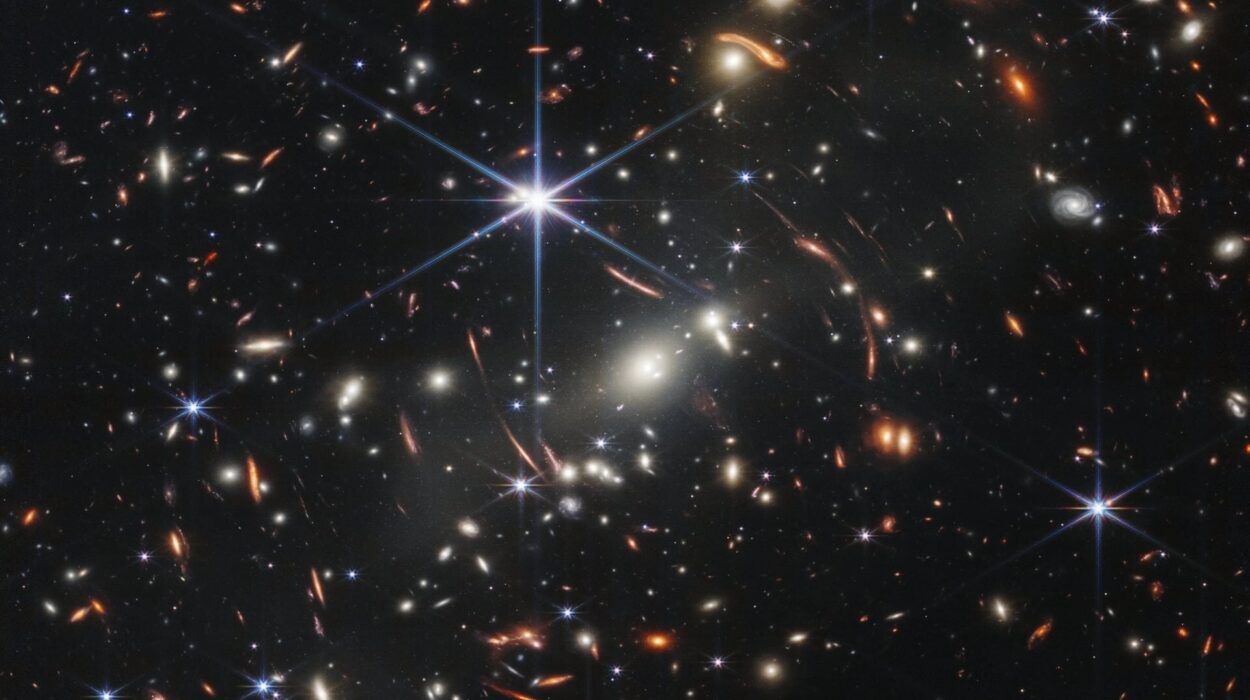
Among the objects attracting attention are compact, red sources known as little red dots, or LRDs. Their spectra include broad hydrogen emission and absorption features, along with distinctive red or V-shaped continua. These characteristics point to black holes growing in dense, obscured environments, but the process that creates such systems has been uncertain.
Sunmyon Chon and colleagues used cosmological radiation-hydrodynamic simulations to follow the formation and early growth of black holes in a protocluster environment. Their calculations connect several stages: the formation of exceptionally massive stellar objects, their collapse into heavy black-hole seeds, a short burst of super-Eddington accretion, and the emergence of systems with properties resembling LRDs.
The simulations produced seeds of roughly one million solar masses, about an order of magnitude heavier than the approximately 100,000-solar-mass seeds often considered in standard direct-collapse models. The black holes then grew to around 30 million solar masses by a redshift of about 8.
Intense radiation delays the collapse
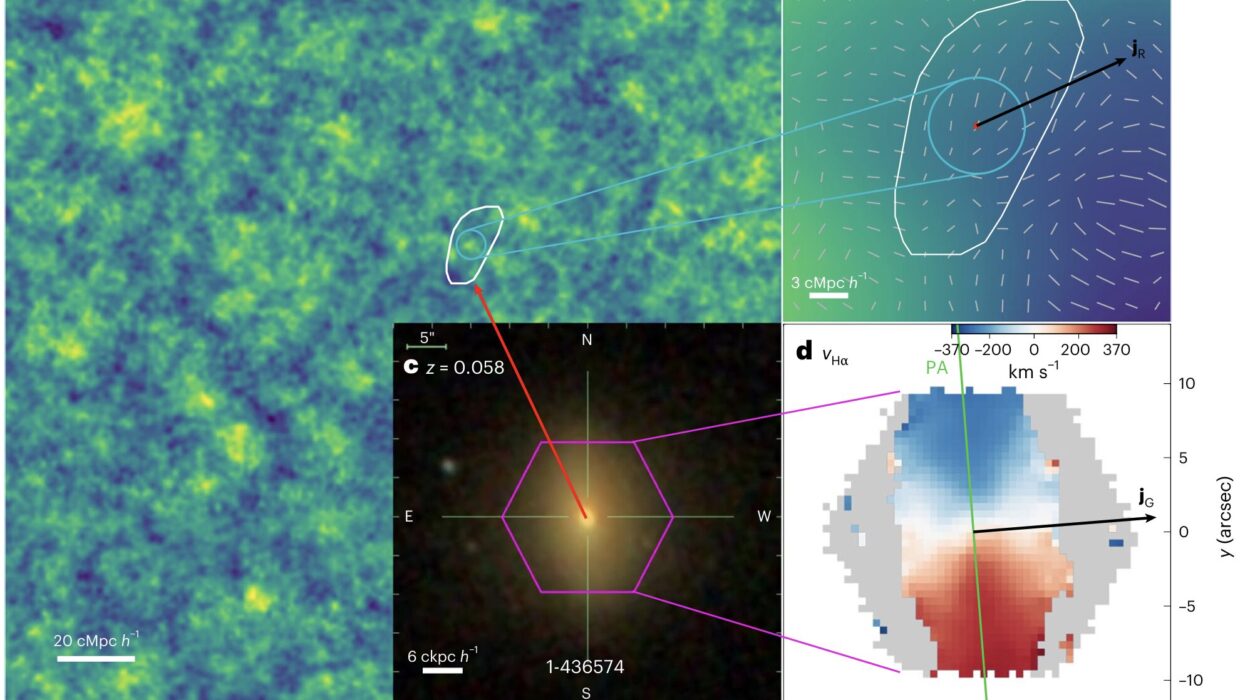
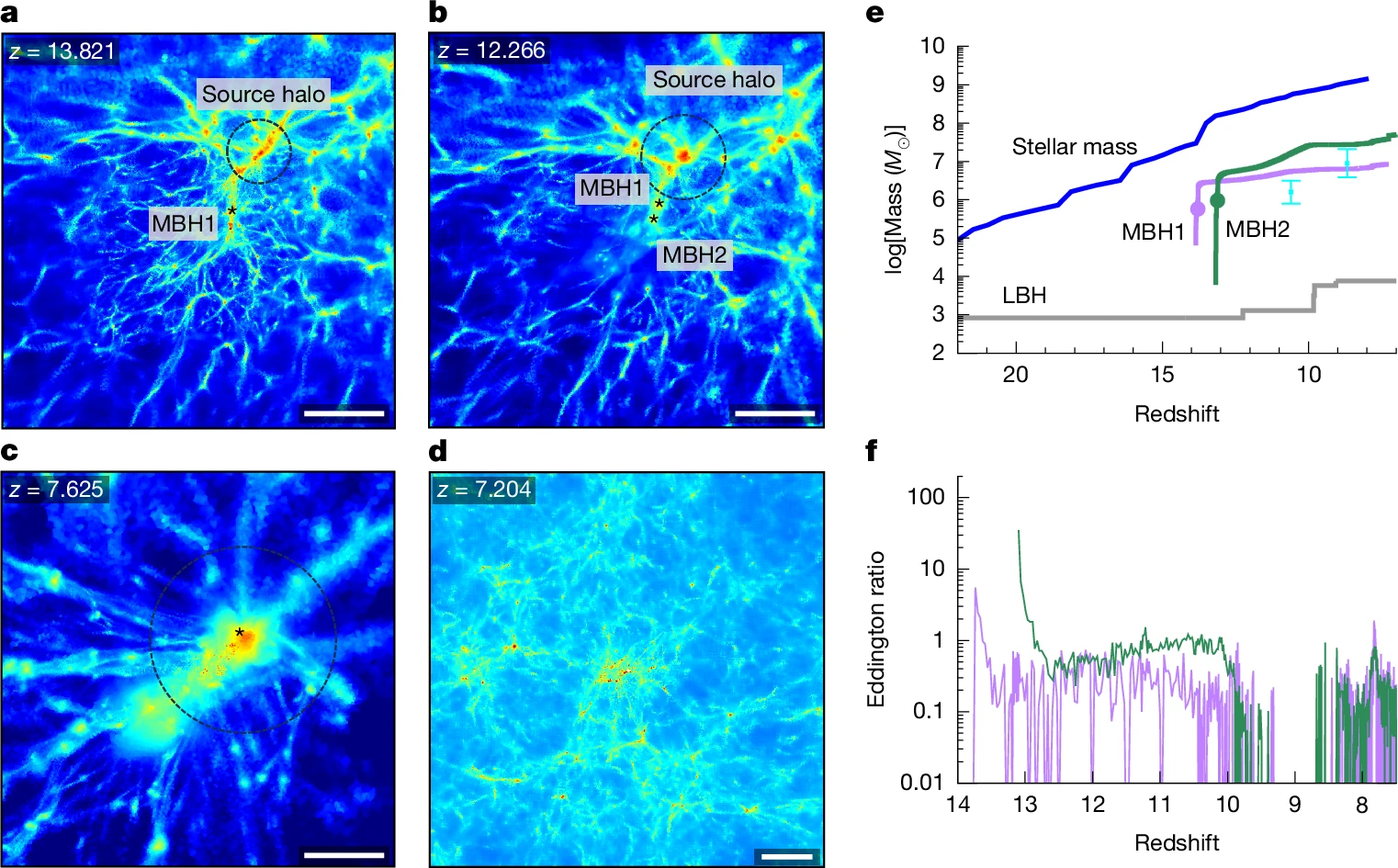
The researchers focused on a halo in an overdense region of the early universe. A nearby luminous galaxy, about 10 kiloparsecs away, supplied intense far-ultraviolet radiation. That radiation suppressed early star formation in the target halo, allowing it to accumulate a large reservoir of gas before collapse began.
The selected region was a 3.8-sigma density fluctuation, meaning it was substantially denser than average. The target halo’s deep gravitational potential was also important. Its virial temperature reached roughly 40,000 kelvin, allowing it to retain ionized gas and sustain the high inflow rates needed to build massive stellar objects.
As the gas collapsed at around redshift 14, the central protostars grew to masses of approximately 500,000 to 900,000 Suns. Several potential seed-forming sites appeared in the same overdense environment, suggesting that this process need not be confined to a single object.
The authors’ calculations indicate that the combination of strong external radiation and a massive host halo can create conditions favorable to heavy-seed formation. The radiation delays ordinary star formation, while the halo’s gravity helps keep the accumulating gas bound.
Multiple supermassive stars emerge
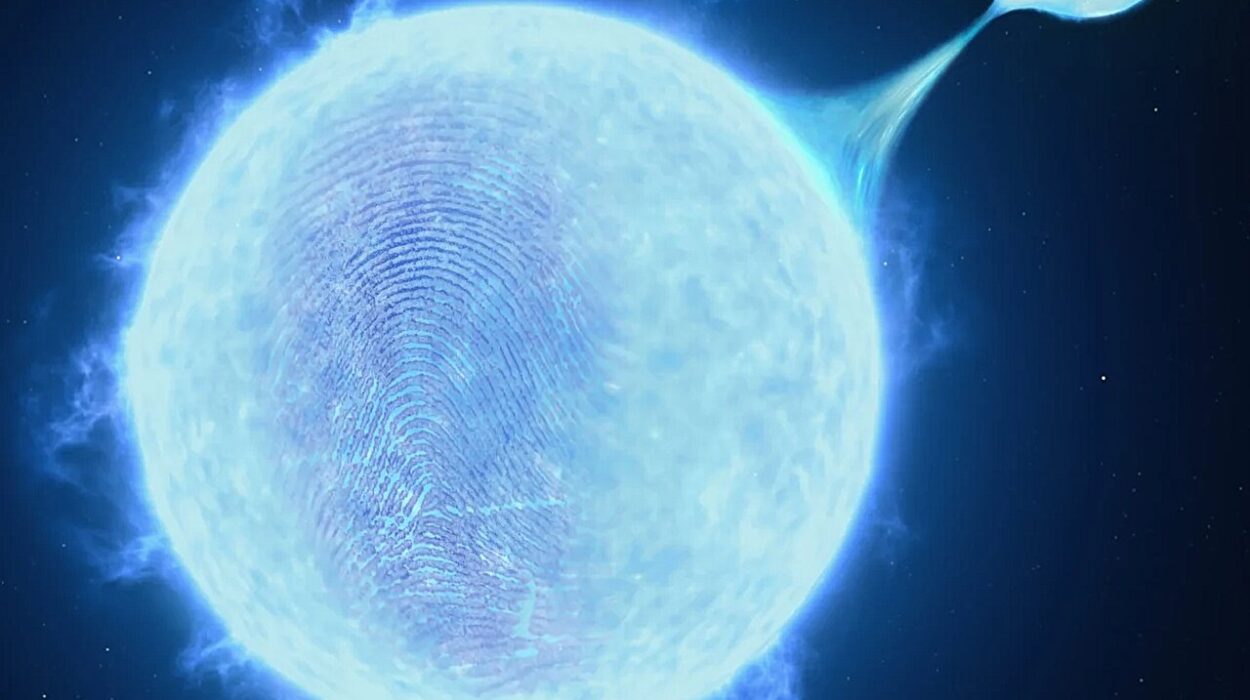
A higher-resolution simulation examined the collapsing cloud that produced the first heavy seed, designated MBH1. Rather than forming one isolated star, the cloud fragmented into a dense multiple system.
The protostars accreted gas at rates of roughly 0.1 to 1 solar mass per year. The most massive object reached about 400,000 solar masses around two million years after the first protostar formed. The four most massive protostars grew to several hundred thousand solar masses, with their mass histories also reflecting mergers.
Rapid accretion kept the stars in inflated supergiant phases. Their radii generally exceeded 100 solar radii and could expand to between 100 and 1,000 solar radii. The stars’ sizes varied as accretion proceeded in bursts, producing cycles of contraction and reinflation.
In the simulations, these extended stars had weaker ultraviolet emission than more compact stars would, reducing their radiative feedback on the surrounding gas. That helped prevent the gas from being photoevaporated and allowed further accretion. The stars eventually collapsed into black holes, with dense gas still gravitationally bound around them.
The calculation’s treatment of stellar evolution includes important approximations. The individual protostars were represented by sink particles, and the numerical resolution did not reach the very high densities at which gas becomes optically thick and protostars physically form. The authors compare their approach with higher-resolution work and note that large-scale inflow is expected to regulate much of the mass growth. They also describe the final stellar masses as lower limits because their feedback prescription can overestimate stellar luminosities.
A short burst of rapid black-hole growth
Once the supermassive stars collapsed, the newly formed black holes were surrounded by dense, optically thick gas. The material formed an envelope and disk that could continue feeding the black holes. In this setting, radiation became trapped in the inflowing gas, allowing matter to fall inward faster than photons could escape.
That process enabled brief periods of super-Eddington accretion, meaning the black holes gained mass at rates above the classical Eddington limit. The two heavy seeds underwent episodes lasting less than a million years, with accretion rates reaching several to a few tens of times the Eddington rate. They grew to several million solar masses soon after formation. As their gas reservoirs dwindled, their accretion rates declined, but they continued growing and reached more than 10 million solar masses by about redshift 10.
The black holes later moved into the central regions of a nearby massive halo. Their surrounding gas was stripped as they passed through the hot environment, and dynamical friction gradually brought them toward the galaxy’s center. By redshift 8, they had settled within its central kiloparsec. The galaxy had a stellar mass of about one billion Suns, while the black holes’ combined growth left the system with a black-hole-to-stellar-mass ratio of roughly 1 percent, about an order of magnitude above the local relation.
For a brief period, accretion approached the Eddington limit, and the simulated black-hole masses and luminosities were consistent with those of observed high-redshift active galactic nuclei. The authors estimate a lower limit of about 10⁻⁴ such massive-black-hole-hosting galaxies per cubic megaparsec, consistent with the abundance needed to account for observed LRDs.
Dense disks can produce little-red-dot-like spectra
The simulations also followed the gas close to one of the heavy seeds, MBH2, resolving scales down to 500 astronomical units. At 26,000 years after the black hole formed, it was embedded in a geometrically thick disk with hydrogen densities above 10¹⁰ particles per cubic centimeter.
At these densities, hydrogen atoms can accumulate in an excited state that supports strong Balmer absorption. The large electron column also makes Thomson scattering important: photons scatter from free electrons, broadening the Hα emission line. In the simulation, the Hα luminosity within 10,000 astronomical units was 1.5 × 10⁴³ ergs per second, comparable to values inferred for LRDs. The Thomson optical depth at that radius was 10.2.
The authors note that this optical depth is higher than the approximately 0.1–1 inferred observationally. They explain that the effective optical depth experienced by Hα photons is lower than the quoted radial value because much of the emission comes from near the disk’s outer region.
In this early phase, the system therefore had physical conditions associated with the proposed “black-hole star” interpretation of LRDs. Its broad Hα emission arose directly from dense gas around the black hole, without requiring the researchers to impose a separate broad-line region.
The obscured phase did not persist unchanged. By 523,000 years after formation, the disk had become thinner and rotationally supported. Its gas remained dense, but the Thomson optical depth had fallen to 0.43 and the Hα luminosity had dropped to 5.3 × 10³⁹ ergs per second, below typical LRD values.
The authors suggest that strong Hα emission at this later stage would require additional line emission from the inner region, within about 100 astronomical units, similar to a compact broad-line region. With the accretion rate near the Eddington limit, they estimate an inner-disk luminosity of about 10⁴⁴ ergs per second. If 0.1–1 percent emerged as Hα, scattering in the outer disk could broaden the line and produce Hα luminosities of 10⁴¹–10⁴² ergs per second, consistent with active galactic nuclei.
These results point to a transition from a heavily obscured, LRD-like state to a less obscured, more AGN-like phase over roughly 0.1–1 million years after the burst of rapid accretion.
Why the lighter seed struggles to grow
To compare the heavy seeds with a more conventional route, the researchers also tracked a black hole formed from a Population III stellar remnant. This light seed began at roughly 800 solar masses and formed earlier, around redshift 22.
Its growth was inefficient. Radiation from the original star heated and expelled gas from the shallow gravitational potential of its host halo. The gas density around the black hole remained at or below about one particle per cubic centimeter, and the estimated Bondi accretion rate was only 10⁻⁸ to 10⁻⁷ solar masses per year, far below its Eddington accretion rate.
When the halo later became deep enough to collect gas, much of that supply went to the more massive MBH1. The light seed’s smaller mass also meant a longer dynamical-friction timescale, slowing its movement toward the galaxy center. Interactions with nearby gas eventually raised its mass to several thousand Suns, but it remained far less massive than the heavy seeds.
The comparison supports the authors’ conclusion that the heavy seeds’ initial mass and their ability to retain a dense gas supply are central to producing the overmassive black holes in their simulations.
The simulated systems are also X-ray faint
The team examined whether radiation from the growing black holes would be visible in X-rays. They measured gas column densities along 64 directions around MBH2 at two stages of its evolution.
During the early super-Eddington phase, the hydrogen column density exceeded 10²⁶ particles per square centimeter in every direction. The authors conclude that X-rays would be strongly Compton-scattered and effectively undetectable from any viewing angle. At the later epoch, the column density had declined to between 10²⁵ and 10²⁶ particles per square centimeter, but the source would still be difficult to detect in X-rays.
In their model, the LRD-like system remains X-ray dark for at least its first roughly half-million years, which the authors say is consistent with current observational constraints.
Heavy seeds also form at later times
The researchers ran another simulation of a candidate region in which direct-collapse black-hole formation occurred at the later redshift of about 14. Eight seed black holes formed in that region. By redshift 7.011, some had migrated into the centers of massive halos, while other clumps were still forming black holes.
All eight seeds grew beyond one million solar masses after brief super-Eddington episodes. Some underwent repeated bursts of rapid accretion. This second calculation indicates that the formation of heavy seeds followed by super-Eddington growth is not restricted to the very earliest epochs represented by the first simulation; it can also occur at later times overlapping the redshift range in which LRDs have been observed.
How sensitive are the results?
The authors tested the model by increasing the numerical resolution and by reducing the far-ultraviolet radiation intensity from the neighboring source galaxy. The higher-resolution run produced one light seed followed by two heavy seeds, with growth histories nearly identical to the standard calculation.
In three additional runs, the background Lyman–Werner radiation intensity was reduced by factors of two, five and ten. The heavy seeds still formed. Their formation redshift shifted by less than about 0.1, and the final black-hole mass varied by less than a factor of three. Even in the weakest-radiation case, the most massive black hole reached 1.9 × 10⁷ solar masses by redshift 7.
The authors also identify limits to what their simulations establish. The calculations do not include kinetic feedback from black-hole jets or winds, which could reduce accretion if those outflows transport mass and momentum into the surrounding gas. The researchers therefore treat their model as a fiducial case that gives an upper limit on black-hole growth under the assumption that kinetic feedback is absent.
The simulation also does not resolve the full galactic gas inflows needed to maintain long-term Eddington accretion. The authors suggest that, if those larger-scale supplies are captured, the black holes could continue growing toward one billion solar masses, but that later growth is not demonstrated by the present calculation.
The team further notes that the formation sites are only a subset of the regions around massive halos. Several heavy seeds can form close together and later merge as galaxies assemble. The authors discuss possible gravitational-wave signals from such mergers, including characteristic strains of approximately 10⁻¹⁷ to 10⁻¹⁶ at millihertz frequencies and an estimated tens to hundreds of LISA events over a three-year mission for similar heavy-seed scenarios. These are implications drawn from the modeled population and extrapolations, rather than merger detections in the simulations themselves.
The study was published in Nature.