The rotation of galaxies may preserve a faint record of gravitational forces acting before galaxies formed, with new observations providing strong evidence that some present-day galactic spins are linked to those primordial conditions.
A galaxy’s spin, measured through its angular momentum, plays an important role in determining its size and shape and in governing the motions of its stars and gas.
One explanation for where that spin came from is called tidal torque theory. It proposes that gravity began influencing the angular momentum of matter before galaxies themselves formed.
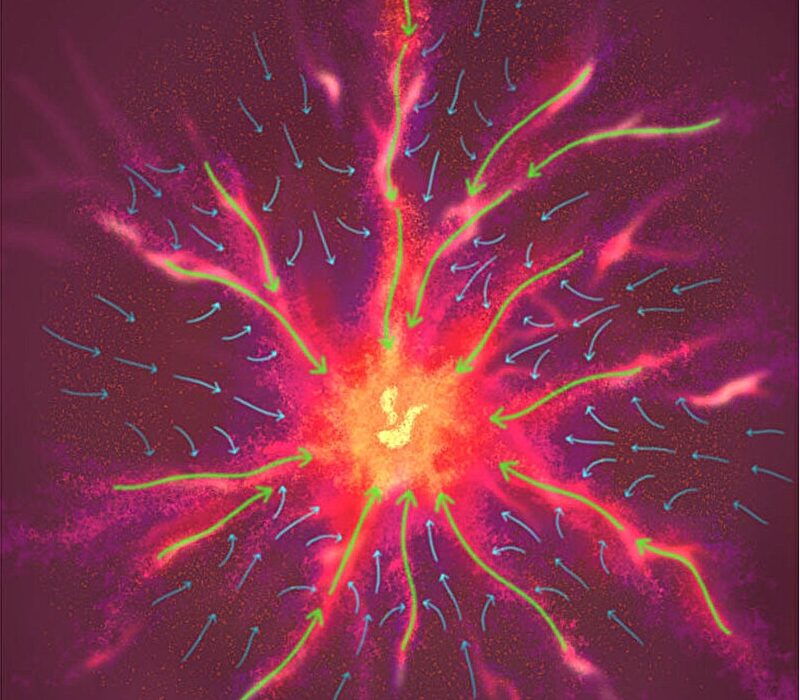
In the early universe, gas and dark matter gathered into uneven clumps. If one of those clumps was slightly elongated, gravity from a nearby massive structure could pull more strongly on the closer end. That uneven force could make the clump rotate.
Under tidal torque theory, some of that early rotation should survive as galaxies formed, leaving a measurable connection between their present-day spins and the gravitational environment of the early universe.
The idea has been widely considered plausible, but confirming that connection has been difficult.
Tracing present-day spins back in time
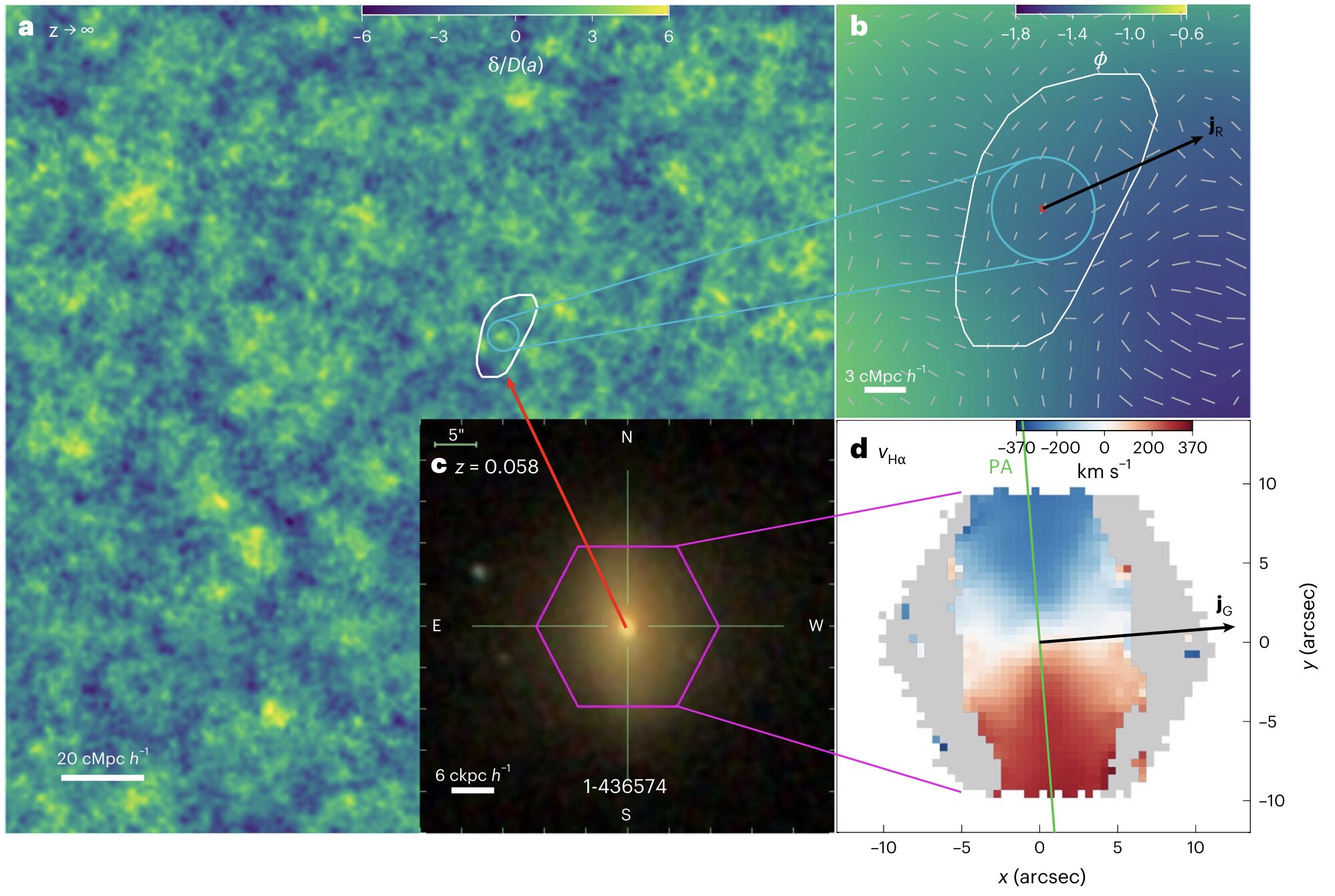
Ming-Jie Sheng of Xiamen University and colleagues tested the idea using data from the ELUCID project, which reconstructs the distribution of matter in the early universe from the locations of galaxies observed today.
The researchers used that reconstruction to trace the expected pattern of galaxy spins back to the primordial tidal forces that produced them. They then compared the predicted pattern with actual measurements of how gas and stars move inside individual galaxies.
Those measurements covered a substantial sample of galaxies in the nearby universe.
The strongest connection appeared in massive elliptical galaxies
The clearest agreement emerged in the gas of large, massive elliptical galaxies.
When the researchers compared the spin of that gas with the pattern predicted from primordial tidal forces, they found a strong correlation. The strength of the correlation was sufficient to rule out chance with very high confidence.
That result provides the clearest evidence to date that present-day galaxies can retain an imprint of conditions in the universe’s infancy.
The finding does not mean that a galaxy’s rotation is completely determined by its earliest environment. Much of a galaxy’s rotation can be scrambled over time by mergers and other forms of disordered growth.
Instead, the result supports the idea that some connection between the gravitational forces acting in the early universe and the spins of galaxies today can survive the later evolution of galaxies.
Galaxy spins could also probe early cosmic conditions
The result may also offer a way to study properties of the universe that are otherwise difficult to measure.
The primordial tidal forces that helped establish galaxy spins could carry information about subtle components of the universe, including neutrinos. Such ingredients may leave their own effects on those early gravitational forces.
The study was published in Nature Astronomy.