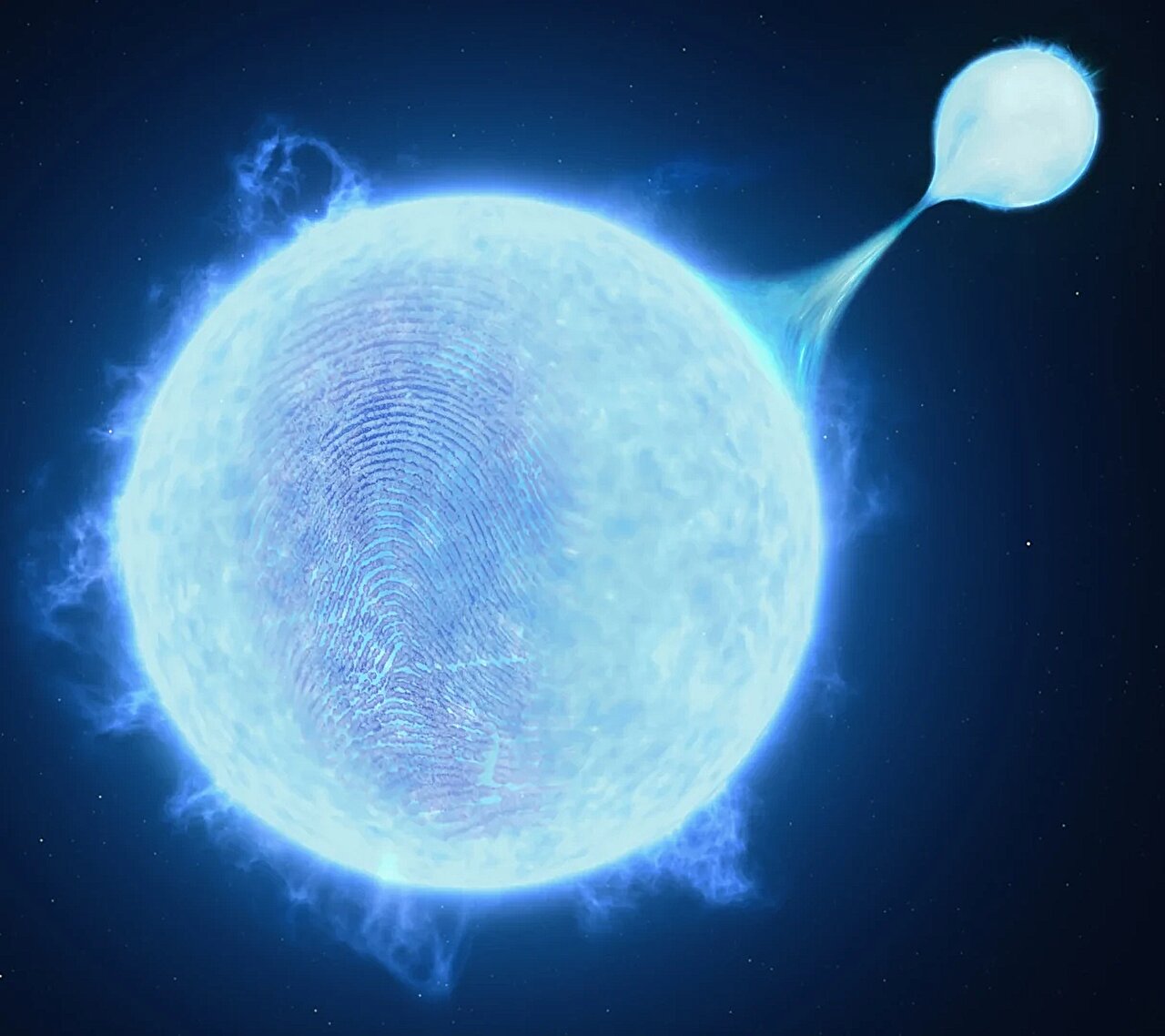
More than 70% of massive stars are born with a close companion, but after mass transfer, a merger or a supernova can leave one star apparently alone. A new study shows that the surviving star may still carry chemical evidence of that earlier partnership in its surface layers.
When two massive stars interact, one can transfer material to the other. The receiving star, known as the accretor, takes in material from the companion’s outer layers as well as material from deeper regions that has been altered by nuclear fusion.
That processed material is rich in nitrogen and helium and depleted in carbon and oxygen. After it mixes into the accretor’s outer layers, it can leave a measurable chemical pattern on the star’s surface.
The researchers found that this pattern can distinguish stars that gained mass from stars that evolved without such an interaction or stars that lost mass to a companion.
Their approach uses a diagnostic diagram based on two ratios: nitrogen to carbon and nitrogen to oxygen. Most stars follow one trend in this diagram, while mass gainers occupy a separate branch.
This gives astronomers a way to identify a past binary interaction even when the companion is no longer present.
The surface chemistry can reveal the original binary
The researchers developed an analytical framework that uses observed surface abundances to estimate the amount and composition of material a star accreted. The method does not depend on a particular stellar evolution model.
From those chemical measurements, the researchers can reconstruct aspects of the original binary system, including the masses of the two stars and how efficiently mass was transferred between them.
The approach therefore turns the present-day chemical composition of a star into evidence about an earlier stage of its evolution.
Gamma Columbae has a different history than expected
The method also changes the interpretation of γ Columbae, a star that had long been considered a rare stripped star. Such a star was thought to have exposed its core after losing its outer layers.
Instead, its surface chemistry fits the predicted pattern of a former mass gainer. γ Columbae has a high nitrogen-to-carbon ratio, a moderate nitrogen-to-oxygen ratio and enhanced helium.
According to the researchers, those properties are consistent with the star having accreted material from a massive companion.
The result raises the possibility that other stars previously classified as stripped stars could also have gained material from companions rather than simply losing their own outer layers.
Testing how massive binaries exchange mass
The chemical method can be applied to different kinds of massive stars, including runaway stars, supergiants and the progenitors of supernovae.
It also provides a way to test theories of binary evolution. In particular, the researchers can compare observed chemical signatures with theoretical models to investigate the efficiency and stability of mass transfer and the loss of angular momentum.
The same approach can also be used to study stellar mergers.
The researchers applied it to Supernova 1987A, which has long been considered the product of a stellar merger. Using the method, they reconstructed the masses of the two stars before the merger and found evidence that a significant amount of mass was expelled during the merger.
Large surveys such as WEAVE and 4MOST are expected to provide precise measurements for thousands of massive stars. Those observations could give astronomers many more stars whose surface chemistry can be examined for evidence of past binary interactions.
The study was published in Nature Astronomy.