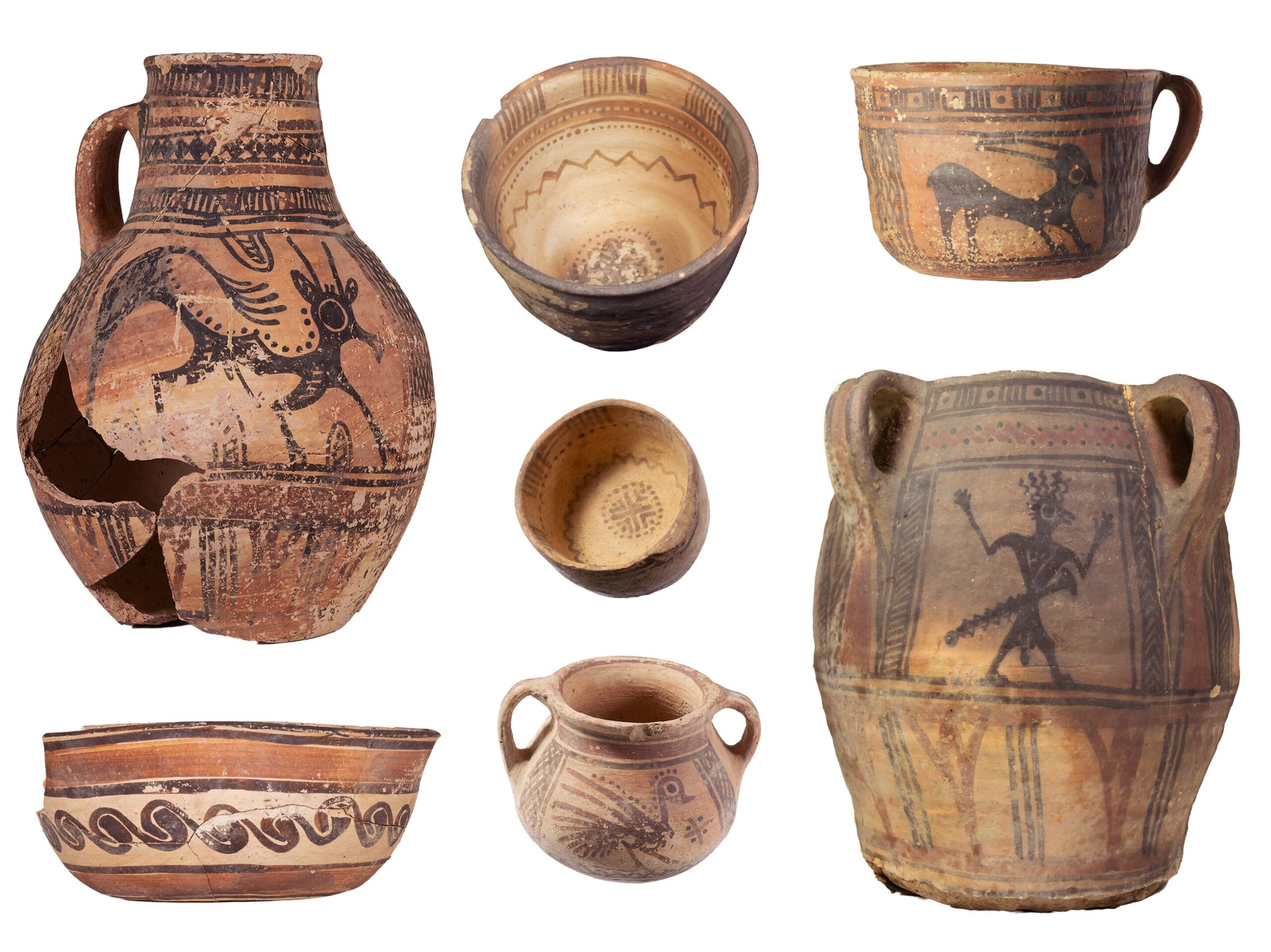
About 3,200 years ago, potters at the oasis of Qurayyah in northwestern Arabia were making painted vessels distinctive enough to be recognized, valued and traded far beyond their home. New analysis suggests that this pottery met several criteria archaeologists can use to identify an ancient brand, offering evidence that recognizable producer identities existed in a Bronze Age economy.
An international research team led by Marta Luciani of the University of Vienna examined several dozen Bronze Age pottery vessels from Qurayyah. The analysis established, for the first time, that the pottery known as “Midianite Pottery” originated at the oasis.
The vessels are known for their two-color painted decoration. Their designs eventually included painted animals and scenes of human rituals, creating a recognizable repertoire that circulated well beyond Qurayyah.
The evidence also challenges earlier ideas that such an arid oasis was a marginal place. The researchers found that its potters developed their own ceramic tradition while participating in wider networks of technological knowledge involving neighboring regions, including the Southern Levant and Syria.
Researchers used several tests to identify a brand
Calling Bronze Age pottery a “brand” requires more than finding attractive or unusual designs. The researchers developed a set of criteria for identifying ancient brands.
These included a recognizable visual identity, consistency in the materials used, continuity in production techniques, centralized production, export beyond the place of manufacture, local imitation, an intentional commercial purpose and a cultural reputation.
The Qurayyah pottery fit these criteria, according to the researchers. Its distinctive appearance, continued production and movement across long distances were part of the evidence supporting that interpretation.
The team reached its conclusions by combining several kinds of analysis. Researchers examined pottery from different archaeological layers and studied how the vessels were shaped. They also examined thin sections of the ceramics under a polarizing microscope to investigate their mineral composition.
Chemical analysis provided another check. Neutron Activation Analysis was used to identify trace elements in the vessels, producing chemical fingerprints that could be compared across the pottery.
The style kept changing while remaining recognizable
The earliest Qurayyah Painted Ware dates to about 3,600 years ago. But production did not simply preserve one fixed design. Instead, the pottery tradition continued to develop.
About 400 years later, around 3,200 years ago, potters were producing a larger range of painted animals and scenes depicting human rituals. This period of production is the point the researchers identify with the pottery becoming a brand.
The vessels were exported hundreds of kilometers north into the Southern Levant, including to sites such as Tell el-Kheleifeh. Some also reached the Timna sanctuary of the Egyptian goddess Hathor. The pottery was also distributed southward into northern Arabia.
Yet the tradition did not disappear as its products traveled elsewhere. Pottery production remained based at Qurayyah for another thousand years, continuing into the final Iron Age.
The findings therefore connect a distinctive visual style with sustained local production, trade and recognition across a broad region. For the researchers, those combined characteristics provide the basis for describing Qurayyah’s Bronze Age pottery as an ancient brand.
The study was published in PLOS ONE.