One brother was placed beside his wife in one of the richest tombs at a cemetery on the Mongolian steppe; his brother, despite belonging to the same family line, ended up more than 200 meters away at the edge of the burial ground. That striking contrast is helping archaeologists reconstruct a society in which blood ties mattered, but wealth, political standing and symbolic affiliation could determine who was allowed closest to the center of the dead.
For more than a century, archaeologists have used burial grounds to reconstruct how ancient societies were organized. When several people buried in the same cemetery turn out to be biological relatives, the obvious interpretation is that the cemetery itself was organized around family.
The Tamir necropolis in Mongolia seemed to offer exactly that kind of opportunity.
Ancient DNA had already identified two extended family lineages, designated A and B, among people buried there. Together, the two lineages included 19 individuals in the study sample and stretched across five to six generations. All of the members descended from a common ancestor. Another 28 individuals did not belong to either lineage and were grouped separately.
That genetic structure might appear to make Tamir a straightforward family cemetery.
But the geography of the graves immediately complicated the picture.
Members of lineage A were concentrated in the central part of the cemetery. Members of lineage B, by contrast, were scattered between northern and southern areas, with some burials separated by more than 250 meters. Spouses were repeatedly buried beside one another, while young children could be placed near grandparents.
The researchers wanted to know what those patterns actually meant.
Were people being buried together primarily because they were biologically related? Or did family relationships merely provide one part of a larger social system in which wealth, rank, marriage and political connections determined where someone belonged after death?
To answer that question, the study brought together evidence that is rarely examined as one system: genetic relationships, the physical arrangement of graves, the architecture of tombs, grave goods, burial practices and computational analyses designed to detect patterns that might not be obvious from archaeology alone.
What emerged was not a cemetery arranged simply according to blood.
It was a social landscape.
Tamir was a cemetery for people with power
The eastern sector of the Tamir necropolis lies on a promontory west of the Tamir–Orkhon river confluence, overlooking the floodplain and facing the steppe extending south toward the Gobi Desert.
The broader necropolis contains 398 tombs, divided between a western sector with 344 tombs and an eastern sector with 54. The study focused on the eastern sector because it contains large elite tombs dating from approximately the first century BC to the end of the first century AD.
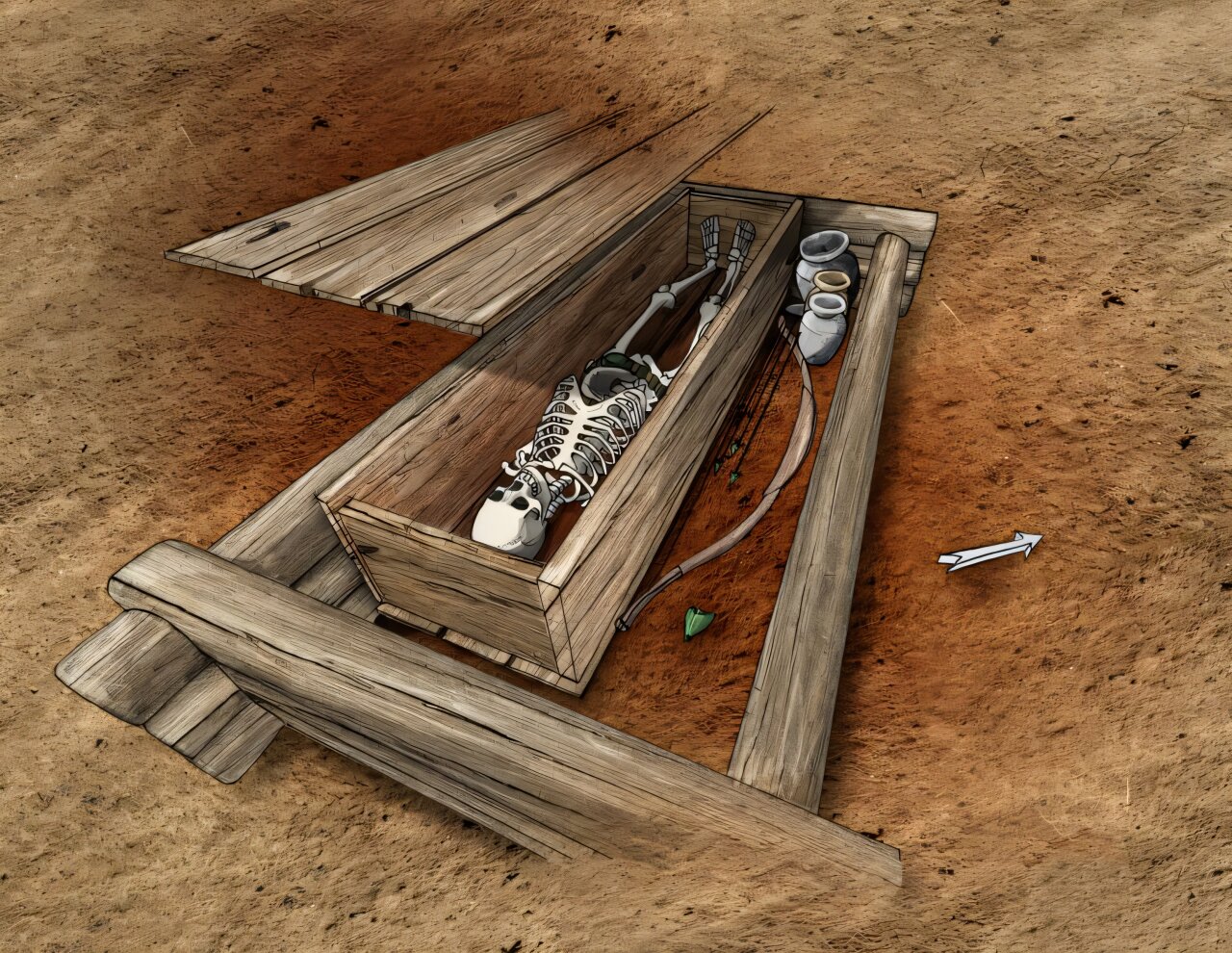
Some of those tombs were substantial constructions. Stone circles could measure more than 20 meters across, while some quadrangular burial pits extended more than 6 meters deep. Many graves had been looted, sometimes repeatedly, leaving precious objects underrepresented. Even so, excavations recovered evidence including iron objects, Chinese lacquerware, pottery and animal remains.
The researchers divided the burials into broad economic categories based on the objects and construction associated with them.
Wealthy individuals tended to have tombs about 4 meters deep, often with two coffins and at least two prestige objects. Their graves could contain traditional Xiongnu prestige goods, Chinese imports such as lacquerware, precious stones including jade and jasper, and metals such as gold, silver and bronze.
Poorer individuals were generally buried around 2.5 meters deep, often without a coffin and with few or lower-quality grave goods. Intermediate burials were around 3.5 meters deep and typically contained one prestige object. Horse bones occurred exclusively in wealthy graves, while goat offerings occurred only in graves belonging to the unrelated group C.
Those differences gave the researchers something crucial to measure.
If biological family were the main force determining burial treatment, closely related people should tend to resemble one another in the cultural and economic features of their graves.
If something else mattered more, those patterns should begin to separate.
The researchers designed their analyses to find out which explanation fit the evidence better.
The people in the graves formed two long family lines
The genetic structure of the cemetery is unusually informative.
Among the 47 individuals included in the study, there were 24 males and 23 females. Only seven were younger than 20 when they died, including two children younger than five. Genetic analysis identified lineage A, containing 10 individuals, and lineage B, containing nine, with both extending across multiple generations.
The researchers used several kinds of genetic evidence to reconstruct those relationships. Y-chromosome and mitochondrial DNA markers helped trace paternal and maternal lines, while short tandem repeat data helped establish familial relationships. Three individuals had no close relatives identified, while the remaining members of group C showed partial genetic matches that could indicate more distant relationships.
The family lines themselves were therefore real.
The question was whether the cemetery followed those lines.
At first, some of the evidence seems to say yes.
Lineage A was concentrated in the center. Spouses in the two major lineages were consistently placed together. Young children were sometimes buried near grandparents. These are precisely the kinds of patterns that might make a cemetery appear familial.
But the researchers noticed something harder to explain.
In each generation of lineages A and B, generally only one individual appears to have been buried in this particular cemetery, often accompanied by a spouse and children who died before reaching marriageable age. Many close relatives, including siblings, appear to have been buried elsewhere.
The cemetery was therefore not simply a place where every member of an extended family was brought after death. Access itself appears to have been selective.
That selectivity becomes especially clear when two brothers are compared.
One brother received an elite burial while the other was pushed to the edge
The contrast between the brothers is one of the clearest clues to the social logic of Tamir.
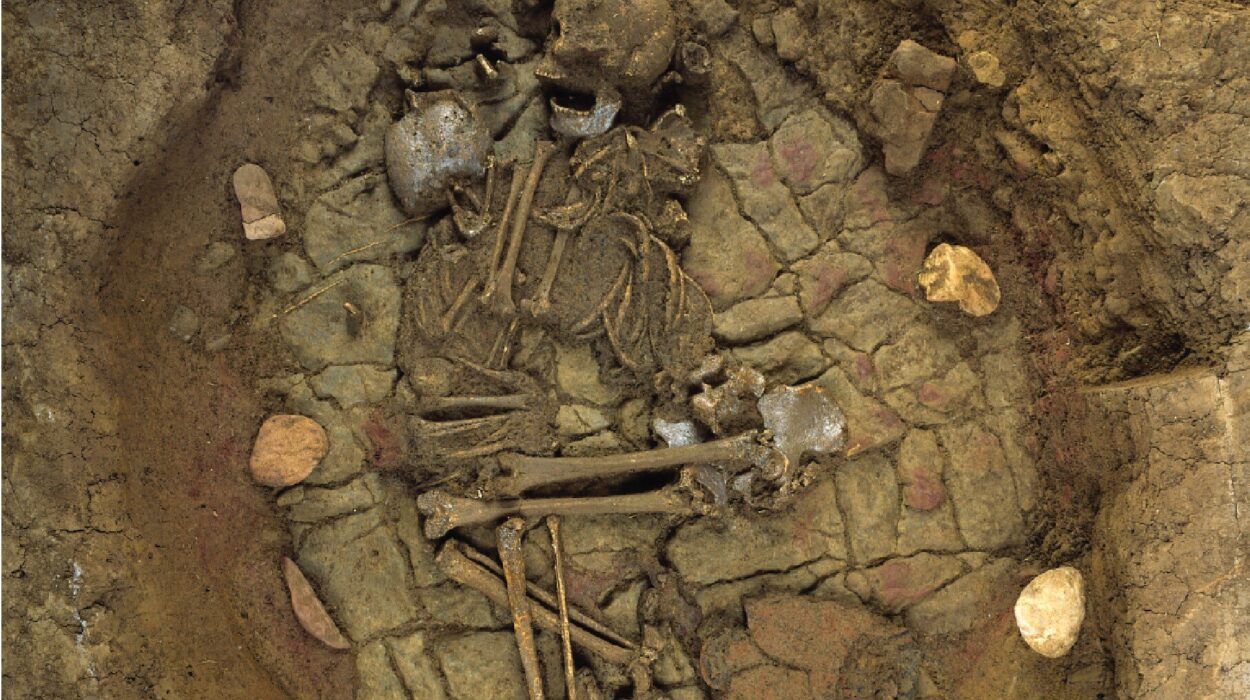
One brother, identified as being in Tomb 25, was buried beside his wife, Tomb 13B, in one of the wealthiest assemblages at the site. Their tomb was positioned near members of lineage A, in the more socially important portion of the cemetery.
His brother, however, was buried more than 200 meters to the north, at the cemetery’s margin.
The two men belonged to the same family line.
Yet their graves occupied radically different places in the social geography of the cemetery.
That difference is difficult to explain if biological relatedness alone determined burial location.
The researchers interpret the peripheral position of the second brother as evidence of an internal hierarchy that could exist even within a family. He had lineage rights, but his position within the descent line apparently did not give him the same access to central funerary space as his brother.
The cemetery therefore appears to have distinguished between being part of a lineage and holding the kind of status that entitled someone to its most prestigious burial locations.
The distinction is subtle but important.
Blood could provide legitimacy.
It did not necessarily guarantee rank.
Genetic relatives did not always share the same cultural identity
The researchers next asked whether the objects and physical characteristics of the graves clustered according to family.
They began with linear discriminant analysis, a statistical method that tests whether groups can be separated using selected characteristics. They then used supervised machine-learning methods including Random Forest, Support Vector Machine and XGBoost, followed by unsupervised K-means clustering to identify patterns without assigning individuals to groups in advance.
The goal was not simply to make a more complicated version of the same family tree.
It was to ask whether the material evidence itself would independently recognize the genetic families.
The first result was striking.
Lineages A and B had cultural profiles that were clearly distinct from group C, the unrelated individuals. The LDA classified those broad groups with 95 percent accuracy, with a Wilks’ Lambda value of 0.0013, indicating strong discriminatory power.
Machine learning produced a similar picture.
Only two individuals were misclassified in the LDA: one person from group C resembled lineage B, while one lineage B individual resembled group C. XGBoost reached 70 percent accuracy and highlighted features such as large and deep tombs, two coffins and prestige objects as important contributors to the distinction between lineage members and unrelated individuals.
At first glance, that might appear to support a strong family effect.
But there was a crucial complication.
The traits separating the family lineages from outsiders were closely tied to wealth and elite treatment.
The strongest signals were not simply biological markers of family membership. They included the physical scale of tombs, coffins, lamps, animal remains and valuable grave goods.
That meant the genetic lineages and social status overlapped—but not perfectly.
The researchers therefore turned the question around.
Instead of asking which cultural traits predicted family membership, they asked what predicted wealth.
Wealth was easier to predict than family
The answer was remarkably strong.
The LDA model predicted wealth category with 100 percent accuracy.
That result does not mean that every wealthy person belonged to one family or that every member of a family was wealthy. In fact, the graves show the opposite.
Of five identified couples, two were wealthy, one was intermediate, one was poor and one consisted of a wealthy male and a poor female. The last pairing involved a man in Tomb 40 and a woman in Tomb 32, and the researchers interpret the mismatch as potentially connected to the economic decline occurring near the end of the cemetery’s use.
The timing is significant.
Radiocarbon dates and Bayesian chronological modeling place the economic collapse of the Xiongnu Empire around AD 85, just before the final two generations buried at Tamir. That estimate is almost identical to the historically reported date discussed by the authors. The final generations show poorer burial treatment, supporting the idea of a progressive decline in economic conditions.
The evidence therefore suggests that status was not static.
The same cemetery changed as the political and economic world around it changed.
That matters because a family-based explanation alone cannot account for those shifts.
The cemetery itself was divided by status
The K-means analysis reinforced the pattern.
The researchers found an optimal solution of five clusters. More than half of the members of lineages A and B fell into two wealthy clusters, one primarily male and one primarily female. But several genetically related people did not end up in the same cultural clusters as their relatives.
Other clusters were defined by different social characteristics.
One was associated with people who underwent cranial-removal practices. Another represented economically disadvantaged individuals. A fifth consisted of older males who also showed evidence of cranial removal.
The important point was that these clusters did not simply reproduce the genetic family tree.
Some members of the same lineage appeared in different cultural groups.
The researchers therefore concluded that socioeconomic status was more important than genetic relatedness in structuring the physical layout of the necropolis.
The cemetery was not ignoring kinship.
It was ranking it.
Some outsiders were allowed surprisingly close to the center
The evidence becomes even more revealing when the researchers examined people who were not closely related to the two principal lineages.
The 28 individuals in group C did not form one extended family. Yet some were buried close to people who held leadership positions and were distantly related to the central lineages.
That means access to the cemetery itself may have been socially selective.
A person did not necessarily need to be a close biological relative to receive an important burial.
Social or symbolic value could apparently compensate for the absence of close genetic ties.
Tomb 22 provides an especially intriguing example.
The woman buried there had no close genetic relationship to the people around her. Yet her son shared the same Y-chromosome lineage as the men of lineage A. The researchers propose that this could indicate a form of symbolic or social adoption, although the evidence cannot establish exactly what relationship existed.
That possibility is important because it demonstrates why DNA cannot simply be treated as a complete record of ancient social identity.
Biological descent and social belonging are not always identical.
Someone could be genetically unrelated but socially accepted.
Someone could be genetically related but occupy a peripheral position.
And someone could enter or reinforce a lineage through marriage.
One woman may have inherited a lineage when no man was available
Another grave complicates the idea of a simple male-only descent system.
Tomb 19 contained a woman belonging to lineage A who may have continued the lineage because her father had no male heir. She was buried beside her husband in Tomb 23, a man carrying the same Y-chromosome haplogroup found in lineage B. The researchers interpret this as a possible redefinition of descent that gave the woman a distinctive status.
Her case is unusual precisely because it does not fit neatly into a strict patrilineal sequence.
The researchers also identify several women who were buried with their husbands despite not fitting a strictly patrilineal funerary complex. Other women, including adults in Tombs 36, 34, 40 and 32 and young daughters in Tombs 21, 11 and 03, were placed at the periphery.
The authors cautiously interpret this peripheral placement as potentially reflecting marginality associated with gender, age or symbolic role.
The result is a social system that was more complicated than either “family” or “patrilineal dynasty.”
Different rules could operate at the same time.
Cultural traditions traveled through families—and across society
The researchers did not stop with the question of who was buried where.
They also wanted to know how burial customs themselves changed.
For this, they constructed a cultural phylogeny using 47 individuals and 14 traits. The traits were coded according to their characteristics, and the earliest burial, Tomb 24, was used as the reference for the analysis. The researchers explored more than 420 million possibilities, ultimately retaining 51 most-parsimonious trees and constructing a consensus tree.
The approach allowed them to ask whether cultural traits were mainly inherited vertically, from parents and earlier generations, or spread horizontally through wider social networks.
The distinction produced a surprisingly mixed picture.
Some traits behaved as if they were strongly connected to family continuity.
The architecture of tombs, including their volume and depth and the number of coffins, tended to be transmitted vertically. So did the inclusion of Xiongnu objects, prestige items and other indicators of wealth.
In other words, families could pass down a recognizable way of displaying status.
But other practices behaved differently.
Tomb orientation, the abundance of pottery, lamps and swords, and practices such as cranial removal appeared to spread through broader social mechanisms rather than simply following biological descent.
Some traits, including inferred social roles and the presence of Chinese imports, showed vertical patterns but also strong social mediation.
The cemetery therefore preserved both family inheritance and wider cultural exchange.
A family’s wealth could shape the appearance of its tombs across generations.
But burial customs could also change through contact with people outside the family.
The family model lost to the economic model
The cultural phylogeny produced three broad cultural groupings.
One clade contained nine of 11 related individuals and was closest to the earliest reference individual, Tomb 24. Another consisted mostly of unrelated people with culturally divergent traits. A third, intermediate clade contained both related and unrelated individuals. The researchers interpret these as three cultural pools: an elite familial group, a more general familial group and an unrelated group.
The critical test came from comparing different explanations for how those cultural patterns evolved.
The researchers used Bayesian modeling to compare scenarios based on no prior structure, familial organization, economic organization and the structure suggested by the cladistic analysis.
The result was consistent across the evolutionary model comparisons.
The familial model was repeatedly outperformed by economic, cladistic and even random models.
Economic variables provided the strongest explanatory power.
That does not mean family was irrelevant.
It means that biological kinship alone could not explain the cultural organization of the cemetery as well as economic and social factors could.
The distinction is crucial.
The two genetic lineages were real, and they mattered. But their influence operated within a broader hierarchy.
The cemetery may preserve a political struggle
The final interpretation takes the evidence beyond the cemetery itself.
The researchers compare the spatial and genealogical structure of Tamir with the known political organization of the Xiongnu confederation.
The Xiongnu political system had a dual organization, divided into Left and Right branches. According to the historical framework used in the paper, these branches could be led by sons or other close relatives of the Shanyu, with the Left branch often associated with the heir.
The authors propose—carefully, as a hypothesis—that lineage A might correspond to one of these branches and lineage B to the other.
Under that interpretation, the cemetery’s changing organization could reflect changes in political power.
Lineage A appears to have followed a strongly patrilineal model until the fourth generation, when the absence of a male heir may have led to the incorporation of a socially modest son-in-law.
Lineage B, meanwhile, appears to have strengthened its patrilineal identity through a wealthy alliance involving the individual in Tomb 13B, who was connected to Chinese elites. The researchers propose that this could reflect a shift in political influence from one branch to the other.
If that interpretation is correct, it would help explain why lineage B continued placing male descendants in the cemetery for two additional generations while lineage A eventually lost its central role.
But the authors are explicit about the limits of this reconstruction.
Detailed historical records do not exist for the specific social organization represented at Tamir. The Left-versus-Right interpretation is therefore a framework for understanding the evidence, not a demonstrated identification of the cemetery’s lineages with those political branches.
The uncertainty matters.
The strongest evidence comes from the graves, genetic relationships and statistical analyses.
The political identities assigned to those patterns remain interpretive.
The cemetery was changing as the Xiongnu world changed
The Tamir burial ground was in use for roughly two centuries, from the early first century BC to the end of the first century AD.
Its earliest phase followed military defeats suffered by the Xiongnu against Han forces between 129 and 119 BC, after which Xiongnu groups retreated north of the Gobi Desert into the region where Tamir is located.
Its final burials coincide with the defeat of the Northern Xiongnu by the Han in AD 89. The eastern section of the cemetery appears to have been abandoned around AD 100, while the last tombs—18, 32 and 11—were notably poorer.
The archaeological evidence therefore records not just family continuity but a changing political and economic environment.
The decline visible in the final generations is consistent with the model that places the collapse around AD 85.
The cemetery’s social hierarchy did not exist outside history.
It responded to history.
As political circumstances shifted, the material signs of status changed with them.
That is another reason why the researchers argue against treating Tamir as simply a family burial ground. A purely genealogical explanation cannot easily account for economic decline, changing access to prestige objects and shifts in cultural practices across generations.
Even burial customs could move independently of bloodlines
One of the most revealing aspects of the study is that the researchers found different rates of cultural transmission for different traits.
A family could preserve the size and architecture of its tomb and continue using prestige objects, while another aspect of burial practice changed because of broader social influences.
That means culture did not travel through the cemetery along a single route.
Some practices moved from generation to generation within families.
Others moved sideways, between people who were not necessarily related.
The distinction helps explain why unrelated people could sometimes resemble members of elite lineages in the archaeological record.
Three individuals in group C, for example, displayed traits strongly associated with lineage members, including large and deep tombs, double coffins and prestige objects.
Their genetic ancestry did not put them inside the principal lineages.
Their funerary treatment nevertheless brought them closer to the cultural world of those lineages.
Status could therefore create cultural similarity without biological kinship.
That is precisely the pattern the researchers were trying to uncover.
The evidence changes what a DNA-based cemetery study can tell us
Ancient DNA has transformed archaeology by allowing researchers to reconstruct relationships that cannot be seen from bones or artifacts alone.
But the Tamir study makes a broader point: knowing who was biologically related does not automatically tell us how people understood family, status or belonging.
The cemetery contains people who were genetically related but socially separated.
It contains people who were not closely related but were granted access to prestigious burial space.
It contains marriage alliances that crossed lineage boundaries.
It contains a woman who may have continued a lineage when no male heir was available.
It contains wealthy and poor couples whose burial treatments differed.
And it contains cultural traditions that sometimes followed family lines and sometimes moved across them.
The researchers’ conclusion is therefore not that genetics failed.
Quite the opposite.
Genetic relationships provided the framework that made the more complicated social pattern visible.
Without the family reconstructions, the difference between lineage membership and social status would have been much harder to identify.
But without the grave architecture, spatial distribution and material culture, the genetic evidence might have encouraged an overly simple interpretation of the cemetery as a family-based burial ground.
The study required both.
One grave can belong to a family without belonging to its center
The contrast between the two brothers ultimately captures the logic of Tamir better than any single statistic.
They shared a biological connection.
But they did not share the same place in the cemetery.
One was buried with his wife in an exceptionally wealthy tomb near the center. The other was placed far away, at the periphery. The difference suggests that membership in a lineage did not automatically translate into equal social standing.
That same principle appears repeatedly across the site.
Lineage A occupied the central area, while lineage B was more dispersed.
Some women followed their husbands into important burial spaces; others were placed at the margins.
Some unrelated people gained access to areas associated with socially important individuals.
Some family traditions were passed from one generation to the next, while other customs changed through wider social interaction.
The result is a cemetery that looks less like a family tree and more like a map of a society.
Its center was not simply where the oldest ancestors lay.
It was where lineage, wealth, legitimacy and symbolic importance converged.
What the researchers can say—and what remains uncertain
The study provides strong evidence that biological kinship was not the sole or primary organizing principle of the Tamir necropolis.
The combination of genetic reconstruction, spatial analysis, statistical modeling, machine learning and cultural phylogenetics consistently points toward socioeconomic factors as a stronger explanation for the overall organization of the burial landscape.
But the researchers do not claim that every burial decision has been solved.
The sample is relatively small: 47 individuals from 44 graves were included in the analysis. Ten graves were excluded, including six from earlier excavations, two with incomplete information because of later disturbance, and two that belonged to a much later Turkic horizon rather than the Xiongnu period.
The researchers also acknowledge that classifying individuals according to wealth and family is constrained by the archaeological record, especially because many graves had been looted.
The political interpretation is likewise tentative. The possibility that lineages A and B corresponded to larger Xiongnu political branches is an interpretive hypothesis rather than a conclusion directly demonstrated by the cemetery.
And the meaning of some individual burials remains uncertain.
The man returned to the cemetery in a secondary burial in Tomb 11, for example, was the only identified representative of the sixth generation and was placed near his grandparents. The researchers interpret his inclusion as potentially reflecting emotional considerations rather than symbolic or economic ones.
Ancient societies rarely obeyed one rule perfectly.
Tamir appears to be no exception.
The dead at Tamir reveal a society organized around more than ancestry
The people buried on that Mongolian promontory lived roughly two thousand years ago, but their cemetery preserves a surprisingly recognizable social problem.
Who gets to be at the center?
The answer at Tamir was apparently not simply, “the people who are closest relatives.”
The central spaces were associated with lineage continuity, status and legitimacy. Wealth could be displayed through deeper tombs, multiple coffins, prestige goods and other expensive elements. Marriage could connect people across lineages. Social affiliation could sometimes bring an unrelated individual into a prestigious burial context. Gender, age and symbolic roles may have affected who was placed at the margins.
Meanwhile, some of the strongest family traditions were passed down through generations, while other customs circulated more broadly through society.
The researchers’ computational analyses make that complexity measurable.
Family relationships could be reconstructed across five or six generations. Cultural profiles could be compared statistically. Machine-learning models could distinguish groups and identify the characteristics that mattered most. Cultural phylogenetics could test whether individual traditions tended to remain within families or spread more widely.
When those independent lines of evidence were brought together, the same pattern emerged.
Kinship mattered, but it was not enough.
The Tamir cemetery was organized through an interaction of blood, wealth, political power, marriage alliances and symbolic belonging.
That is why the two brothers matter so much.
Their graves turn an abstract statistical conclusion into something tangible. They belonged to the same family, yet death did not erase the hierarchy that existed among the living.
One brother was close to the center.
The other was not.
And in the landscape of Tamir, that distance—more than 200 meters of steppe between two men from the same lineage—may preserve one of the clearest traces of how status worked inside an ancient Xiongnu elite community.
Publication details
Ameline Alcouffe et al, Genetic relatedness, social status and cemetery organisation: the Xiongnu Tamir necropolis, Mongolia, Antiquity (2026). DOI: 10.15184/aqy.2026.10360