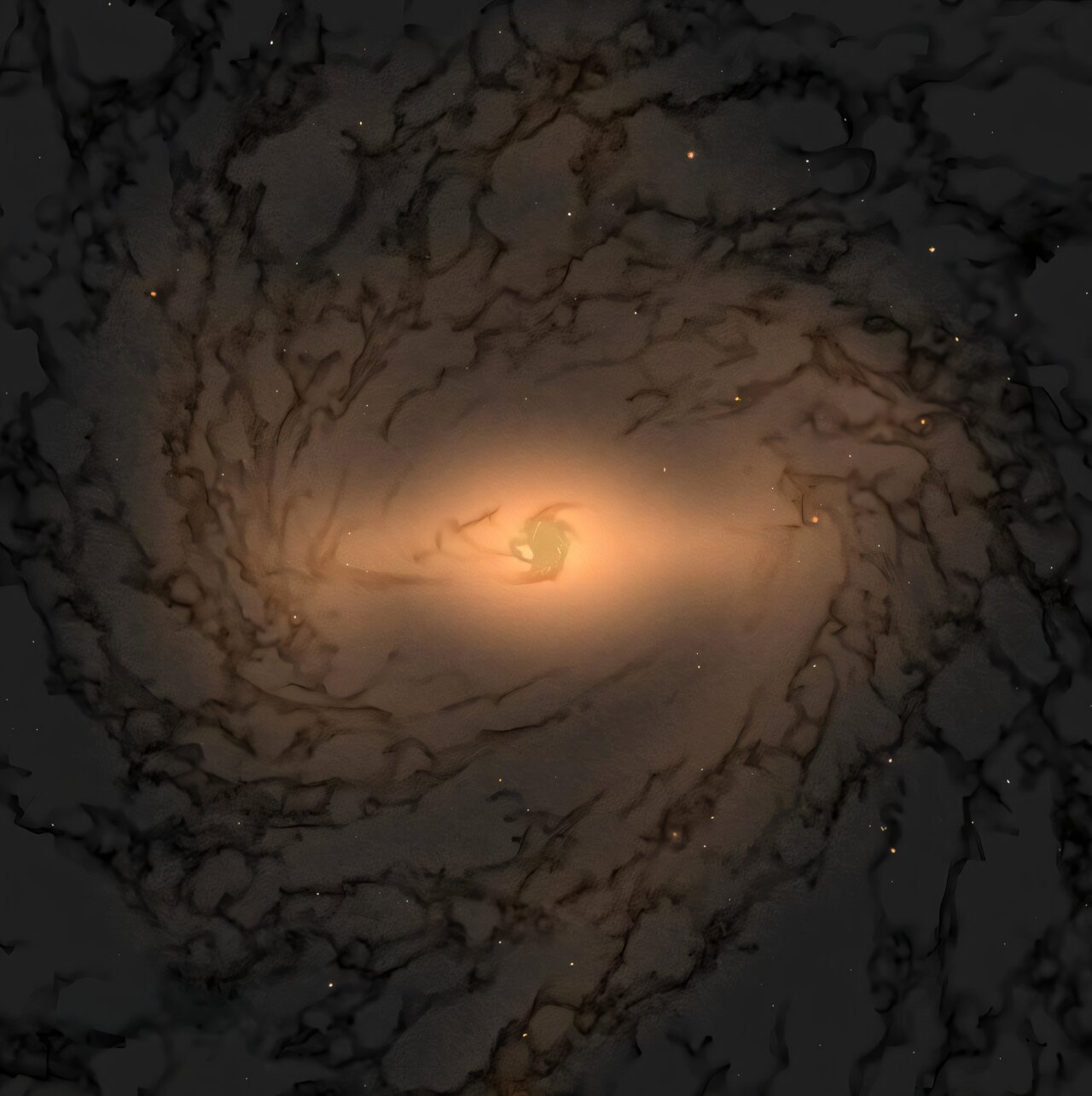
At the centers of galaxies, two dense structures called nuclear star clusters and nuclear stellar disks have long appeared to grow by separate processes. A new high-resolution galaxy simulation instead traces both structures forming and evolving from the same supply of gas, with a stellar bar driving material toward the galactic center.
Nuclear star clusters and nuclear stellar disks have been observed in the Milky Way and other galaxies, but their formation has remained difficult to explain. Observations have not shown a clear relationship between the masses and sizes of the two structures, reinforcing the idea that they might have separate origins.
The new simulation, developed as part of the SMUGGLE-Ring project, provides a different picture. It models a Milky Way-like barred galaxy with enough detail to follow the formation and growth of both structures over four billion years.
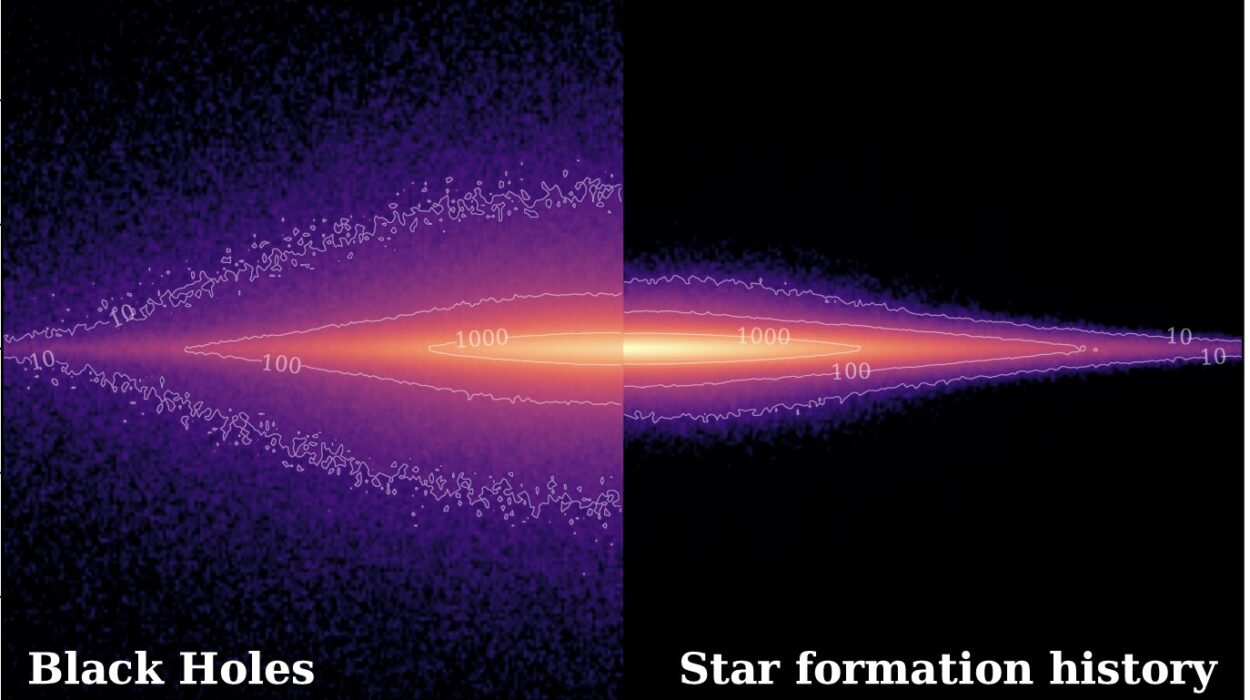
That long time span is important because observations capture galaxies at only one point in their evolution. The simulation instead lets researchers follow the sequence as the stellar bar forms, gas moves inward, stars form in bursts and the nuclear stellar disk expands outward from the center.
The stellar bar drives gas toward the center
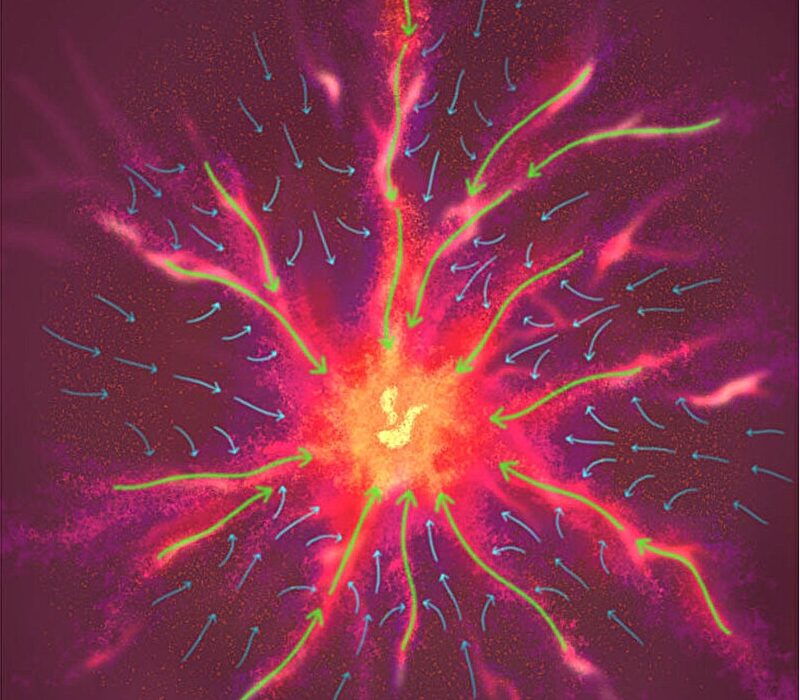
The simulation points to the galaxy’s stellar bar as a common driver of both structures.
As the bar channels gas toward the central region, that gas supplies material for new stars. Feedback from dying stars then produces shocks that repeatedly trigger further episodes of star formation.
Over several billion years, these processes assemble hundreds of millions of solar masses of stars in the central structures.
This provides a single mechanism through which the nuclear star cluster and nuclear stellar disk can grow from the same gas reservoir rather than requiring two fundamentally different formation processes.
Their different appearances can develop over time
The simulation also offers an explanation for why observations have not found an obvious relationship between the two structures’ masses and sizes.
During extended periods of steady growth, the relative masses and sizes of the nuclear star cluster and nuclear stellar disk gradually move apart. Galaxies observed at different points in that evolution can therefore have central structures that look quite different even when they formed through the same underlying growth mechanism.
The simulation does not indicate that the stars in the two components are fundamentally different in age, chemical composition or motion. Instead, their structural relationship changes as the system evolves.
Dark matter dynamics help the bar evolve
The model also treats stars and the dark matter halo as dynamically evolving particles rather than placing the galaxy inside fixed background potentials.
That allows the stellar bar itself to form and change over time before driving the development of the nuclear structures.
The simulation also produces a “dark gap” around the bar region. This feature is found in many observations and is described as evidence of an interaction between stars and dark matter associated with the rotating stellar bar.
A massive cluster can merge with the central cluster
The simulation includes another event that changes the central structure on a much shorter timescale. A particularly massive star cluster, containing roughly 30 million solar masses, spirals into the galactic center and merges with the nuclear star cluster.
Observations of NGC 1365 have recently identified massive star clusters inside its bar, and some are expected to spiral toward the center and merge with that galaxy’s nuclear star cluster.
Such mergers can change the mass and size of a nuclear star cluster over a short period. Because a supermassive black hole is located within the nuclear star cluster in galaxies, the simulation suggests that these merger events might also leave an imprint on the black hole’s mass.
The study was published in Astronomy & Astrophysics.