Gas between the dense filaments of a nearby stellar nursery appears to be an active part of the flow feeding the region where massive stars form. In the Monoceros R2 hub–filament system, researchers found that this lower-density gas both moves into the central hub and replenishes dense filaments, increasing the estimated material flowing into the hub by about 50%.
Stars form within clouds of gas and dust. In these clouds, dense filaments can converge on central regions called hubs, where clusters and massive stars form. Gas moving along the filaments into a hub has been studied before, but the lower-density material between those structures has received less attention.
Jihye Hwang, an assistant professor at Kyushu University’s Institute for Advanced Study, and associate professor Doris Arzoumanian examined this less-dense gas in Monoceros R2. The team used observations of the carbon monoxide isotopes 13CO and C18O made with the Nobeyama 45-meter radio telescope.
They identified three dense filaments and three regions between filaments, then measured how gas was moving toward the central hub and nearby filaments.
The different gas components did not move in the same way. Gas inside the dense filaments was traveling toward the hub much faster than gas in the regions between them.
But the inter-filament gas was not simply sitting between the denser structures.
Some diffuse gas moves into the filaments
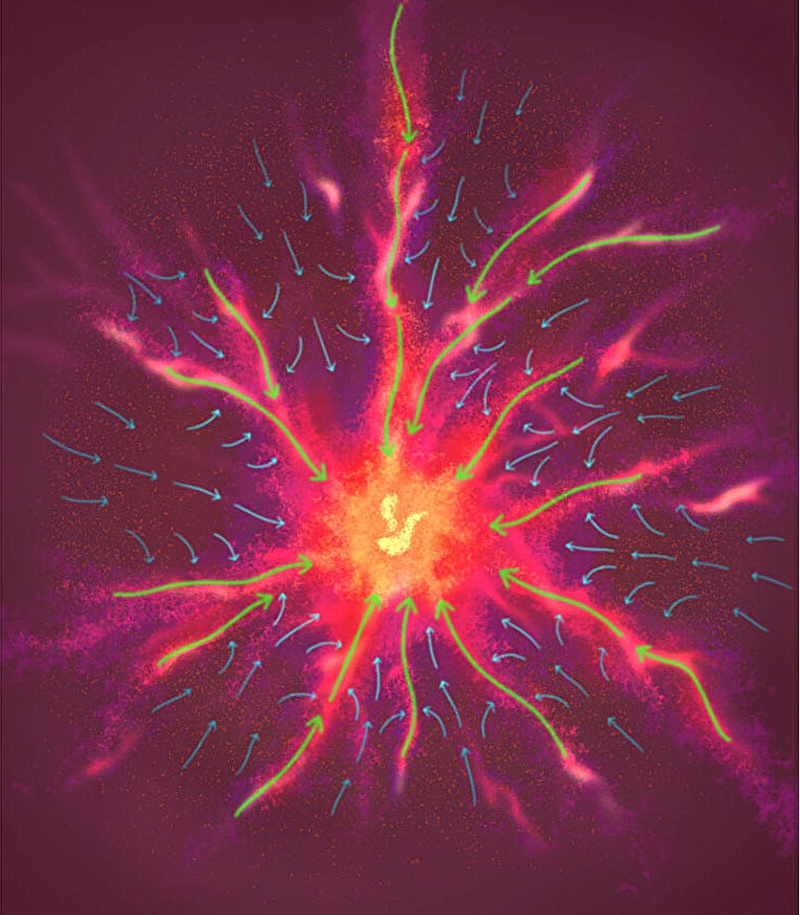
At least 30% of the gas in the inter-filament regions appeared to move sideways into nearby dense filaments. From there, that material could continue toward the hub.
When the researchers included both the dense filament gas and the diffuse gas in their estimate, the amount of material flowing onto the hub was about 50% higher than an estimate based only on the dense filaments.
“Previous studies mainly focused on the dense filaments because complementary observations tracing the diffuse gas were not included in their analysis,” Hwang said.
The combined observations, using C18O to trace denser gas and 13CO to trace more diffuse gas, indicated that the inter-filament material contributes to feeding the hub in two ways: it can flow into the hub directly, or it can first replenish a dense filament.
That means measurements focused only on the most obvious dense structures can leave out a substantial part of the material moving through the system.
More massive cores are found inside the hub
The researchers also looked at dense cores, which are compact structures that can eventually collapse under gravity to form stars.
Cores inside the hub were generally more massive and warmer than cores outside it. The researchers said this is consistent with conditions in the hub being favorable for forming higher-mass stars.
The observations also support the idea that continuing gas inflow helps build the dense environments in which massive stars preferentially form.
“Our results indicate that understanding star formation requires accounting for the entire gas reservoir, not only that of the dense filaments,” Hwang said.
The researchers say further observations of other hub–filament systems, along with comparisons with numerical simulations, are needed to determine how widespread these gas-flow patterns are.
The study was published in The Astrophysical Journal Letters.