The glow around IC 1101 grows steadily fainter until it almost disappears into the darkness of space, making it remarkably difficult to tell where the galaxy actually ends. By combining hours of ultra-deep observations with new techniques to remove scattered light that can mimic faint structures, astronomers followed this enormous galaxy farther than before and identified what they interpret as the boundary of its main stellar body—while uncovering an even larger diffuse envelope that extends hundreds of thousands of light-years beyond it.
Some galaxies have obvious edges. Others gradually fade into surrounding space until their outermost stars become almost impossible to distinguish from the environment around them.
That challenge becomes especially severe for brightest cluster galaxies (BCGs), the enormous galaxies that occupy the centers of galaxy clusters. Their outskirts are built over billions of years through minor mergers and the stripping of stars from smaller galaxies, creating vast stellar halos that can blend into the diffuse intracluster light shared by the entire cluster.
IC 1101 is one of the most extreme examples known.
Located at the center of the galaxy cluster Abell 2029, IC 1101 has long been recognized as an exceptionally massive and luminous galaxy. Earlier observations had already traced stellar light to a projected distance of about 607 kiloparsecs and estimated a total luminosity of approximately one trillion times that of the Sun, placing it among the brightest known BCGs. It also contains one of the largest depleted galactic cores measured in a brightest cluster galaxy.
Despite its fame, one basic question has remained surprisingly difficult to answer: where does IC 1101 itself actually end?
Seeing what ordinary observations cannot
To investigate that question, the researchers obtained ultra-deep observations using the Wide Field Camera on the 2.5-meter Isaac Newton Telescope.
The galaxy was observed in the Sloan g and r bands during May 2022. The final dataset combined 79 g-band exposures lasting 180 seconds each and 53 r-band exposures of 300 seconds each, totaling nearly four hours in g and more than 4.4 hours in r.
The finished mosaic covered roughly 55 by 66 arcminutes while reaching extremely faint surface-brightness limits of about 30.5 magnitudes per square arcsecond in the g band and 30 magnitudes per square arcsecond in the r band.
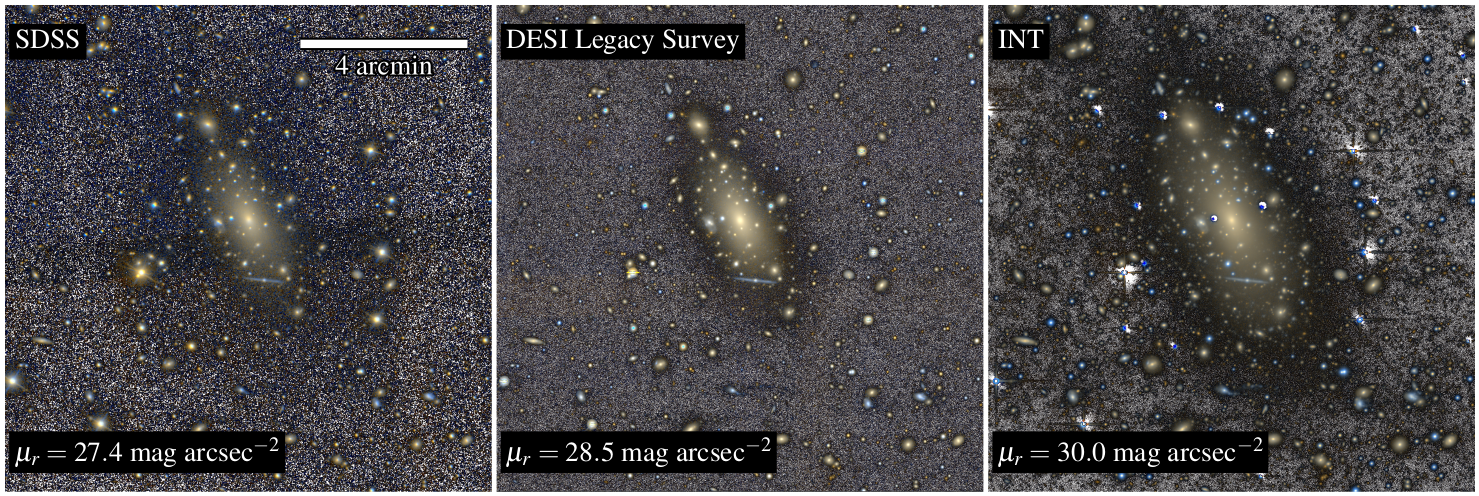
The depth of those observations was one of the study’s biggest advantages. Compared with images from surveys such as the Sloan Digital Sky Survey and the DESI Legacy Imaging Surveys, the new data exposed diffuse structures that are barely visible—or completely absent—in shallower images.
But collecting deep images alone was not enough.
Removing light that was never part of the galaxy
At the faintest brightness levels, scattered light becomes a serious obstacle.
Bright foreground stars spread light far beyond their visible disks through the telescope’s optics and Earth’s atmosphere. That scattered light can create broad halos capable of hiding or even imitating the diffuse structures astronomers hope to measure.
To minimize that problem, the team carefully constructed an extended model of the telescope’s point spread function—the pattern describing how starlight spreads through the imaging system.
Instead of relying on a single brightness range, they built the model using stars of different magnitudes so that both the bright inner regions and the extremely faint outer wings of the light profile could be measured accurately. Because the IC 1101 field lacked stars bright enough to fully characterize the outermost portions of the point spread function, the researchers supplemented their model with observations of a bright calibration star observed with the same instrument.
They then modeled and subtracted scattered light from 250 foreground stars brighter than magnitude 16.
A second processing step applied wavelet-based techniques to reduce scattered light associated with IC 1101 itself and neighboring galaxies without introducing the high-frequency artifacts that can accompany direct image deconvolution.
Only after these corrections did the faintest structures surrounding IC 1101 become much easier to study.
Several changes appeared as the galaxy faded outward
Rather than searching for a sharp cutoff—which massive elliptical galaxies are not expected to have—the researchers examined how several properties changed with increasing distance from the galaxy’s center.
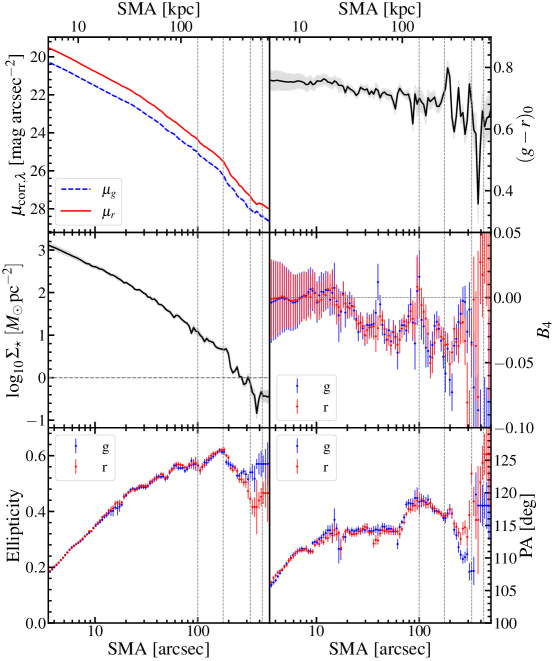
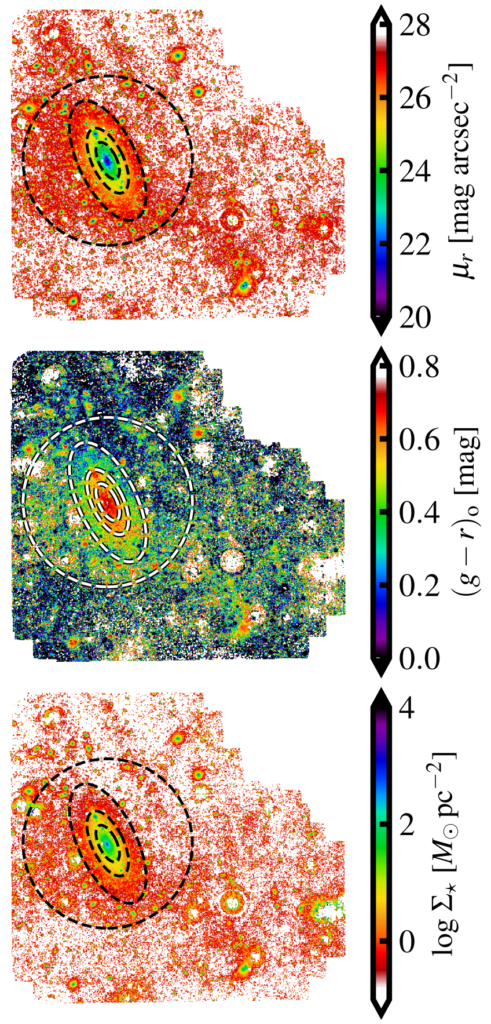
They measured surface brightness, color, stellar mass surface density, ellipticity, and position angle, looking for locations where multiple properties changed together.
One transition appeared about 146 kiloparsecs from the center.
At that distance, the galaxy’s ellipticity and position angle began to change, while the color profile also hinted at a flatter behavior. However, the surface-brightness and stellar-mass profiles did not undergo their strongest transition there.
Because of that combination of evidence, the researchers interpret this inner feature as a structural transition within the galaxy rather than its outer boundary. They suggest it could represent increased mixing of stellar populations or another internal structural change.
The strongest boundary emerged much farther out
A much more pronounced transition appeared at approximately 260 kiloparsecs from the galaxy’s center.
Here, several independent measurements changed together.
The galaxy became noticeably rounder, its position angle shifted significantly, its color profile changed, and both the surface-brightness and stellar-mass-density profiles altered their slopes.
Because these structural and photometric signatures occurred simultaneously, the researchers identified this location as the most convincing observational boundary of IC 1101’s main stellar body.
Instead of representing an abrupt edge, they interpret it as a gradual transition between the central galaxy and an outer stellar envelope assembled through repeated mergers and accretion events.
Using this definition, they estimate the galaxy’s edge radius to be 260 ± 38 kiloparsecs, corresponding to a projected diameter of roughly 520 kiloparsecs.
The stellar mass enclosed within that boundary is estimated to be (3.36 ± 0.01) × 10¹² solar masses.
Beyond the edge, the galaxy blends into something even larger
The observations did not stop at the proposed edge.
Profiles measured along the galaxy’s major axis continued outward and uncovered additional changes.
Around 475 kiloparsecs, the researchers observed another transition where the regular elliptical appearance of the galaxy gave way to a more diffuse and asymmetric low-surface-brightness component.
Rather than interpreting this as the galaxy’s edge, the team argues that this region is better understood as part of an extended system in which the galaxy and the surrounding intracluster light have become spatially intertwined.
An even more distant feature appeared near 620 kiloparsecs.
Beyond that distance, coherent low-surface-brightness emission largely disappeared, with the remaining signal becoming increasingly irregular and dominated by low signal-to-noise fluctuations.
The researchers interpret this outermost region as a possible boundary separating material that has already become incorporated into the combined BCG and intracluster-light structure from material that has not yet fully mixed into the cluster’s central stellar system.
The galaxy’s enormous size is matched by an enormous mass
To compare IC 1101 with other galaxies, the team also measured several commonly used size indicators.
Its effective radius—the radius enclosing half of the total light—is 73 ± 2 kiloparsecs.
Another commonly used measurement, known as R₁, where the stellar mass surface density falls to one solar mass per square parsec, reaches 362 ± 38 kiloparsecs.
Using the radius where the g-band surface brightness declines to 29 magnitudes per square arcsecond, the researchers estimate a total stellar mass of (4.2 ± 0.1) × 10¹² solar masses.
No matter which size measurement is used, IC 1101 consistently occupies the extreme upper end of the mass-size relations examined in the study.
Faint structures hint at a complicated history
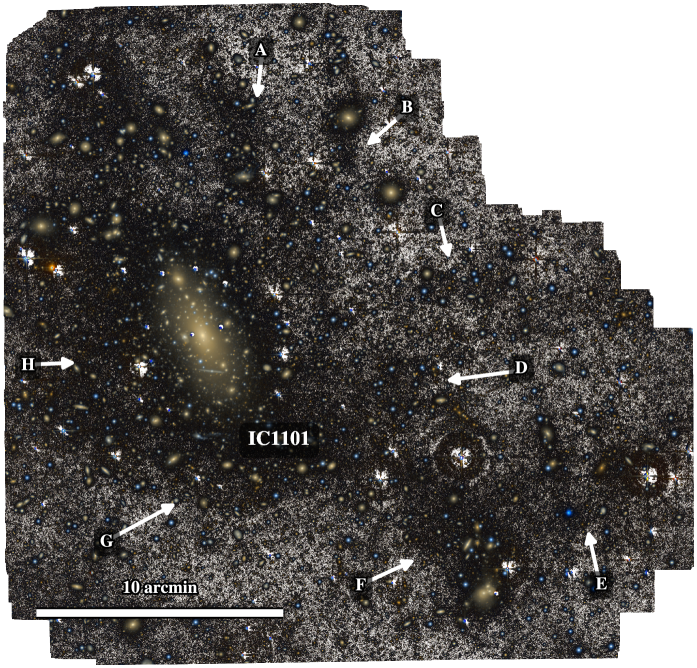
Correcting the images also uncovered numerous diffuse structures surrounding the galaxy.
The researchers identified several elongated plumes, broad diffuse overdensities, and asymmetric stellar features extending through the cluster.
They argue that these structures are consistent with material produced by accretion events and mergers.
Interestingly, some of the most prominent low-surface-brightness features occupy regions that overlap spatially with previously reported X-ray spiral structures in the hot gas of the Abell 2029 cluster. Earlier X-ray studies interpreted those gas structures as the aftermath of an off-axis merger that occurred roughly 2 to 3 billion years ago.
The authors emphasize that a one-to-one correspondence between the optical and X-ray features is not expected. Nevertheless, they suggest that the comparable extent and overall morphology of the stellar structures and X-ray residuals may indicate that both trace different components of the same large-scale dynamical disturbance.
They also examined whether the faint optical features could instead be foreground Galactic cirrus. Based on their colors and the lack of correspondence with Galactic extinction maps, the researchers conclude that a cirrus origin is not supported.
The study provides a new way to define the edge of an extraordinary galaxy
The authors argue that identifying the edge of a massive galaxy should rely not on an arbitrary brightness threshold but on a coherent structural transition seen across multiple independent measurements.
For IC 1101, they conclude that the transition at approximately 260 kiloparsecs provides the clearest observational marker of that boundary.
Beyond it lies an enormous stellar envelope that gradually merges with the surrounding intracluster light, extending hundreds of kiloparsecs farther before fading into an even more diffuse environment.
The researchers note that IC 1101 remains among the largest individual galaxies measured using this approach. At the same time, the extensive low-surface-brightness structures surrounding it suggest that even a galaxy widely regarded as residing in a dynamically relaxed cluster still preserves visible traces of its long history of mergers, accretion, and continuing evolution.
Publication details
Carlos Marrero-de la Rosa et al, How large can galaxies be? Ultra-deep imaging of IC 1101, the most extended known galaxy, arXiv (2026). DOI: 10.48550/arxiv.2607.15340