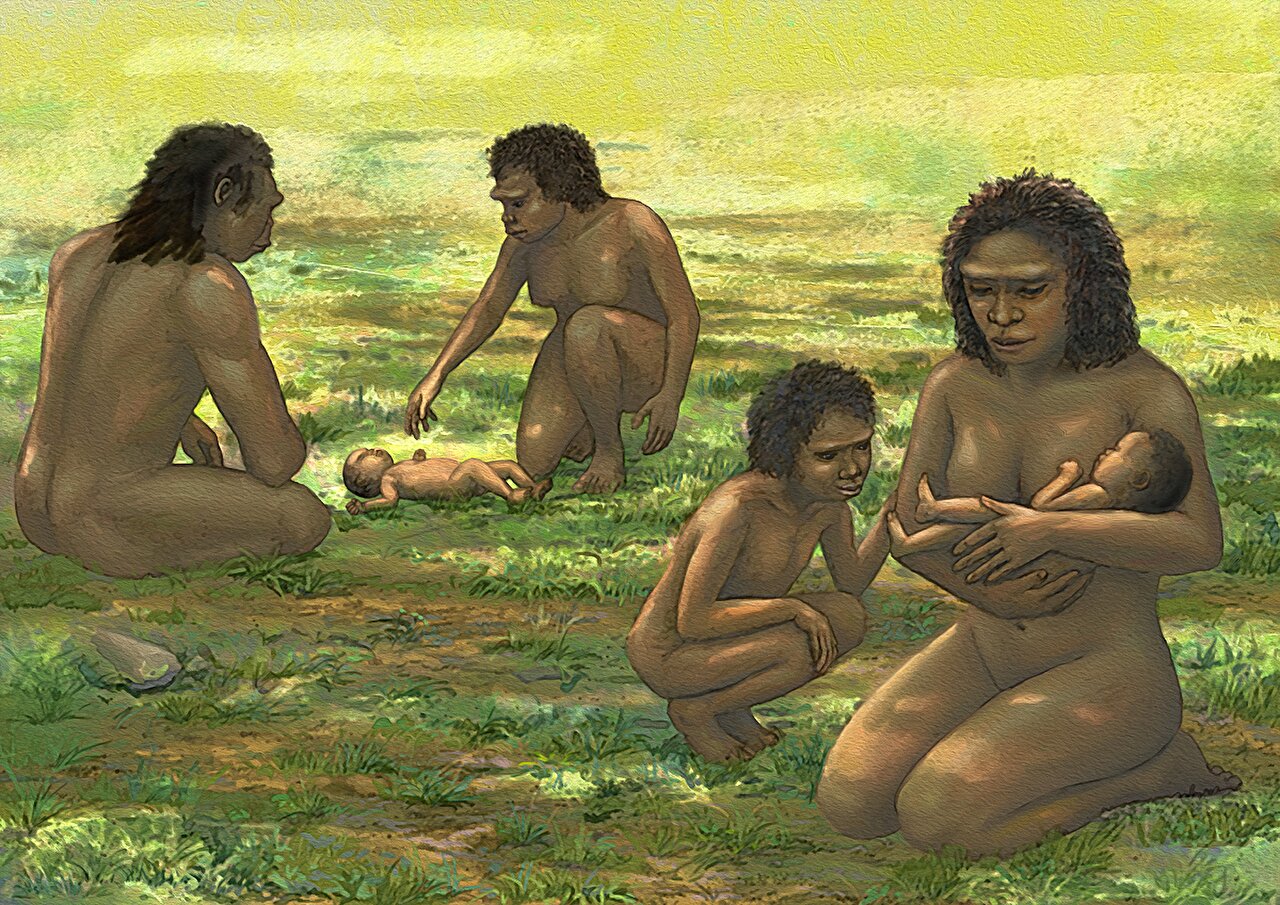
Long before anyone could study ancient DNA or recover the soft tissues of prehistoric babies, an unusual twist in the shape of a fossil skull may have preserved an entirely different kind of evidence. By tracing subtle skull deformities that today develop in vulnerable human infants, scientists have uncovered signs that some ancient members of the genus Homo may have begun life just as dependent on prolonged care as modern human babies—hinting that this distinctive stage of human development emerged much earlier than many researchers had expected.
Modern humans enter the world in an unusual state compared with other primates. Newborn babies cannot support their own heads, cannot crawl, cannot cling to their mothers, and require months of constant protection and care before becoming physically capable of basic movement.
That prolonged period of dependence is closely connected to one of the defining features of our species: continued rapid brain growth after birth. Human babies are born while their skull bones are still thin, flexible, and only loosely connected. Wide openings called fontanelles, along with unfused sutures between the skull bones, allow the rapidly expanding brain to continue growing during the first year of life.
The evolutionary origins of this pattern have remained uncertain for decades.
Scientists have long debated whether this uniquely human style of infancy appeared only after large-brained humans evolved or whether it began much earlier in the history of the genus Homo, when brain sizes were still substantially smaller than those of modern people.
Previous attempts to answer that question relied on indirect evidence, such as fossil infant skulls, estimates of early brain growth, or the size of ancient female birth canals. Those approaches have often produced conflicting conclusions because the available fossils are rare, incomplete, difficult to reconstruct, and frequently uncertain in age.
The new study approached the problem from an entirely different direction.
Looking for the marks left by helpless infancy
Instead of trying to estimate how ancient babies grew, the researchers searched for evidence of what happened to their skulls while they were alive.
Their focus was deformational plagiocephaly, a form of positional skull deformation that commonly develops in healthy modern human infants.
The condition appears when several factors occur together. Human babies spend long periods lying on flat surfaces because they cannot yet control their heads or bodies. Their skull bones remain soft and flexible while the brain grows rapidly. Pressure on one part of the skull can gradually flatten that area, creating an asymmetrical head shape.
Clinical studies have shown that these deformities typically become most pronounced during the first four to six months after birth, when infants have the least head control. As neck muscles strengthen and babies begin moving independently, the severity often decreases, although more pronounced cases can remain visible throughout life.
The researchers argued that this combination of characteristics should make marked deformational plagiocephaly largely unique among living primates.
Other great apes have more mature skull bones shortly after birth. Young chimpanzees, for example, develop head control far earlier than human babies and quickly gain the ability to cling to their mothers. They also do not normally spend long periods sleeping independently on flat ground surfaces.
If pronounced deformational plagiocephaly is essentially restricted to humans, then fossil skulls carrying the same pattern might preserve direct evidence of human-like helpless infancy.
Building the largest comparison the researchers could assemble
To test that idea, the team measured skull asymmetry across 1,504 cranial specimens.
The collection included 996 great ape skulls representing chimpanzees, bonobos, gorillas, and orangutans, along with 508 modern human skulls from present-day and historical Japanese populations. Their human material included CT scans of 123 healthy infants between 27 and 545 days old, allowing the researchers to track how skull flexibility changed during the first year and a half of life.
The infant CT scans confirmed that the openings between skull bones remain substantial during early infancy before gradually closing as children grow.
The researchers also measured differences between the left and right sides of skulls using two separate forms of cranial skewness—one viewed from above and another viewed from the front. Together, these measurements allowed them to quantify asymmetrical deformation across humans, great apes, and fossil hominins using the same methods.
Humans proved far more variable than great apes
When the measurements were compared, an important pattern emerged.
Great apes displayed only modest skull asymmetry regardless of species, age, or sex.
Modern humans were very different.
The human sample exhibited substantially greater variation, including many skulls with far more pronounced asymmetry than anything typically observed among the nearly one thousand great ape specimens. Statistical comparisons showed this increased variability was highly significant.
The researchers do not argue that their Japanese sample represents the full range of human skull deformation worldwide. Infant sleeping practices vary among cultures, and modern recommendations encouraging babies to sleep on their backs may influence the frequency of some deformities.
Nevertheless, the difference between humans and great apes was clear enough to support the study’s central working hypothesis: pronounced deformational plagiocephaly appears to be a characteristic of human infancy that reflects prolonged physical helplessness.
Ancient Indonesian fossils stood out
The researchers then turned to six exceptionally well-preserved fossil skulls.
Five belonged to Homo erectus from Java, dating to approximately 300,000 to 100,000 years ago, while one belonged to Homo floresiensis, the famous small-bodied hominin represented by the specimen known as LB1 from Flores.
Three of these fossils displayed unusually strong asymmetry.
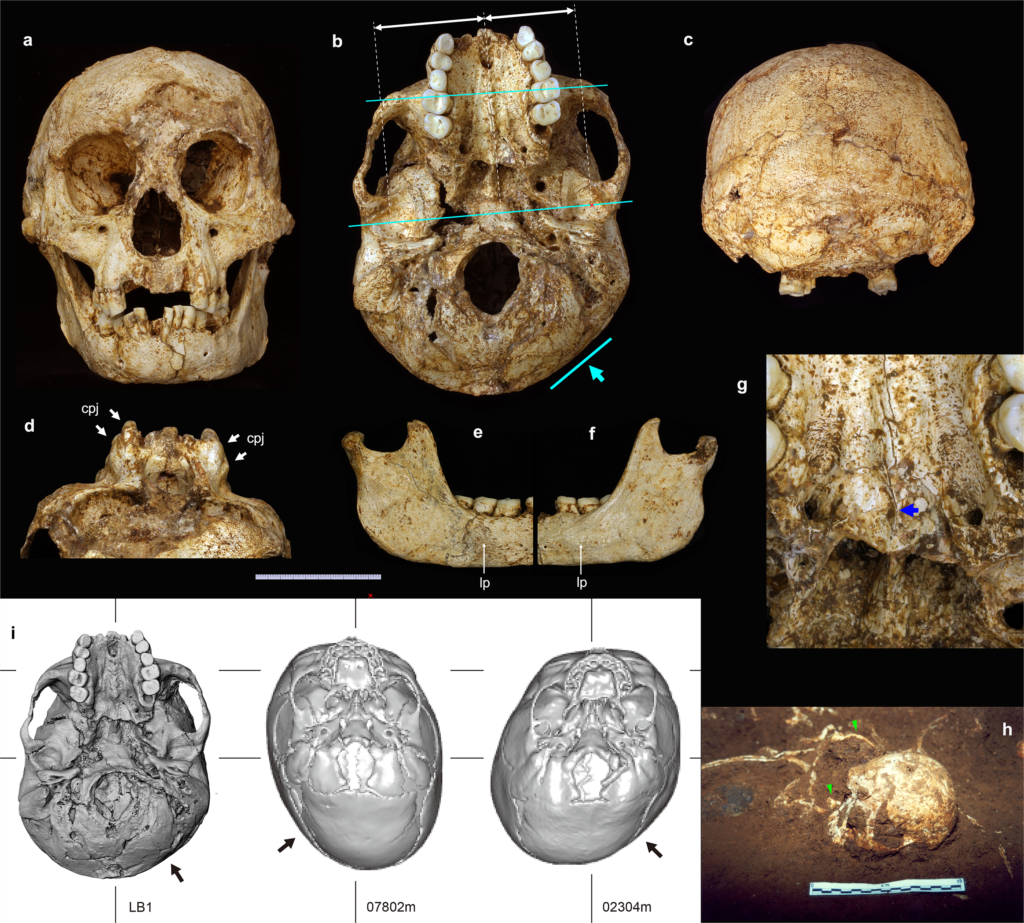
The LB1 skull exhibited exceptionally large horizontal skewing. Its measured asymmetry exceeded the maximum observed among the great ape sample in both absolute size and percentage measurements.
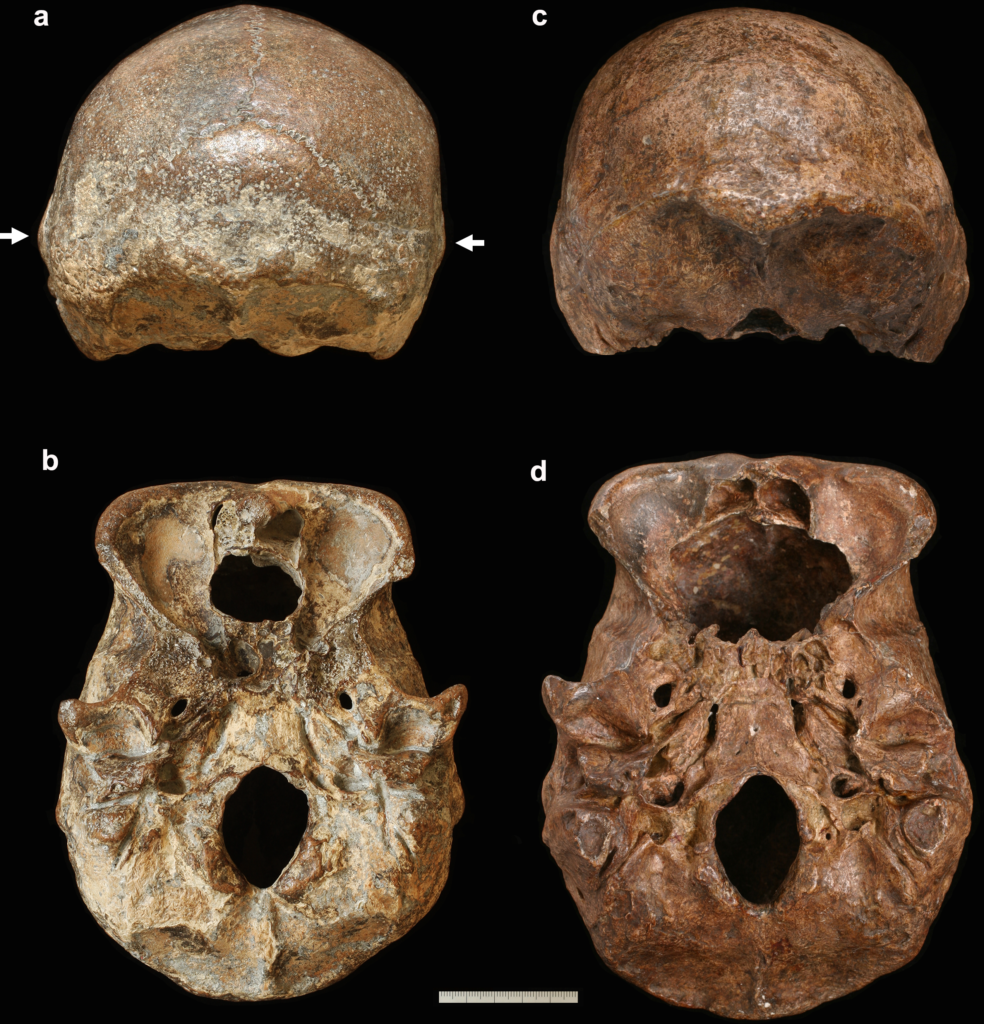
Two Homo erectus skulls—Ngawi 1 and Ngandong 12—showed unusually pronounced asymmetry in another plane of measurement. Only two of the 990 measured great ape skulls reached comparable percentage values, making the probability of randomly obtaining two similarly distorted skulls among five great ape specimens only 0.004%, according to the authors’ statistical analysis.
When the researchers considered both forms of skull asymmetry together, all three fossils fell outside the estimated range of variation observed in great apes.
Could burial have distorted the fossils?
One obvious alternative explanation had to be ruled out.
Fossil skulls often become distorted after burial as sediments compress the bones over thousands or millions of years. If that had happened here, the asymmetry would say nothing about how these individuals looked while alive.
The researchers therefore examined the original fossils together with high-resolution micro-CT scans and carefully reviewed each specimen’s preservation.
For LB1, they concluded that postmortem distortion could not adequately explain the observed pattern.
The skull is exceptionally well preserved despite localized damage that occurred during excavation and later reconstruction. Internal features remained aligned, and several facial asymmetries—including twisting of the upper jaw, asymmetrical facial bones, and changes in dental alignment—appeared consistent with changes that developed during life rather than after burial.
The fossil’s position at discovery also conflicted with the type of pressure that would be needed to create its distinctive horizontal distortion.
The two Homo erectus skulls presented a different but similarly persuasive picture.
Although both lacked facial bones, their remaining skulls showed remarkably intact external surfaces with little evidence of crushing. CT scans revealed smooth continuity of the bone without widespread cracking or displacement, including in fragile regions that would be expected to deform under strong burial pressure.
Instead, the unusual asymmetry affected robust portions of the skull while leaving delicate structures comparatively undistorted—again matching what would be expected if the asymmetry developed naturally during life rather than after death.
The researchers conclude that while they cannot completely eliminate every possible contribution from burial processes, taphonomic deformation is unlikely to be the major source of the observed skull shapes.
A different picture of early human childhood
If these fossil skulls truly preserve deformational plagiocephaly, the implications extend well beyond skull anatomy.
Such deformities develop only when infants possess several characteristics simultaneously: flexible skull bones, immature neck and body muscles, prolonged dependence, and habits that place sustained pressure on the developing head.
The authors argue that these conditions imply human-like helpless infancy.
That would mean some populations of Homo erectus and Homo floresiensis required extended parental care resembling that of modern humans despite having considerably smaller brains.
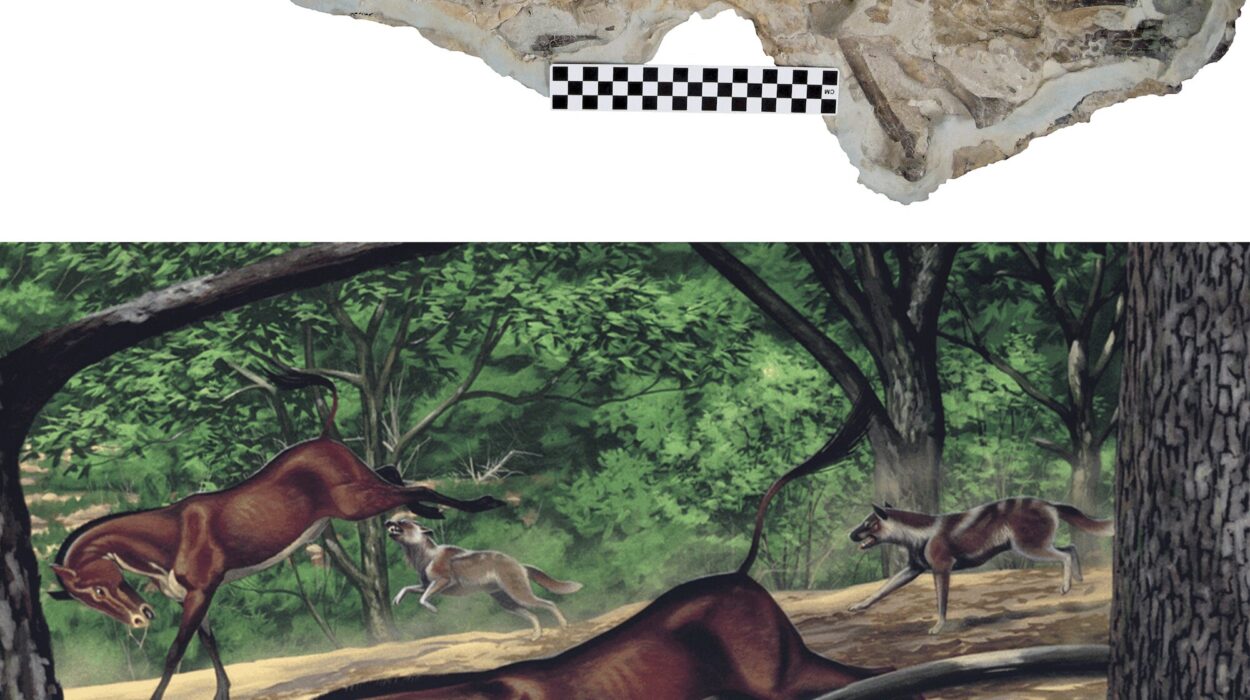
The findings also imply that caregivers successfully protected and raised highly vulnerable infants under demanding environmental conditions. The paper notes that Indonesian Homo erectus lived alongside large predators such as tigers and leopards, while Homo floresiensis shared its environment with Komodo monitors and giant carrion birds.
Although archaeological evidence from these species remains relatively limited, the skull evidence implies that they had already developed effective ways of caring for infants who could not fend for themselves.
Why Homo floresiensis makes the story even more surprising
Among all the fossils examined, Homo floresiensis may carry the most unexpected message.
Its brain volume, measured at 426 cubic centimeters, falls within the estimated range reported for Australopithecus afarensis, and its body size is similarly small.
If helpless infancy evolved simply as a consequence of increasingly large brains, researchers might expect this island species to have returned to a more ape-like developmental pattern after evolving such a reduced brain.
Instead, the skull of LB1 appears consistent with the opposite possibility.
According to the authors, this suggests that the reduction in brain size experienced by Homo floresiensis did not reverse its infant developmental pattern. Rather, the species may have retained a human-like form of infancy inherited from earlier members of the genus Homo.
The authors propose that once prolonged infant care became established within hominin societies, it may no longer have represented merely a biological trade-off required by large brains. Established parental and social caregiving could have reduced its costs, allowing the developmental pattern to persist even as body and brain size changed.
The paper also discusses other possible advantages that prolonged infancy might have offered, but presents these as interpretations rather than demonstrated conclusions.
The evolutionary timeline may reach much deeper than expected
The authors place their new findings alongside previous reports of deformational plagiocephaly in Neanderthals.
Together, they argue that at least four Homo lineages—modern humans, Neanderthals, Indonesian Homo erectus, and Homo floresiensis—appear to share evidence consistent with prolonged helpless infancy during the Middle and Late Pleistocene.
Exactly when this developmental pattern first evolved remains unresolved.
Because Homo floresiensis probably descended either from Javanese Homo erectus or from an even more primitive member of the genus Homo, the authors argue that helpless infancy likely originated before the unique evolutionary history of Flores began—probably sometime between more than 1.0 million and 0.7 million years ago.
However, they emphasize that this inference requires testing with older fossil material.
What remains uncertain
The researchers acknowledge important limitations.
A central challenge is distinguishing genuine deformational plagiocephaly from distortion caused after burial. Although they believe the evidence strongly favors an in-life origin for the three key fossils, they recognize that some contribution from geological processes cannot be completely excluded.
Their modern human sample also comes entirely from Japanese populations and was not intended to represent the full range of skull deformation across all humans.
Finally, only six fossil skulls were suitable for this analysis because exceptionally well-preserved specimens are extremely rare.
The authors argue that applying the same approach to additional fossil discoveries around the world will be essential for determining exactly when human-like helpless infancy first evolved and how widespread it became among ancient members of the genus Homo.
Publication details
Kaifu Y, et al. Cranial evidence for human-like helpless infancy in Homo erectus and Homo floresiensis, Proceedings of the Royal Society B: Biological Sciences (2026). DOI: 10.1098/rspb.2026.1055