A set of barely visible concentric rings appeared across Venus in an unusually sensitive polarization observation, even though the planet looked perfectly ordinary in regular images. If the mysterious pattern is real rather than an observational artifact, it could represent enormous atmospheric waves rippling through the thin gas above Venus’s clouds—an elusive phenomenon that ordinary imaging would have been unable to detect.
For decades, scientists have known that Venus is a world of restless winds and powerful atmospheric waves. Spacecraft have photographed wave patterns in its clouds, and instruments have detected disturbances high above the planet. Yet many expected waves have remained frustratingly difficult to observe because they produce only tiny changes in the thin upper atmosphere while the planet’s brilliant cloud deck overwhelms almost everything beneath.
Now a rare set of observations has presented researchers with an intriguing mystery. Instead of seeing only the familiar appearance of Venus, an extremely sensitive polarimeter detected faint, planet-wide rings that seem to spread outward from a region near the point receiving the most direct sunlight. The researchers are careful not to claim they have discovered a new atmospheric phenomenon. They emphasize that the observations come from a single, unrepeatable dataset. Even so, detailed computer simulations show that such rings could naturally arise if enormous gravity waves were slightly changing the density of Venus’s upper atmosphere.
An unexpected pattern hidden inside ordinary sunlight
The unusual observation dates back to May 24, 2010, when astronomers were not even planning to study Venus. They were waiting for evening twilight to end before beginning observations of circumstellar disks with the Extreme Polarimeter (ExPo) mounted on the William Herschel Telescope on La Palma.
During roughly 36 minutes, Venus happened to be available, so the team captured images through six visible-light filters.
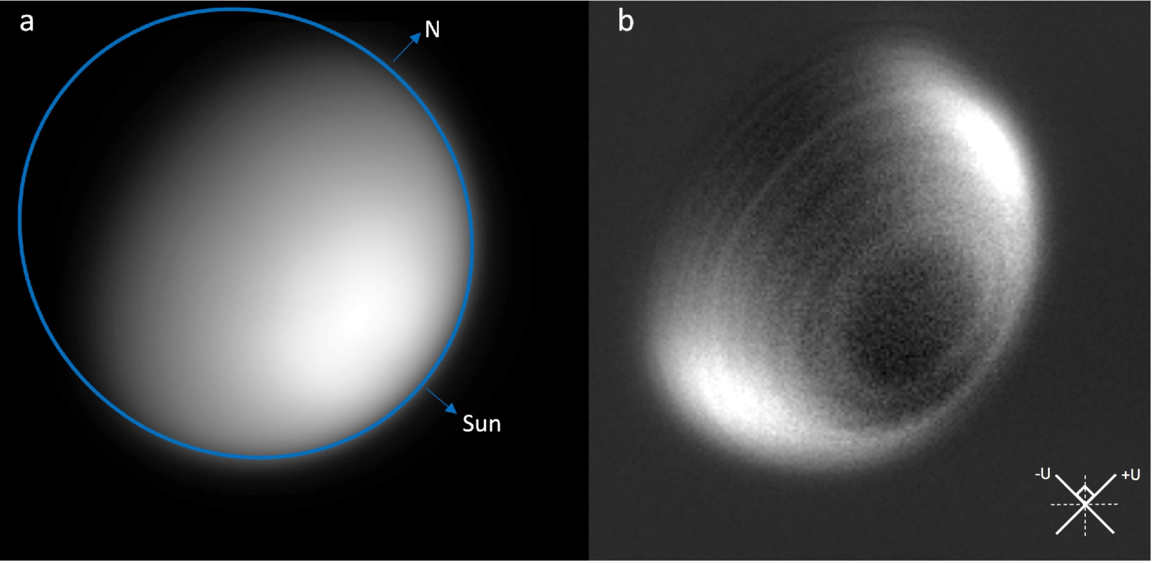
At first glance, nothing appeared unusual. Ordinary images showed the familiar bright crescent with smooth illumination that became brightest near the subsolar region, where sunlight strikes the planet most directly.
The surprise emerged only after examining the polarized light.
Polarization measures the orientation of light waves after they scatter through an atmosphere. Because gas molecules and cloud particles polarize light differently, polarization can reveal subtle atmospheric structures that remain invisible in ordinary brightness images.
In the polarized images, researchers found faint concentric rings stretching across much of Venus’s illuminated disk. The rings appeared centered slightly downwind from the subsolar point rather than exactly on it.
The signal was extraordinarily small—about one part in a million—yet the pattern extended across much of the visible planet.
Even more intriguing, the corresponding total-light images showed essentially no comparable ring structure.
An equatorial slice through the data demonstrated this contrast clearly. Brightness measurements followed the expected smooth curve across the planet, while the polarized signal oscillated in a repeating pattern with an amplitude of roughly 10⁻⁴ of the peak brightness, matching the ring structures seen in the images.
Why polarization could detect what ordinary images cannot
The researchers suspected that if these rings represented a genuine atmospheric phenomenon, they would have to originate somewhere above Venus’s dense clouds.
The reasoning comes from how sunlight interacts with the planet.
The brilliant cloud layer dominates the reflected brightness seen from Earth. Small changes in the thin gas above those clouds contribute almost nothing to the total amount of reflected light.
Polarization is different.
Gas molecules scatter sunlight through Rayleigh scattering, the same physical process responsible for Earth’s blue sky. This scattering produces a strong polarization signature. Even relatively small changes in gas density can therefore alter polarized light enough to become detectable while leaving the planet’s ordinary appearance almost unchanged.
That makes polarization an unusually sensitive tool for searching for subtle changes in the upper atmosphere.
Only half of the observations contained the rings
The observing sequence included six filters spanning visible wavelengths.
The rings appeared clearly in the Hα, Hα continuum, and sodium (Na) observations.
However, they were absent from later observations made through the Na continuum, Sloan r, and Sloan i filters.
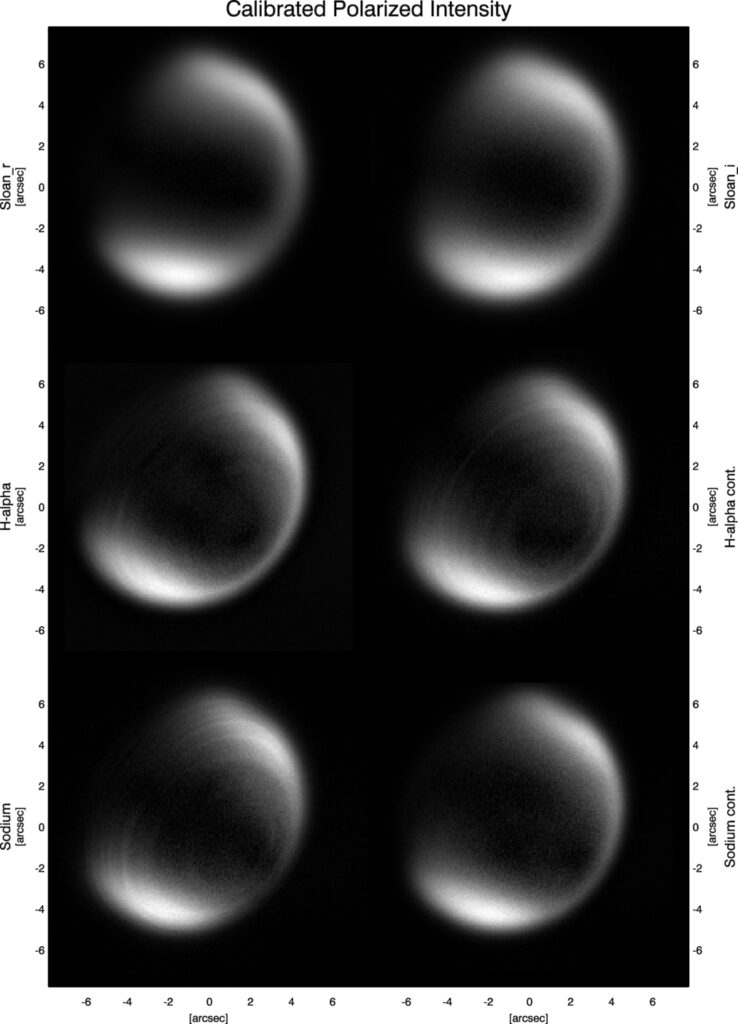
At first glance, this might suggest the pattern simply disappeared as observing conditions worsened. Venus was sinking lower toward the horizon, increasing the amount of Earth’s atmosphere between the telescope and the planet.
But the explanation was not that straightforward.
The sodium observation still displayed particularly clear rings even though it was recorded later and at higher air mass than the earlier Hα observations.
This indicated that air mass alone could not explain why the rings appeared in some images but not others.
Instead, the researchers concluded that several factors probably worked together. Polarization becomes naturally more sensitive to upper-atmospheric gas at shorter wavelengths because Rayleigh scattering strengthens as wavelength decreases. The later observations also experienced poorer atmospheric seeing, and ExPo lacked an atmospheric dispersion corrector, allowing additional spectral smearing in the broader filters.
Together, these effects could have weakened an already extremely subtle signal.
Eliminating the obvious explanations
Whenever scientists encounter an unexpected pattern, the first question is whether the instrument itself created it.
That possibility received considerable attention.
The rings looked roughly centered near the brightest part of Venus, making an instrumental effect seem plausible.
However, ExPo was specifically designed to suppress instrumental polarization through a sophisticated dual-beam exchange system. The instrument rapidly switched polarization states while simultaneously recording two orthogonal polarization channels, allowing many systematic effects to cancel during data reduction.
The researchers could not identify any known instrumental process that would create rings in only three filters while leaving the remaining observations unaffected.
They also found no convincing explanation involving the filters themselves. If filter-induced polarization were responsible, it would not naturally produce a large, organized ring pattern centered near a physically meaningful location on Venus.
Previous ExPo observations of other astronomical targets had never produced similar features. Laboratory experiments, including tests using a white Styrofoam sphere to imitate Venus, also failed to reproduce anything comparable.
The team additionally considered whether scattering in Earth’s own atmosphere—perhaps by thin layers of ice crystals—could have generated the pattern. They found no convincing mechanism that explained the rings’ geometry, stability during the early observations, and consistent polarization direction.
Even so, the researchers stop well short of declaring victory.
Because ExPo has since been dismantled and cannot repeat the observation under identical conditions, they acknowledge that an unknown observational artifact cannot be completely ruled out.
Computer models recreated the mysterious pattern
To test whether the rings could arise from a real Venusian atmosphere, the researchers built detailed radiative transfer simulations that calculated how polarized sunlight would emerge after passing through layers of carbon dioxide gas, sulfuric acid clouds, and atmospheric haze.
The atmosphere was represented as four stacked layers.
Only the uppermost layer, lying above the cloud tops, was allowed to vary.
The simulations introduced gentle wave-like changes in gas density while leaving the clouds and haze unchanged.
The results closely matched the key observational behavior.
Changing gas density produced almost no detectable change in total brightness, exactly as seen in the telescope images.
In contrast, polarization responded clearly.
The models showed that gas-density variations of roughly 5% to 10% above the clouds could generate ring-like polarization signatures comparable to those observed.
Importantly, the simulations also reproduced another characteristic of the observations: although the degree of polarization changed, the overall direction of polarization remained essentially the same across the rings.
A possible glimpse of giant gravity waves
If the candidate signal truly comes from Venus, the researchers argue that one explanation stands out.
The rings could represent enormous gravity waves moving through the upper atmosphere.
Unlike gravitational waves predicted by Einstein, atmospheric gravity waves occur when buoyancy causes parcels of air to oscillate vertically after being disturbed. They transport energy and momentum through planetary atmospheres and play an important role in atmospheric circulation.
Venus is already known to host gravity waves of many sizes.
Previous spacecraft, including Venus Express and Akatsuki, have observed various wave structures, while in situ measurements have detected waves with wavelengths ranging from roughly 100 to 600 kilometers.
The new simulations suggest that the observed ring pattern could correspond to waves with horizontal wavelengths varying from about 900 kilometers near the subsolar region to approximately 100 kilometers closer to the terminator, broadly matching theoretical expectations and previous observations.
The apparent center of the rings lies roughly 20 degrees, or about 2,100 kilometers, downwind from the subsolar point.
The researchers suggest this offset might result from delayed heating of the cloud layer combined with Venus’s powerful equatorial winds, which can reach around 100 meters per second, shifting the source region away from the point of maximum sunlight.
If so, the waves might propagate across the planet within the known flow that carries air from the sunlit side toward the nightside.
Why nobody has reported these rings before
The apparent absence of earlier reports does not necessarily argue against the phenomenon.
Previous ground-based polarimeters lacked sufficient spatial resolution to resolve structures across Venus’s disk.
The Orbiter Cloud Photopolarimeter aboard Pioneer Venus achieved a polarimetric sensitivity of roughly 10⁻³, about an order of magnitude less sensitive than ExPo.
The SPICAV instrument aboard Venus Express possessed some polarimetric capability but mainly observed in the near-infrared, where the models predict these gas-density signatures become extremely weak.
Meanwhile, Akatsuki, despite transforming scientists’ understanding of Venusian weather, carries no imaging polarimeter.
Future missions may finally provide an opportunity to test the idea. The paper notes that South Korea’s planned CLOVE CubeSat mission intends to include polarimetric observations of Venus. ESA’s EnVision mission, currently scheduled for launch in 2032, will carry the VenSpec-H spectropolarimeter, although it will observe primarily in the near-infrared, where the predicted signal should be much weaker.
A fascinating possibility that still awaits confirmation
The researchers repeatedly stress that the evidence remains preliminary.
Everything rests on a single serendipitous observing sequence obtained more than fifteen years ago with an instrument that no longer exists.
Although ExPo was specifically engineered to minimize instrumental polarization and the team found no convincing explanation for the rings as an observational artifact, the available data cannot definitively prove that the signal originated on Venus.
Their simulations instead answer a different question: Could a physically realistic atmosphere produce such rings if they are genuine?
According to the modeling, the answer is yes.
Small density variations high above Venus’s cloud tops can naturally create planet-wide polarization rings while leaving the planet’s ordinary appearance virtually unchanged.
That possibility transforms the mysterious pattern from a curious observational oddity into a scientifically plausible glimpse of atmospheric waves that may have escaped detection for decades.
Whether those ghostly rings truly ripple through Venus’s upper atmosphere will require future observations with equally sensitive polarimeters. Until then, they remain one of the most intriguing unresolved clues hidden inside the polarized light of Earth’s closest planetary neighbor.
Publication details
Gourav Mahapatra et al, Planet-wide, Concentric Density Waves in Venus’s Upper Atmosphere Revealed through Polarimetry?, The Planetary Science Journal (2026). DOI: 10.3847/psj/ae7e6f