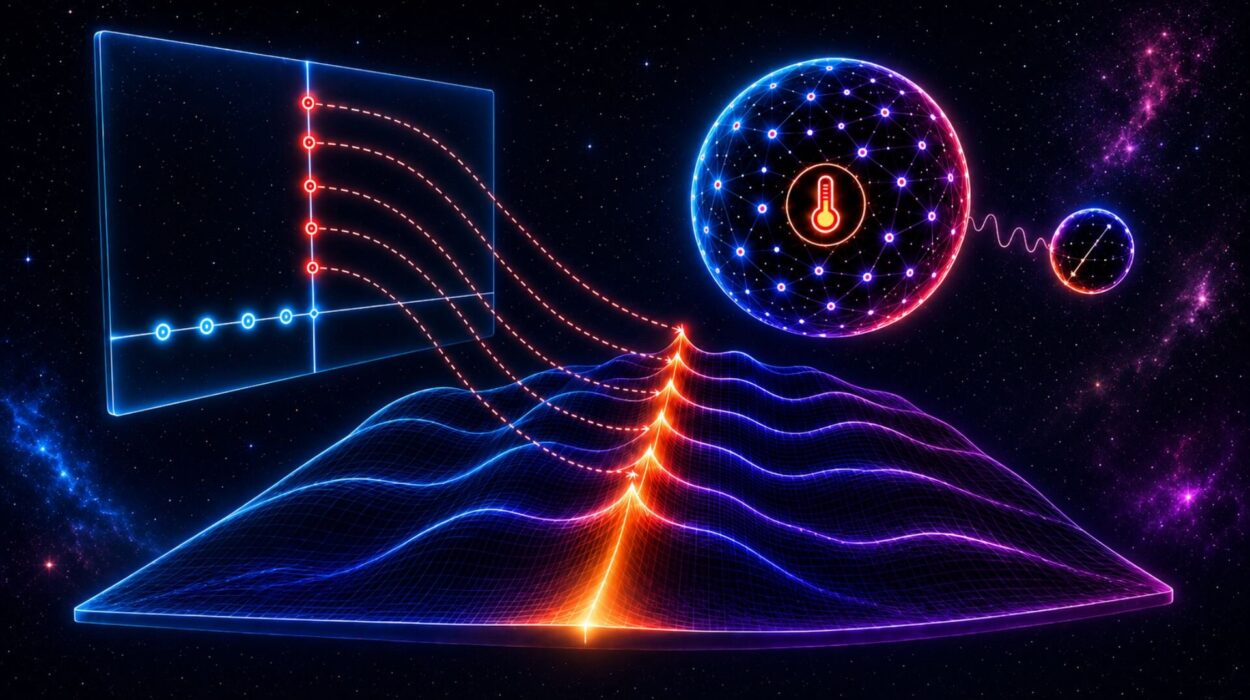
The very environmental noise that seems too weak to matter may quietly stop some adiabatic quantum computers from completing the delicate quantum transitions they depend on. Instead of simply introducing errors, the surrounding environment can behave like an endless series of invisible measurements, locking the system into place through the quantum Zeno effect and potentially erasing the expected computational speed-up as quantum devices grow larger.
Adiabatic quantum computing was designed around an elegant idea. Rather than executing a long sequence of quantum logic gates, the computer begins in a quantum state that is easy to prepare and then changes its governing physics so slowly that the system naturally settles into the desired answer. In principle, the quantum state continuously follows the lowest-energy path until the solution emerges at the end.
The approach has long been viewed as naturally resistant to some forms of noise because the system remains in its ground state throughout the calculation. But the new theoretical work argues that this picture overlooks another kind of obstacle—one that becomes increasingly important precisely when the computation reaches its most delicate stage.
According to the analysis, the problem is not simply that the environment injects energy or random errors. Instead, weak interactions with the outside world can continually monitor the quantum system, producing the quantum Zeno effect, a phenomenon in which frequent measurements suppress quantum evolution itself.
The slowest moment of the computation may also be its most vulnerable
To investigate this question, the researchers focused on one of the best-known examples of adiabatic quantum computing: the adiabatic version of Grover’s quantum search algorithm, originally proposed by Roland and Cerf.
Grover’s search is designed to locate a desired item within an unsorted database. In the conventional gate-based version, it offers a quadratic improvement over classical searching. The adiabatic version seeks the same advantage through a gradual transformation of the system’s Hamiltonian—the mathematical object that determines its quantum behavior.
The computation begins with the system spread equally across every possible answer. As time passes, the Hamiltonian slowly changes until the correct answer becomes the ground state.
Everything depends on the system remaining in that lowest-energy state during the entire evolution.
The challenge appears near the middle of the computation.
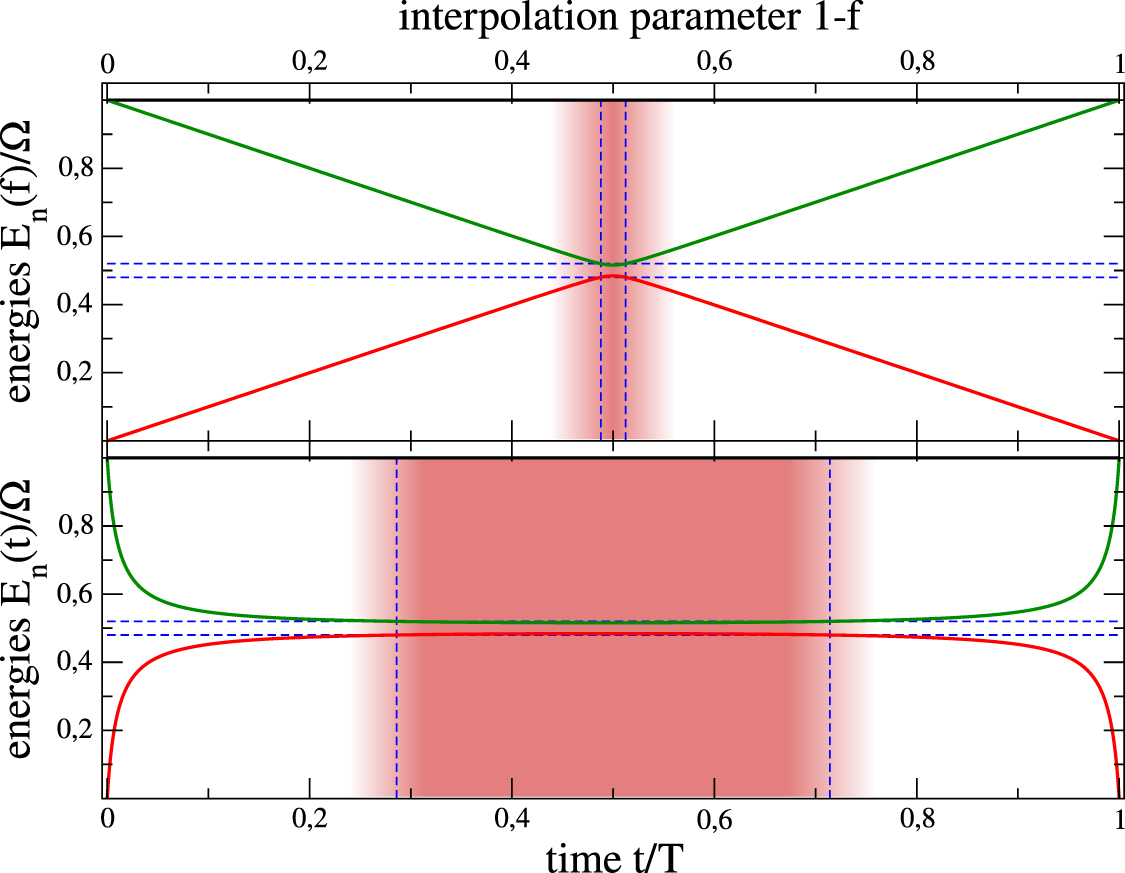
At one particular point, the energy difference between the ground state and the first excited state shrinks dramatically. This tiny energy gap resembles an avoided level crossing, mathematically equivalent to a Landau–Zener transition, where two quantum states come extremely close without actually crossing.
Because the gap becomes so small, the Hamiltonian must change extraordinarily slowly to preserve adiabatic evolution. For the optimized version of Grover’s algorithm, the runtime grows as approximately √N, where N is the size of the database, allowing the familiar quadratic quantum speed-up.
Ironically, the paper argues that this slow transition creates exactly the conditions under which environmental monitoring becomes dangerous.
A weak environment can behave like a relentless observer
The quantum Zeno effect traces its origins to a famous philosophical paradox associated with the ancient Greek thinker Zeno, whose arguments questioned how motion could occur at all.
In quantum mechanics, the effect has a remarkably different interpretation.
If a quantum system is repeatedly measured often enough, transitions into new quantum states become increasingly unlikely. Instead of evolving naturally, the system repeatedly collapses back toward its current state.
The authors explain that an external environment can produce essentially the same outcome even without anyone intentionally performing measurements.
Every tiny interaction between the quantum computer and surrounding particles, electromagnetic fields, vibrations, or other environmental degrees of freedom can act like a weak measurement. Individually these interactions may appear harmless, but collectively they can monitor the system continuously.
The crucial competition is between two rates.
One is the system’s own quantum transition rate, determined by the tiny energy gap during the avoided crossing.
The other is the environment’s effective measurement—or decoherence—rate.
As long as the quantum transition proceeds much faster than environmental monitoring, the computation remains largely unaffected.
But the researchers found that the opposite situation naturally develops as quantum systems become larger.
The transition slows while the environment does not
The team examined a broad model in which each qubit interacts only weakly with its surroundings through general spin-environment couplings.
Using perturbation theory, they first calculated how these interactions influence the quantum system.
At first order, the environment mainly shifts energy levels slightly. Although these shifts could complicate carefully optimized schedules that depend on knowing exactly where the smallest energy gap occurs, they do not fundamentally destroy the computation.
The more significant effects emerge at second order.
The analysis showed that the accumulated influence of environmental interactions grows with the duration of the computation. Because optimized adiabatic Grover search requires progressively longer runtimes as the search space increases, even weak couplings can eventually produce substantial errors.
This observation motivated the authors to move beyond simple perturbation theory and develop a description valid over long times.
The mathematics naturally turns into quantum measurements
To study the long-time behavior, the researchers derived effective descriptions using both a coarse-grained Lindblad master equation and the Redfield equation, avoiding the standard secular approximation because it breaks down when the energy gap becomes extremely small.
Remarkably, both approaches converged on essentially the same physical picture.
The environment behaves as though it repeatedly asks a simple question: “Is the system in this quantum state?”
Mathematically, the environmental interaction reduces to effective projector-like Lindblad operators that continually destroy quantum coherence between the two competing states involved in the avoided crossing.
Those repeated weak measurements do not necessarily kick the system into the wrong answer.
Instead, they suppress the very transition that must occur for the computation to continue.
In other words, the environment continually checks where the system is, preventing it from smoothly moving to where it needs to go.
That is the quantum Zeno effect emerging naturally from ordinary environmental decoherence.
Growing quantum computers could make the imbalance worse
The paper argues that the danger becomes increasingly severe as problem size increases.
For Grover’s algorithm, the minimum energy gap shrinks proportionally to 1/√N.
Consequently, the intrinsic transition rate also decreases.
The environmental measurement rate, however, is governed primarily by the coupling strength, environmental correlation times, and the number of qubits. Under the general assumptions examined in the study, it does not decrease exponentially with problem size and may even increase polynomially with the number of qubits.
Eventually, the environmental measurement rate becomes much larger than the system’s own transition rate.
Once that happens, the system enters the quantum Zeno regime.
Instead of completing the desired transition efficiently, the computation slows dramatically.
The authors argue that the runtime can then scale roughly as N rather than √N, eliminating the quadratic advantage that makes Grover’s algorithm attractive in the first place.
The concern may extend well beyond one search algorithm
Although the detailed calculations focus on Grover’s search, the authors argue that the same reasoning should apply much more broadly.
Many adiabatic quantum algorithms rely on isolated avoided level crossings in which two nearly competing quantum states exchange their roles as the ground state.
Whenever these states are macroscopically different—meaning they differ across many qubits—the environment can generally distinguish between them.
Because local environmental interactions can recognize these differences without forcing the entire quantum state to change, they naturally generate effective measurements of the competing states.
The researchers argue that this mechanism should arise quite generally unless special symmetries prevent the environment from distinguishing between the two states.
As a result, any adiabatic algorithm built around similar isolated Landau–Zener-type transitions could face analogous limitations from the quantum Zeno effect.
The authors emphasize that they have not proven every adiabatic quantum algorithm suffers this fate. Instead, they conclude that their results provide strong reasons to carefully evaluate environmental decoherence whenever such algorithms rely on extremely small energy gaps.
Possible paths around the problem remain open
The paper does not present the quantum Zeno effect as an unavoidable dead end.
Instead, it outlines several directions that might weaken or circumvent the mechanism.
One possibility is adapting ideas from spin-echo techniques, which periodically reverse quantum phases to average out environmental influences while preserving the desired quantum evolution.
Another is encoding information within decoherence-free or symmetry-protected subspaces, where the environment cannot distinguish between the competing quantum states.
The authors also suggest that future adiabatic algorithms might avoid abrupt tunneling between two macroscopically distinct states altogether.
Instead, computations based on more gradual state transformations—similar to second-order phase transitions rather than first-order transitions—could both enlarge the minimum energy gap and reduce the effectiveness of environmental measurements.
Monitoring the environment itself and using feedback-based control, or exploiting structured forms of noise, represent additional possibilities discussed in the paper.
Rather than closing the door on adiabatic quantum computing, the study reframes one of its central engineering challenges. If future quantum computers are to preserve their expected computational advantages, they may need to do more than shield themselves from ordinary noise. They may also have to prevent the surrounding world from quietly watching every step they take.
Publication details
Naser Ahmadiniaz et al, Quantum Zeno effect versus adiabatic quantum computing and quantum annealing, New Journal of Physics (2026). DOI: 10.1088/1367-2630/ae6e68
https://www.hzdr.de/presse/qzeno