For most of his life, a man living on a small Danish island around 5,000 years ago depended heavily on the sea for food. Fish, shellfish and other marine resources sustained him through childhood and much of his adult life. But chemical evidence preserved in his teeth tells a more complicated story. Beginning in adolescence, his diet gradually included more food from the land, an unusual shift for someone from his coastal hunter-gatherer community. The change may have brought him into contact with the first farming communities reaching Denmark, placing him among the last members of the country’s genetically distinct Mesolithic population.
The man, known as Rødhals Man, was buried in a shell midden on the island of Sejerø, part of a small archipelago off the western coast of Zealand, Denmark. His remains offer an unusually detailed opportunity to examine how an individual experienced the transition from a way of life based on hunting, fishing and gathering to one increasingly shaped by farming.
An international research team combined archaeological evidence, skeletal examination, ancient DNA, radiocarbon dating and several forms of chemical isotope analysis to reconstruct his background and aspects of his life. Particularly important was the analysis of successive layers of dentine in one of his teeth, which allowed the researchers to follow changes in his diet at different stages of childhood and adulthood.
The results place Rødhals Man at an important point in Danish prehistory. His genetic ancestry belonged entirely to the Western European hunter-gatherer population, yet his later-life diet differed from that of other known coastal Mesolithic individuals. The researchers argue that this may reflect the arrival of farming communities during his lifetime, although the available evidence cannot establish exactly where his terrestrial food came from.
A burial beneath an ancient shell midden
Rødhals Man’s skeleton was discovered in 1956 when residents of Sejerø were digging for archaeological artifacts in a place known as Rødhals, a kitchen midden containing accumulated remains of human activity.
Beneath an undisturbed shell layer approximately 20 centimeters thick, they found an almost complete human skeleton. Archaeologist Ole Klindt-Jensen was sent by the Danish National Museum to document and recover the remains.
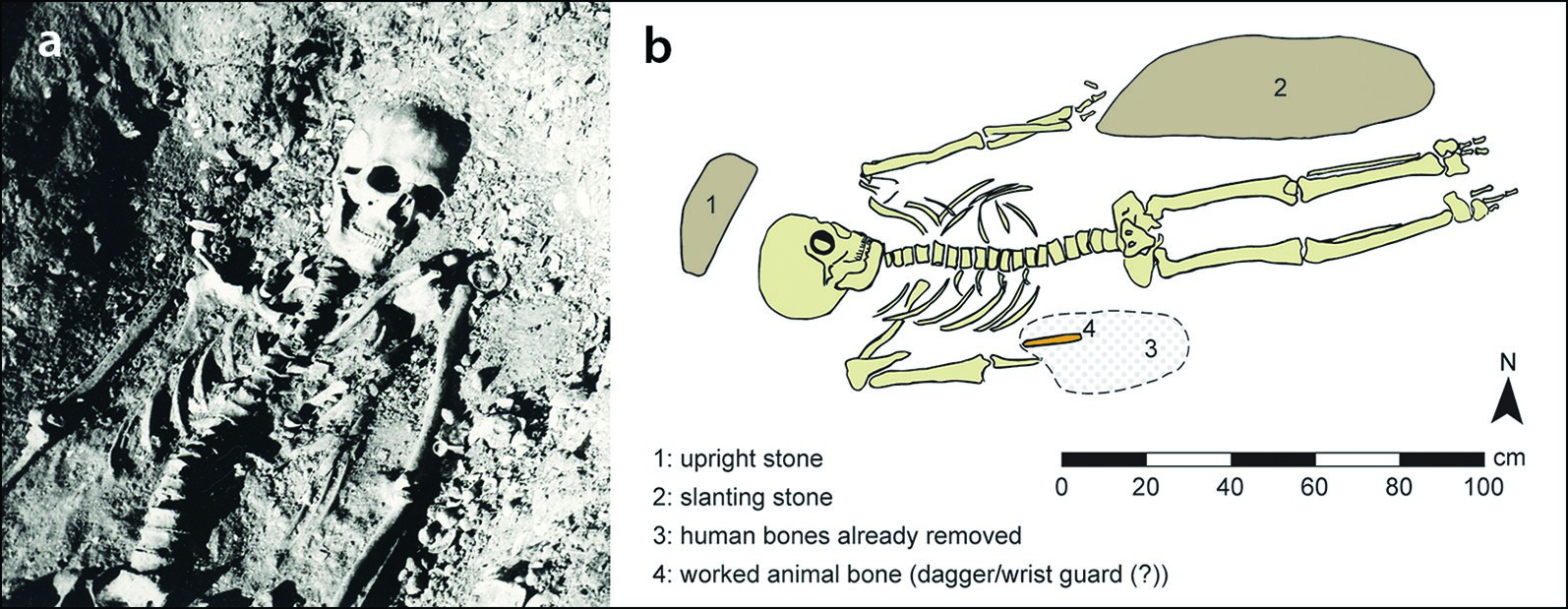
The body had been deliberately buried rather than simply left at the site. It lay on its back, with the arms extended alongside the body, the legs straight and the head pointing west. Two large stones were positioned beside the skeleton, with their flatter sides facing the body. One may have been a naturally occurring boulder, while the other appears to have been deliberately placed on its edge.
An object approximately 14 centimeters long was also recorded between the man’s right forearm and lower ribs. The original excavator described it as a possible skinning knife or elongated bone knife. A museum employee later changed its description to an unformed, water-worn piece of bone, and it was eventually discarded.
The researchers suggest that the object might instead have been an archer’s wrist guard, based on comparisons with artifacts from early Neolithic graves. If that interpretation is correct, it could indicate a connection with the Funnel Beaker Culture, associated with the arrival of farming in the region. However, the object’s original form cannot now be verified.
The burial itself also has some unusual features. Unlike typical Danish Late Mesolithic graves, it lacked ochre staining and had a stone arrangement more closely resembling certain early Neolithic farmer burials.
These details do not establish the man’s cultural identity, but they provide additional evidence that his burial may have occurred in a period when older Mesolithic traditions and emerging Neolithic practices were coming into contact.
A man shaped by a coastal environment
Around the time Rødhals Man lived, the Rødhals settlement occupied a small island surrounded largely by shallow coastal waters. The surrounding archipelago contained numerous reefs and smaller islands, with water depths generally below 5 meters. Deeper channels were found farther offshore.
The archaeological remains indicate that the local community depended heavily on marine resources. Oyster and cockle shells were particularly abundant, while fish bones and other animal remains reveal a diverse coastal subsistence economy.
Different parts of this environment offered different food sources.
Shallow-water habitats supported shellfish, flatfish and eels. These resources were associated with eelgrass meadows, underwater environments that the researchers identify as especially productive in the region.
Deeper offshore channels provided access to fish such as haddock and mature cod. Marine mammals, including seals and small whales, could also have been hunted.
The archaeological remains include slender bone points that were probably used to spear flatfish in shallow water. Abundant eel bones suggest that stationary wooden fishing structures may also have been used to catch eels.
Although the island itself offered little land, its forested higher ground provided wood for boats, dwellings, fishing equipment and firewood. It also offered access to wild terrestrial foods, including hazelnuts.
Larger animals such as red deer, if hunted by the inhabitants, would probably have come from larger landmasses. Zealand, for example, was approximately 18 kilometers away across open water.
This setting helps explain why marine food remained so important in the life of Rødhals Man. It also provides the environmental context needed to understand why a later increase in terrestrial food stands out in his chemical records.
His bones reveal a physically demanding life
Examination of the skeleton identified Rødhals Man as a male approximately 1.55 meters tall who died between the ages of 30 and 40. The researchers suggest he may have been toward the older end of that range, based partly on degenerative changes in his joints.
His skull has morphological characteristics consistent with individuals from the local Danish Mesolithic population. Dental wear and differences in the lengths of his upper arm bones also indicate that he was right-handed.
The skeleton was generally well preserved, with heavy bones and no evidence of violent injury. Its condition suggests that he experienced relatively good health and nutrition earlier in life. However, several features indicate physical strain and possible health problems during his later years.
His lower arm bones show bony growths around the elbow and wrist joints, along with changes in the surfaces where the bones connect. These features are consistent with repeated mechanical stress and substantial muscle loading.
The right knee also shows moderate degenerative changes. Both heels contain ossification of the Achilles tendon, a change associated with pronounced activity involving the calf muscles and feet.
The researchers suggest that these combined features could be consistent with prolonged paddling. One possible posture would have involved keeping the right leg bent and the left leg extended backward for balance.
This is an interpretation rather than a direct reconstruction of his daily activities. The skeletal changes indicate repeated physical demands, but they cannot identify a specific occupation or establish precisely how he moved.
There are also traces of inflammation and possible vitamin deficiency that may relate to his later life.
His teeth offer additional clues. They show moderate wear, a pattern more commonly associated with Mesolithic individuals than with Neolithic populations. However, a small cavity on one of his lower-right third molars is a feature more frequently observed among Neolithic individuals.
These observations provide a picture of someone whose physical remains largely reflect a traditional hunter-gatherer way of life, while also preserving a few characteristics that fit the changing environment of the period.
His DNA places him among Denmark’s last Mesolithic people
Ancient DNA analysis provides another important part of Rødhals Man’s history.
His nuclear genetic profile identifies him as a male with typical Western European hunter-gatherer ancestry, commonly abbreviated as WHG. He belonged to a large and well-studied genetic group found in Denmark throughout the Mesolithic period.
According to the researchers, this was the only genetic ancestry group documented in Denmark before the arrival of Neolithic farming populations with ancestry ultimately derived from Anatolia, in what is now Turkey.
Genetic evidence from other Danish individuals indicates considerable continuity within the Mesolithic population. The researchers also found little evidence of substantial genetic contributions from hunter-gatherer populations in peninsular Scandinavia and the northeastern Baltic region during this period.
Rødhals Man’s ancestry therefore connects him to the indigenous hunter-gatherer population of Denmark rather than to the incoming farming populations.
Genetic analysis also provides estimates of some physical characteristics, although these are probabilities rather than direct observations.
His genetic profile suggests relatively dark skin pigmentation and an approximately 85% probability of blue eyes. Other predicted traits include relatively high scores for height and basal metabolic rate compared with many other Danish Mesolithic individuals.
These predictions must be distinguished from direct observations of his appearance. They are based on genetic variants associated with particular traits, not preserved soft tissue or a complete reconstruction of his face and body.
Nevertheless, the genetic evidence establishes an important distinction: although his later diet may have reflected changes associated with the arrival of farming, there is no evidence that he had inherited ancestry from the incoming Anatolian farming population.
Chemical traces in his teeth reveal a changing diet
The most revealing evidence about Rødhals Man’s changing lifestyle comes from stable isotope analysis.
Scientists can examine the chemical composition of human bones and teeth to investigate the foods people consumed. Different food sources can leave distinguishable patterns of carbon, nitrogen and sulfur isotopes in the collagen preserved in these tissues.
These chemical signatures vary according to the environments and food chains from which dietary protein originates.
For Rødhals Man, the researchers used three isotope systems: carbon-13 (δ¹³C), nitrogen-15 (δ¹⁵N) and sulfur-34 (δ³⁴S).
Interpreting these measurements required more than simply comparing his values with those of other people. The researchers assembled an extensive reference dataset from animal bones and mollusk shells recovered from the Rødhals midden, alongside additional comparative material.
This was particularly important because the surrounding waters contained two isotopically distinct marine environments.
One was the shallow-water eelgrass habitat, which supplied resources such as mollusks, flatfish and eels. The other was the deeper offshore environment, associated with fish such as haddock and mature cod.
Because these marine habitats produced different isotope signatures, the researchers could distinguish between dietary contributions from the two environments rather than treating all seafood as one uniform source.
They also compared the marine signatures with those of terrestrial food sources.
The analysis included collagen from Rødhals Man’s bones and teeth. However, the teeth provided something especially valuable.
Unlike bone, which is continually remodeled during life, dentine forms incrementally and preserves information about different periods of development. By sampling successive layers of dentine from his lower-right first premolar, the researchers could reconstruct changes in his diet as he grew older.
The resulting record covered approximately seven years of age through adulthood.
This approach made it possible to move beyond a general estimate of what Rødhals Man ate during his life and examine how his food sources changed across different stages of development.
The shift toward terrestrial food began in adolescence
The isotope evidence indicates that Rødhals Man relied primarily on marine resources throughout his life, particularly food from the productive eelgrass habitat.
His childhood diet was broadly consistent with other individuals from the Ertebølle Culture, the Late Mesolithic population associated with Denmark and neighboring regions.
There was some variation during childhood. Around the ages of eight and nine, his diet appears to have included a somewhat greater contribution from terrestrial food.
From approximately age 11 onward, the isotope record indicates an increased contribution from offshore marine resources. More importantly, the proportion of terrestrial protein began rising sharply during adolescence and continued to be substantial in adulthood.
This was not simply a case of replacing seafood with land-based food. Marine resources remained important throughout his life.
Instead, the evidence points to a gradual diversification of his diet. He continued to obtain much of his protein from the sea while increasingly incorporating food from terrestrial environments.
The distinction is important because other Mesolithic individuals in Denmark also consumed varying amounts of terrestrial food. Some relied more heavily on land animals, freshwater resources or offshore fish than others.
However, Rødhals Man’s adult dietary pattern was unusual among known coastal Ertebølle individuals. The sustained terrestrial contribution was unlike that recorded in other Mesolithic individuals examined by the researchers.
His diet therefore provides evidence of a change that occurred within his lifetime, rather than a simple difference between two populations living in different periods.
The isotope record cannot identify the exact foods he ate or establish whether the terrestrial protein came from domesticated animals, wild game or a combination of sources.
That distinction becomes central when interpreting his place in the transition to farming.
Did he begin eating food produced by farmers?
An increase in terrestrial food does not automatically mean that someone had adopted agriculture.
A coastal hunter-gatherer could obtain land-based protein by hunting wild animals or gathering available resources. Rødhals Man might also have spent considerable time on a larger landmass, where terrestrial food was more readily available, before returning to Sejerø.
The researchers explicitly consider this possibility.
However, they identify two observations that make an association with incoming farming communities plausible.
First, Rødhals Man’s diet did not contain isotopically visible amounts of freshwater fish. Inland hunter-gatherers often had access to freshwater environments, making this absence relevant when considering whether he had spent substantial time living and foraging inland.
Second, the terrestrial component of his adult diet was sustained over a prolonged period and was unusually high for a coastal Ertebølle individual.
Together, these features suggest that he may have adopted aspects of a partly Neolithic lifestyle or maintained close contact with farming communities.
The researchers argue that the arrival of farmers during his lifetime offers an obvious explanation for the unusual dietary pattern.
But this remains an interpretation. The isotope evidence demonstrates a change in the sources of his dietary protein. It does not directly establish that he cultivated crops, raised livestock or regularly obtained food from farming households.
There is also no way to determine from the dietary record alone whether the change reflected a new cultural identity, economic relationships with farmers or a more limited interaction with their communities.
The distinction between what the chemical evidence demonstrates and what it suggests is essential to understanding the archaeological significance of his life.
Correcting the dates reveals when he lived
Establishing Rødhals Man’s precise position in the transition to farming presented another scientific challenge.
Five radiocarbon dates were available for his remains, but all initially appeared older than his actual time of death.
The problem was a phenomenon known as the marine reservoir effect.
Marine organisms can incorporate carbon that has been circulating in the ocean for much longer than carbon in the atmosphere. When people consume marine food, some of this older carbon enters their bodies and can make their remains appear older in radiocarbon dating than they really are.
For someone who obtained much of his protein from the sea, this effect can substantially distort chronological estimates.
The problem is especially complicated when an individual’s marine diet changes over time. Different marine habitats can carry different radiocarbon signatures, and the proportion of marine food in the diet determines how strongly the reservoir effect influences the dating results.
There is another complication. Different parts of the skeleton incorporate and replace collagen at different rates. Consequently, a bone or tooth sample can retain biological material representing a different period of the person’s life rather than precisely the moment of death.
The researchers addressed these problems by combining the five radiocarbon measurements in a Bayesian chronological model.
The model incorporated estimates of how much protein Rødhals Man obtained from three sources: terrestrial environments, the shallow-water eelgrass habitat and the deeper offshore marine environment. It also accounted for the intrinsic age of the sampled skeletal materials.
This allowed the researchers to correct for the dietary reservoir effect before estimating his date of death.
The resulting chronology places Rødhals Man’s death between 3930 and 3710 cal BC, with 95% probability. The narrower interval with 68% probability is 3890–3770 cal BC.
This corrected dating is particularly important because it places him close to the period when domestic animals and farming began appearing in Denmark.
Without accounting for his marine diet, the radiocarbon measurements would have placed him misleadingly far back in time.
Farming reached Denmark while hunter-gatherers were still living there
The corrected chronology becomes more informative when compared with the archaeological and genetic evidence for the arrival of farming.
Directly dated bones of domestic cattle and sheep indicate that a subsistence economy involving domesticated animals appeared in Denmark around 3950–3850 cal BC.
This means that farming and herding were already present in the region during at least part of the period in which Rødhals Man lived.
The researchers also discuss Viksø Woman, the earliest dated individual in Denmark with demonstrable Anatolian farmer ancestry. Their chronological estimate places her death around 3790–3730 cal BC. Her diet was overwhelmingly terrestrial, presumably reflecting agricultural food production in her archaeological context.
On the Sejerø archipelago itself, another important individual is the Sejerby Female. She was buried approximately 2.5 kilometers from Rødhals Man’s burial and lived around 200–300 years later.
She is currently the earliest directly dated individual with Anatolian farmer ancestry identified from the archipelago. Her diet was also overwhelmingly terrestrial.
Together, these findings establish that farming communities had become locally established by the time of the Sejerby Female and that domestic animals were present in Denmark during Rødhals Man’s lifetime.
The exact circumstances of the earliest transition remain unresolved.
The first herders may have been relatively small groups of immigrants carrying Anatolian farmer ancestry. Alternatively, indigenous hunter-gatherer groups may have adopted herding through contact with farming communities in neighboring regions.
The available evidence does not yet establish which process initiated the appearance of domestic animals in the Danish archipelago.
What it does establish is that the arrival of farming was not necessarily an instantaneous replacement of one way of life by another. For a period, people following different subsistence traditions existed within the same broader region.
Rødhals Man’s life falls within this period of overlap.
The last known coastal hunter-gatherer with unadmixed Mesolithic ancestry
The researchers identify Rødhals Man as the most recent securely dated individual currently known from Denmark who combined unadmixed Western European hunter-gatherer ancestry with a coastal fisher-hunter-gatherer dietary signature.
Other individuals provide important qualifications to this distinction.
A male buried at Dragsholm had the same genetic profile and a similar date, but his diet was much more terrestrial. Two individuals from inland Danish sites, Tingbjerggård Vest and Ravnsbjerggård, may also date to the beginning of the fourth millennium BC, although freshwater reservoir effects complicate their radiocarbon chronology.
Another individual, known as Lola, was identified through DNA recovered from ancient birch-tar chewing gum at Syltholm. She was a female with unadmixed Western European hunter-gatherer ancestry and a date comparable to Rødhals Man.
The genetic record therefore does not mean that Rødhals Man was necessarily the final person in Denmark with Mesolithic ancestry. Rather, he is the latest securely dated individual identified with the particular combination of ancestry and coastal dietary characteristics described by the researchers.
The distinction matters because genetic ancestry and everyday subsistence are not interchangeable.
An individual could retain hunter-gatherer ancestry while consuming food associated with farming communities. Similarly, a person could maintain a largely foraging-based diet even after farmers had settled nearby.
Rødhals Man’s life demonstrates why examining both genetic and dietary evidence is necessary to understand the transition.
The broader archaeological record also reveals how dramatically the population of Denmark changed during the Neolithic period. Later individuals recovered from Danish shell middens included people with Anatolian farmer ancestry and, subsequently, individuals with steppe-related ancestry. These later individuals had overwhelmingly terrestrial diets.
The appearance of these different ancestry groups, together with the dietary differences recorded in their remains, documents substantial changes in the population and subsistence patterns of the region.
Contact between two different ways of life
The researchers place Rødhals Man’s experience within a longer period of interaction between Ertebølle hunter-gatherer-fishers and incoming farming communities.
The Ertebølle Culture occupied coastal areas across Denmark and neighboring parts of southern Scandinavia and northern Europe. Its communities exploited marine environments intensively, and archaeological evidence suggests that some settlements may have been occupied throughout the year.
The researchers propose that the exceptional productivity of Danish eelgrass habitats helped support relatively large and settled hunter-gatherer populations.
They estimate that the Ertebølle population across the broader region may have numbered several thousand people. Such a population would have required efficient exploitation of abundant marine resources.
This ecological setting may help explain why farming spread into Denmark relatively late compared with areas farther south.
The arrival of farming south of the Baltic preceded its subsequent spread into Denmark by more than 1,000 years. The researchers suggest that established coastal communities, supported by productive marine environments and connected through water transport, may have slowed the expansion of farming populations.
However, the relationship between the two groups was not necessarily peaceful or entirely cooperative.
Skeletal remains associated with the Ertebølle Culture show relatively frequent evidence of interpersonal violence. More than 10% of males in some studied groups display traces of such injuries. Researchers have previously suggested that territorial disputes, potentially involving access to productive fishing grounds, could have contributed to this pattern.
The authors discuss the possibility that relations between indigenous hunter-gatherers and incoming farmers sometimes involved conflict. Genetic evidence suggests that the later arrival of farming populations was accompanied by relatively limited interbreeding with local hunter-gatherer groups and a substantial population replacement.
At the same time, archaeological evidence points to contact well before the final Neolithic transition.
Danubian shaft-hole axes found in Ertebølle contexts indicate connections with farming-associated regions centuries before farming became established in Denmark. More direct evidence of interaction around 3850 BC includes the rapid adoption of stationary weir fishing by farmers and evidence that Ertebølle communities had access to dairy products.
These findings suggest that the two ways of life were not completely isolated from one another.
Rødhals Man’s unusual diet may represent another individual-level example of this contact, although the precise nature of his relationship with farming communities remains unknown.
His burial also adds a possible cultural dimension. Its stone arrangement resembles some early Neolithic graves, and the disputed bone object may have been an archer’s wrist guard associated with the Funnel Beaker Culture. Neither observation is conclusive, but both fit the possibility that he lived in an environment where Mesolithic and Neolithic practices were beginning to overlap.
The researchers’ reconstruction therefore places him within a period of coexistence, interaction and eventual population change, rather than treating the transition as a single event.
Rødhals Man died sometime between 3930 and 3710 cal BC, according to the corrected radiocarbon chronology. His remains preserve evidence of a life that began within a marine-dependent hunter-gatherer society but included a substantial dietary shift toward terrestrial food during adolescence and adulthood. Whether that change resulted directly from contact with farmers cannot be established, but it occurred during the period when domestic animals and farming communities were reaching the Danish archipelago.
The study was published in Antiquity.