Rapidly spinning young Venus could once have hosted a moon that migrated outward for billions of years, only to be overtaken as tidal forces slowed the planet and pushed its synchronous radius toward the moon’s orbit. New modeling of that coupled evolution finds that a Venusian moon’s fate depended strongly on its mass, Venus’s initial spin, the moon’s orbit and eccentricity, and how tidal dissipation inside Venus is modeled. Under some conditions, a lunar-mass moon could survive for 4.5 billion years. Under others, it could cross the Roche limit and be destroyed in less than a million years.
Venus has no natural satellite today, but that does not establish that the planet never had one.
The study examines whether a moon formed around Venus could have been removed through tidal evolution alone. Rather than assuming a particular impact or moon-forming event, the researchers built a semianalytical model that follows the coupled evolution of Venus’s rotation and a hypothetical satellite’s orbit. They varied the planet’s initial spin period from 5 to 100 hours, moon masses from 0.01 to 10 times the mass of Earth’s Moon, orbital eccentricity, the moon’s starting distance, and Venus’s tidal quality factor. They also calculated the evolution using two different descriptions of tidal dissipation, known as the constant-Q and constant-time-lag, or CTL, models.
The central competition is between two effects.
When a moon orbits outside the synchronous radius, tidal interaction with a rapidly rotating planet can transfer angular momentum from the planet’s spin into the moon’s orbit. The moon moves outward while Venus spins down. As Venus loses rotational speed, its synchronous radius, the distance at which a satellite would orbit at the same rate as the planet rotates, moves outward.
Those two distances do not necessarily grow at the same rate. The calculations show that the moon’s outward migration rate scales linearly with satellite mass, while the expansion of the synchronous radius scales with the square of satellite mass. That difference creates a boundary between systems in which a moon can move outward and survive and systems in which the expanding synchronous radius eventually overtakes the moon’s orbit.
Once that happens in the constant-Q calculations, the direction of tidal migration reverses. The moon begins moving inward until it reaches Venus’s Roche limit, where tidal forces can disrupt it.
For a fluid moon with lunar density, the modeled Roche limit is 2.85 Venus radii. The planet’s Hill sphere extends much farther, to about 167 Venus radii, while the critical semimajor axis for long-term prograde satellite stability is about 82 Venus radii.
A lunar-mass moon can survive around a fast-spinning Venus
The calculations do not make moon loss inevitable.
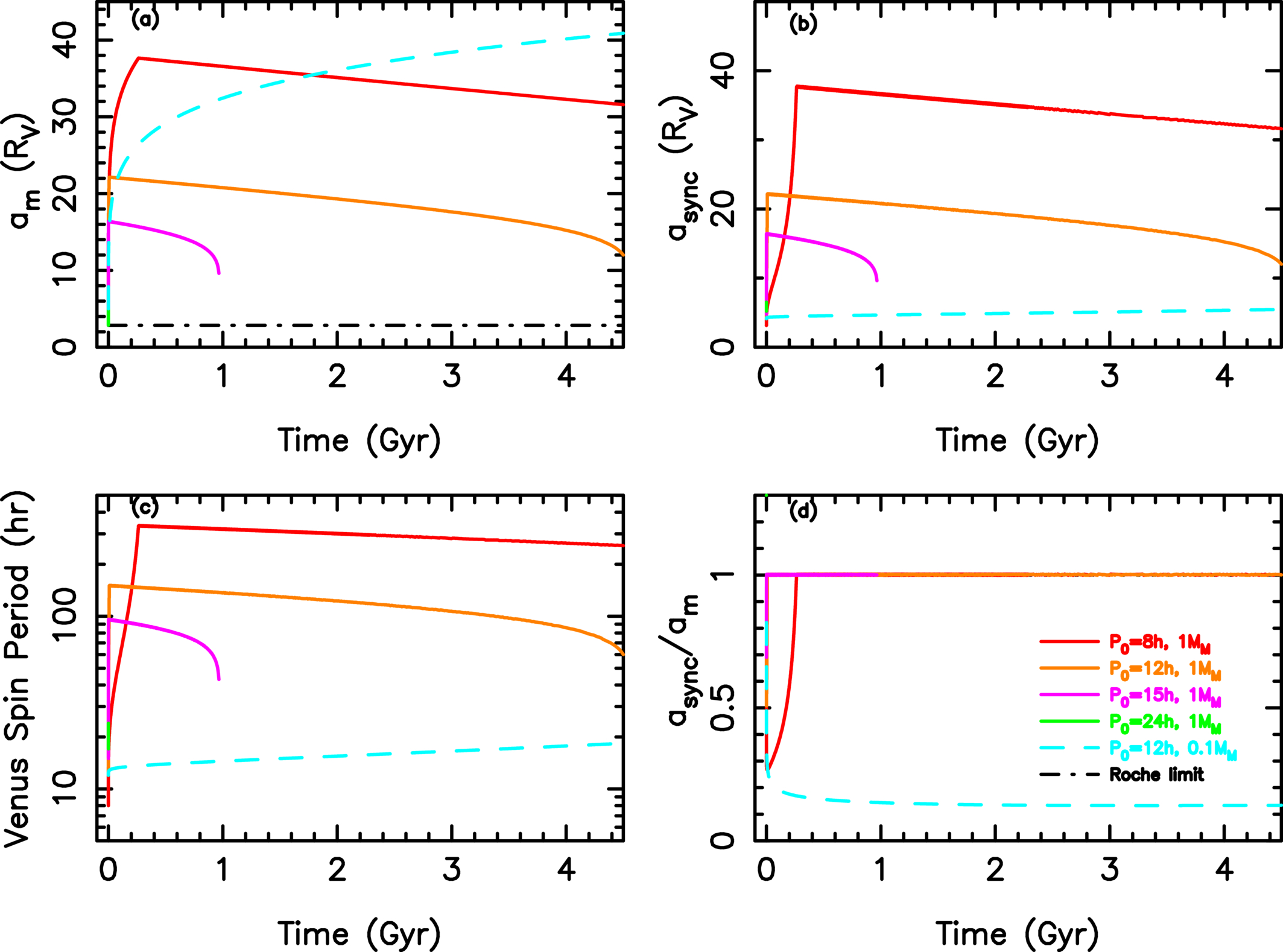
For a circular orbit and a rapidly rotating Venus, a moon with the mass of Earth’s Moon can survive the full 4.5-billion-year integration. In the constant-Q model with Venus’s tidal quality factor set to 50 and an initial moon distance of five Venus radii, lunar-mass satellites survive when Venus initially spins with periods of 5, 8 or 12 hours. A case beginning with a 15-hour spin period instead undergoes synchronous reversal and reaches the Roche limit after about 0.97 billion years. With an initial 24-hour spin, the moon is destroyed within roughly 1 million years.
The difference can be seen especially clearly in a comparison with Earth.
The researchers modeled an Earth-Moon system and a Venus-moon system with the same starting planetary spin period of 5 hours, an initial moon distance of 3.5 planetary radii and a one-Moon satellite. In the Earth case, the Moon migrates outward to about 60 Earth radii while the synchronous radius remains well inside its orbit. In the Venus case, the moon also moves outward, but Venus’s synchronous radius grows much more rapidly. By 4.5 billion years, it reaches about half the moon’s orbital distance.
The difference comes from how strongly the tidal torque depends on orbital distance. A moon orbiting relatively close to Venus exerts a much stronger torque on the planet, which increases the rate at which Venus loses spin. That despinning causes the synchronous radius to expand, narrowing the gap between the moon and the synchronous radius.
The result is a feedback between Venus’s spin and the moon’s orbit. A small change in the initial conditions can therefore move the system from long-term survival into eventual destruction.
Moon mass changes the outcome
Satellite mass is another critical part of the balance.
The model surveys masses from one-hundredth to 10 times the mass of Earth’s Moon. In the constant-Q calculations, increasing the moon’s mass does not simply make the satellite more resistant to destruction. A more massive moon exerts a stronger tidal torque on Venus, causing faster planetary despinning and faster expansion of the synchronous radius.
At the fiducial value of Venus’s tidal quality factor, 50, the calculations show that moons of roughly two lunar masses or more can enter the destruction regime even when Venus begins with a rapid spin. For example, with an initial spin period of 8 hours, a two-lunar-mass moon is destroyed after about 1.7 billion years in the constant-Q model.
At still slower initial spins, destruction can occur much sooner. Across the modeled parameter space, the constant-Q model gives destruction times of roughly 0.03 to 1.7 billion years for sufficiently massive moons or more slowly rotating Venus.
The calculations also show why a moon cannot simply be assumed to have formed at any arbitrary distance. For a one-lunar-mass satellite starting with Venus rotating every 12 hours, initial orbital distances of 5, 8 and 12 Venus radii all allow survival in the modeled cases, but the moon reaches different maximum distances. The starting orbit therefore changes the detailed evolution even when the final fate remains the same.
Very slow rotation can doom a moon almost immediately
There is an especially sharp boundary when Venus begins rotating too slowly.
If the planet’s initial spin period is longer than the critical value for the satellite’s orbit, the moon begins inside the synchronous radius rather than outside it. In that configuration, the tidal torque drives the moon inward from the beginning.
The calculations find that such satellites are destroyed within about 1 million years regardless of satellite mass or which of the two tidal models is used. For an initially 24-hour Venus, for example, the modeled moon is rapidly driven to the Roche limit.
This makes the planet’s initial spin important not only because it determines whether the moon initially moves outward, but because it determines how much orbital room the moon has before Venus’s evolving synchronous radius becomes a problem.
Eccentric orbits add another way to lose a moon
The moon’s orbit does not have to be perfectly circular for another instability to appear.
For very rapidly rotating Venus, with initial spin periods of about 10 hours or less, the ratio between the planet’s spin frequency and the moon’s orbital frequency can enter a regime in which tidal interactions initially increase the moon’s orbital eccentricity rather than damping it.
The calculations identify a threshold at a spin-to-orbit frequency ratio of 18/11. Below the corresponding initial spin periods, low-mass moons can experience eccentricity growth that destabilizes their orbits. The effect can occur even when the initial eccentricity is only 0.01.
More massive moons behave differently because their stronger tidal torque can slow Venus before the eccentricity has time to grow substantially. Thus, increasing the moon’s mass can both make synchronous-radius expansion more dangerous and, in the appropriate fast-spin regime, help the system escape the eccentricity-pumping regime.
At initial eccentricities above about 0.5, the calculations find that enhanced tidal dissipation associated with eccentricity overwhelms the damping behavior and drives the moon toward destruction. When Venus begins with a 24-hour spin, however, eccentricity does not change the outcome because the moon is already in the rapid inward-migration regime.
For a lunar-mass moon, the survival region at very rapid initial spin is therefore constrained by both the eccentricity behavior and the evolution of the synchronous radius. The calculations indicate that survival requires initial spin periods of roughly 10 to 12 hours when the starting eccentricity is low.
The tidal model itself changes the fate of massive moons
One of the study’s most important results comes from comparing the two descriptions of tidal dissipation.
The constant-Q model assumes that the efficiency of tidal dissipation is independent of tidal frequency. Near synchronization, its tidal torque changes sign abruptly when Venus’s rotation rate matches the moon’s orbital rate.
The CTL model instead makes the tidal response depend on the tidal frequency. Its torque approaches zero smoothly as Venus and the moon approach synchronization.
That difference matters most for massive moons.
For a one-lunar-mass moon around Venus initially rotating every 8 hours, the two models give the same broad result: the satellite survives through a quasi-synchronous state. But for moons of about two lunar masses or more, the predictions diverge. In the constant-Q calculation, a massive moon can rapidly despin Venus, allowing the synchronous radius to overtake the moon’s orbit and trigger inward migration to the Roche limit. In the CTL calculation, the tidal torque weakens as the system approaches synchronization, allowing the moon to approach a tidal fixed point instead.
The difference is quantitative as well as qualitative. At an initial spin period of 8 hours and a moon mass of two lunar masses, the constant-Q model gives Roche destruction after about 1.7 billion years, while the CTL model predicts survival. The same mass therefore has opposite long-term fates under the two tidal prescriptions in that part of the parameter space.
The authors note that the CTL treatment is generally considered more physically motivated near synchronization because it avoids the discontinuous torque reversal of the constant-Q model. They also caution that constant-Q lifetimes near the boundary are sensitive to the numerical treatment of that abrupt sign change, which can introduce oscillations whose net effect depends on the integration resolution.
For lower-mass satellites, the distinction is much less important. The two models agree that moons of roughly one lunar mass or less can survive around rapidly spinning Venus under appropriate initial conditions.
Losing the moon and slowing Venus are separate constraints
The absence of a moon today is not the only feature the model has to reproduce.
Venus currently rotates very slowly compared with a rapidly spinning young planet, and it has no satellite. If a moon was responsible for transferring angular momentum out of Venus’s rotation, a successful evolutionary history has to produce both outcomes: the moon must eventually disappear, while Venus must lose enough spin.
The parameter survey shows that these requirements do not overlap across the entire range of initial conditions.
In the constant-Q model, the region where a satellite is destroyed does not automatically correspond to a region where Venus becomes substantially despun. Some systems lose the moon quickly while leaving Venus rotating relatively rapidly. Other systems allow the moon to survive while transferring substantial angular momentum to its orbit.
The calculations therefore identify a comparatively restricted region in which both moon loss and substantial despinning occur. That region favors moderate initial spin periods and lunar-to-super-lunar satellite masses.
The study compares this result with simulations of giant impacts that have been proposed for Venus. Those simulations predict spin periods of about 12 hours or longer for configurations capable of producing Venus’s present rotation. A lunar-mass moon produced under such conditions would sit near the survival boundary identified by the tidal calculations.
There is another complication. The rapidest-spinning impact scenarios can place debris inside the synchronous orbit, where it may reaccrete without producing a long-lived moon. The impact configurations that put debris outside the synchronous orbit and therefore make moon formation possible tend to leave Venus with initial spin periods around or above 12 hours, placing a resulting lunar-mass satellite closer to the tidal boundary. The authors interpret the combination of impact geometry and subsequent tidal evolution as a possible route to a moonless Venus without requiring a later catastrophic event to strip the satellite away.
That remains a modeled evolutionary scenario rather than a direct observation of Venus’s early history.
Venus’s uncertain tidal response limits the calculation
The model also depends on how efficiently Venus dissipates tidal energy.
The planet’s tidal response is poorly constrained because Venus has no moon whose orbital evolution can be measured directly. The study therefore varies the tidal quality factor, rather than relying on a single precisely known value.
In the constant-Q calculations, changing that value shifts the boundary between survival and destruction. A higher Q means weaker tidal dissipation and generally extends moon lifetimes, while a lower Q produces more rapid evolution. At the fiducial value of Q = 50, for example, some lunar-mass moons survive for the full 4.5-billion-year integration while more massive or more slowly rotating systems are destroyed. The study also examines Q values of 10 and 100, spanning more than an order of magnitude.
The researchers also emphasize that their calculations include gravitational body tides raised by both the moon and the Sun but omit atmospheric thermal tides.
That omission matters particularly for Venus. Solar heating of Venus’s atmosphere can produce thermal tides that affect the planet’s spin. The authors state that including this additional despinning torque would accelerate the expansion of the synchronous radius, hasten the onset of inward migration and shorten satellite lifetimes. They therefore regard their calculated survival prospects as conservative within the assumptions of the model.
A destroyed moon would leave material behind
If a Venusian moon crossed the Roche limit, the resulting debris would not simply disappear. The authors discuss the possibility that disrupted lunar material would eventually be deposited on Venus’s surface and in its atmosphere.
That raises a possible connection with measurements of Venus’s atmosphere. The study points to the NASA DAVINCI mission, whose in situ measurements of atmospheric composition could potentially constrain such a history through noble-gas abundances and isotope ratios. The authors stress that a lunar contribution would have to be distinguished from material associated with Venus itself, later volcanic outgassing and atmospheric escape, and they identify a future mass-balance calculation as necessary before the detectability of such a signal could be assessed quantitatively.
The age of Venus’s surface provides another timing constraint in the authors’ scenario. Venus has a globally young surface, with a crater-retention age of several hundred million years, indicating substantial resurfacing after the era of the last giant impact. Because reaccretion of a disrupted moon would have placed a large amount of silicate debris on the surface, the authors argue that moon destruction could not have occurred during the most recent resurfacing interval without leaving an observable signature. Any such moon-loss event would therefore have had to occur earlier in Venus’s history, consistent with the sub-billion-year destruction times found for the relevant parameter range.
The same dynamics point to different outcomes for Venus-like exoplanets
The study briefly extends the direction of its results to terrestrial planets in the Venus Zone, while emphasizing that the calculations were calibrated specifically to Venus and are not a general survey of exoplanetary systems.
For slowly rotating terrestrial planets orbiting interior to the habitable zone, the authors describe a regime in which a satellite can begin outside the synchronous radius only under sufficiently rapid planetary rotation. If the planet rotates too slowly, the satellite starts inside that radius and rapidly migrates inward.
The authors also consider Venus analogs around M-dwarf stars. Because an equivalent level of stellar illumination occurs at a closer orbital distance around a lower-mass star, the planet’s Hill sphere is smaller, forcing a moon into a tighter orbit relative to the planet. The resulting increase in tidal torque can accelerate satellite evolution. As an illustrative case, the study calculates that for a Venus analog at 0.1 astronomical units around a 0.3-solar-mass star, the critical spin period is about 10 times lower than for Venus. The authors describe moon survival there as effectively impossible for plausible postimpact spin periods, while stressing that this is a directional extrapolation rather than a comprehensive exoplanet calculation.
For Venus itself, the modeled histories remain sensitive to the initial conditions and to the tidal prescription. A lunar-mass satellite around a rapidly spinning planet can remain in orbit for the age of the solar system, while a more massive moon or a slower initial rotation can bring the synchronous radius across the orbit and send the satellite toward the Roche limit. Very slow initial rotation instead places the moon inside the synchronous radius from the start.
The resulting picture is therefore not that a moon around Venus would necessarily have been short-lived. It is that the coupled evolution of the moon and Venus’s rotation creates a narrow set of conditions under which a satellite can both survive long enough to despin the planet and ultimately be lost. The study finds that, for the modeled last-impact conditions within that region, tidal evolution alone can account for the present absence of a Venusian satellite without requiring a later catastrophic stripping event.
The study was published in The Astrophysical Journal.