A distant blazar appears to have experienced a sudden shift in its powerful jet, along with an unusually fast gamma-ray flash, and astronomers say the combination may be evidence that an unseen clump of dark matter briefly bent the jet’s apparent path.
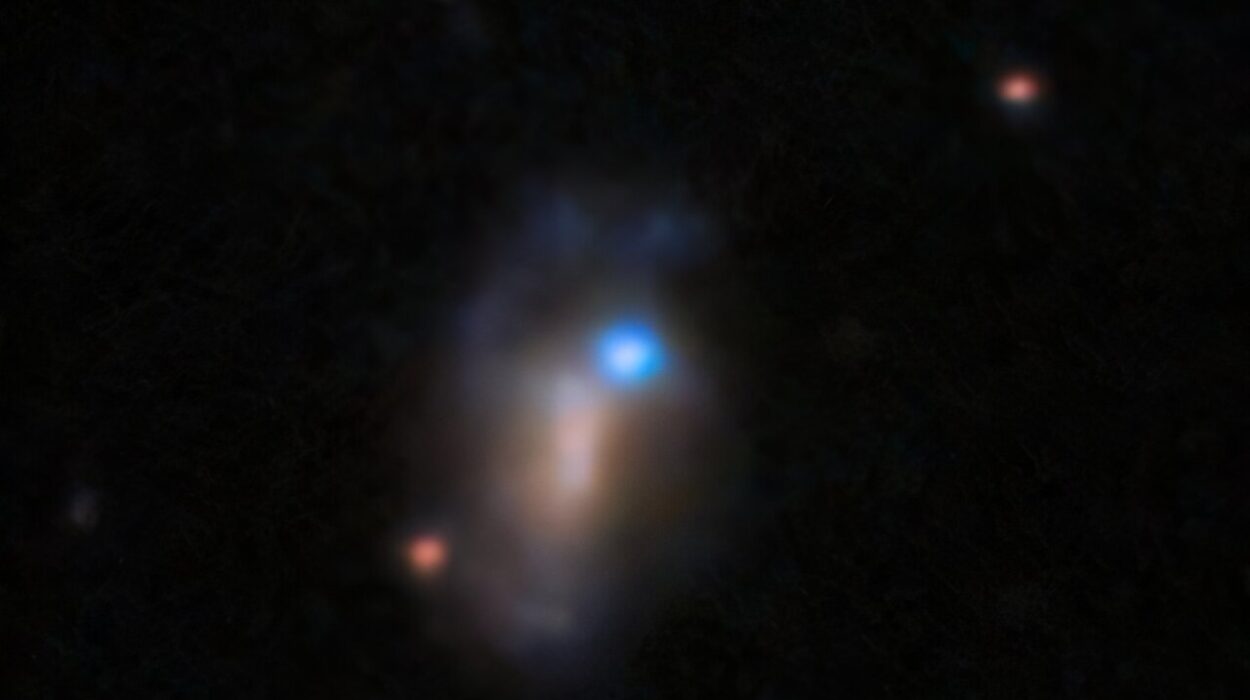
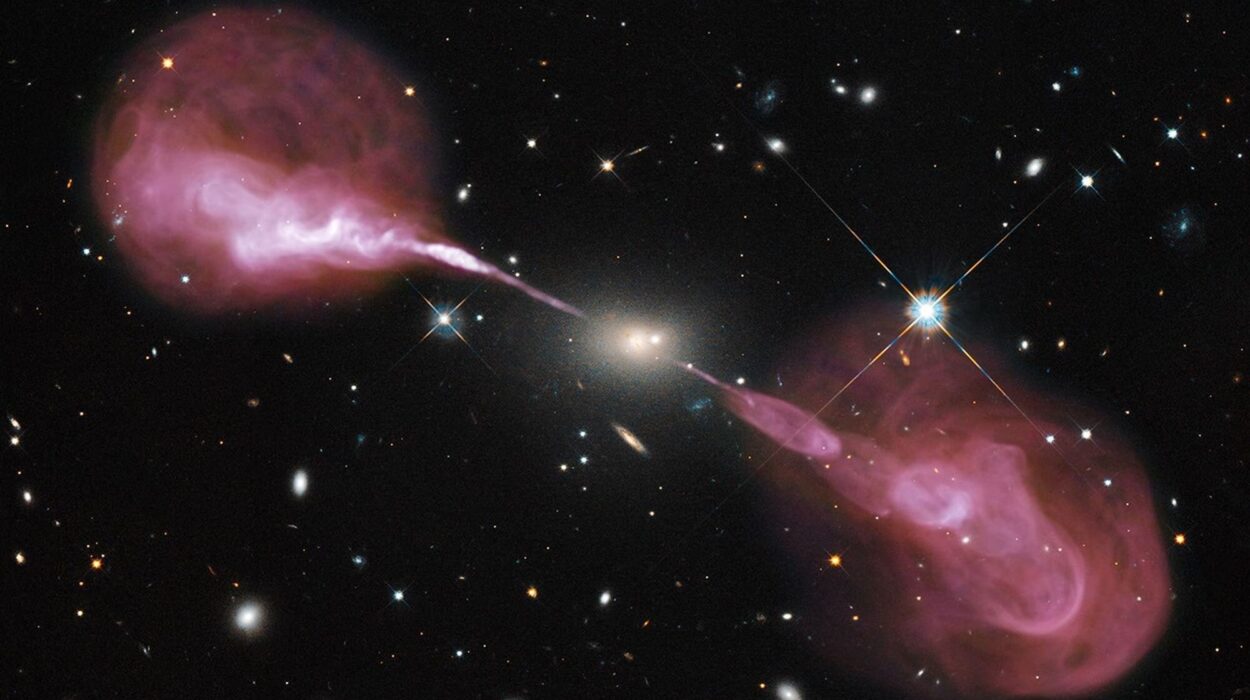
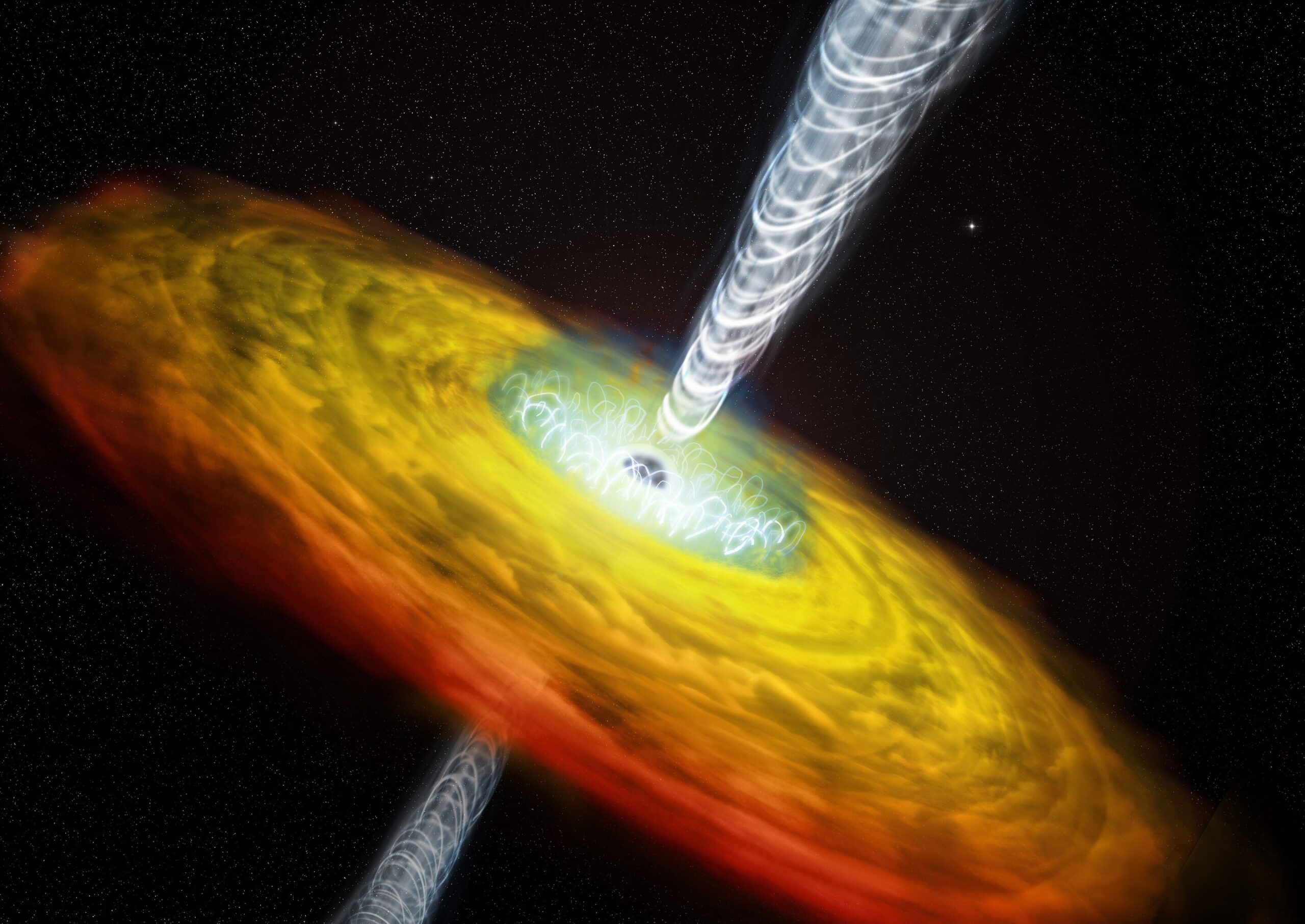
The object at the center of the study is PKS 2233-148, a blazar whose active galactic nucleus sends jets of ionized matter outward from its two poles at speeds close to that of light. One of those jets points directly toward Earth, making it an important target for astronomers studying possible sources of cosmic neutrinos.
Cosmic neutrinos are extremely difficult to detect. The IceCube Neutrino Observatory uses thousands of detectors embedded in a cubic kilometer of Antarctic ice to record tiny flashes of light produced when neutrinos interact with the ice. Those signals can be used to trace the particles back toward their distant sources.
But detecting a neutrino does not by itself explain how the particle was produced. Astronomers therefore look for cases in which neutrino detections coincide with electromagnetic activity from the same object.
Silke Britzen of the Max Planck Institute for Radio Astronomy in Germany and her colleagues focused on PKS 2233-148 because its jet could be producing neutrinos.
“These large-scale jets are cosmic accelerators, and might be generating neutrinos,” Britzen said. “We study them to search for any peculiarities which might help us to gain a better understanding of neutrino emission.”
The jet suddenly shifted
To investigate the blazar in greater detail, the researchers examined high-resolution observations collected across different parts of the electromagnetic spectrum.
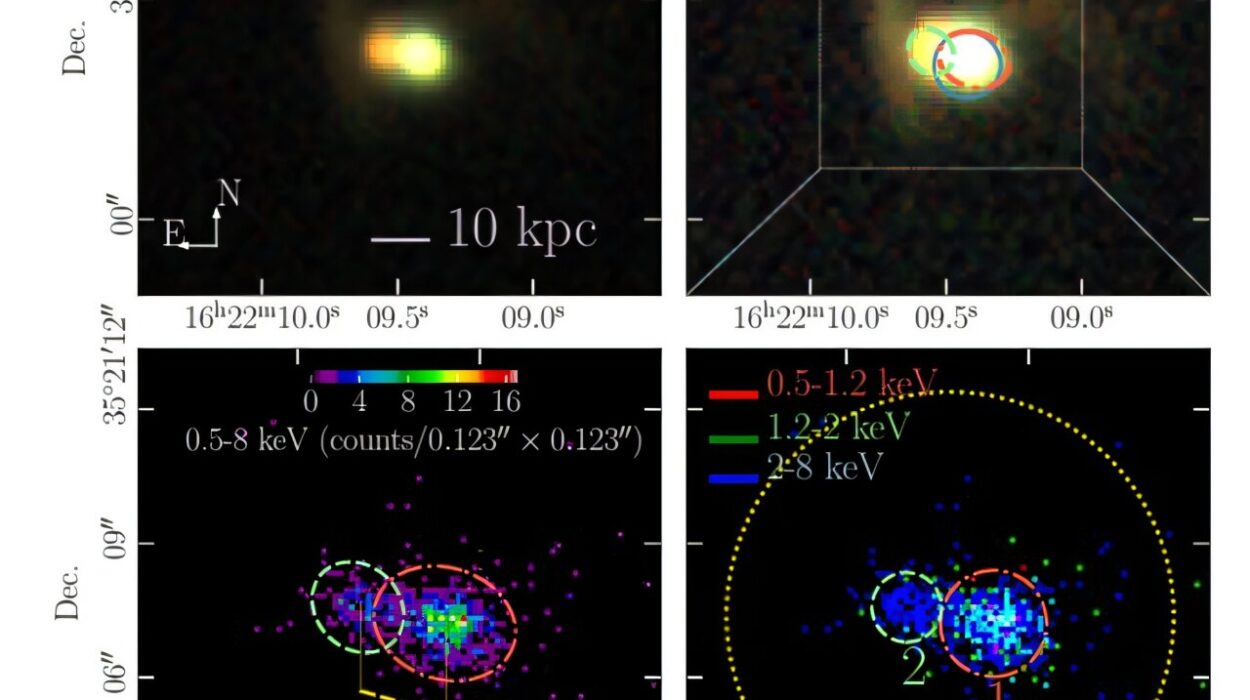
The data included radio observations from the Very Long Baseline Array, a network of radio dishes across the United States, as well as gamma-ray measurements from the Fermi-LAT space telescope and X-ray observations from the Swift-XRT observatory.
Together, these observations allowed the researchers to track the motion of the blazar’s jet and how that motion changed over time.
The analysis revealed an unexpected feature. The jet appeared to have suddenly moved away from its expected path.
The researchers also found an unusual feature in the blazar’s gamma-ray light curve. A very rapid gamma-ray flash appeared on top of the object’s more regular flaring activity.
Britzen described the two observations as previously undetected phenomena in the jet and gamma-ray light curve.
The timing of the rapid gamma-ray flash became particularly important because its timescale could be consistent with a signature of gravitational lensing by dark matter.
An unseen mass may have bent the jet
Gravitational lensing happens when a mass lies between a distant source of light and an observer. The mass can bend the light’s path, changing the apparent position of the source behind it.
The researchers propose that an unseen clump of dark matter may have passed in front of PKS 2233-148. If so, the dark matter could have temporarily lensed the blazar’s jet, producing the observed displacement.
The interpretation remains conditional. The observations are consistent with the possibility of dark matter lensing, but the researchers describe the event as something that “might” indicate dark matter substructure.
Short-lived lensing events can be difficult to identify, according to Britzen.
“This is the first time that we find a lensing phenomenon which might hint at dark matter substructure,” she said.
If the interpretation is correct, PKS 2233-148 would be the fourth likely cosmic-neutrino source identified as having been gravitationally lensed, alongside examples reported in earlier studies.
Looking for more lensing events
The researchers hope to identify additional short-lived lensing events and eventually connect them with observations from the IceCube Neutrino Observatory.
Such links could help astronomers investigate the distant sources associated with cosmic neutrinos and the events that produce them. The researchers specifically hope that connections between rapid flashes and neutrino observations could provide further information about how these particles are released.
The study was published in Monthly Notices of the Royal Astronomical Society.