A single strontium atom can remain in an extremely excited circular Rydberg state for more than 10 milliseconds at room temperature when it is held between carefully designed conducting plates that suppress the microwave modes responsible for blackbody-radiation decay.
Rydberg atoms are atoms whose electrons have been excited into very high-energy orbitals far from the atomic core. In the states normally used for neutral-atom experiments, these highly excited electrons eventually decay through spontaneous emission and interactions with thermal radiation. The resulting lifetimes are typically on the order of 100 microseconds for commonly used S and D Rydberg states.
Circular Rydberg states take a different route to longer lifetimes. Their electron has the maximum possible orbital angular momentum for a given principal quantum number, satisfying |m| = l = n − 1. That angular momentum strongly restricts spontaneous optical decay through selection rules. The remaining problem at room temperature is blackbody radiation, which can drive microwave transitions between nearby Rydberg states.
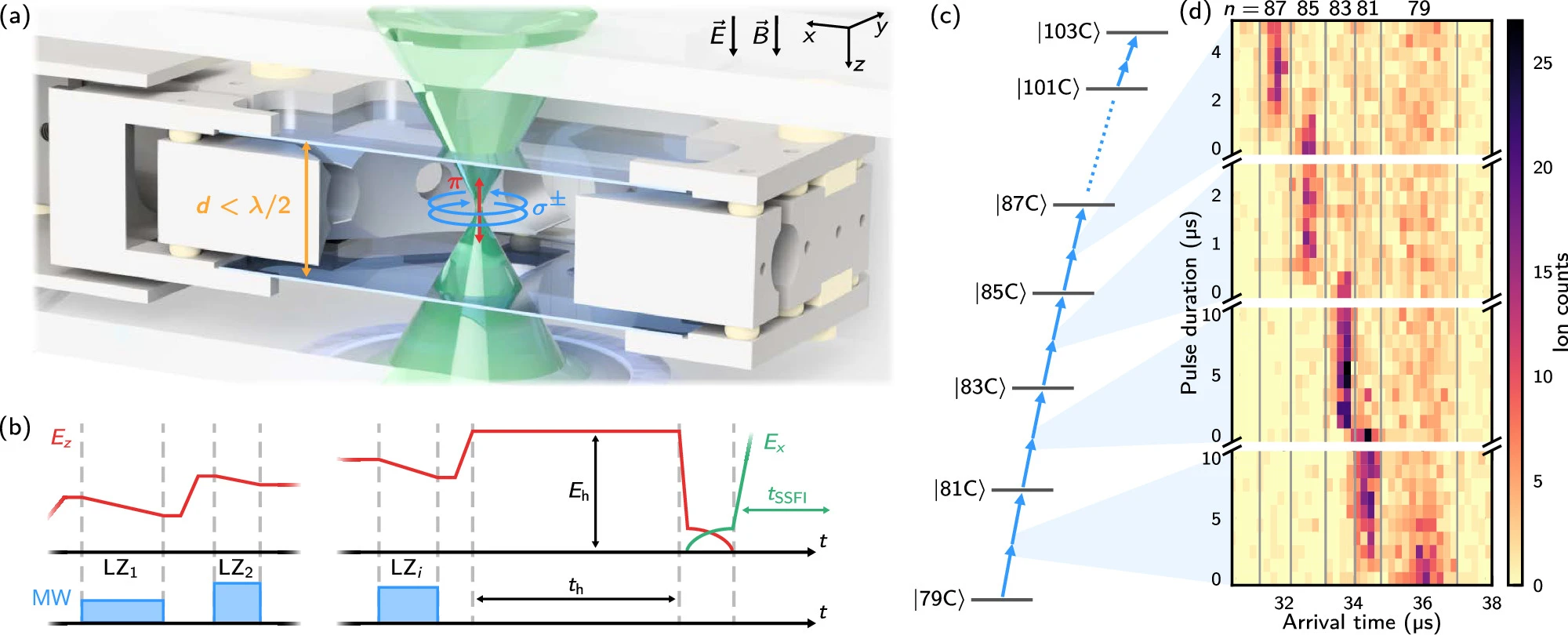
The Stuttgart experiment addressed that problem without cooling the apparatus to cryogenic temperatures. The researchers placed an individual ⁸⁸Sr atom in an optical tweezer at the center of an electrode structure. Two transparent glass plates coated on their inner surfaces with indium tin oxide formed a capacitor around the atom. The ITO coatings are transparent to the optical fields used to manipulate the atom but highly reflective at microwave frequencies.
The purpose of the plates was to change the density of available electromagnetic modes around the atom. In free space, blackbody radiation predominantly drives circular Rydberg atoms between neighboring circular states with principal quantum numbers n − 1 and n + 1. These transitions involve circularly polarized microwave photons. When the relevant wavelength becomes longer than roughly twice the 10.5-millimeter plate separation, the capacitor suppresses those modes.
The experiment therefore combined two effects that both reduce decay. The capacitor suppresses the blackbody-radiation modes that drive the strongest transitions, while increasing the principal quantum number also reduces the rate of blackbody-induced transitions between neighboring circular states. The paper states that the latter rate decreases approximately as n⁻².
Pushing the atoms past n = 100
Getting to such high principal quantum numbers is itself difficult. As n increases, the number of states within a hydrogenic manifold grows as n², making state preparation increasingly complicated. The researchers had previously demonstrated trapped circular Rydberg atoms at n = 79. In the new experiment, they used a sequence of microwave pulses to climb from n = 79 to n = 103.
The atom was first transferred into the n = 79 circular state through optical excitation followed by adiabatic state transfer using a circularly polarized radio-frequency drive. The principal quantum number was then increased in steps of two using two-photon microwave transitions. Each transition was driven with an adiabatic Landau-Zener sweep, in which the electric field was ramped through the two-photon resonance.
The researchers used microwave spectroscopy to identify the required resonances and distinguish the desired circular-to-circular transitions from nearby transitions involving elliptical Rydberg states. Electric and magnetic fields shifted the relevant states enough to separate most unwanted resonances, while differences in their quadratic Stark shifts provided additional discrimination. The microwave transitions were implemented at fixed frequencies while the electric field was swept across resonance.
The individual Landau-Zener steps transferred an average of 94% of the population from one target state to the next. The complete coherent transfer up to n = 101 took about 400 microseconds. The researchers also performed an independent check of the state preparation: elliptical states produced a characteristic linearly Stark-shifted transition that was absent when the atom had been successfully prepared in the intended circular state.
At n = 103, the circular Rydberg orbit has a diameter of about 1.1 micrometers. The ability to coherently connect these high-n states gave the researchers access to a broad range of microwave frequencies with which to examine how the engineered electromagnetic environment affected decay.
The lifetime changes sharply with principal quantum number
The lifetime measurements were performed by preparing an atom in a chosen circular state, allowing it to evolve for a variable hold time, and then using state-selective field ionization to determine which Rydberg states were populated. The ions were detected on a microchannel plate detector, and their arrival times were mapped onto the principal quantum number of the state from which they originated.
The electric field during the hold period was 5.9 volts per centimeter, orienting the circular electron orbit parallel to the capacitor plates. For atoms initially prepared in n = 89 and n = 97, the measurements showed population spreading into neighboring principal-quantum-number manifolds as the hold time increased. The n = 97 state displayed decay on the 10-millisecond scale, whereas the n = 89 state decayed substantially faster.
A simple exponential fit to the population of the starting state would not accurately describe the dynamics because atoms that have left the initial manifold can make subsequent transitions back into it. Instead, the researchers used a rate-equation model describing population transfer between different n manifolds. The lifetime extracted from that model was determined for a series of initial circular states.
The lifetime first increased strongly around n ≈ 80, reaching about 5 milliseconds near n = 85. This change coincided with suppression of the strongest circularly polarized blackbody transitions to neighboring circular states.
But suppressing those transitions did not make every other decay route disappear. Once the strongest channels were reduced, weaker transitions to elliptical Rydberg states became important. The coupling to elliptical states in the next higher principal-quantum-number manifold was roughly 160 to 200 times weaker than the strongest neighboring circular-state coupling in free space, but those channels became significant after the dominant circular transitions were suppressed.
Those elliptical-state transitions have different polarization. They are π-polarized transitions, with no change in the magnetic quantum number. The simple parallel-plate capacitor does not suppress those modes. In the actual electrode structure, some of the π-polarized modes were instead enhanced at particular frequencies. The result was a pronounced dip in the measured lifetime around n ≈ 90.
The n = 89 measurements provided a direct view of that effect. Population flowed asymmetrically toward higher principal quantum numbers, consistent with enhanced decay into elliptical states. The integrated ionization signal also contained substructure in the n = 90 and n = 91 regions because elliptical states ionize somewhat differently from circular states.
The lifetime increased again above n ≈ 95. At these higher states, additional weak transitions became suppressed, including σ⁺-polarized transitions to elliptical states in the n + 2 manifold. The corresponding photons have roughly half the wavelength of those driving transitions to n + 1. At the same time, the π-polarized modes associated with the ring electrodes become suppressed in this range.
The result was a measured lifetime of 11.5(8) milliseconds for the n = 101 circular Rydberg state. The authors compare this with a calculated free-space lifetime of 545 microseconds, making the measured lifetime about 21 times longer. More generally, the experiment produced lifetimes above 10 milliseconds for states above n = 95, more than 20 times the expected free-space lifetime.
The measured lifetimes also exceeded the room-temperature result previously reported at n = 60 by about an order of magnitude and were about three times longer than the cryogenic lifetimes cited by the authors.
The electrode geometry matters
The lifetime did not simply increase smoothly with n. Its detailed structure reflected the electromagnetic environment created by the entire electrode assembly.
The researchers first compared their measurements with a simplified calculation for an infinitely extended ITO capacitor with finite microwave reflectivity. That model reproduced the broad lifetime enhancements around n ≈ 80 and above n ≈ 95, but it did not reproduce the lifetime reduction around n ≈ 90.
They therefore modeled the actual electrode structure using finite-element simulations. The four ring-shaped electrodes, together with the ITO plates and other conducting components, effectively form a cylindrical microwave cavity. That geometry supports additional discrete electromagnetic modes. The lowest-energy, longest-wavelength mode of this type was identified in the model as the source of the lifetime reduction around n ≈ 90.
The simulations used a plate separation of 10.5(2) millimeters and an ITO microwave reflectivity of approximately 96%. The calculated Purcell factors showed that the ring electrodes produced additional resonances, particularly for π-polarized modes below the simple parallel-plate cutoff frequency. The simulated modes had intensity maxima at the center of the cylindrical cavity, where the atom was located.
The calculations identified several cavity modes, including TM₀₁₀ and TM₀₂₀ modes affecting the π-polarized response and TE₁₁₁ and TE₁₂₁ modes producing additional features for circularly polarized modes above the cutoff. Smaller features were attributed to other conductive components and the particular shape of the ring electrodes.
The lifetime calculation incorporated these mode-dependent effects into the transition rates. For each possible final state, the model combined the Einstein spontaneous-emission coefficient, the thermal photon occupation at 300 K and the calculated Purcell factor describing the electromagnetic environment. For the high-angular-momentum states considered, the calculations used analytic hydrogenic expressions for the Stark-shifted transition frequencies and dipole matrix elements, with the strontium Rydberg constant used to account for the nuclear mass. Transitions with changes in principal quantum number larger than three were omitted because the relevant dipole matrix elements decrease rapidly with that separation.
The resulting picture is therefore more complicated than simply placing an atom between two plates. The cavity suppresses some blackbody modes while creating or enhancing others, and the balance among those channels changes with the atom’s principal quantum number.
Most decay products are not always circular states
That complexity also affects how the measured lifetime should be interpreted.
The researchers calculated the relative contributions of different decay channels for both an idealized infinite capacitor and the full electrode structure. In the idealized case, the relative importance of different channels changes progressively from about n = 77, with two transitions to elliptical states in the n + 2 manifold becoming suppressed at different points around n = 94 and n = 99. The difference arises from the different Stark shifts of the elliptical states in the applied electric field.
For the actual electrode geometry, the additional resonances make the branching strongly dependent on n. At n = 89, the calculations indicate that about 80% of the decay products are elliptical states. Above n = 100, by contrast, roughly 80% of the population remains within the ladder of circular Rydberg states.
Once an atom reaches an elliptical state, its subsequent decay follows different rates and can branch into additional substates within the hydrogenic manifolds. This means the observed population dynamics cannot be treated as a simple one-dimensional ladder of circular states.
To test whether their simpler experimental rate model nevertheless produced reliable lifetimes, the researchers built a much larger numerical model containing the circular-state ladder plus 229 elliptical states. They calculated the transition rates, summed the simulated populations into the same n-manifold bins measured experimentally and then fitted those simulated data with the simpler model used for the actual measurements.
Across the range studied, the lifetimes obtained from the simplified fitting procedure differed from the directly calculated lifetimes by less than 16%, including cases where elliptical-state populations were substantial. The fits systematically produced somewhat lower lifetimes. The authors use this comparison to support and quantitatively validate their experimental lifetime-extraction method.
The atoms remain trapped much longer than they remain circular
The long internal-state lifetime would be difficult to observe if the atom simply escaped the optical tweezer.
Rydberg electrons normally experience a repulsive ponderomotive force from the light field of a standard Gaussian optical tweezer, making conventional trapping difficult. In strontium, however, the polarizable Sr⁺ ionic core provides an attractive potential strong enough to trap the Rydberg atom in a standard Gaussian tweezer. The trapping potential can also hold the atom after the electron decays into other Rydberg states with different angular momentum or principal quantum number.
The researchers prepared an atom in the n = 97 circular state and measured the total detected Rydberg-ion signal without distinguishing among the different product states. With the tweezer left on, an exponential fit gave a 1/e trapping lifetime of 133(6) milliseconds. That is about an order of magnitude longer than the lifetime of the initial circular state.
When the optical tweezer was switched off, the ion signal disappeared within about a millisecond because the Rydberg atoms left the trapping region and were no longer detected by the field-ionization procedure.
The 133-millisecond value is a lower bound on the trapping time rather than a complete measurement of how long the atoms remain physically trapped. The detection scheme does not capture every possible Rydberg product state. With the field-ionization settings used in the experiment, states above n = 104 were outside the detection range, and decay to sufficiently low-angular-momentum states could also move the ionization threshold outside that range.
Long lifetimes, but a shorter coherence time
The experiment established a long T₁-type lifetime for the circular Rydberg states, but the researchers note that the time over which a quantum superposition remains phase coherent is currently much shorter.
In their setup, technical sources including magnetic-field noise and electric-field inhomogeneity limit the measured T₂ coherence time to roughly 100 microseconds. The authors say that active feedback and cancellation of field gradients could improve this, while laser cooling of the ionic core could address thermal motion in the tweezer. They also discuss dynamical-decoupling approaches as another way to address some sources of dephasing.
The experiment also leaves the larger space of elliptical Rydberg states unexplored. The researchers note that their system could in principle provide access to a wider set of states, while the demonstrated coherent control across many circular states already provides a multilevel state space extending from n = 79 through n = 103.
The central experimental result remains the lifetime itself: a trapped circular Rydberg state at n = 101 survived for 11.5(8) milliseconds in a room-temperature apparatus, while the engineered electromagnetic environment produced a strongly n-dependent pattern of suppressed and enhanced decay channels. The same strontium-based tweezer system kept the atom detectable for at least 133(6) milliseconds under the trapping measurement.
The study was published in Nature Communications.