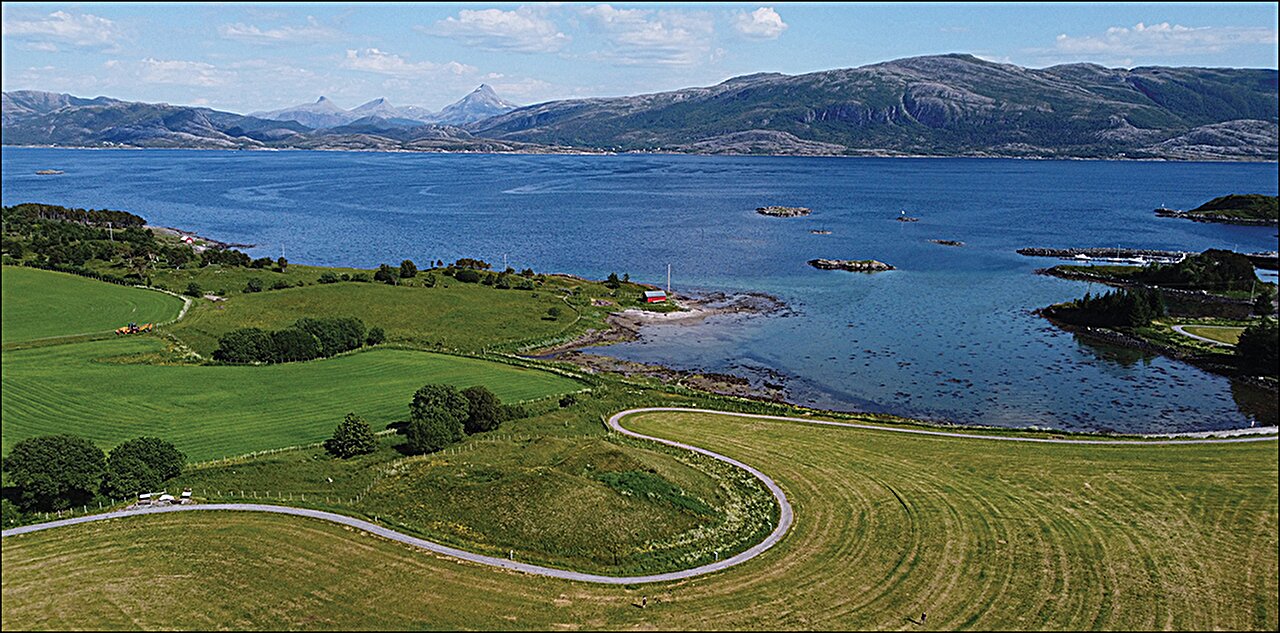
On the small Norwegian island of Leka, archaeologists have identified the remains of a large ship buried beneath one of the region’s most imposing mounds. The discovery at Herlaugshaugen dates the burial to around AD 700, making it one of the earliest known monumental ship burials in Scandinavia and providing a chronological link between the early ship graves of eastern England and the better-known Scandinavian examples that appeared later.
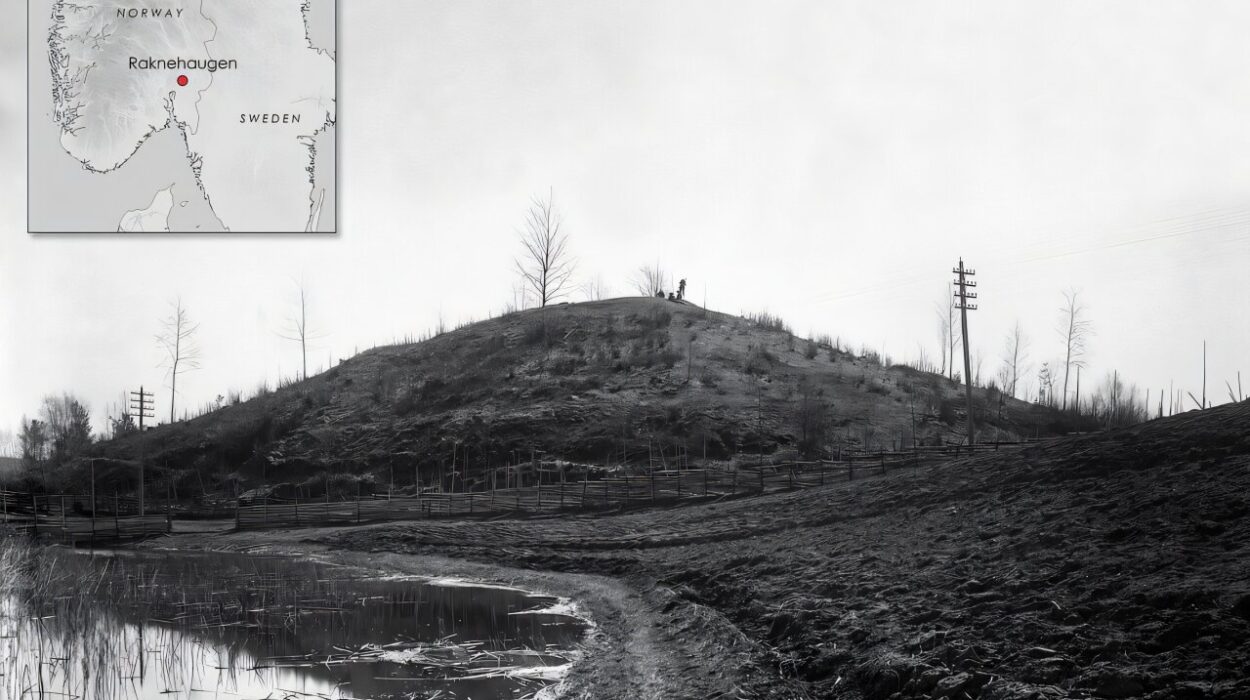
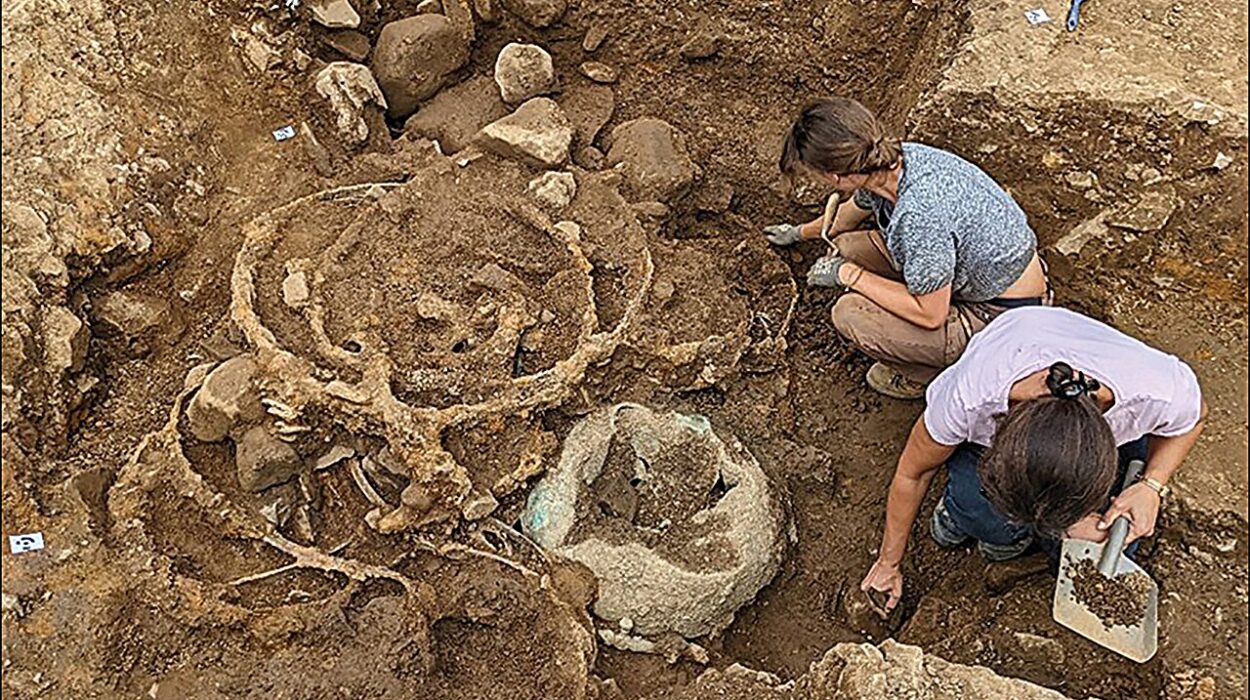
The evidence emerged from a 2023 excavation of Herlaugshaugen, a huge burial mound on the eastern side of Leka, off the coast of Namdalen in northern Trøndelag. Archaeologists recovered large iron clinker nails, several still retaining fragments of wood. Radiocarbon dating of the wood and charcoal associated with the mound then placed the construction of the ship burial in the late seventh or early eighth century.
That date matters because monumental ship burials in Norway have traditionally been associated with the beginning of the Viking Age, around AD 800–1050. Before Herlaugshaugen was dated, the oldest known Scandinavian ship mounds were the late-eighth-century examples on Karmøy in western Norway. Herlaugshaugen therefore occupies an earlier position in the sequence, between the early seventh-century ship burials of Anglo-Saxon England and Norway’s famous late-eighth- and ninth-century ship burials.
The mound had been investigated for centuries
Herlaugshaugen was already famous long before archaeologists identified the ship burial. A saga recorded by Snorri Sturluson describes the mound as the burial place of Herlaug, a king of Namdalen. According to the story, Herlaug and his brother Rollaug built a large mound. When Harald Fairhair demanded submission, Herlaug entered the mound with a large amount of food and had it sealed behind him, while Rollaug submitted to Harald.
The story prompted excavations in the eighteenth century. Local farmers first investigated the mound in 1755 and found a deep hole near its center, which they interpreted as an air vent. They also discovered parts of a brass cauldron, although those pieces were later melted down into shoe buckles. Further excavations followed in 1775 and 1780.
The eighteenth-century investigators recorded a mound about 63 meters across and 7–8 meters high. Near its center they encountered iron nails and a wall made of boulders. Deeper down, they found a stone slab covering a skeleton, with a sword beside it. Additional human bones, animal bones and wooden beams with iron nails were also reported. Those discoveries were interpreted at the time as confirmation of the legendary storeroom and grave of Herlaug. The sword and skeleton were later taken to Trondheim but were lost in the early twentieth century.
It was not until 1917 that archaeologist Theodor Petersen proposed that the mound was actually a ship burial. He interpreted the supposed eighteenth-century “air vent” as the imprint of a mast. Later geophysical work provided another view of the monument. Analysis of aerial photographs and high-resolution lidar data in 2012 measured a maximum preserved mound diameter of 62 meters, while combining lidar, ground-penetrating radar, earth-resistivity surveys and earlier excavation descriptions suggested that the mound had originally stood about 12.5 meters tall and was surrounded by a ditch 5–8 meters wide.
The 2023 excavation was designed to test the ship-burial interpretation and establish when the mound had been constructed. Archaeologists opened three areas. One trench near the mound’s edge examined its construction and the original ground surface. A second test pit examined two charcoal layers previously reported near the upper part of the mound. A third trench, measuring 3 × 1.8 meters, was placed near the center specifically to look for surviving ship remains. Metal detecting was also carried out in and around the trenches.
The iron nails identified the buried vessel
The central trench produced 29 iron rivets. Another 16 were found in the eastern section of the trench. Their original positions had been disturbed, probably by the eighteenth-century excavations, but several still had wood preserved around them. Two of the rivets with the best-preserved wood were only 0.2 meters apart, and their wood fibers ran in the same direction. If those rivets were still in their original positions, their orientation would place the ship southwest to northeast, parallel to the strait between Leka and the mainland.
The form of the rivets provided the more direct evidence that a ship had been buried there. They were consistently large and well preserved. Their shafts averaged 50 millimeters in length, while the nail heads reached 29 millimeters in diameter and the rectangular roves, or washers used to secure the nails against the wood, reached about 30 millimeters. The authors identify them as clinker nails, the type used to fasten overlapping planks in a clinker-built vessel.
Nearly all of the nails were used to clamp hull planks together. One shorter nail was probably used to join two planks end to end, while another was probably a stem nail used to attach a plank to the ship’s stem or stern. The nails are comparable to those recovered from the large Gokstad, Oseberg and Tune ships.
The excavation exposed only a small portion of the vessel, so its complete shape and dimensions cannot be reconstructed from the surviving evidence. But the size of the nails provides an important clue. Because nail lengths vary according to where they occur on a ship, the consistently large nails from Herlaugshaugen are likely to have come from the middle part of the hull below the waterline. The authors conclude that the vessel was large, probably comparable to ships measuring around or more than 20 meters long.
The conclusion is therefore not based on the mound’s legendary association with Herlaug. It rests on the archaeological remains themselves: a concentration of large clinker nails, preserved wood associated with some of those nails, and radiocarbon dates that place the burial around AD 700.
Radiocarbon dating places the burial around 700
The dating evidence came from both wood preserved around the iron rivets and charcoal layers higher in the mound. The unmodelled radiocarbon ages span calibrated dates from AD 580 to 870. The outer tree rings preserved around the iron rivets produced two principal ranges, approximately AD 656–703 and AD 741–774, although the authors caution that additional missing outer tree rings mean the true felling date could have been later.
The charcoal samples consisted of pine and dated to the late seventh and early eighth centuries. The researchers considered the possibility of an “old wood effect,” in which charcoal made from older timber can produce dates older than the event being investigated. Most of the charcoal dates agreed well, however, suggesting that the burned material was largely younger wood from small trunks or branches. One sample was substantially older than the others and was treated as an outlier that may reflect the burning of older branches or trunks.
The researchers then built a Bayesian age model incorporating the stratigraphic information that the charcoal layers were younger than the ship burial. They did not assume how much time separated the burial from those layers. The resulting model indicates that the ship was constructed after AD 670 and that the mound was built either in the late seventh century or at the beginning of the eighth century.
That places Herlaugshaugen substantially earlier than the famous Norwegian ship burials traditionally associated with the Viking Age. It also changes the geographical picture of the early tradition.
The discovery connects two ends of a ship-burial tradition
Ship and boat burials occurred across Northern Europe from the first through the eleventh centuries AD. The earliest known Northern European boat burials are Scandinavian and date to AD 1–550, while the number of such burials increased during the Merovingian period, AD 550–800. The oldest known ship burials, however, are in eastern England: the Snape cemetery dates to about AD 550–600 and Sutton Hoo to about AD 600–625.
The Norwegian sequence had appeared to contain a substantial chronological gap between those early English examples and the later Scandinavian ship mounds. Herlaugshaugen helps fill that gap. Its late-seventh-century date places a large Scandinavian ship burial only decades after the earliest English examples and before the late-eighth-century Norwegian ship mounds.
The authors do not present the discovery as proof of a direct connection between Herlaugshaugen and Britain. They note that definitive evidence for direct contact between Norway and the British Isles during the Migration Period and before the latter part of the eighth century remains lacking. At the same time, they argue that the new late-seventh-century seagoing ship provides substantial support for the possibility of a continuous tradition of monumental ship burials extending from East Anglia to Scandinavia.
That distinction is important. The archaeological evidence establishes the early date and nature of the Herlaugshaugen burial. Its relationship to other ship-burial traditions is an interpretation of those findings within the wider archaeological record.
Leka occupied a strategic maritime setting
Herlaugshaugen also sits in a location that the authors associate with movement and regional connections. Leka lies along the coast of Namdalen, where an east–west land and river route through the Namdalen valley meets the north–south sea route along the coast. The region had relatively little agricultural land but possessed resources including fish, sea mammals, timber, game and bog iron ore. Namdalen and the innermost Trondheim fjord also contain a dense concentration of boat burials and monumental mounds, many dating between about AD 700 and 1050.
Herlaugshaugen itself stands beside the harbor at Leka, on the farm Skei. The researchers note that the name Skei is associated with recurring gathering places where markets and sports, including horse fights, took place. A neighboring farm called Leknes may also preserve a connection to a place where groups gathered. Until 1681, a church stood at Leknes, near a place called Tinghaugen, or “Thing mound.” The age and original meaning of that name are uncertain, but local tradition associates it with an assembly at Leka.
From this evidence, the authors propose that Leka may have functioned as a gathering place for people from a wider area. In that interpretation, Herlaugshaugen’s prominent position beside the harbor would have made the monument visible to people arriving from the mainland or along the coast. The authors suggest that the mound could therefore have demonstrated the political strength of the Leka region.
The island was also connected to broader maritime networks. The authors point to the Norwegian coast as an important route for transporting goods and people, with products including stockfish, skins, furs, antlers, iron, marine oil and whetstones moving southward and being exported to other northern European coasts. They also cite archaeological evidence for wider contacts involving northern Norway and continental Europe during this period.
The evidence does not establish that Herlaugshaugen itself was a trading center. Instead, the authors interpret Leka and the mound as part of a regional network in which maritime movement, resources, gathering places and monumental construction were interconnected.
A monument built around maritime power
The meaning of the burial remains more difficult to establish than its date and construction. The authors note that ship burials have been interpreted in several ways, including as expressions of social status and political power, ritual practices connected with mythology and religion, and monuments associated with the transformation from life to death. Herlaugshaugen can contribute to all of these questions, but the study focuses particularly on its relationship to myth and monumentality.
The mound’s size is central to that interpretation. Monumental mounds could be associated with status and territorial claims, and previous research has connected ship mounds with political competition and changing forms of rulership. At the same time, the authors caution that linking Herlaugshaugen directly to the development of royal power would be speculative on the current evidence.
Instead, they place the monument within longer processes of territorialization and social hierarchy during the Late Iron Age. In their interpretation, the large ship burial was a monumental expression of maritime mobility and competence, reflecting networks that connected people across a larger region and contributed to the emergence of new elites.
The excavation therefore changes what can be said about Herlaugshaugen with confidence. The mound is not merely a monument later associated with a legendary king. Archaeological evidence now identifies it as the burial place of a large ship, probably more than 20 meters long, constructed after AD 670 and buried beneath the monumental mound around the end of the seventh or beginning of the eighth century.
Its early date and northern location make Herlaugshaugen an important addition to the archaeological record of ship burial. For the authors, it represents another piece of evidence that the development of monumental ship burials was part of wider interregional processes already underway in northern Europe before the Viking Age was fully established.
The study was published in Antiquity.