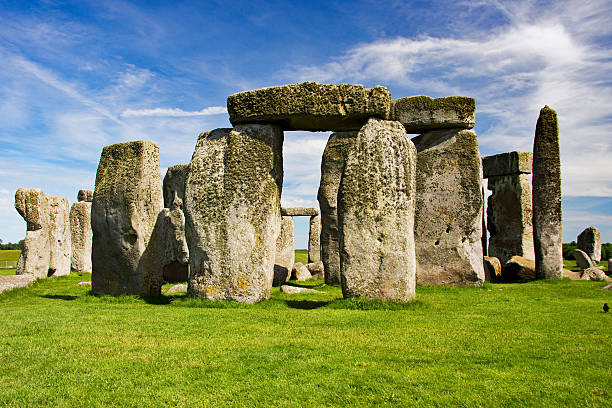
A massive sandstone block at the heart of Stonehenge may not have traveled to southern England in one continuous human expedition after all. Instead, the evidence raises the possibility that glaciers first carried it hundreds of kilometers toward a now-submerged landscape beneath the North Sea before people completed the final leg of its journey. Even so, the new research concludes that human transport remained essential, leaving one of archaeology’s greatest mysteries only partly solved.
The Altar Stone, a sandstone megalith weighing about 6,000 kilograms, has long stood apart from the other stones at Stonehenge. Unlike the giant sarsens, which likely came from nearby West Woods, or the bluestones linked to western Wales, the Altar Stone appears to have originated much farther away. Earlier research identified northeastern Scotland as its most likely birthplace, placing its source roughly 700 kilometers (435 miles) from Stonehenge.
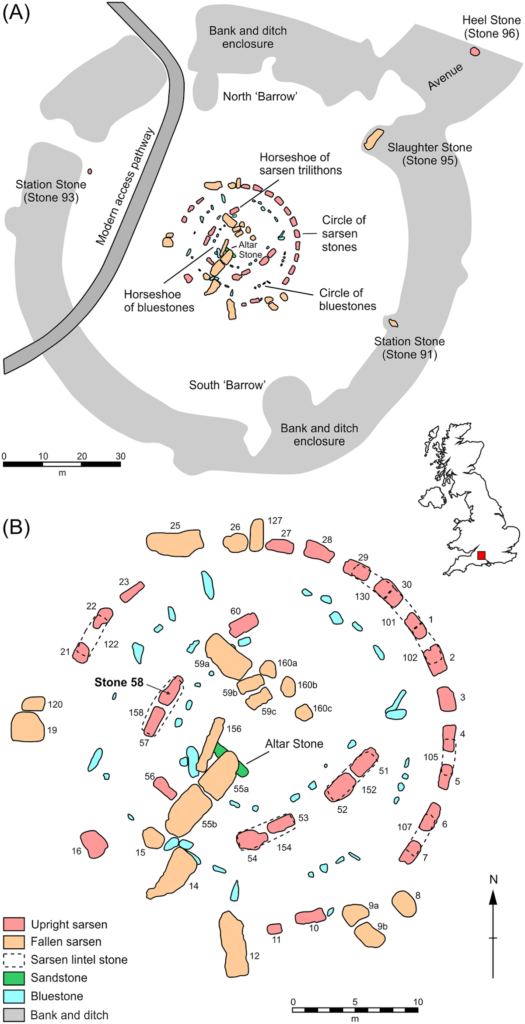
That extraordinary distance immediately raised a difficult question. How could a six-ton block measuring roughly 4.9 meters long, 1 meter wide, and 0.5 meters thick have reached Salisbury Plain during the Neolithic?
The new study tackles that mystery from two directions at once. Rather than focusing only on where the stone came from, the researchers also examined whether ancient ice sheets might have completed part of the transport before humans ever encountered the rock.
Narrowing down where the Altar Stone most likely began its journey
Finding the Altar Stone’s exact origin is more difficult than identifying its general region.
The sandstone belongs to the Old Red Sandstone formations of the Orcadian Basin in northeastern Scotland, but that basin covers thousands of square kilometers and contains many sandstone deposits formed in different environments during the Devonian Period. Simply knowing that the rock came from the basin is not enough to reconstruct how it eventually reached Stonehenge.
To refine the search, the researchers compared the Altar Stone with every published dataset of detrital zircon ages from Scottish Old Red Sandstone rocks. Zircons are tiny mineral grains that preserve the ages of the older rocks from which they were originally eroded. Because different sedimentary deposits inherit distinctive mixtures of zircon ages, these mineral “fingerprints” can help identify where a sandstone originated.
The team analyzed previously published zircon age data from the Altar Stone alongside sandstone samples from across Scotland, using statistical tests to measure how closely each source matched the stone’s mineral signature.
One location stood out above all the others.
Sandstone from Sarclet, in Caithness, produced the closest statistical match, with a Kolmogorov-Smirnov test p-value of 0.96, indicating that its zircon age distribution was extremely similar to that of the Altar Stone. Other Caithness locations—including Braemore, Kirtomy, and Portskerra—also proved statistically indistinguishable from the Altar Stone using the same test.
The researchers also compared the samples using multidimensional scaling, another method for evaluating similarities among entire collections of zircon ages. While the two approaches differed slightly for some locations, both independently identified the Caithness region as the strongest overall match.
Just as importantly, the analysis ruled out several southern Scottish sandstone deposits that had once remained possible candidates. Their zircon age patterns differed too much from the Altar Stone to support them as likely sources.
By narrowing the search area, the researchers also narrowed the possible routes the stone could have taken.
Could glaciers have done part of the work?
The study’s second major objective was to test an idea that has remained controversial for years.
Some researchers have proposed that glaciers transported at least some of Stonehenge’s famous stones. Others have argued that the monuments owe their existence almost entirely to human engineering.
Rather than treating these explanations as mutually exclusive, the new research asked whether glaciers could have carried the Altar Stone partway before people completed the journey.
To investigate that possibility, the team used computer models of the British-Irish Ice Sheet during the Late Devensian glaciation, spanning roughly 30,000 to 15,000 years ago. Unlike simpler reconstructions that show only a single direction of ice movement, these simulations accounted for the fact that ice flow changed over thousands of years.
That distinction matters because rocks trapped inside glaciers do not move instantly. As ice sheets grow, shift, and retreat, the direction of transport can also change. A boulder might first move one way before later being carried in another direction entirely.
The researchers therefore modeled how erratic boulders released from different parts of northeastern Scotland could have been transported under these evolving ice-flow conditions.
Most simulated routes never reached southern Britain
The results showed that the details of the stone’s origin matter enormously.
If the Altar Stone originated in southern parts of the Orcadian Basin, glaciers could more easily have transported it southward. The problem is that those southern rocks do not match the Altar Stone’s zircon fingerprint as well as the northern Caithness samples do.
The strongest geological match—the Caithness region—created a different problem.
According to the ice-flow models, glaciers carrying rocks from Caithness generally moved them northward or eastward, not toward southern England. Only under specific circumstances did the simulations allow rocks to move south into the Moray Firth, where later changes in ice flow could redirect them farther southeast.
That alternative pathway eventually carried simulated rocks as far as Dogger Bank, a broad area beneath today’s North Sea.
The result was significant because it demonstrated that glacial transport from northeastern Scotland toward Dogger Bank is physically possible under certain modeled conditions.
But it also highlighted just how limited that opportunity would have been.
The southward pathway depended on a narrow combination of source location and changing ice-flow patterns rather than representing the dominant direction of glacial transport.
Dogger Bank changes the story—but does not solve it
At first glance, Dogger Bank appears to make the transport puzzle easier.
If glaciers had already carried the Altar Stone there, humans would have needed to move it only about 400 kilometers (250 miles) to Stonehenge instead of the full 700 kilometers (435 miles) from northeastern Scotland.
During parts of the Late Pleistocene, Dogger Bank was not underwater. It formed a broad, elevated landscape exposed above sea level after the retreat of the ice sheet, remaining dry for thousands of years before gradually disappearing beneath rising seas.
The researchers note that this landscape lacked exposed bedrock, meaning that any large sandstone boulders present there would most likely have arrived through glacial transport. Such boulders could therefore have been available to prehistoric people living in or passing through the region.
Even so, this apparently simpler explanation creates a new chronological problem.
Dogger Bank was inundated by post-glacial sea-level rise between roughly 8,000 and 7,000 years ago. The Altar Stone, however, was erected at Stonehenge several thousand years later.
That means any stone collected from Dogger Bank would have needed to be removed before the landscape disappeared beneath the sea, then preserved somewhere on land for millennia before finally reaching Stonehenge.
Instead of one remarkable journey, the scenario requires multiple stages spread across an exceptionally long period.
The researchers argue that this extended sequence makes a Dogger Bank intermediary less plausible, even though the ice-flow modeling shows that such transport cannot be ruled out.
The evidence still points to remarkable human effort
One conclusion remained consistent regardless of which transport scenario was considered.
The models never produced a pathway that carried the Altar Stone directly to Stonehenge.
Even if glaciers transported the rock hundreds of kilometers, people would still have been responsible for moving a six-ton sandstone block over an enormous remaining distance.
The researchers note that this could have involved maritime travel, overland movement, or a combination of both. A route from Dogger Bank, if it occurred, would have involved shorter distances and more sheltered waterways than a direct journey from northeastern Scotland, but it would still represent a major logistical undertaking.
Either possibility implies a society capable of organizing labor, coordinating transport, and maintaining connections across large parts of Britain.
A mystery that has become more precise, but not fully resolved
The study does not claim to have reconstructed the Altar Stone’s complete history.
Instead, it refines two critical pieces of the puzzle.
First, the mineral evidence strengthens the case that the stone most likely came from mainland northeastern Scotland, particularly the Caithness region or the nearby Inverness–Black Isle area.
Second, the ice-sheet simulations demonstrate that glacial transport alone cannot explain how the stone reached Stonehenge. At most, glaciers may have completed an intermediate stage by carrying the rock toward Dogger Bank, leaving humans to accomplish the final and still extraordinary journey.
The authors also acknowledge an important limitation. Their modeling covers only the Late Devensian ice sheet because sufficiently detailed simulations do not yet exist for the much older Anglian glaciation, which extended farther south. As a result, they cannot evaluate whether earlier glaciations might have transported the stone over even greater distances.
For now, the Altar Stone remains an archaeological traveler whose route is becoming clearer but whose complete journey remains elusive. The new evidence weakens the idea that glaciers alone delivered the megalith to Salisbury Plain, while preserving the possibility that ice and people both played roles—one beginning the journey across ancient Britain, and the other finishing one of prehistory’s most ambitious feats of monument building.
Publication details
From Highlands to Henge: Refining the Provenance and Transport Pathways of Stonehenge’s Altar Stone, Journal of Quaternary Science (2026). DOI: 10.1002/jqs.70080