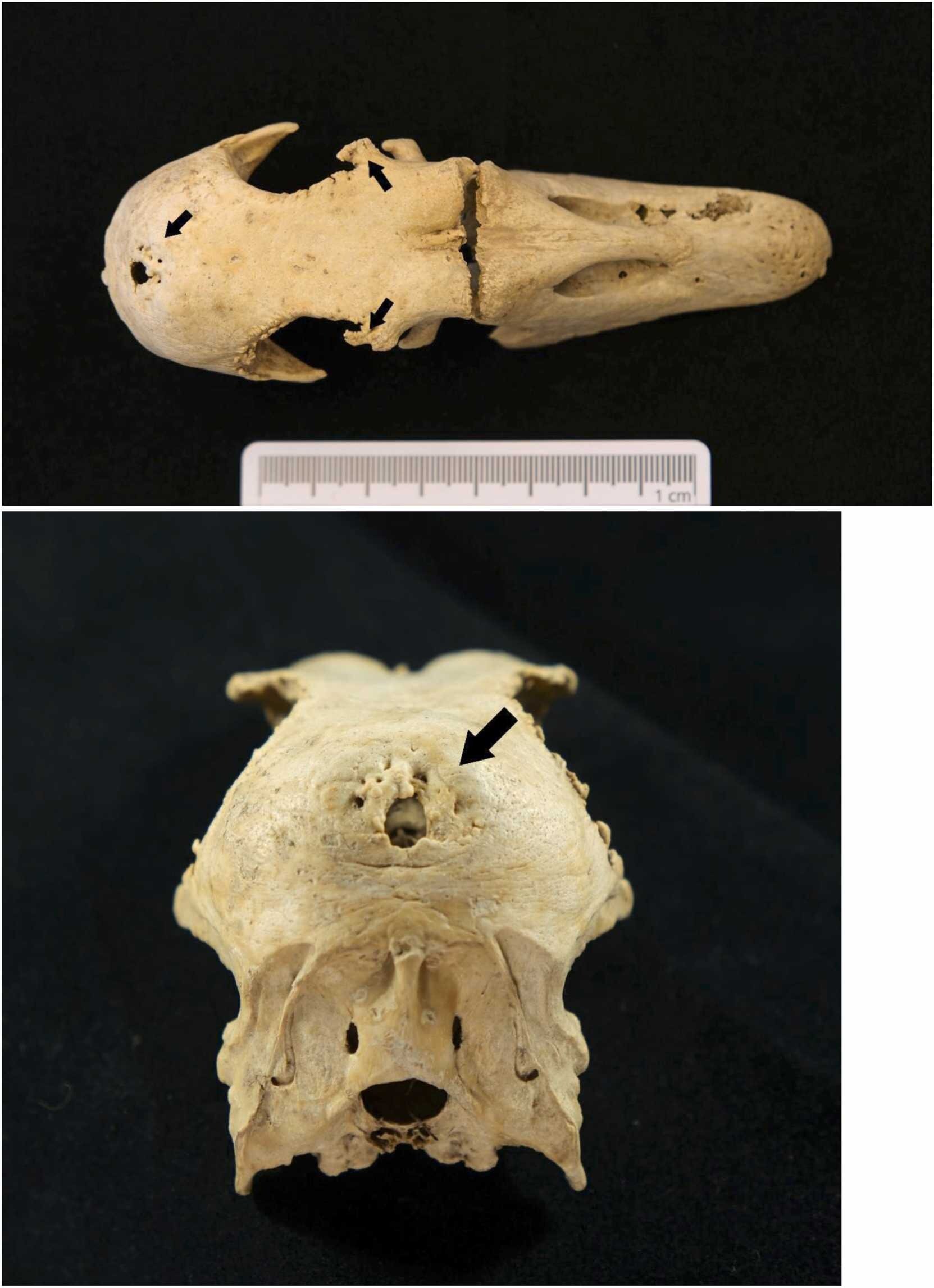
Four goose skulls found in a former toilet shaft in Brandenburg, Germany, have provided the earliest archaeological evidence of geese bred with distinctive feathered crests. The skulls, dating to the 17th century, contain unusual openings that researchers identified as evidence of the trait.
The skulls were excavated between 2021 and 2023 at Flecken Zechlin, about 100 kilometers (62 miles) from Berlin. The site has a long association with bishops and aristocrats.
The four goose skulls were found among bones from chickens and ducks. Each had several unusual holes, including one skull with a 15-millimeter opening large enough for part of the skull to be missing.
The bones were preserved well enough for researchers to examine several possible causes. Butchery marks and damage from animal gnawing did not account for the holes. Infection, parasites and poor nutrition also did not fit the pattern.
Instead, the skulls closely resembled those of crested ducks. The location and appearance of the openings were described in the study as remarkably similar to the holes seen in crested ducks.
That comparison led Maaike Groot, an archaeozoologist at Freie Universität Berlin and author of the study, to recognize another possibility: the geese had been bred to develop crests.
Groot then connected the finding with paintings by the Dutch artist d’Hondecoeter, which include crested geese and date to roughly the same period.
As far as Groot is aware, the skulls and those paintings represent the earliest known examples of crested geese in Europe.
The crest could come with serious health problems
The unusual skull openings are important because crested feathers in ducks are linked to an underlying skeletal abnormality.
In crested ducks, the crest results from a genetic defect that produces a cushion of fat on top of the skull. The bone beneath it often does not close properly, leaving openings in the skull.
That condition can be associated with high death rates before and after hatching, poor coordination, and loss of sight or hearing in some adult birds.
But the relationship between the crest and these problems is not simple. The presence or size of a crest does not reliably indicate whether an individual duck will have anatomical or behavioral abnormalities. Some ducks with openings in their skulls live their entire lives without obvious problems, while others experience severe difficulties.
There has not been comparable research examining crested geese in this level of detail. Because geese and ducks are closely related, however, Groot said crested geese likely experienced similar health problems.
Evidence of selective breeding in 17th-century Europe
The finding places crested geese in at least two regions of Northern Europe during the 17th century. The birds may have been kept for display and prestige, according to Groot.
Their remains eventually ended up with other kitchen waste in the former toilet shaft at Flecken Zechlin.
The history of the trait may extend further back than the 17th century. Crested chickens, for example, existed during the Roman era, although the newly identified goose skulls are the earliest archaeological examples of crested geese currently known.
The researchers hope the discovery will encourage closer examination of bird skulls, which can be fragile and easily overlooked. Groot also hopes further work on crested birds can help clarify how and why people bred animals for particular appearances.
The study was published in the International Journal of Paleopathology.