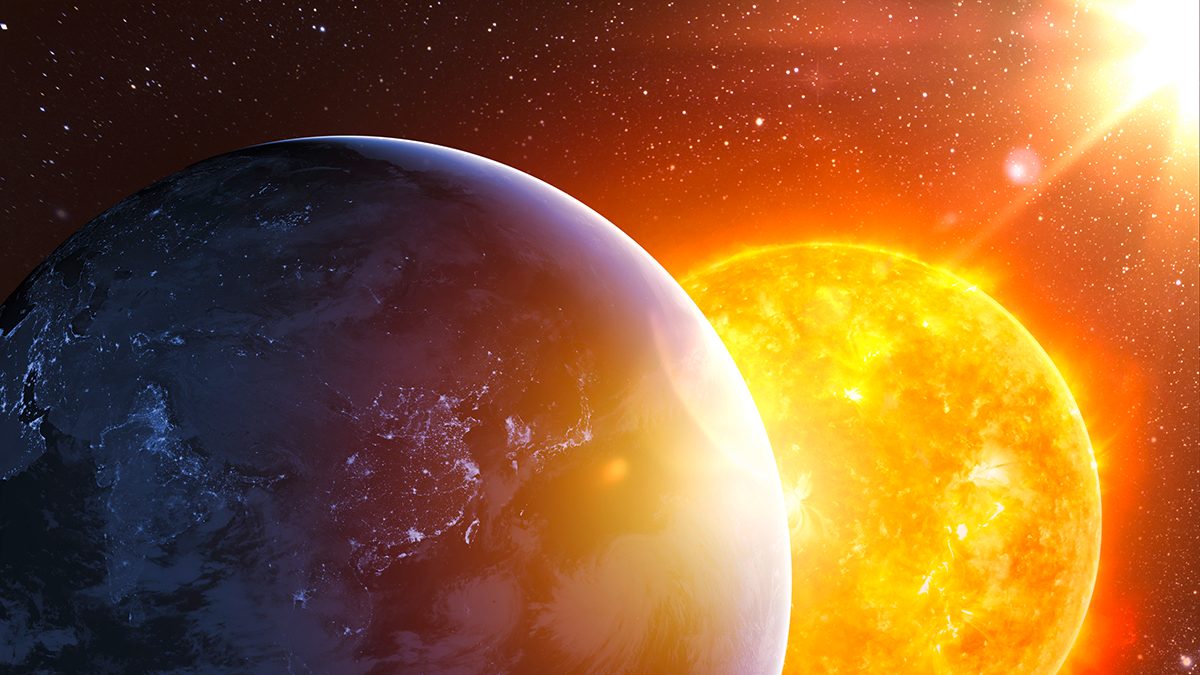
On a clear night, when you look up at the sky, it may seem as though the stars are scattered randomly across an endless darkness. But hidden among those countless points of light is something deeply familiar—our home in the universe. Earth is not drifting through space alone. It is part of a remarkable family of worlds known as the Solar System.
The Solar System is a place of astonishing diversity. It contains a blazing star that powers life on Earth, rocky planets with towering volcanoes, giant worlds wrapped in colorful storms, icy moons hiding underground oceans, countless asteroids, dazzling comets, and mysterious objects far beyond the orbit of Neptune. Every corner of it tells a story about how planets formed, how worlds evolved, and perhaps even how life began.
Although humanity has studied the Solar System for thousands of years, modern telescopes and robotic spacecraft continue to reveal new surprises. Every mission teaches us something unexpected, reminding us that even our own cosmic neighborhood still holds many secrets.
Understanding the Solar System is the first step toward understanding our place in the universe.
What Is the Solar System?
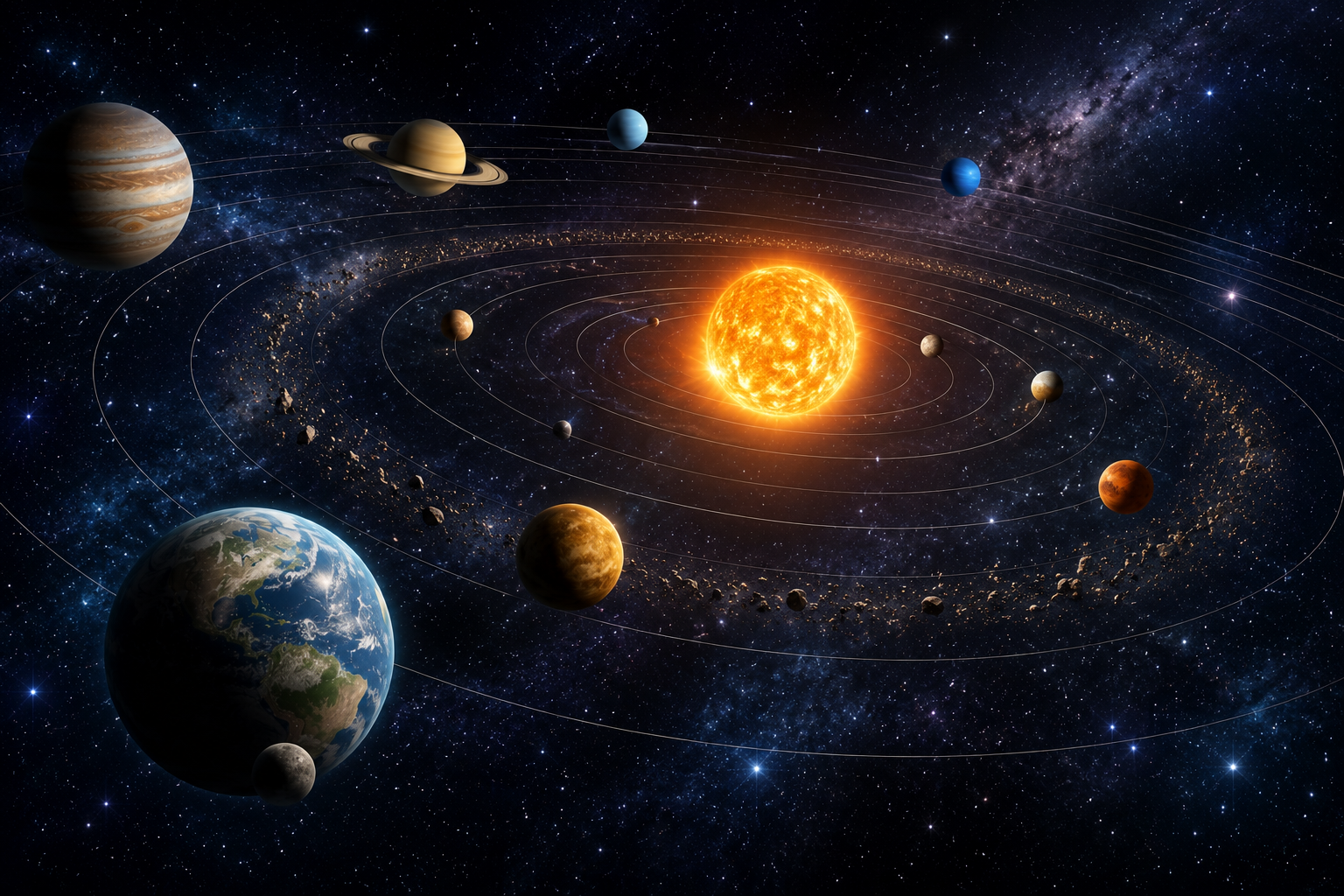
The Solar System is the collection of the Sun and everything that orbits it because of the Sun’s gravity.
At its center is the Sun, an ordinary star that contains almost all the mass in the Solar System. Around it travel eight major planets, hundreds of known moons, dwarf planets, millions of asteroids, billions of icy objects, countless meteoroids, and vast clouds of dust and gas.
Everything in the Solar System is connected by gravity. The Sun’s immense gravitational pull keeps planets moving around it in stable paths called orbits. Moons orbit planets, while smaller objects follow their own paths around the Sun.
The Solar System stretches far beyond the planets. Its outer boundary extends into a region where the Sun’s influence gradually gives way to interstellar space.
Why Is It Called the Solar System?
The name comes from the Latin word Sol, which means “Sun.”
Because the Sun is the central object around which everything revolves, the collection of all these objects is called the Solar System.
Every planetary system discovered around other stars is technically another “star system,” but ours is uniquely named after our own star.
How Did the Solar System Form?
Scientists estimate that the Solar System formed about 4.6 billion years ago.
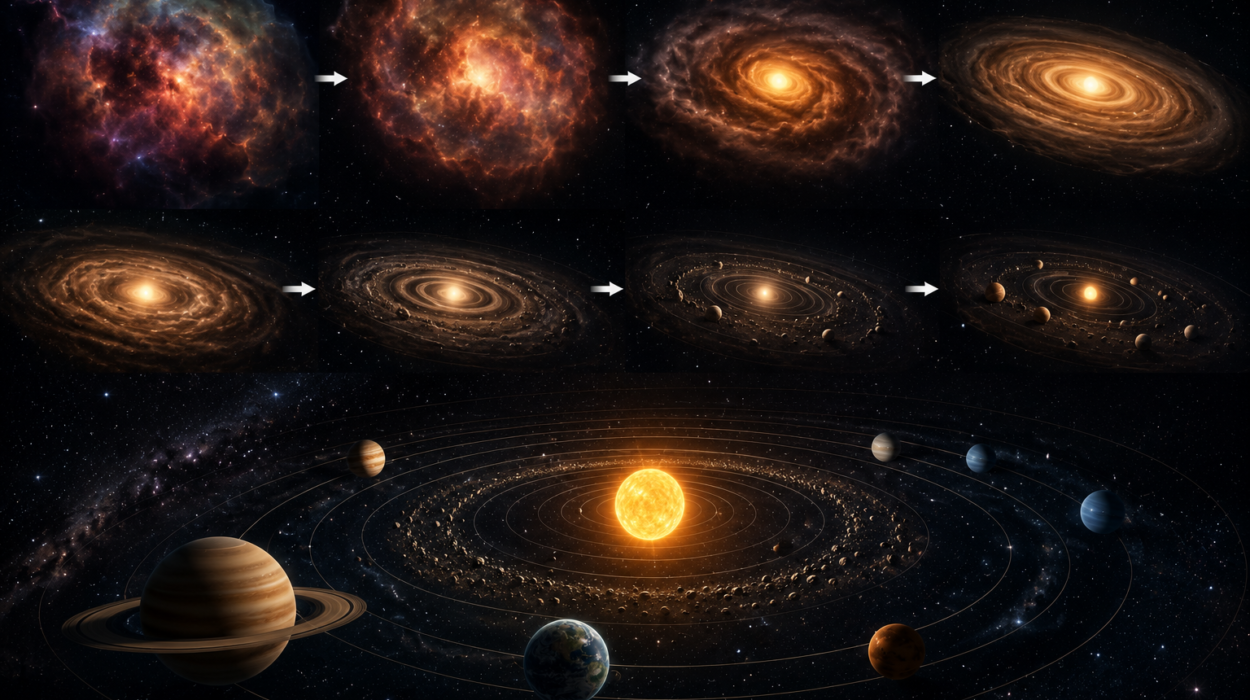
It began as a vast cloud of gas and dust floating through space. This cloud, known as the solar nebula, slowly collapsed under its own gravity.
As it shrank, it began spinning faster, much like an ice skater pulling in their arms. Most of the material gathered in the center, where pressure and temperature became so high that nuclear fusion began. A new star—the Sun—was born.
The remaining gas and dust flattened into a rotating disk surrounding the young Sun.
Tiny dust grains collided and stuck together.
Those grains became pebbles.
Pebbles became larger rocks.
The rocks combined into mountain-sized bodies called planetesimals.
Over millions of years, gravity pulled these objects together to build the planets, moons, asteroids, and many other objects we see today.
Although this process sounds simple, it was an incredibly dynamic period filled with violent collisions, giant impacts, and dramatic changes.
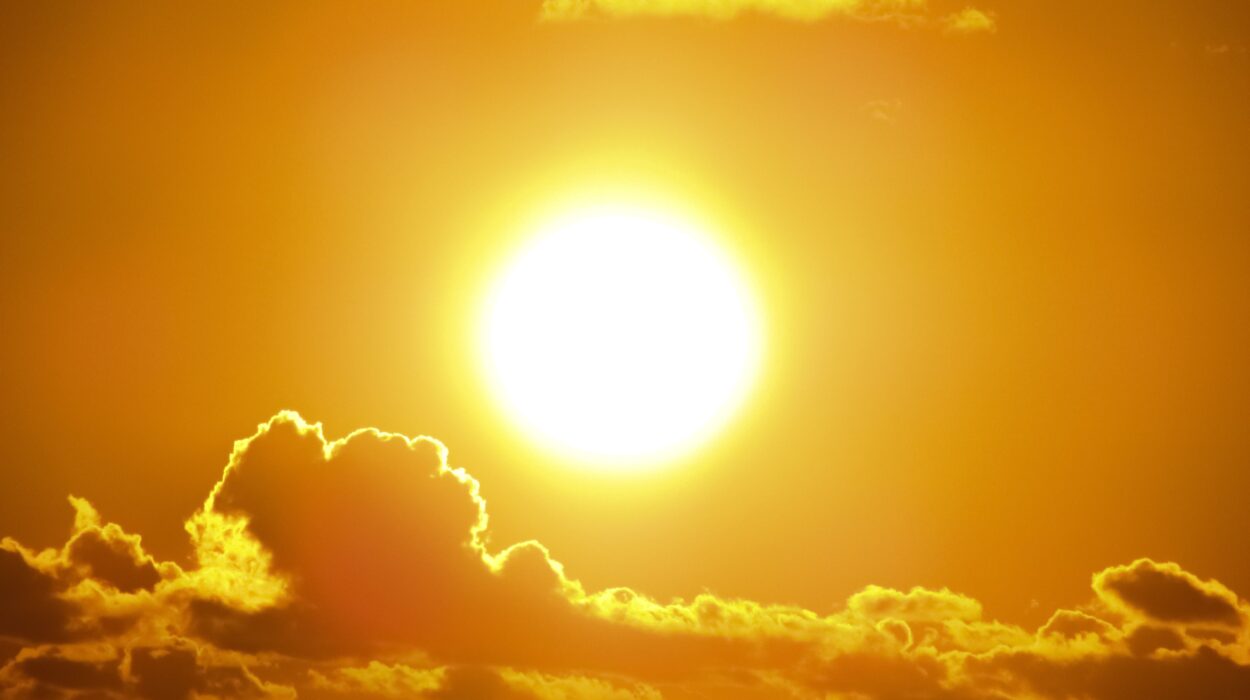
The Sun: The Heart of the Solar System
Everything in the Solar System revolves around the Sun.
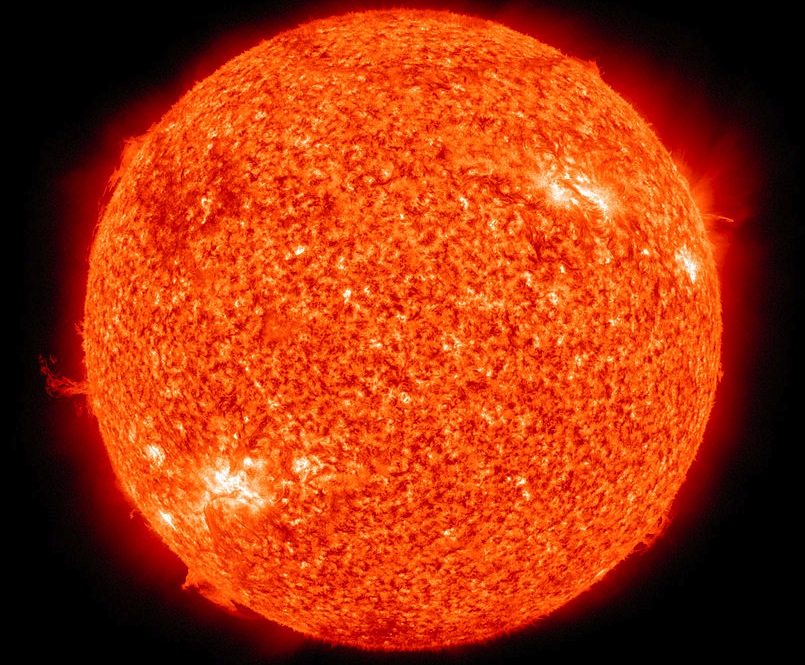
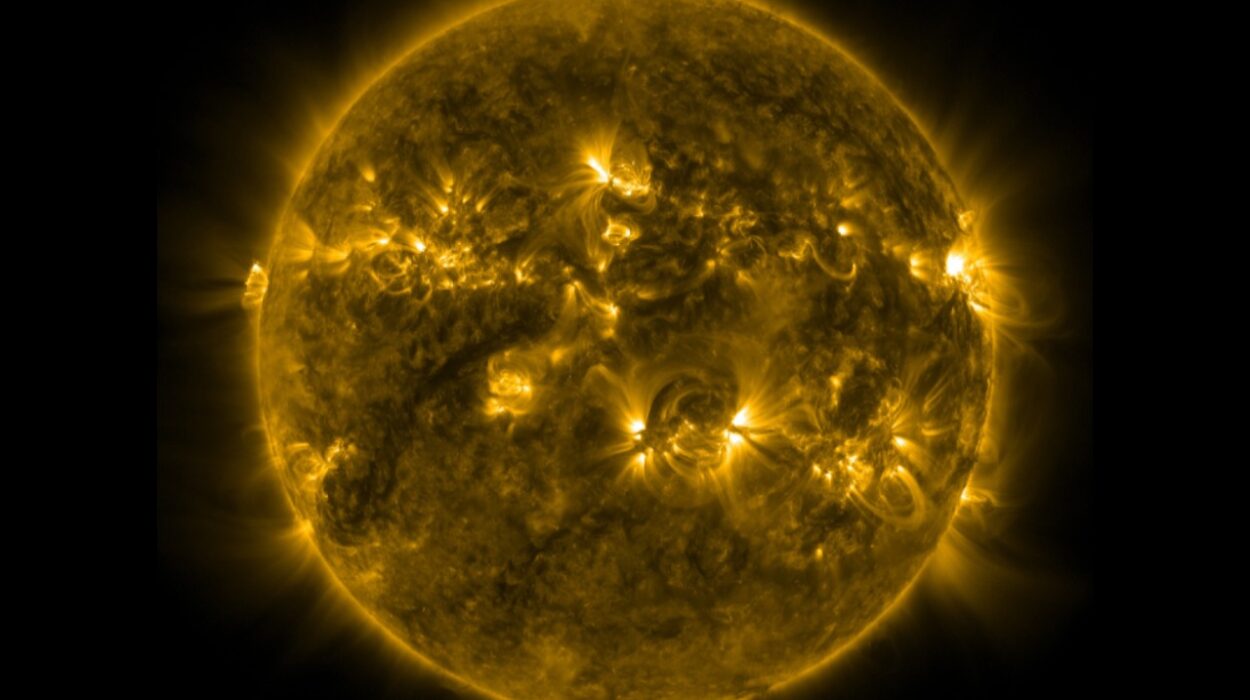
The Sun is a medium-sized star made mostly of hydrogen and helium.
Its diameter is about 1.39 million kilometers (864,000 miles), making it more than 100 times wider than Earth.
It contains approximately 99.8% of all the mass in the Solar System.
Inside its core, hydrogen atoms fuse into helium, releasing enormous amounts of energy.
That energy travels outward as sunlight and heat.
Without the Sun, Earth would become a frozen world drifting through darkness.
The Sun also produces the solar wind, a constant stream of electrically charged particles flowing throughout the Solar System. Earth’s magnetic field protects our planet from much of this radiation, while the interaction between solar particles and our atmosphere creates beautiful auroras near the poles.
Although the Sun is about halfway through its life, it will continue shining for roughly another five billion years before entering its final stages of evolution.
The Inner Rocky Planets
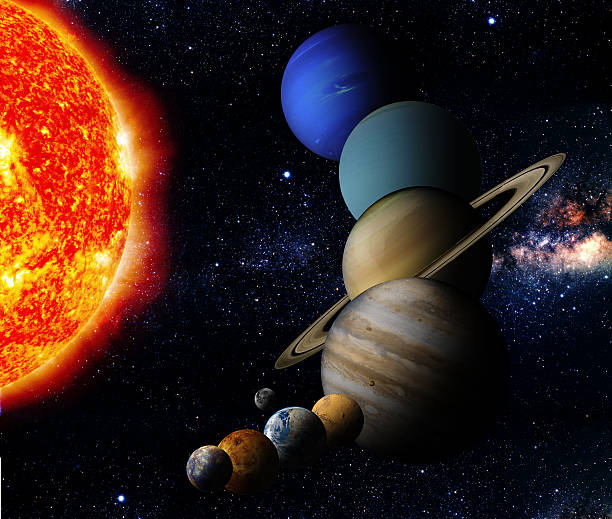
Closest to the Sun are four relatively small, rocky worlds known as the terrestrial planets.
Mercury is the smallest and closest planet to the Sun. It has almost no atmosphere, causing temperatures to swing dramatically between scorching daytime heat and freezing nighttime cold. Despite being nearest to the Sun, Mercury is not the hottest planet because it lacks a thick atmosphere capable of trapping heat.
Venus is nearly the same size as Earth but has become an extreme greenhouse world. Thick clouds of carbon dioxide create surface temperatures hot enough to melt lead, making Venus the hottest planet in the Solar System.
Earth is the only known planet where life exists. Liquid water covers much of its surface, and its atmosphere provides the right conditions for a vast diversity of living organisms. Earth’s magnetic field also shields life from much of the harmful radiation coming from space.
Mars, often called the Red Planet, owes its reddish appearance to iron oxide—essentially rust—in its soil. Ancient river valleys, lakebeds, and minerals indicate that liquid water once flowed across its surface billions of years ago. Today, Mars remains one of the most promising places in the Solar System to search for evidence of past microbial life.
The Giant Outer Planets
Beyond Mars lie four enormous planets unlike anything found closer to the Sun.
Jupiter is the largest planet in the Solar System. More than 1,300 Earths could fit inside it by volume. It is famous for the Great Red Spot, a gigantic storm that has raged for centuries. Jupiter’s powerful gravity influences many smaller objects throughout the Solar System.
Saturn is best known for its spectacular ring system. Although several planets have rings, Saturn’s are by far the most extensive and beautiful. They consist mostly of countless pieces of water ice ranging in size from tiny grains to large boulders.
Uranus is unique because it rotates on its side. Scientists believe a massive collision early in its history may have knocked the planet into this unusual orientation. Its blue-green color comes from methane gas in its atmosphere.
Neptune is the most distant major planet. Powerful winds race through its atmosphere at speeds faster than the speed of sound under Earth’s atmospheric conditions. Despite receiving very little sunlight, Neptune remains an active and dynamic world.
The Incredible Diversity of Moons
Planets are not the only worlds in the Solar System.
Many planets have natural satellites called moons.
Scientists have discovered hundreds of moons, each with its own unique story.
Earth has one large Moon that stabilizes our planet’s rotation and creates ocean tides.
Jupiter’s moon Europa likely hides a vast liquid ocean beneath an icy crust. Many scientists consider it one of the most promising places to search for extraterrestrial life.
Ganymede, another moon of Jupiter, is the largest moon in the Solar System—even larger than the planet Mercury.
Saturn’s moon Titan possesses rivers, lakes, rain, and clouds, but instead of liquid water, they are made primarily of liquid methane and ethane because Titan is so cold.
Enceladus, another moon of Saturn, shoots towering plumes of water vapor and ice into space from an underground ocean, making it another exciting target in the search for life.
Some moons are geologically more active than entire planets.
What Are Dwarf Planets?
Not every spherical object orbiting the Sun is classified as a planet.
A dwarf planet is a body that orbits the Sun, has enough gravity to become nearly round, but has not cleared other objects from its orbital neighborhood.
The most famous dwarf planet is Pluto.
For decades, Pluto was considered the ninth planet.
In 2006, the International Astronomical Union established a formal definition of a planet. Under that definition, Pluto was reclassified as a dwarf planet because it shares its orbital region with many similar icy objects in the Kuiper Belt.
Other well-known dwarf planets include Eris, Haumea, Makemake, and Ceres.
Far from being insignificant, these worlds have become some of the most scientifically interesting objects in the Solar System.
The Asteroid Belt
Between Mars and Jupiter lies the Asteroid Belt.
This region contains millions of rocky objects left over from the formation of the Solar System.
Contrary to popular science fiction, the Asteroid Belt is mostly empty space. Spacecraft routinely travel through it without difficulty because the asteroids are separated by enormous distances.
The largest object in the belt is Ceres, which is also classified as a dwarf planet.
Studying asteroids helps scientists understand the earliest history of the Solar System because many have changed very little over billions of years.
Comets: Cosmic Time Capsules
Comets are icy bodies often described as “dirty snowballs.”
They spend most of their lives in the cold outer Solar System.
As a comet approaches the Sun, solar heat causes its ice to vaporize.
Gas and dust stream away, creating the comet’s glowing coma and long tails.
Interestingly, a comet’s tails always point generally away from the Sun because they are shaped by sunlight and the solar wind.
Comets preserve ancient material from the Solar System’s birth, making them valuable scientific time capsules.
Some researchers also think that impacts by comets and water-rich asteroids may have contributed some of Earth’s water and organic molecules early in its history.
Meteoroids, Meteors, and Meteorites
Small rocky fragments travel throughout the Solar System.
When one of these objects is still in space, it is called a meteoroid.
If it enters Earth’s atmosphere and produces a bright streak of light, it becomes a meteor.
If part of it survives the fiery journey and reaches the ground, it is known as a meteorite.
Meteorites provide scientists with actual pieces of other worlds, allowing laboratories on Earth to study materials that formed billions of years ago.
The Kuiper Belt
Beyond Neptune lies a vast region known as the Kuiper Belt.
This area contains countless icy objects left over from the formation of the Solar System.
Pluto is one of its largest known members.
The Kuiper Belt is much larger than the Asteroid Belt and serves as the source of many short-period comets.
It marks the beginning of the Solar System’s distant icy frontier.
The Oort Cloud
Even farther away lies the hypothetical Oort Cloud.
Although it has not been directly observed, strong evidence suggests that this enormous spherical cloud surrounds the Solar System at tremendous distances.
It likely contains trillions of icy objects.
Scientists believe many long-period comets originate from the Oort Cloud after being disturbed by passing stars or the gravitational effects of the Milky Way.
If it exists as predicted, the Oort Cloud marks the outermost reservoir of Solar System objects.
How Big Is the Solar System?
The Solar System is almost unimaginably vast.
Light from the Sun reaches Earth in about eight minutes.
It takes more than four hours for sunlight to reach Neptune.
The distance from the Sun to Neptune is about 30 times the distance between Earth and the Sun.
The suspected Oort Cloud may extend tens of thousands to perhaps around one hundred thousand astronomical units from the Sun, approaching the region where the Sun’s gravitational influence blends into interstellar space.
Even traveling at the speed of today’s fastest spacecraft, reaching these outer regions would take many thousands of years.
The Solar System Is Always Moving
The planets orbit the Sun.
Moons orbit planets.
Asteroids and comets orbit the Sun.
The Sun itself is not standing still.
It orbits the center of the Milky Way galaxy at an average speed of about 220 kilometers (137 miles) per second.
Completing one orbit around the Milky Way takes approximately 225 to 250 million years.
During all this motion, the entire galaxy itself is also moving through the universe.
The Solar System is part of a much larger cosmic journey.
Exploring the Solar System
Human curiosity has driven remarkable exploration.
Robotic spacecraft have visited every major planet.
Rovers have driven across the surface of Mars.
Spacecraft have landed on comets and asteroids.
Orbiters continue studying distant worlds in extraordinary detail.
The Voyager 1 and Voyager 2 spacecraft, launched in 1977, have traveled beyond the heliosphere into interstellar space while continuing to send valuable scientific data back to Earth.
Modern missions continue searching for signs of ancient life, studying planetary climates, and revealing how worlds formed and evolved.
Future missions may return samples from Mars, explore the oceans beneath icy moons, and eventually carry humans farther into the Solar System than ever before.
Could There Be Life Elsewhere in the Solar System?
Earth remains the only place where life has been confirmed.
However, scientists have identified several promising locations where simple life might exist.
Europa and Enceladus possess subsurface oceans beneath thick ice.
Titan contains complex organic chemistry.
Ancient Mars had rivers, lakes, and perhaps even oceans.
These worlds are now among the most exciting destinations in planetary science.
Finding even microscopic life elsewhere in the Solar System would be one of the greatest scientific discoveries in history.
Why Studying the Solar System Matters
The Solar System is more than our address in the universe.
It is a natural laboratory where scientists can investigate how planets form, how atmospheres evolve, how climates change, and how the conditions necessary for life develop.
Every asteroid preserves clues to the Solar System’s birth.
Every comet carries ancient material from the earliest days of planetary formation.
Every moon reveals a different path of geological evolution.
By studying these worlds, scientists gain insight not only into our own origins but also into the countless planetary systems scattered across the Milky Way.
The Future of Our Solar System
The Solar System will not remain the same forever.
Billions of years from now, the Sun will exhaust the hydrogen fuel in its core and expand into a red giant star.
During this phase, it will grow enormously, dramatically changing the inner Solar System. Mercury and Venus will almost certainly be engulfed, and Earth’s long-term fate remains an active area of research, though our planet will become uninhabitable well before then as the Sun gradually brightens.
Eventually, the Sun will shed its outer layers, creating a beautiful planetary nebula.
Its remaining core will become a white dwarf—a small, extremely dense stellar remnant that will slowly cool over trillions of years.
The planets that survive will continue orbiting this fading stellar ember.
Our Place in the Solar System
Every atom in your body has a story that stretches back billions of years. The calcium in your bones, the oxygen you breathe, the iron in your blood, and the carbon that forms every living cell were forged through cosmic processes that long predate Earth itself. The Solar System is not just a collection of planets orbiting a star—it is the environment that made our existence possible.
From the fiery surface of the Sun to the frozen edge of the Kuiper Belt, from tiny dust particles to giant planets, the Solar System is a breathtaking example of nature’s creativity and complexity. It reminds us that our world is part of something far greater—a dynamic, evolving cosmic neighborhood that continues to surprise us with every new discovery.
As humanity builds more powerful telescopes, launches more ambitious spacecraft, and dreams of exploring distant worlds, our understanding of the Solar System will continue to grow. Yet no matter how much we learn, one truth remains unchanged: this extraordinary family of worlds is our home in the vast universe, and its story is also our own.