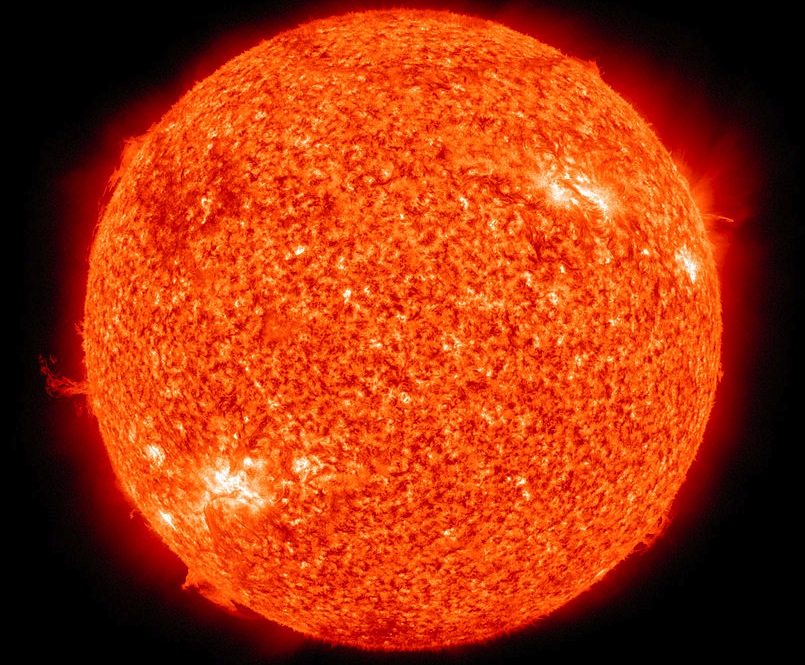
Every second, the Sun floods our Solar System with an astonishing amount of energy. That energy warms Earth, drives our weather, powers photosynthesis, and ultimately makes life possible. Yet the sunlight that reaches your face on a bright afternoon has a remarkable history. It did not simply burst out of the Sun and race toward Earth. Instead, it began an incredible journey deep within the Sun’s core—a journey so slow and complex that it may have taken hundreds of thousands of years before finally escaping into space.
The story of how energy travels through the Sun is one of the most fascinating processes in astronomy. It involves nuclear fusion, countless collisions between particles of light, gigantic rivers of hot plasma, and the constant struggle between gravity pulling inward and pressure pushing outward. Together, these processes keep the Sun shining steadily and have done so for about 4.6 billion years.
The Sun Is a Giant Ball of Hot Plasma
To understand how energy moves through the Sun, it is first important to understand what the Sun actually is.
Although it may appear as a solid glowing disk in the sky, the Sun has no solid surface. Instead, it is an enormous sphere of plasma, often called the fourth state of matter. Plasma forms when temperatures become so high that electrons are stripped away from atoms, leaving behind a mixture of positively charged ions and free electrons.
The Sun is made mostly of hydrogen, which accounts for about 74 percent of its mass, and helium, which makes up about 24 percent. The remaining small fraction consists of heavier elements such as oxygen, carbon, neon, and iron.
Gravity compresses this immense cloud of plasma so tightly that temperatures in the center reach about 15 million degrees Celsius (27 million degrees Fahrenheit). At these extreme conditions, the Sun becomes a gigantic nuclear reactor.
The Journey Begins in the Core
Every bit of the Sun’s energy begins in its central region, known as the core.
The core extends from the center to about one-quarter of the Sun’s radius. Here, gravity squeezes hydrogen atoms together under tremendous pressure.
Normally, positively charged hydrogen nuclei repel one another because like charges repel. But inside the Sun’s core, the combination of enormous pressure and extremely high temperature allows them to come close enough for the strong nuclear force to bind them together.
This process is called nuclear fusion.
In the Sun, four hydrogen nuclei are gradually transformed into one helium nucleus through a series of nuclear reactions known as the proton-proton chain.
During this process, a tiny amount of mass disappears.
According to Albert Einstein’s famous equation,
E = mc²
that lost mass is converted into energy.
Although each individual fusion reaction releases only a small amount of energy, the Sun performs an unimaginable number of these reactions every second. Around 600 million tons of hydrogen are converted into helium every second, producing roughly 3.8 × 10²⁶ watts of power.
That enormous energy is what ultimately becomes the sunlight reaching Earth.
Tiny Particles of Light Carry the Energy
Fusion reactions produce energy in several forms.
Some of it appears as neutrinos, nearly massless particles that pass almost effortlessly through the Sun and continue into space. Trillions of these neutrinos pass through your body every second without interacting.
Most of the energy, however, begins as extremely energetic particles of light called gamma-ray photons.
At first glance, it might seem these photons simply travel straight out of the Sun.
They do not.
Instead, they face an extraordinarily difficult journey.
The Radiative Zone Is a Cosmic Obstacle Course
Surrounding the core is the radiative zone, which extends to about 70 percent of the Sun’s radius.
This region is incredibly dense.
Even though photons move at the speed of light between interactions, they cannot travel very far before colliding with electrons or ions.
Each collision changes the photon’s direction.
Sometimes it is absorbed.
Sometimes it is re-emitted.
Sometimes it loses energy and emerges as a different photon.
As a result, the photon does not travel in a straight line toward the surface. Instead, it follows an endless zigzag path.
Imagine trying to leave a crowded stadium where every step sends you in a completely random direction. Although the exit may be only a short distance away, reaching it could take an incredibly long time.
The same thing happens inside the Sun.
Scientists estimate that the energy produced in the core may spend hundreds of thousands of years—and possibly up to about a million years—working its way through the radiative zone before reaching the next layer.
The journey is astonishingly slow despite each individual photon moving at the speed of light between collisions.
Energy Changes Form Along the Way
As photons bounce through the Sun, they gradually lose energy.
The gamma rays produced during nuclear fusion do not remain gamma rays forever.
Repeated interactions reduce their energy step by step.
By the time the energy approaches the Sun’s outer layers, much of it has been transformed into lower-energy photons.
Eventually, much of the escaping radiation reaches space as visible light, infrared radiation, and ultraviolet light.
In other words, the sunlight we see today began as immensely energetic gamma rays deep inside the Sun’s core.
The Convective Zone Takes Over
Near the outer part of the Sun, conditions change dramatically.
The plasma becomes cooler and less dense.
Here, photons cannot efficiently carry energy by radiation alone.
Instead, another process becomes dominant.
This region is called the convective zone.
Rather than relying mainly on photons, energy is transported through the movement of hot plasma itself.
Hot plasma deep within the convective zone becomes less dense than the surrounding material.
Like hot water rising in a pot on a stove, the hot plasma rises toward the surface.
As it reaches the upper layers, it cools.
The cooler plasma becomes denser and sinks back downward.
This continuous circulation creates enormous convection currents.
Some of these rising and sinking flows are thousands of kilometers across.
Together, they carry energy much more efficiently than radiation can in these cooler outer layers.
The Sun’s Surface Reveals Convection
Although we cannot directly watch plasma moving inside the Sun, we can see evidence of convection on its visible surface.
The surface, called the photosphere, is covered with countless bright, irregular cells known as granules.
Each granule marks the top of a convection current.
Bright centers contain hot plasma rising upward.
The darker edges contain cooler plasma sinking back down.
Each granule is roughly the size of a country, and millions cover the Sun at any given moment.
They constantly appear, evolve, and disappear over periods of about ten to twenty minutes.
Together, they reveal the enormous boiling motion taking place beneath the Sun’s surface.
Finally, Energy Escapes Into Space
When energy finally reaches the photosphere, the long journey inside the Sun is complete.
The photons are now free to leave.
Unlike their difficult passage through the Sun’s interior, the trip through space is remarkably easy.
Space is nearly empty.
Without countless particles blocking their path, photons travel almost entirely uninterrupted.
Light leaving the Sun reaches Earth in about 8 minutes and 20 seconds.
That means every sunrise shows us the Sun as it was just over eight minutes ago.
The same sunlight continues traveling far beyond Earth, eventually passing Mars, Jupiter, the outer planets, and into interstellar space.
Different Types of Solar Radiation
The Sun does not emit only visible light.
It produces radiation across nearly the entire electromagnetic spectrum.
Visible light allows us to see.
Infrared radiation carries heat.
Ultraviolet radiation influences Earth’s atmosphere and can cause sunburn.
The Sun also emits radio waves, microwaves, X-rays, and small amounts of gamma rays generated in its outer atmosphere.
Each type of radiation provides astronomers with valuable information about different regions of the Sun.
By studying these wavelengths, scientists can investigate everything from magnetic fields to solar storms.
Why the Sun Does Not Collapse
Given its enormous gravity, one might expect the Sun to collapse inward.
Yet it remains remarkably stable.
The reason lies in a delicate balance.
Gravity constantly pulls the Sun’s material inward.
At the same time, nuclear fusion generates tremendous energy.
That energy creates pressure pushing outward.
These opposing forces remain nearly balanced in a condition called hydrostatic equilibrium.
As long as fusion continues in the core, the Sun can maintain this balance and remain stable.
This equilibrium has allowed the Sun to shine consistently for billions of years.
Energy Powers Everything the Sun Does
The energy generated in the core affects every layer of the Sun.
It creates the pressure supporting the Sun against gravity.
It drives convection beneath the surface.
It powers magnetic activity.
It contributes to sunspots, solar flares, and coronal mass ejections.
It fills the Solar System with light and heat.
Without this continuous flow of energy, the Sun would rapidly change, and life on Earth would never have developed.
The Sun Is Surprisingly Efficient
Although the Sun produces an enormous amount of energy, it converts only a tiny fraction of its hydrogen into energy during each fusion reaction.
Only about 0.7 percent of the mass involved in the fusion of hydrogen into helium becomes energy.
The remaining mass stays in the helium nucleus.
Even this small percentage is enough to keep the Sun shining for billions of years because the Sun contains an immense supply of hydrogen.
Astronomers estimate that the Sun has enough fuel to continue producing energy for roughly another five billion years before exhausting the hydrogen in its core.
Scientists Can Study the Sun’s Interior
No spacecraft can reach the Sun’s core, yet scientists have learned a great deal about what happens inside.
One powerful method is called helioseismology.
Just as earthquakes reveal Earth’s interior through seismic waves, the Sun vibrates with sound waves traveling through its plasma.
By carefully measuring tiny motions on the Sun’s surface, scientists can reconstruct the structure and movement deep inside the star.
Another valuable tool comes from solar neutrinos.
Because neutrinos rarely interact with matter, they escape directly from the core in only a few seconds. Detecting them on Earth provides direct evidence that nuclear fusion is actively occurring inside the Sun.
Together, these techniques allow astronomers to investigate regions that can never be seen directly.
Every Ray of Sunshine Has an Incredible History
The next time sunlight shines through a window or warms your skin, it is worth remembering that those photons have completed one of the longest journeys imaginable.
Their story began deep within the Sun’s core, where hydrogen atoms fused together under extraordinary temperatures and pressures. The energy they carried wandered through the crowded radiative zone for hundreds of thousands of years, changing direction countless times before reaching the convective zone. There, gigantic currents of boiling plasma carried the energy upward until it finally escaped from the Sun’s glowing surface.
Once free, those photons crossed nearly 150 million kilometers of space in just over eight minutes before reaching Earth.
Every sunrise is therefore much more than a beautiful sight. It is the final chapter of an epic journey that began long before humans existed—a journey powered by the laws of physics, sustained by nuclear fusion, and essential for every living thing on our planet.