Every morning, long before most of us begin our day, an incredible journey reaches Earth.
Golden rays spread across mountains, cities, forests, and oceans. They warm the ground, illuminate the sky, help flowers bloom, and wake millions of living creatures. We often take this daily event for granted, yet sunlight is one of the most extraordinary phenomena in the universe. It is far more than brightness or warmth. Sunlight is the energy that powers almost every ecosystem on Earth, drives our weather, supports life, and allows us to see the world around us.
Without sunlight, our planet would be a frozen, lifeless world drifting through the darkness of space.
Understanding sunlight means understanding one of nature’s greatest gifts—a gift that began nearly 150 million kilometers (93 million miles) away inside the blazing heart of the Sun.
What Is Sunlight?
Sunlight is the electromagnetic radiation emitted by the Sun. It includes the visible light our eyes can detect, along with invisible forms of radiation such as infrared and ultraviolet.
In simple terms, sunlight is energy traveling through space in the form of electromagnetic waves and tiny particles called photons.
When sunlight reaches Earth, it brings the energy that warms the planet, powers photosynthesis, drives atmospheric circulation, and makes vision possible.
Although we usually think of sunlight as simply “light,” it is actually a broad spectrum of electromagnetic radiation with many different wavelengths, each interacting with matter in different ways.
Where Does Sunlight Come From?
Sunlight is born deep inside the Sun’s core.
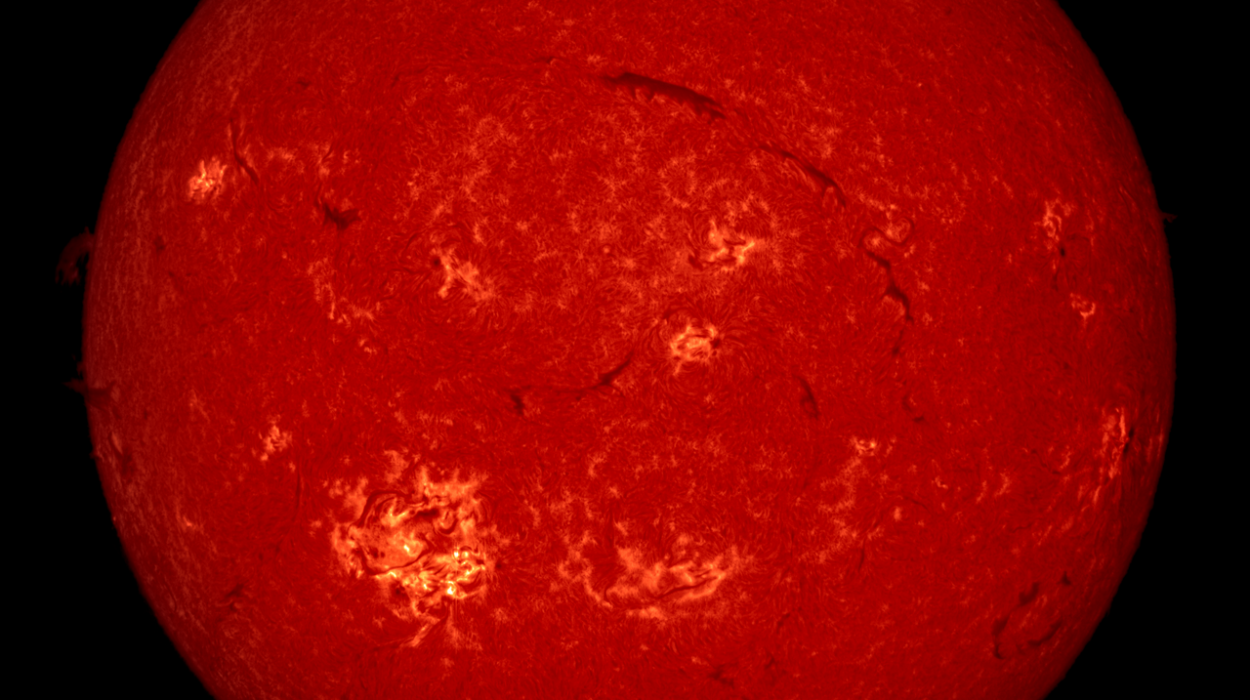
The Sun is a giant sphere of hot plasma with a diameter of about 1.39 million kilometers (864,000 miles). At its center, temperatures reach approximately 15 million degrees Celsius (27 million degrees Fahrenheit).
Under these extreme conditions, hydrogen nuclei collide and fuse together through a process called nuclear fusion.
During fusion, four hydrogen nuclei eventually combine to form one helium nucleus. A tiny fraction of the original mass is converted directly into energy according to Albert Einstein’s famous equation:
E = mc²
This energy is initially produced as high-energy gamma rays.
However, those gamma rays do not travel directly out of the Sun. Instead, they spend thousands to hundreds of thousands of years repeatedly being absorbed and re-emitted by particles inside the Sun. During this long journey, their energy gradually changes.
By the time the energy reaches the Sun’s visible surface, known as the photosphere, much of it has become the visible light, infrared radiation, and ultraviolet radiation that make up sunlight.
From there, sunlight escapes into space at the speed of light.
How Long Does Sunlight Take to Reach Earth?
Although sunlight travels incredibly fast, space is unimaginably vast.
Light moves at approximately 299,792 kilometers (186,282 miles) per second.
The average distance between Earth and the Sun is about 149.6 million kilometers (93 million miles).
As a result, sunlight takes about 8 minutes and 20 seconds to travel from the Sun to Earth.
This means every time you watch a sunrise or feel sunshine on your face, you are experiencing energy that left the Sun more than eight minutes earlier.
If the Sun were to suddenly disappear—which physics tells us cannot happen in this way—we would continue receiving sunlight for those same eight minutes before darkness arrived.
Sunlight Is Made of Many Colors
To our eyes, sunlight appears white or slightly yellow.
In reality, white sunlight contains every color of the visible spectrum.
When sunlight passes through a glass prism or tiny water droplets in the atmosphere, it separates into the familiar rainbow of colors: red, orange, yellow, green, blue, indigo, and violet.
Each color corresponds to a different wavelength.
Red light has longer wavelengths, while violet light has shorter wavelengths.
Together, these colors combine to produce the white sunlight we normally see.
The famous experiments of Isaac Newton demonstrated that sunlight is not created by a prism. Instead, the prism simply separates the colors already present within white light.
Visible Light Is Only Part of Sunlight
Human eyes detect only a small portion of the Sun’s radiation.
This narrow band is called visible light.
Beyond the visible spectrum lies infrared radiation.
Infrared carries heat. When sunshine warms your skin or heats a sidewalk, much of that warmth comes from infrared radiation.
On the opposite side of the visible spectrum is ultraviolet radiation, commonly called UV radiation.
Ultraviolet light has shorter wavelengths and higher energy than visible light.
Small amounts of ultraviolet radiation help the human body produce vitamin D, which is important for healthy bones and immune function.
However, excessive exposure can damage skin cells, increase the risk of skin cancer, and harm the eyes.
Earth’s atmosphere, especially the ozone layer, absorbs much of the Sun’s most dangerous ultraviolet radiation before it reaches the surface.
Photons: The Tiny Messengers of Sunlight
Sunlight consists of countless tiny packets of energy known as photons.
Photons are elementary particles that have no rest mass and always travel at the speed of light in a vacuum.
Each photon carries a specific amount of energy determined by its wavelength.
Blue and violet photons carry more energy than red photons because they have shorter wavelengths.
Every second, trillions upon trillions of photons strike your body, your surroundings, and every object on Earth.
When these photons interact with matter, they may be absorbed, reflected, scattered, or transmitted.
These interactions explain why objects have different colors and why we are able to see them.
Why the Sky Is Blue
One of sunlight’s most beautiful effects is the blue daytime sky.
As sunlight enters Earth’s atmosphere, it collides with molecules of nitrogen and oxygen.
Shorter wavelengths, especially blue light, are scattered much more efficiently than longer wavelengths.
This process, known as Rayleigh scattering, sends blue light in many different directions.
Because scattered blue light reaches our eyes from all parts of the sky, the entire sky appears blue during the day.
If Earth had no atmosphere, the sky would appear black even in full daylight, just as it does for astronauts in space.
Why Sunrises and Sunsets Are Red
Sunrises and sunsets create some of the most breathtaking colors in nature.
When the Sun is low on the horizon, its light must travel through much more of Earth’s atmosphere than it does at midday.
During this longer journey, most of the shorter blue and violet wavelengths are scattered away before reaching your eyes.
The remaining light becomes dominated by longer red, orange, and yellow wavelengths.
As a result, the Sun and surrounding clouds often glow with brilliant warm colors.
Dust, pollution, volcanic ash, and tiny water droplets can further enhance these spectacular displays.
Sunlight Makes Vision Possible
Without sunlight, our eyes could not see the colorful world around us.
When sunlight strikes an object, some wavelengths are absorbed while others are reflected.
The reflected light enters our eyes through the cornea and lens before reaching the retina.
Specialized cells called cones detect different wavelengths corresponding to different colors.
The brain processes these signals to create the rich visual experiences we enjoy every day.
In this way, sunlight allows us not only to see brightness but also the remarkable diversity of colors found throughout nature.
Sunlight Powers Photosynthesis
Perhaps the most important role of sunlight is providing energy for photosynthesis.
Green plants, algae, and certain bacteria capture sunlight using a pigment called chlorophyll.
They use this energy to convert carbon dioxide and water into glucose, a sugar that stores chemical energy.
As a byproduct, oxygen is released into the atmosphere.
Nearly all complex life on Earth depends directly or indirectly on this process.
Plants become food for animals.
Animals become food for other animals.
Humans rely on plants both directly and through agriculture and livestock.
Even fossil fuels such as coal and oil ultimately originate from ancient organisms that captured sunlight millions of years ago.
In a very real sense, sunlight powers almost every food chain on Earth.
Sunlight Drives Earth’s Climate
The Sun is Earth’s primary source of energy.
As sunlight warms the planet, different regions receive different amounts of solar energy.
Areas near the equator receive more direct sunlight than regions near the poles.
These temperature differences drive atmospheric circulation, ocean currents, winds, storms, and weather patterns.
Without sunlight, there would be no water cycle.
Rain would cease.
Clouds would disappear.
Oceans would gradually freeze.
Earth’s climate system depends entirely on the continuous flow of solar energy.
The Changing Angle of Sunlight Creates the Seasons
Many people mistakenly believe the seasons occur because Earth moves closer to or farther from the Sun.
The real reason is Earth’s 23.5-degree axial tilt.
As Earth orbits the Sun, different hemispheres tilt toward or away from the Sun during different parts of the year.
When a hemisphere tilts toward the Sun, sunlight strikes it more directly and daylight lasts longer.
This produces warmer temperatures and summer.
When the hemisphere tilts away, sunlight arrives at a lower angle and days become shorter.
This produces winter.
The changing angle of sunlight is the true cause of Earth’s seasons.
Sunlight and Human Health
Sunlight plays an essential role in human health.
Exposure to moderate amounts of sunlight enables the skin to produce vitamin D.
Vitamin D helps regulate calcium absorption, supports bone health, contributes to immune function, and plays roles in many other biological processes.
Sunlight also helps regulate the body’s circadian rhythm, the internal biological clock that controls sleep and wake cycles.
Morning sunlight signals the brain that it is daytime, promoting alertness and helping maintain healthy sleep patterns.
However, sunlight is beneficial only in moderation.
Excessive exposure to ultraviolet radiation can damage DNA in skin cells, accelerate skin aging, cause sunburn, increase the risk of cataracts, and raise the likelihood of developing skin cancer.
Using protective clothing, sunglasses, shade, and sunscreen when appropriate helps reduce these risks.
Sunlight and Solar Energy
Modern technology has found remarkable ways to harness sunlight.
Solar panels convert sunlight directly into electricity using the photovoltaic effect.
When photons strike certain semiconductor materials, they can release electrons, creating an electric current.
Solar energy has become one of the world’s fastest-growing renewable energy sources.
Unlike fossil fuels, sunlight is continuously replenished by the Sun and produces electricity without emitting greenhouse gases during operation.
As technology improves, solar power is playing an increasingly important role in the global transition toward cleaner energy.
Does Sunlight Ever Change?
Although the Sun appears constant, its brightness changes slightly over time.
The Sun experiences approximately 11-year solar cycles during which magnetic activity rises and falls.
During periods of high activity, more sunspots, solar flares, and coronal mass ejections occur.
Despite these changes, the Sun’s total energy output varies only slightly.
Over much longer timescales, however, the Sun gradually becomes brighter as it ages.
Astronomers estimate that the Sun’s luminosity increases by roughly 10 percent every billion years.
Billions of years from now, this gradual increase will significantly alter Earth’s climate.
Can Sunlight Reach Everywhere?
Sunlight spreads outward in every direction from the Sun.
As it travels farther away, it becomes less concentrated because the same amount of energy is spread over a larger area.
This is why distant planets receive much less sunlight than Earth.
Mercury experiences intense solar radiation because it orbits close to the Sun.
Mars receives only about half as much sunlight as Earth.
The giant outer planets are so distant that sunlight there appears much dimmer, though it is still brighter than a full Moon seen from Earth.
Beyond the Solar System, sunlight continues traveling through interstellar space, eventually becoming indistinguishable from the vast background of radiation filling the universe.
Scientists Study Sunlight Every Day
Scientists learn an enormous amount about the Sun simply by analyzing its light.
By studying the colors and wavelengths present in sunlight, researchers can determine the Sun’s temperature, chemical composition, magnetic activity, and motion.
This technique, called spectroscopy, has become one of the most powerful tools in astronomy.
The same methods allow scientists to study distant stars, galaxies, and even the atmospheres of planets orbiting other stars.
Much of what we know about the universe has come from carefully examining light.
The Future of Sunlight Research
Although sunlight has illuminated Earth for billions of years, scientists continue making new discoveries about it.
Space missions constantly monitor the Sun to better understand solar storms that can affect satellites, astronauts, communication systems, and electrical power grids.
Researchers are improving solar technologies that capture sunlight more efficiently.
Physicists continue exploring how light interacts with matter at the quantum level.
Every advance deepens our understanding of both the Sun and the fundamental nature of light itself.
Sunlight Is the Energy That Connects Life and the Universe
Sunlight is much more than the glow that brightens our mornings. It is the visible expression of nuclear fusion occurring deep within the Sun, carrying energy across nearly 150 million kilometers of space before reaching Earth. Every beam of sunlight contains photons that warm the planet, illuminate landscapes, drive weather, power photosynthesis, regulate biological rhythms, and sustain nearly every form of life.
From the colors of a rainbow to the growth of forests, from the warmth on your skin to the electricity produced by solar panels, sunlight quietly shapes the world in countless ways. It links the fiery heart of our nearest star with every living organism on Earth, reminding us that life on our planet is deeply connected to the energy of the cosmos.
Each sunrise is more than the beginning of another day. It is the arrival of ancient starlight, carrying the power that has sustained Earth for billions of years and continues to make our remarkable world possible.