Have you ever looked up at the night sky and wondered how far away the planets really are? We often hear that Mars is millions of kilometers from Earth or that Jupiter lies hundreds of millions of kilometers away. These numbers are so enormous that they can be difficult to imagine. For astronomers, constantly working with such huge distances would be cumbersome and confusing. To solve this problem, scientists created a special unit of measurement called the Astronomical Unit, often abbreviated as AU.
The Astronomical Unit is one of the most important distance measurements in astronomy. It provides a simple and practical way to describe distances within our Solar System. Instead of saying that a planet is hundreds of millions of kilometers from the Sun, astronomers can express its distance in astronomical units, making comparisons much easier.
Although the concept is simple, the Astronomical Unit has played a crucial role in helping scientists understand the Solar System, calculate planetary orbits, navigate spacecraft, and even measure the vast distances to stars beyond our cosmic neighborhood.
Understanding the Astronomical Unit
An Astronomical Unit (AU) is defined as exactly 149,597,870,700 meters, which is approximately 149.6 million kilometers or about 93 million miles.
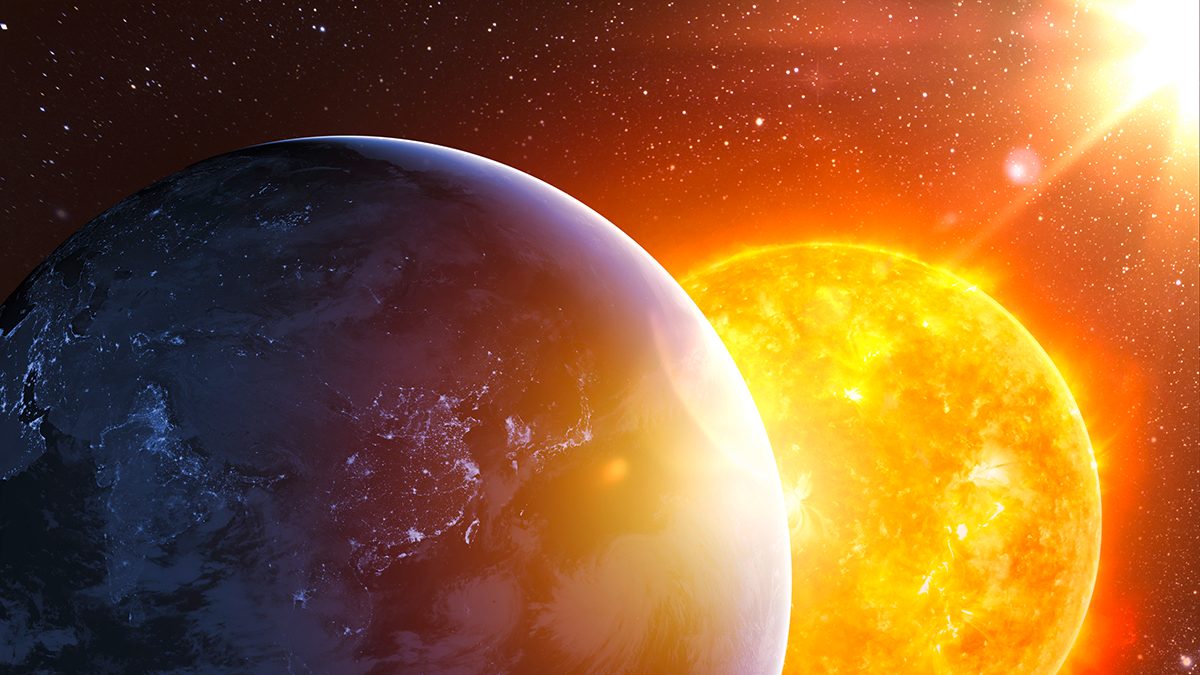
This distance represents the average distance between Earth and the Sun.
Because Earth’s orbit is slightly elliptical rather than perfectly circular, the actual Earth–Sun distance changes throughout the year. Sometimes Earth is slightly closer to the Sun, while at other times it is slightly farther away. The Astronomical Unit represents the standard average distance rather than the exact distance on any particular day.
Today, the value of one AU is fixed by international agreement, allowing scientists around the world to use the same precise measurement.
Why Was the Astronomical Unit Created?
Imagine trying to describe the Solar System using only kilometers.
Mercury is about 58 million kilometers from the Sun.
Earth is about 150 million kilometers away.
Jupiter orbits at roughly 778 million kilometers.
Neptune circles the Sun at approximately 4.5 billion kilometers.
These numbers quickly become overwhelming.
Using astronomical units makes these distances much easier to understand.
Earth is 1 AU from the Sun.
Mercury is about 0.39 AU.
Mars is about 1.52 AU.
Jupiter is about 5.2 AU.
Neptune is about 30 AU.
Suddenly, the layout of the Solar System becomes much clearer. Instead of enormous numbers filled with zeros, astronomers can compare planetary distances using simple values.
The History of the Astronomical Unit
For thousands of years, people observed the movements of the Sun, Moon, and planets without knowing their true distances.
Ancient astronomers understood the relative motions of celestial bodies but had no accurate way to determine how far away they actually were.
During the seventeenth century, astronomers began making increasingly accurate observations of planetary motions. The work of scientists such as Johannes Kepler revealed the relative sizes of planetary orbits, but the actual scale of the Solar System remained unknown.
A major breakthrough came in the eighteenth century when astronomers carefully observed the transit of Venus across the Sun. By comparing observations made from different locations on Earth, scientists estimated the Earth–Sun distance much more accurately than ever before.
As technology improved, radar measurements of nearby planets and spacecraft tracking allowed scientists to determine the Astronomical Unit with extraordinary precision.
In 2012, the International Astronomical Union officially redefined the AU as an exact value rather than a measured one, ensuring consistency in scientific calculations.
Earth’s Orbit and the Astronomical Unit
Earth does not travel around the Sun in a perfect circle.
Instead, it follows an ellipse, meaning the distance between Earth and the Sun changes slightly throughout the year.
Around early January, Earth reaches perihelion, the point where it is closest to the Sun.
Around early July, Earth reaches aphelion, the point where it is farthest from the Sun.
Even though these distances vary by several million kilometers, the Astronomical Unit remains the average Earth–Sun distance.
This standardized measurement allows astronomers to describe planetary orbits consistently without accounting for these small seasonal changes.
Measuring Distances in the Solar System
The Astronomical Unit is ideal for measuring distances within our Solar System.
Mercury orbits at approximately 0.39 AU.
Venus circles the Sun at about 0.72 AU.
Earth orbits at exactly 1 AU by definition.
Mars travels around the Sun at roughly 1.52 AU.
The asteroid belt lies mainly between about 2 and 3.5 AU.
Jupiter orbits at about 5.2 AU.
Saturn is nearly 9.6 AU from the Sun.
Uranus orbits at approximately 19 AU.
Neptune circles the Sun at about 30 AU.
The dwarf planet Pluto follows a highly elliptical orbit averaging about 39 AU from the Sun.
Using AU makes it much easier to visualize the spacing of planets throughout the Solar System.
The Astronomical Unit and Spacecraft
Modern space exploration relies heavily on astronomical units.
When scientists plan missions to Mars, Jupiter, or Saturn, they often describe the spacecraft’s journey in terms of AU.
For example, a spacecraft traveling to Jupiter must cover a distance of more than 5 AU from the Sun.
NASA’s Voyager 1 spacecraft, launched in 1977, has traveled far beyond the outer planets. It is now over 160 AU from the Sun, meaning it is more than 160 times farther from the Sun than Earth is.
Expressing such distances in kilometers would require enormous numbers that are much harder to interpret.
Is One AU Always Enough?
Although the Astronomical Unit is perfect for describing distances inside the Solar System, it becomes less practical when studying the rest of the universe.
The nearest star beyond the Sun, Proxima Centauri, is about 268,000 AU away.
Writing distances this way quickly becomes inconvenient.
For this reason, astronomers use larger units such as the light-year and the parsec when discussing stars, galaxies, and the broader universe.
Each measurement has its own purpose.
The Astronomical Unit is ideal for planets and spacecraft.
Light-years are better for nearby stars.
Parsecs are commonly used in professional astronomy for measuring even greater distances.
How Scientists Measure the Astronomical Unit
Determining the Earth–Sun distance has become remarkably precise.
One important method uses radar.
Scientists transmit powerful radio waves toward nearby planets such as Venus. The radio waves bounce off the planet’s surface and return to Earth.
By measuring the travel time of these signals and knowing the speed of light, astronomers can calculate planetary distances with exceptional accuracy.
Spacecraft tracking has made these measurements even more precise. Signals exchanged between Earth and spacecraft throughout the Solar System provide detailed information about planetary positions and orbital distances.
Today, the Astronomical Unit is known with extraordinary precision, allowing highly accurate spacecraft navigation and astronomical calculations.
Why the Astronomical Unit Matters
The Astronomical Unit is far more than just a convenient measuring stick.
It forms the foundation of many astronomical calculations.
Scientists use it to determine planetary orbits, calculate spacecraft trajectories, study asteroid movements, model the Solar System, and understand how planets interact through gravity.
It also serves as an important stepping stone for measuring larger cosmic distances.
Many techniques used to calculate the distances to nearby stars begin with accurate knowledge of Earth’s orbit, whose size is defined by the Astronomical Unit.
Without this fundamental measurement, our understanding of the scale of the universe would be far less precise.
The Astronomical Unit Helps Us Visualize the Solar System
One of the greatest strengths of the Astronomical Unit is that it makes the Solar System easier to imagine.
Instead of memorizing billions of kilometers, we can picture Earth at 1 AU and compare every other object to that familiar distance.
Mercury circles much closer to the Sun than Earth.
Mars orbits just beyond Earth.
Jupiter lies over five times farther from the Sun than Earth.
Neptune is about thirty times farther away.
These comparisons immediately reveal the enormous scale of our planetary neighborhood.
The AU transforms abstract numbers into a simple mental map of the Solar System.
Beyond the Planets
The Astronomical Unit is also useful for describing objects beyond the major planets.
Many comets spend much of their time hundreds or even thousands of AU from the Sun before returning to the inner Solar System.
The Kuiper Belt, home to Pluto and many icy worlds, stretches beyond Neptune and extends to roughly 50 AU from the Sun.
Farther still lies the hypothetical Oort Cloud, believed to surround the Solar System at distances reaching tens of thousands of AU.
Although these regions are incredibly distant, the AU continues to provide a practical way to describe their locations.
A Measurement That Connects Earth to the Cosmos
The Astronomical Unit begins with something familiar—the distance between Earth and the Sun—but its importance reaches far beyond our planet.
It allows astronomers to compare planetary orbits, navigate spacecraft across billions of kilometers, understand the structure of the Solar System, and build the foundation for measuring the universe itself.
What began as humanity’s effort to determine the distance to our own star has become one of the most essential tools in astronomy.
Conclusion
An Astronomical Unit (AU) is the average distance between Earth and the Sun, defined as exactly 149,597,870,700 meters, or about 149.6 million kilometers. It provides a simple, standardized way to measure distances within the Solar System, replacing unwieldy numbers with values that are easier to understand and compare.
From mapping planetary orbits and guiding interplanetary spacecraft to supporting the measurement of far more distant objects, the Astronomical Unit remains a cornerstone of modern astronomy. It reminds us that even though the universe is unimaginably vast, thoughtful scientific tools can help us comprehend its scale and continue our journey of exploration beyond Earth.