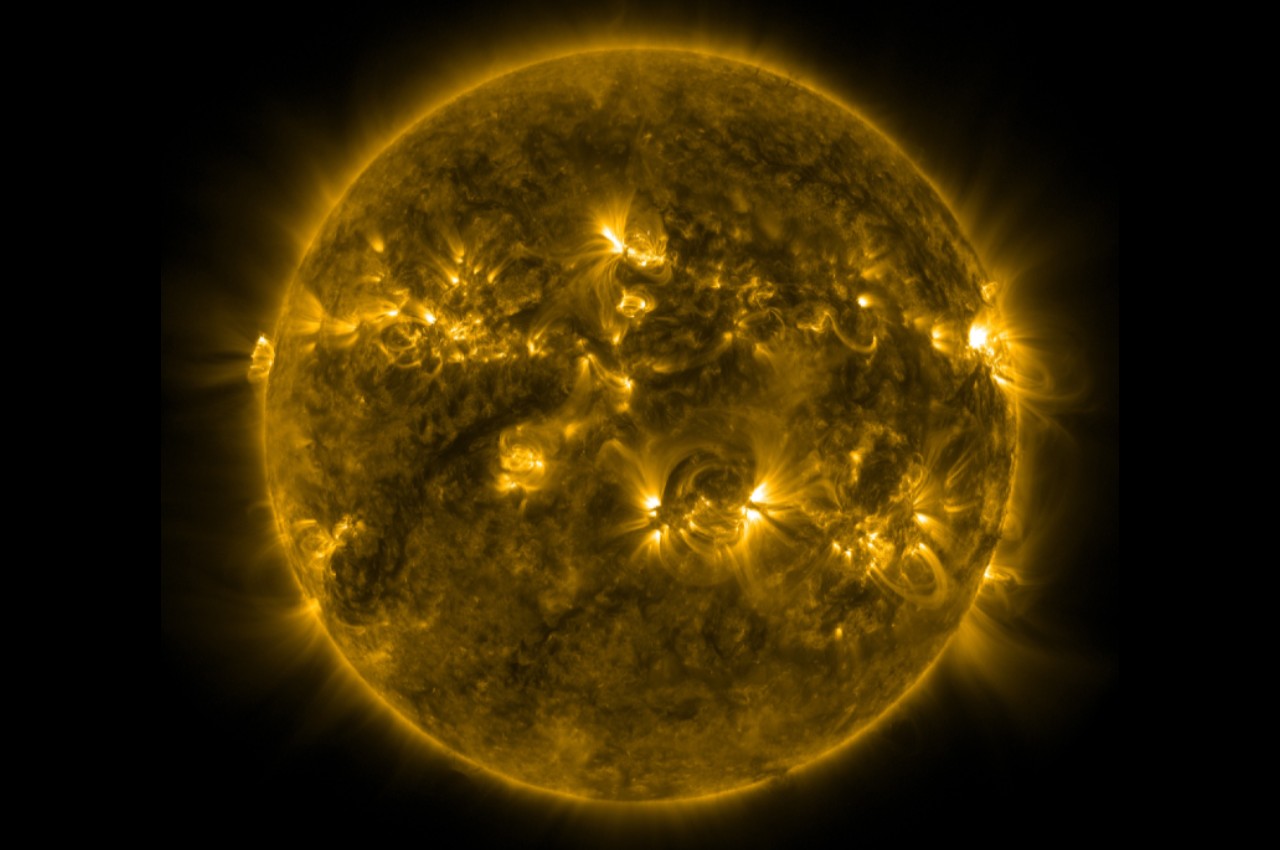
Every morning, the Sun rises and fills our world with light and warmth. It paints the sky with brilliant colors, powers the weather, helps plants grow, and makes life on Earth possible. Yet this glowing sphere in the sky is much more than a giant ball of fire. It is an enormous star—a cosmic engine that has been shining for about 4.6 billion years.
For thousands of years, people wondered what the Sun was made of. Was it burning like wood? Was it made of molten metal? Could it ever burn out? Today, thanks to centuries of scientific discoveries, astronomers know the answer in remarkable detail. The Sun is made mostly of the simplest elements in the universe, and deep within its core, an extraordinary process turns tiny atoms into the energy that lights up the entire Solar System.
Understanding what the Sun is made of is also a way of understanding our own origins. The atoms in our bodies, the planets beneath our feet, and even the oxygen we breathe are all connected to the life cycles of stars like the Sun.
The Sun Is a Star
The Sun is not unique. It is one of hundreds of billions of stars in the Milky Way galaxy and one of trillions of stars throughout the observable universe.
Like other stars, the Sun is a giant sphere of extremely hot plasma held together by its own gravity. Plasma is often called the fourth state of matter. Unlike a solid, liquid, or gas, plasma contains atoms that have been stripped of many of their electrons, leaving a mixture of positively charged ions and free electrons.
Because of its incredibly high temperature, nearly all of the Sun exists in this plasma state.
Although it appears calm from Earth, the Sun is a dynamic and constantly changing star filled with flowing gases, powerful magnetic fields, and enormous explosions.
Hydrogen Makes Up Most of the Sun
The Sun is made primarily of hydrogen, the lightest and most abundant element in the universe.
About 73 to 74 percent of the Sun’s mass consists of hydrogen.
Hydrogen is the simplest atom imaginable. Each hydrogen atom normally contains just one proton in its nucleus and one electron surrounding it.
Inside the Sun, however, temperatures are so high that electrons are separated from their nuclei, creating the plasma that fills the star.
Hydrogen is the Sun’s main fuel. Deep inside the core, hydrogen nuclei collide and fuse together, releasing tremendous amounts of energy.
Without hydrogen, the Sun could not shine.
Helium Is the Second Most Abundant Element
The second most common element in the Sun is helium.
Helium makes up about 24 to 25 percent of the Sun’s mass.
Unlike hydrogen, helium atoms contain two protons in their nuclei. Helium is actually produced inside the Sun through nuclear fusion.
Every second, the Sun converts enormous amounts of hydrogen into helium.
Over billions of years, the amount of helium in the Sun’s core has gradually increased while the amount of hydrogen has slowly decreased.
Even so, there is still enough hydrogen remaining for the Sun to continue shining for billions more years.
The Sun Also Contains Heavier Elements
Although hydrogen and helium dominate the Sun’s composition, they are not the only elements present.
A small fraction—roughly 2 percent by mass—consists of heavier elements that astronomers collectively call “metals,” even though many are not metals in the everyday sense.
These include oxygen, carbon, neon, nitrogen, iron, silicon, magnesium, sulfur, and many others.
Together they account for only a tiny portion of the Sun’s total mass, but they play important roles in the Sun’s structure, energy transport, and the light it emits.
These heavier elements were created long before the Sun was born inside even older generations of stars.
When those ancient stars reached the ends of their lives, they released these elements into space, where they eventually became part of the cloud that formed our Solar System.
In a very real sense, the Sun inherited material from stars that lived and died billions of years earlier.
How Scientists Know What the Sun Is Made Of
No spacecraft has ever brought back a sample from the Sun. Its surface is nearly 5,500 degrees Celsius (about 9,900 degrees Fahrenheit), while its core reaches around 15 million degrees Celsius (about 27 million degrees Fahrenheit). These extreme temperatures make direct sampling impossible.
Instead, scientists use a powerful technique called spectroscopy.
When sunlight passes through a prism or a special instrument called a spectrograph, it spreads into a rainbow of colors known as a spectrum.
Within this spectrum are countless dark lines called absorption lines.
Each chemical element absorbs light at specific wavelengths, creating a unique pattern much like a fingerprint.
By studying these patterns, astronomers can identify which elements are present in the Sun and estimate their abundances with remarkable accuracy.
This same method is used to study distant stars that are trillions of kilometers away.
The Sun Is Not Burning Like a Campfire
One of the biggest misconceptions about the Sun is that it is burning like wood, coal, or gasoline.
A campfire burns through a chemical reaction involving oxygen.
The Sun does not.
There is almost no oxygen available in the Sun’s core for ordinary burning, and chemical reactions could never produce enough energy to power the Sun for billions of years.
Instead, the Sun shines because of nuclear fusion.
Fusion is a process in which small atomic nuclei combine to form larger nuclei.
This process releases far more energy than any chemical reaction.
Nuclear fusion is the true source of the Sun’s incredible brightness.
Nuclear Fusion Powers the Sun
Deep inside the Sun’s core, temperatures and pressures become almost unimaginable.
Hydrogen nuclei move at tremendous speeds.
Most simply pass by one another because positively charged particles naturally repel each other.
However, under the extreme conditions in the Sun’s core, some hydrogen nuclei collide with enough energy to overcome this electrical repulsion.
When they do, they fuse together through a series of nuclear reactions known as the proton–proton chain.
The final result is the formation of one helium nucleus from four hydrogen nuclei.
During this process, a tiny amount of mass is converted into energy according to Einstein’s famous equation:
E = mc²
Although only a small fraction of the mass is transformed, the speed of light squared is such a large number that the released energy is enormous.
This energy eventually makes its way to the Sun’s surface and escapes into space as sunlight and other forms of electromagnetic radiation.
The Layers of the Sun
The Sun is not the same throughout. It is organized into several layers, each with different temperatures and physical conditions.
At the center lies the core, where nuclear fusion takes place. This is the hottest region of the Sun and the source of all its energy.
Surrounding the core is the radiative zone. Here, energy moves outward mainly through radiation. Individual photons can be absorbed and re-emitted many times, so it takes a very long time for energy to work its way outward.
Above this lies the convective zone. In this region, hot plasma rises while cooler plasma sinks, much like boiling water in a pot. This continuous motion helps transport energy toward the surface.
The visible surface is called the photosphere. Although we think of it as the Sun’s surface, it is simply the layer from which most visible light escapes into space.
Above the photosphere is the chromosphere, a thin atmospheric layer that can be seen during total solar eclipses as a reddish glow.
The outermost layer is the corona, a vast, extremely hot atmosphere extending millions of kilometers into space. Surprisingly, the corona is much hotter than the visible surface, a phenomenon that remains an active area of scientific research.
The Sun Is Constantly Changing
Although the Sun seems steady from day to day, it is actually an active star.
Its magnetic field twists and changes over time, producing dark sunspots, bright regions, powerful solar flares, and enormous eruptions called coronal mass ejections.
These events release huge amounts of energy and charged particles into space.
When these particles reach Earth, they can create beautiful auroras near the poles.
In stronger events, they may temporarily affect satellites, radio communications, navigation systems, and electric power infrastructure.
The Sun follows an approximately 11-year cycle during which its magnetic activity rises and falls.
The Sun Is Losing Mass Every Second
As the Sun produces energy, a small amount of its mass is continuously converted into radiation.
Every second, the Sun transforms about 600 million metric tons of hydrogen into helium. Of that, roughly 596 million metric tons become helium, while about 4 million metric tons of mass are converted directly into energy.
Although this sounds enormous, the Sun is so massive that this gradual loss barely changes it over human timescales.
Its total mass is about 2 × 10³⁰ kilograms, making the current rate of mass loss insignificant compared with the Sun’s immense size.
Where Did the Sun’s Material Come From?
The Sun formed about 4.6 billion years ago from a giant cloud of gas and dust known as a molecular cloud.
Gravity caused parts of this cloud to collapse inward.
As the material became denser, it grew hotter until a young star formed at the center.
Eventually, temperatures in the core became high enough for nuclear fusion to begin.
At that moment, the Sun officially became a star.
The gas and dust left over from its formation gradually formed the planets, moons, asteroids, and comets of the Solar System.
Because Earth formed from the same cloud, many of the elements found on our planet also exist within the Sun.
Will the Sun Ever Run Out of Hydrogen?
Yes, but not anytime soon.
The Sun has enough hydrogen fuel to continue stable nuclear fusion for roughly another 5 billion years.
As hydrogen in the core becomes depleted, the Sun will begin a new stage of its evolution.
Its core will contract while its outer layers expand dramatically.
The Sun will become a red giant, growing so large that it is expected to engulf Mercury and Venus. Whether Earth survives this phase remains uncertain, but even if it does, it will become far too hot to support life as we know it.
Eventually, the Sun will shed its outer layers into space, forming a glowing cloud called a planetary nebula.
Its remaining core will become a white dwarf, a small, dense stellar remnant that slowly cools over billions of years.
The Sun Connects Us to the Universe
One of the most inspiring facts about the Sun is that it is made of the same elements found throughout the cosmos.
Hydrogen and helium were produced primarily during the earliest moments of the universe, shortly after the Big Bang.
Many of the heavier elements in the Sun—and in our own bodies—were forged inside ancient stars that lived before our Solar System existed.
Every breath we take contains atoms that have traveled through multiple generations of stars.
Every ray of sunlight carries energy produced by nuclear reactions that began deep inside the Sun thousands to hundreds of thousands of years before reaching its surface, and then took just over eight minutes to travel the nearly 150 million kilometers (93 million miles) to Earth.
Looking at the Sun is, in a sense, looking at a chapter in the universe’s long story of creation.
Why Understanding the Sun Matters
Learning what the Sun is made of is about much more than satisfying curiosity.
It helps scientists understand how stars are born, how galaxies evolve, and how the chemical elements necessary for planets and life are distributed throughout the universe.
Studying the Sun also improves our ability to predict space weather, protect satellites and astronauts, and better understand the environments of planets orbiting other stars.
As the nearest star to Earth, the Sun serves as a natural laboratory for understanding countless other stars across the cosmos.
The Sun Is More Than a Bright Light
The Sun is an immense sphere of glowing plasma composed mostly of hydrogen and helium, with small amounts of heavier elements inherited from ancient stars. Its energy comes not from ordinary burning but from nuclear fusion deep within its core, where hydrogen atoms combine to form helium and release extraordinary amounts of energy.
For billions of years, this process has illuminated Earth, powered its climate, and sustained nearly every form of life. The sunlight warming your face today began as nuclear energy in the Sun’s heart, traveled slowly through the star’s interior, and then crossed the vast emptiness of space in just over eight minutes.
Every sunrise is therefore more than the start of a new day. It is a daily reminder that we live beside a remarkable star—one whose composition, energy, and history reveal not only the story of the Sun itself but also the story of the universe and our place within it.