Every time you look at the Sun, watch the Moon rise, or marvel at images of Saturn’s rings and Jupiter’s swirling clouds, you are witnessing the survivors of an extraordinary story that began billions of years ago. The planets, moons, asteroids, and comets that make up our Solar System did not always exist. There was a time when there was no Earth, no oceans, no mountains, and certainly no life.
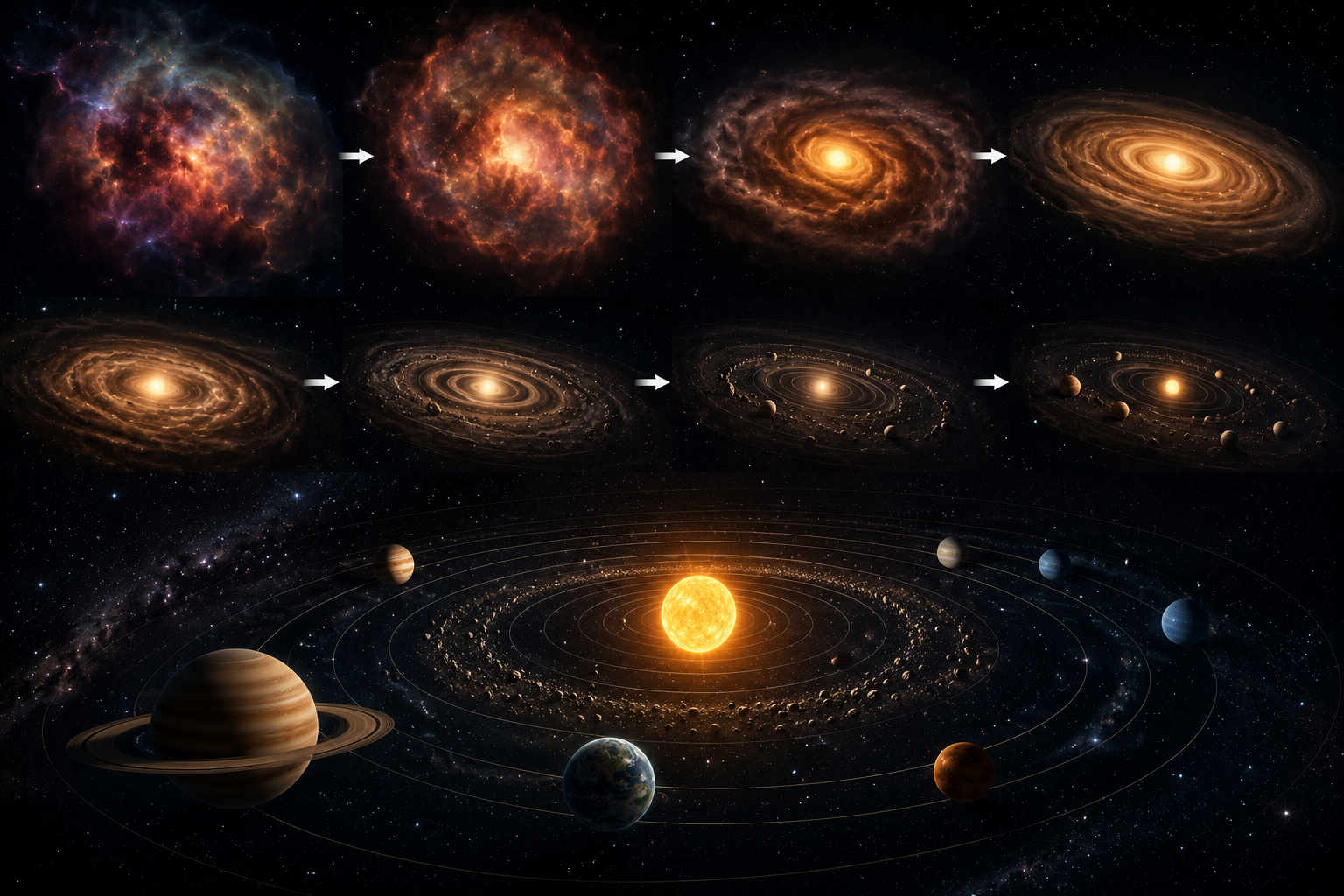
Instead, everything that now orbits the Sun began as a vast cloud of gas and dust drifting through our region of the Milky Way galaxy. Over millions of years, gravity transformed this seemingly ordinary cloud into one of the most remarkable planetary systems known in the universe.
Understanding how the Solar System formed is one of the greatest achievements of modern astronomy. By studying meteorites, distant young stars, newborn planetary systems, and the laws of physics, scientists have reconstructed the incredible sequence of events that led to the birth of our cosmic home approximately 4.6 billion years ago.
The Solar System Before It Existed
Long before the Sun was born, our part of the Milky Way looked very different.
Instead of a bright star surrounded by planets, there was a giant molecular cloud—a cold, dark region filled mostly with hydrogen gas, along with helium and tiny grains of dust. These clouds are enormous, often stretching across dozens or even hundreds of light-years.
Although they appear calm from a distance, molecular clouds are constantly changing. Turbulence, magnetic fields, and gravity create dense pockets where material slowly gathers together.
The atoms inside this cloud were already ancient. Most of the hydrogen had formed shortly after the Big Bang nearly 13.8 billion years ago. Many of the heavier elements, including carbon, oxygen, silicon, iron, and calcium, had been created inside earlier generations of stars and scattered into space when those stars died.
In a very real sense, the material that eventually became Earth—and even the atoms in our own bodies—was recycled from ancient stars.
A Cloud Begins to Collapse
The birth of the Solar System likely began when part of this giant molecular cloud became unstable.
Astronomers think several events could have triggered the collapse. A nearby supernova explosion may have sent a powerful shockwave through the cloud. The cloud might also have collided with another cloud or simply become dense enough that gravity overwhelmed the internal pressure resisting collapse.
Whatever the trigger, gravity began pulling the gas and dust inward.
As more material collected, the gravitational pull became stronger, causing the collapse to accelerate. Over hundreds of thousands of years, enormous amounts of matter fell toward the center of the collapsing cloud.
Why the Cloud Started Spinning Faster
Even if the original cloud rotated only very slowly, an important law of physics dramatically changed its motion.
As the cloud shrank, it spun faster because of the conservation of angular momentum.
This is similar to an ice skater who spins more rapidly after pulling in their arms.
As the cloud continued collapsing, it became flatter. Instead of remaining a roughly spherical cloud, most of the material spread into a rotating disk surrounding the growing center.
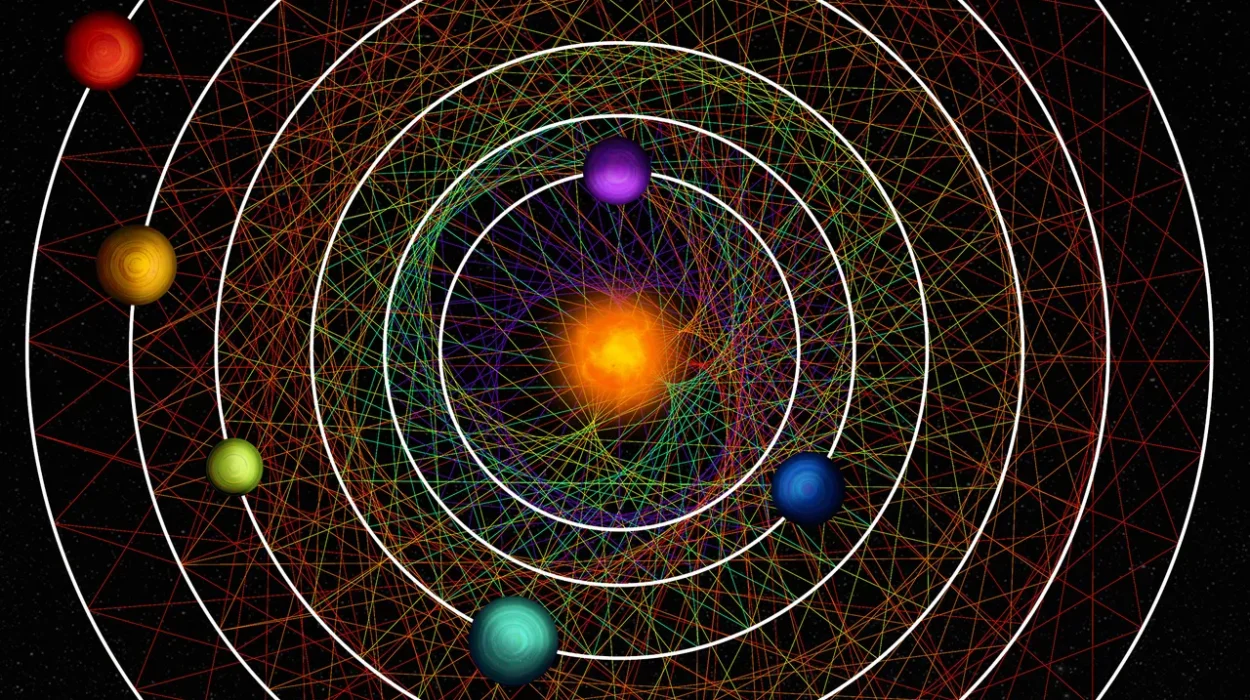
This structure is called a protoplanetary disk, and astronomers observe similar disks around many young stars throughout our galaxy today.
These observations provide strong evidence that our Solar System formed through the same process.
The Birth of the Sun
As gravity continued drawing material inward, pressure and temperature at the center increased enormously.
Eventually, the central region became so hot and dense that it formed a protostar, the earliest stage of a star’s life.
The protostar continued gathering gas from the surrounding disk.
Deep inside its core, temperatures eventually exceeded about 10 million degrees Celsius. At these extreme temperatures, hydrogen nuclei began fusing together to form helium.
This process, known as nuclear fusion, released tremendous amounts of energy.
At that moment, the Sun was truly born.
The outward pressure generated by fusion balanced gravity pulling inward, allowing the young Sun to shine steadily.
This marked the beginning of our Solar System as we know it.
The Protoplanetary Disk
Although the Sun contained most of the collapsing cloud’s mass, a significant amount of gas and dust remained in the rotating disk around it.
This disk was anything but empty.
Tiny dust grains continuously collided with one another.
Some collisions caused particles to bounce apart.
Others caused them to stick together because of electrostatic forces, much like tiny dust particles clinging to a surface.
Over time, microscopic grains became larger clumps.
These clumps collided repeatedly, gradually growing into pebbles, rocks, and eventually objects several kilometers across.
These early building blocks are known as planetesimals.
Tiny Rocks Became Worlds
Once planetesimals formed, gravity became increasingly important.
Larger objects attracted smaller ones.
Frequent collisions caused rapid growth.
Some impacts shattered objects apart, while many others merged them into increasingly massive bodies.
Over millions of years, the largest planetesimals became protoplanets, the early versions of today’s planets.
This stage of growth was surprisingly chaotic.
Young worlds frequently collided with one another.
Some merged to become larger planets.
Others were broken apart.
Many objects were thrown completely out of the Solar System by gravitational interactions.
The peaceful arrangement we see today emerged only after hundreds of millions of years of violent evolution.
Why the Inner and Outer Planets Are So Different
One of the most noticeable features of our Solar System is that the inner planets are small and rocky, while the outer planets are giant worlds made mostly of gas and ice.
The reason lies largely in temperature.
Close to the newborn Sun, temperatures were extremely high.
Only materials with high melting points, such as metals and rocky minerals, could remain solid.
Water, methane, ammonia, and other volatile substances existed mainly as gases.
As a result, Mercury, Venus, Earth, and Mars formed primarily from rock and metal.
Farther from the Sun, temperatures were much colder.
Water froze into ice.
Methane and ammonia also condensed into solid form.
These icy materials greatly increased the amount of solid building material available.
As a result, planetary cores beyond the so-called snow line grew much larger than those closer to the Sun.
Once these cores became sufficiently massive, they began attracting enormous amounts of hydrogen and helium gas directly from the surrounding disk.
This process created the giant planets Jupiter and Saturn.
Farther out, Uranus and Neptune formed with large amounts of ice mixed with gas, making them ice giants rather than true gas giants.
Jupiter Changed Everything
Jupiter formed very early in Solar System history.
Its enormous gravity strongly influenced the evolution of the remaining planets.
As Jupiter grew, it disturbed nearby planetesimals.
Some were pulled into Jupiter.
Others were thrown inward toward the rocky planets.
Still others were ejected entirely from the Solar System.
Jupiter likely prevented another planet from forming between Mars and itself.
Instead, that region became today’s asteroid belt.
Modern computer simulations suggest that Jupiter may even have migrated inward and then outward during its early history, reshaping the architecture of the young Solar System.
Although researchers continue studying the details of this migration, Jupiter clearly played a central role in determining the final arrangement of the planets.
The Formation of Earth
Earth did not appear overnight.
It grew through countless collisions among rocky planetesimals over tens of millions of years.
Each impact released enormous energy.
The young Earth became extremely hot, with much of its surface covered by molten rock.
Because Earth was partially molten, heavier elements such as iron and nickel sank toward the center under gravity.
Lighter rocks floated upward.
This process, called planetary differentiation, created Earth’s layered structure consisting of a metallic core, rocky mantle, and crust.
This internal structure continues influencing earthquakes, volcanoes, and Earth’s magnetic field today.
How the Moon Formed
One of the most dramatic events in Earth’s early history occurred shortly after the planet formed.
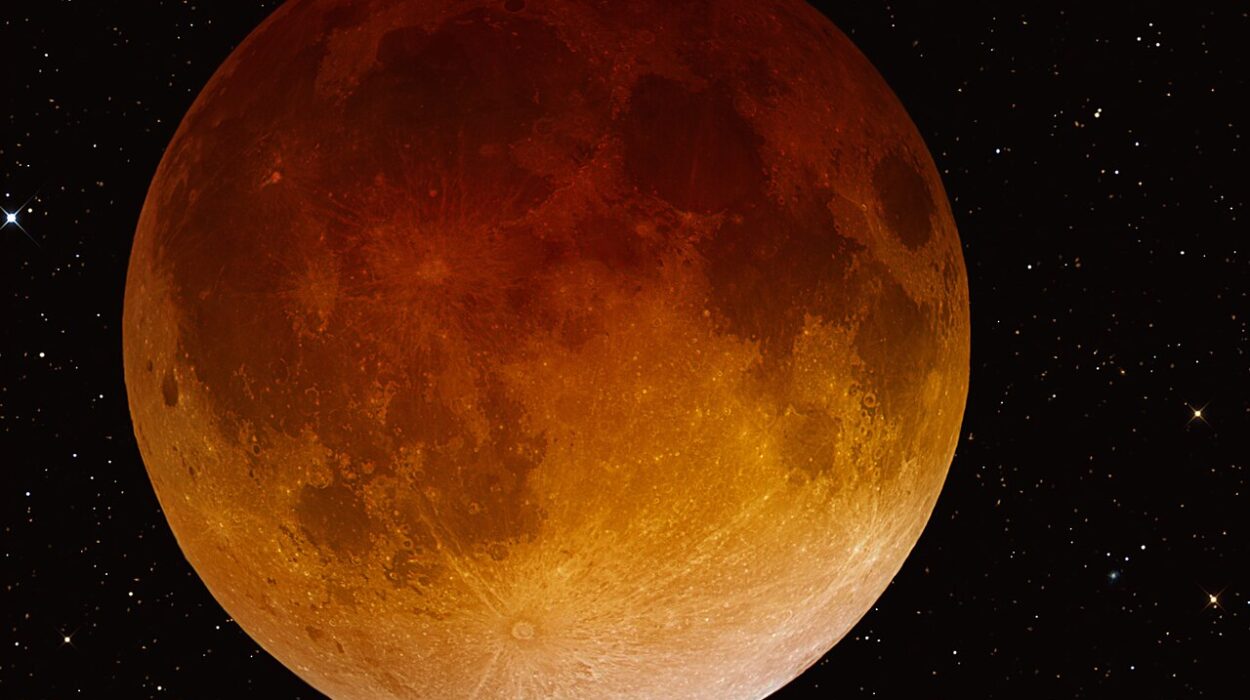
According to the leading scientific explanation, a Mars-sized protoplanet often called Theia collided with the young Earth.
The impact was unimaginably powerful.
Large amounts of rock were blasted into orbit around Earth.
Over time, this debris gradually came together through gravity to form the Moon.
Evidence supporting this idea includes the Moon’s composition, computer simulations of giant impacts, and samples returned by the Apollo missions.
The Moon has profoundly influenced Earth’s history by stabilizing our planet’s rotation and producing ocean tides.
The Young Sun Was More Active
The newborn Sun differed from today’s relatively stable star.
Young stars typically rotate faster and produce stronger solar winds, more frequent flares, and greater magnetic activity.
Powerful streams of charged particles flowed outward from the Sun.
These solar winds gradually swept away the remaining gas and dust from the protoplanetary disk.
Once this gas disappeared, the giant planets could no longer grow significantly.
The Solar System entered a new phase in which the planets largely followed stable orbits around the Sun.
The Leftovers of Planet Formation
Not every piece of material became part of a planet.
Many leftovers still remain.
The asteroid belt contains rocky objects that never combined into a full-sized planet.
Beyond Neptune lies the Kuiper Belt, home to countless icy bodies, including Pluto and many dwarf planets.
Even farther away is the Oort Cloud, a vast spherical reservoir of icy objects thought to surround the Solar System at enormous distances.
Occasionally, gravitational disturbances send some of these icy bodies inward, where they become comets visible from Earth.
These objects are valuable scientific time capsules because many have changed very little since the Solar System formed.
Meteorites Preserve Ancient History
Some of the oldest surviving materials from the birth of the Solar System are found inside meteorites.
Certain meteorites contain tiny mineral grains known as calcium-aluminum-rich inclusions, or CAIs.
These formed approximately 4.567 billion years ago and represent the oldest known solid materials in the Solar System.
Scientists use radioactive dating techniques to determine their ages with remarkable precision.
Meteorites preserve a chemical record of conditions during the earliest stages of planetary formation.
Studying them allows researchers to investigate events that occurred long before Earth developed oceans or life.
Evidence from Other Planetary Systems
For many years, scientists could only study one planetary system—our own.
Today, astronomers have discovered thousands of planets orbiting other stars.
Many young stars are surrounded by protoplanetary disks remarkably similar to the one that once surrounded the Sun.
Powerful telescopes, including the Atacama Large Millimeter/submillimeter Array (ALMA) and the James Webb Space Telescope, have captured detailed images of these disks.
Some even show gaps where newly forming planets appear to be clearing paths through the surrounding material.
These observations strongly support the modern theory of Solar System formation.
Rather than being unique, our Solar System appears to be one example of a common process occurring throughout the Milky Way.
The Late Heavy Bombardment
After the planets formed, the Solar System remained a dangerous place.
Large numbers of asteroids and comets continued striking planets and moons.
Evidence preserved on the Moon suggests that many of these impacts occurred during a period often called the Late Heavy Bombardment, roughly four billion years ago, although scientists continue to debate its timing and intensity.
These collisions reshaped planetary surfaces, created enormous impact basins, and may have delivered additional water and organic molecules to Earth.
Over time, the number of impacts gradually decreased as most remaining debris was either incorporated into planets or ejected from the Solar System.
How Water Reached Earth
One of the most important questions in planetary science concerns the origin of Earth’s water.
Some water was likely incorporated into Earth’s building materials during its formation.
Additional water may have arrived later through impacts from water-rich asteroids. Comets may also have contributed, though current evidence suggests that asteroids probably supplied a larger share of Earth’s water than comets.
This water eventually formed oceans, rivers, lakes, glaciers, clouds, and rain.
Without liquid water, life as we know it would almost certainly not have evolved.
The Solar System Today
More than 4.5 billion years after its formation, the Solar System has become a remarkably stable place.
The Sun continues producing energy through nuclear fusion.
The planets travel in predictable orbits.
Moons circle their parent planets.
Asteroids and comets continue their long journeys around the Sun.
Although dramatic events still occur—such as asteroid impacts, volcanic eruptions on distant moons, and solar storms—the overall structure established during the Solar System’s earliest history has remained remarkably consistent for billions of years.
The Future of the Solar System
The Solar System will not remain unchanged forever.
The Sun will continue converting hydrogen into helium for about another five billion years.
Eventually, it will expand into a red giant star.
Its outer layers will likely engulf Mercury and Venus and may reach Earth’s orbit.
Later, the Sun will shed its outer atmosphere, leaving behind a dense white dwarf.
The planets that survive will continue orbiting this stellar remnant for billions of years.
By understanding how the Solar System formed, scientists can also better predict its distant future.
Conclusion
The story of how the Solar System formed is a story of gravity, time, and transformation. From a cold cloud of gas and dust drifting through the Milky Way emerged a brilliant star, eight planets, hundreds of moons, countless asteroids, icy comets, and eventually a small blue world capable of supporting life.
Every rock beneath our feet, every drop of water in Earth’s oceans, every atom in our bodies traces its origins to this extraordinary process that began 4.6 billion years ago. Modern astronomy continues to refine our understanding of that ancient history, revealing that the same forces shaping young planetary systems across the galaxy once shaped our own.
The Solar System is not merely a collection of worlds orbiting the Sun. It is the enduring legacy of cosmic evolution—a remarkable reminder that from a simple cloud of gas and dust, nature can create planets, oceans, living organisms, and minds capable of looking back across billions of years to uncover their own origins.