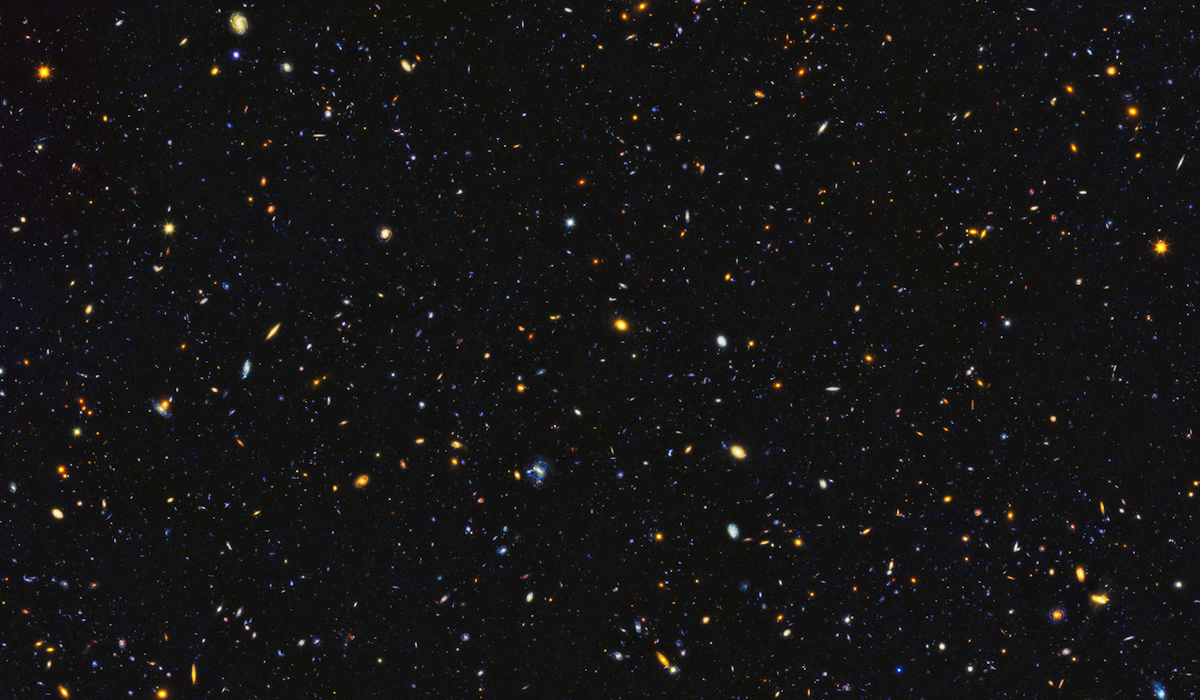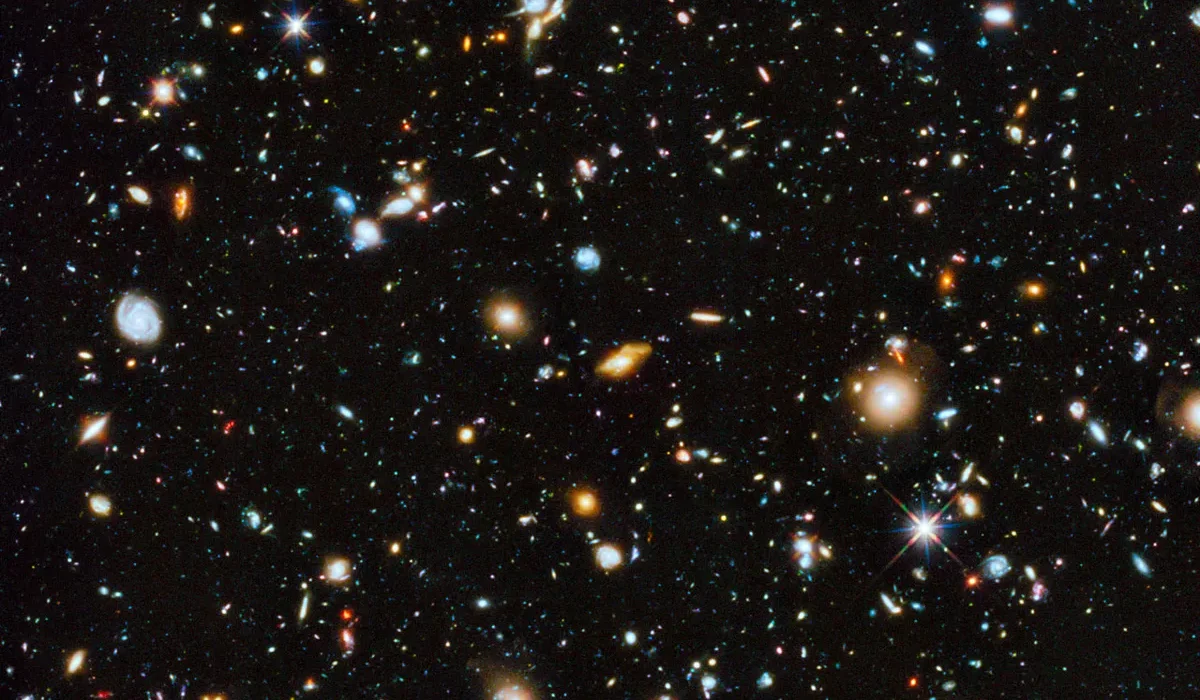
Look up at the night sky on a clear evening, and it is easy to feel both amazed and humbled. Thousands of stars sparkle overhead, while faint clouds of the Milky Way stretch across the darkness. Beyond what our eyes can see lie trillions of galaxies, each containing billions of stars. The universe is so vast that even light—the fastest thing known in nature—takes billions of years to cross only a portion of it.
This breathtaking scale naturally leads to one of humanity’s oldest and most profound questions: What is the shape of the universe?
At first glance, the answer may seem simple. We are familiar with the shapes of everyday objects. Earth is nearly spherical. A football is oval. A sheet of paper is flat. But when it comes to the universe itself, the question becomes far more complex. The universe is not an object floating inside a larger space. Instead, it includes all of space, all of time, all matter, and all energy. Asking about its shape means asking about the geometry of space itself.
For centuries, philosophers, astronomers, mathematicians, and physicists have tried to answer this question. Today, thanks to powerful telescopes, satellites, and the theory of relativity, scientists have a much clearer picture than ever before. Yet the universe still holds mysteries that continue to challenge our understanding.
What Does “Shape of the Universe” Mean?
When scientists talk about the shape of the universe, they are usually referring to the large-scale geometry of space rather than the arrangement of galaxies or stars.
Imagine standing on Earth’s surface. To someone looking nearby, the ground appears flat. However, if you travel far enough in any direction, you eventually realize that Earth curves into a sphere.
Similarly, the universe may appear flat or straight over relatively small distances while having a different geometry across unimaginable cosmic scales.
The shape of the universe describes how space behaves when viewed over billions of light-years. It determines how light travels, how galaxies move, and even the ultimate fate of the cosmos.
The Universe Is Not Expanding Into Empty Space
One of the most common misconceptions is that the universe is expanding into some enormous empty space.
Modern cosmology tells us that this is not the case.
The universe is not expanding into anything. Instead, space itself is expanding.
An analogy often used is raisins inside rising bread dough. As the dough expands, every raisin moves farther away from every other raisin. The raisins are not moving through the dough under their own power. Rather, the dough itself is stretching.
Likewise, galaxies are generally moving farther apart because the fabric of space between them is expanding.
This distinction is essential because the universe does not need an “outside” into which it grows. According to current scientific understanding, space itself is what expands.
Einstein Changed the Way We Think About Space
Before the twentieth century, many scientists thought of space as a fixed, unchanging stage where the events of the universe took place.
Everything changed when Albert Einstein introduced the theory of general relativity in 1915.
Einstein showed that space and time are woven together into a four-dimensional structure called spacetime. Massive objects such as stars, planets, and galaxies bend this spacetime, creating what we experience as gravity.
General relativity also revealed that space itself can have curvature.
Just as Earth’s surface curves without needing an edge, space may also curve in ways that are difficult to imagine because we experience only three spatial dimensions in everyday life.
This revolutionary idea made it possible for scientists to investigate the geometry of the entire universe.
Three Possible Shapes of the Universe
According to modern cosmology, there are three main possibilities for the overall geometry of the universe.
One possibility is that space is positively curved, another is that it is flat, and the third is that it is negatively curved.
Each possibility describes how space behaves on the largest scales.
A Positively Curved Universe
A positively curved universe is similar to the two-dimensional surface of a sphere, although the real universe would curve in three spatial dimensions rather than two.
On a sphere, two straight paths that begin parallel eventually meet. Triangles drawn on a sphere have angles that add up to more than 180 degrees.
If the universe had positive curvature, it might be finite in volume while having no edge.
This idea may sound strange, but Earth provides an excellent example.
The surface of Earth is finite because it has a limited area. Yet you can travel continuously without ever reaching an edge. Eventually, you return to your starting point.
Similarly, a positively curved universe could allow someone traveling in a perfectly straight line to eventually arrive back where they started, assuming the universe remained unchanged long enough.
Such a universe would resemble a three-dimensional analogue of a sphere.
A Flat Universe
Current observations strongly suggest that the universe is extremely close to being flat.
In a flat universe, Euclidean geometry—the geometry taught in schools—works on cosmic scales.
Parallel lines remain parallel.
The angles inside a triangle add up to exactly 180 degrees.
Light travels in straight lines unless affected by gravity.
Although the universe appears flat, this does not necessarily mean it is infinite.
A flat universe could extend forever, or it could have a more complex overall structure that wraps around itself in ways that are difficult to visualize.
Scientists continue to investigate this possibility.
A Negatively Curved Universe
A negatively curved universe has a geometry similar to a saddle.
Unlike a sphere, where lines tend to come together, straight paths in negatively curved space gradually move farther apart.
Triangles have angles totaling less than 180 degrees.
Such a universe would likely continue expanding forever, with distances between galaxies growing increasingly large over time.
Although mathematically possible, current observations indicate that if the universe has negative curvature, it is extremely slight.
How Do Scientists Measure the Shape of the Universe?
Determining the shape of something as enormous as the universe is one of science’s greatest challenges.
Researchers cannot simply travel outside the universe and photograph it.
Instead, they rely on careful observations and sophisticated mathematics.
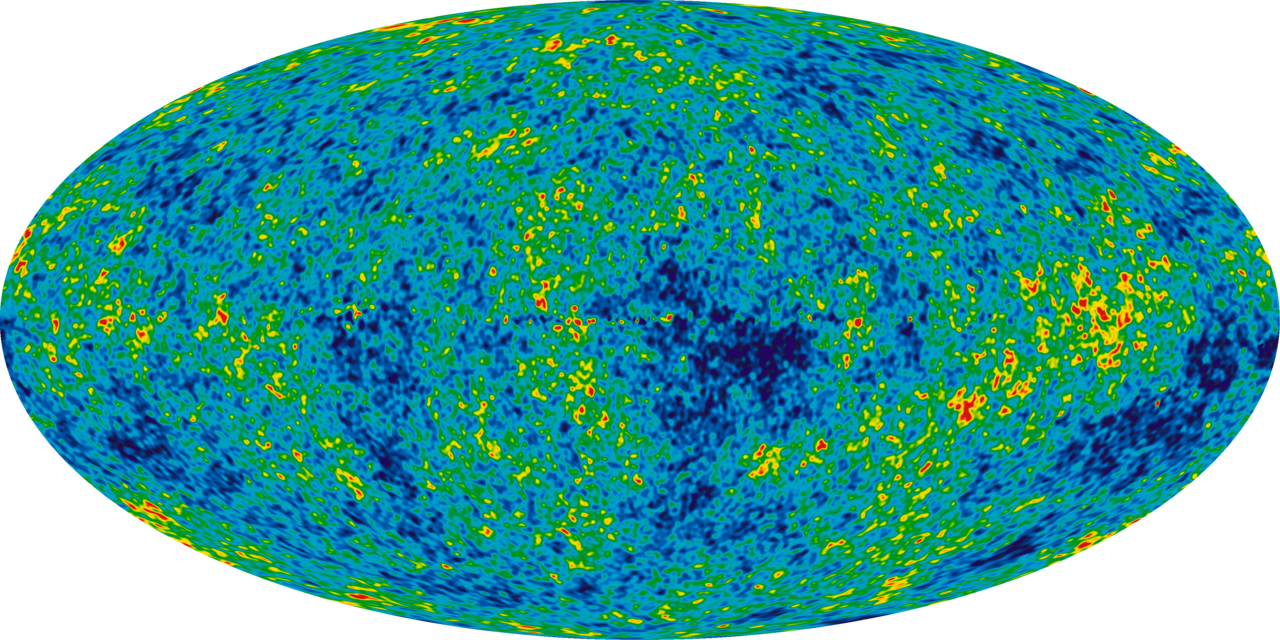
One of the most important tools is the cosmic microwave background, often called the oldest light in the universe.
This faint radiation fills all of space and originated approximately 380,000 years after the Big Bang, when the universe became cool enough for light to travel freely.
The cosmic microwave background acts like a snapshot of the early universe.
Tiny temperature variations within this ancient light provide valuable information about the geometry of space.
Space telescopes have measured these fluctuations with extraordinary precision.
By comparing observations with theoretical predictions, scientists can determine whether space is positively curved, flat, or negatively curved.
What Is the Cosmic Microwave Background?
About 13.8 billion years ago, the universe was incredibly hot and dense.
Light could not travel freely because it constantly scattered from charged particles.
As the universe expanded and cooled, electrons combined with atomic nuclei to form neutral atoms.
At that moment, light was finally able to move through space.
Today, after billions of years of cosmic expansion, this ancient light has cooled dramatically and appears as microwave radiation.
The cosmic microwave background is remarkably uniform across the sky, but tiny fluctuations reveal the seeds from which galaxies eventually formed.
These minute variations also contain clues about the universe’s shape.
What Have Space Missions Discovered?
Several space missions have revolutionized our understanding of cosmic geometry.
NASA’s Wilkinson Microwave Anisotropy Probe (WMAP) and the European Space Agency’s Planck satellite mapped the cosmic microwave background with exceptional accuracy.
Their observations indicate that the universe is extraordinarily close to flat.
This does not prove perfect flatness.
Instead, it means that any curvature is so slight that it is currently beyond the precision of most measurements.
In other words, if the universe is curved, the curvature is extremely small compared with the observable universe.
The Observable Universe Is Not the Entire Universe
One important idea is that we can observe only part of the universe.
Light travels at a finite speed.
Because the universe has existed for about 13.8 billion years, there is a limit to how far light has had time to reach us.
This creates what astronomers call the observable universe.
Its diameter is approximately 93 billion light-years due to the ongoing expansion of space.
Beyond this cosmic horizon may lie regions forever beyond our view.
The entire universe could be vastly larger than the observable universe.
It might even be infinite.
At present, scientists simply do not know.
Could the Universe Be Infinite?
Infinity is one of the most fascinating concepts in mathematics and physics.
If the universe is truly flat and extends without end, then it may be infinite.
An infinite universe would contain an unlimited amount of space.
Galaxies could continue forever beyond our observable horizon.
However, being unable to detect an edge does not prove infinity.
The observable universe is only a small portion of whatever may exist beyond.
Current evidence cannot distinguish with certainty between an extremely large finite universe and an infinite one.
Both possibilities remain scientifically plausible.
Could the Universe Have No Edge?
Many people imagine the universe ending with a giant wall or empty boundary.
Modern physics does not support this picture.
A finite universe can exist without edges.
Again, Earth’s surface offers a useful analogy.
Someone walking around Earth never encounters a cliff marking the end of the planet’s surface.
Instead, they eventually return to where they began.
Likewise, the universe could have no boundaries while still possessing a finite size.
Although visualizing this in three dimensions is challenging, mathematics allows such geometries.
Is the Universe a Sphere?
The universe itself is not believed to be an enormous ball floating in space.
Instead, the term “spherical universe” refers to the geometry of space rather than its appearance from the outside.
A positively curved universe behaves somewhat like the surface of a sphere, but this does not imply that the universe has an exterior or sits inside another larger space.
The geometry exists within space itself.
This distinction is one of the most difficult concepts in cosmology.
Does the Expansion Affect the Shape?
The expansion of the universe and its shape are related but not identical.
A flat universe can expand.
A positively curved universe can expand.
A negatively curved universe can also expand.
The geometry describes how space is structured, while expansion describes how distances between galaxies change over time.
Since the discovery of cosmic expansion by Edwin Hubble in the 1920s, astronomers have learned that the expansion is not slowing as once expected.
Instead, it is accelerating.
The cause of this acceleration remains one of the greatest mysteries in physics and is commonly attributed to a phenomenon known as dark energy.
The Role of Dark Matter and Dark Energy
The visible matter that makes up stars, planets, and galaxies accounts for only a small fraction of the universe.
Most of the cosmos consists of dark matter and dark energy.
Dark matter produces gravity but does not emit, absorb, or reflect light.
Dark energy appears to drive the accelerating expansion of the universe.
Together, these mysterious components strongly influence the universe’s evolution and may also affect its long-term geometry.
Understanding them remains one of the highest priorities in modern cosmology.
Can We Ever Know the Exact Shape?
Although observations continue improving, there may always be limits to what humanity can know.
The observable universe is finite because light travels at a finite speed.
If regions beyond our cosmic horizon differ from what we observe, we may never detect them.
Future telescopes, improved measurements of the cosmic microwave background, gravitational wave observations, and new theoretical breakthroughs may reveal more about cosmic geometry.
For now, the evidence consistently points toward a universe that is remarkably close to flat.
Why the Shape of the Universe Matters
The shape of the universe is far more than an abstract mathematical curiosity.
It influences how galaxies form, how light travels across billions of light-years, how gravity operates on cosmic scales, and how the universe may evolve in the distant future.
Understanding cosmic geometry also helps scientists test theories about the Big Bang, cosmic inflation, dark matter, dark energy, and the fundamental laws of physics.
Every improvement in our knowledge brings us closer to answering some of humanity’s oldest questions about our place in the cosmos.
Conclusion
The shape of the universe is one of the deepest mysteries in modern science. Thanks to Einstein’s theory of general relativity, observations of distant galaxies, and detailed measurements of the cosmic microwave background, scientists have discovered that the universe is extraordinarily close to flat on the largest observable scales. Whether it is truly infinite, gently curved, or part of a more complex cosmic structure remains an open question.
What is clear is that the universe is far more remarkable than early civilizations could have imagined. It has no known center, no confirmed edge, and may extend far beyond everything we can observe. As new telescopes probe deeper into space and new theories reshape our understanding, the quest to uncover the universe’s true shape continues—a journey that reflects humanity’s endless curiosity about the cosmos and our place within it.