Have you ever looked up at the night sky and wondered where it all ends? The stars seem endless, the darkness stretches forever, and distant galaxies sparkle like tiny islands floating in an infinite ocean. It is natural to ask one of humanity’s oldest and most fascinating questions: Does the universe have an edge?
The idea of reaching the “end” of the universe is easy to imagine. After all, everything we know seems to have boundaries. Oceans have shorelines. Forests eventually give way to fields. Even Earth has a surface and an atmosphere. So it seems reasonable to expect that the universe should also have a border—a place where everything suddenly stops.
Yet modern physics paints a very different picture. The universe is far stranger, far larger, and far more mysterious than our everyday experiences prepare us to imagine. Surprisingly, scientists have found no evidence that the universe has a physical edge. Instead, the answer depends on what we mean by the word “universe.”
What Do We Mean by the Universe?
The universe includes everything that exists.
It contains every galaxy, every star, every planet, every black hole, every cloud of gas and dust, every atom, every photon of light, and every form of energy. Space itself is part of the universe, as is time. There is nothing outside the universe in the ordinary sense because the universe includes all of space and all of time.
This idea can be difficult to grasp because our brains are accustomed to thinking about objects existing inside something else. A house stands on land. Earth moves through space. But the universe is not known to exist inside a larger physical space. According to our current understanding, space itself is part of the universe.
That changes the question entirely. Instead of asking where the universe ends, scientists ask whether space itself has a boundary.
The Observable Universe
When people talk about the size of the universe, they are often referring to the observable universe.
The observable universe is the part of the cosmos whose light has had enough time to reach Earth since the universe began about 13.8 billion years ago.
Because light travels at a finite speed—about 299,792 kilometers (186,282 miles) per second—we cannot instantly see objects that are extremely far away. Looking into space is also looking back in time.
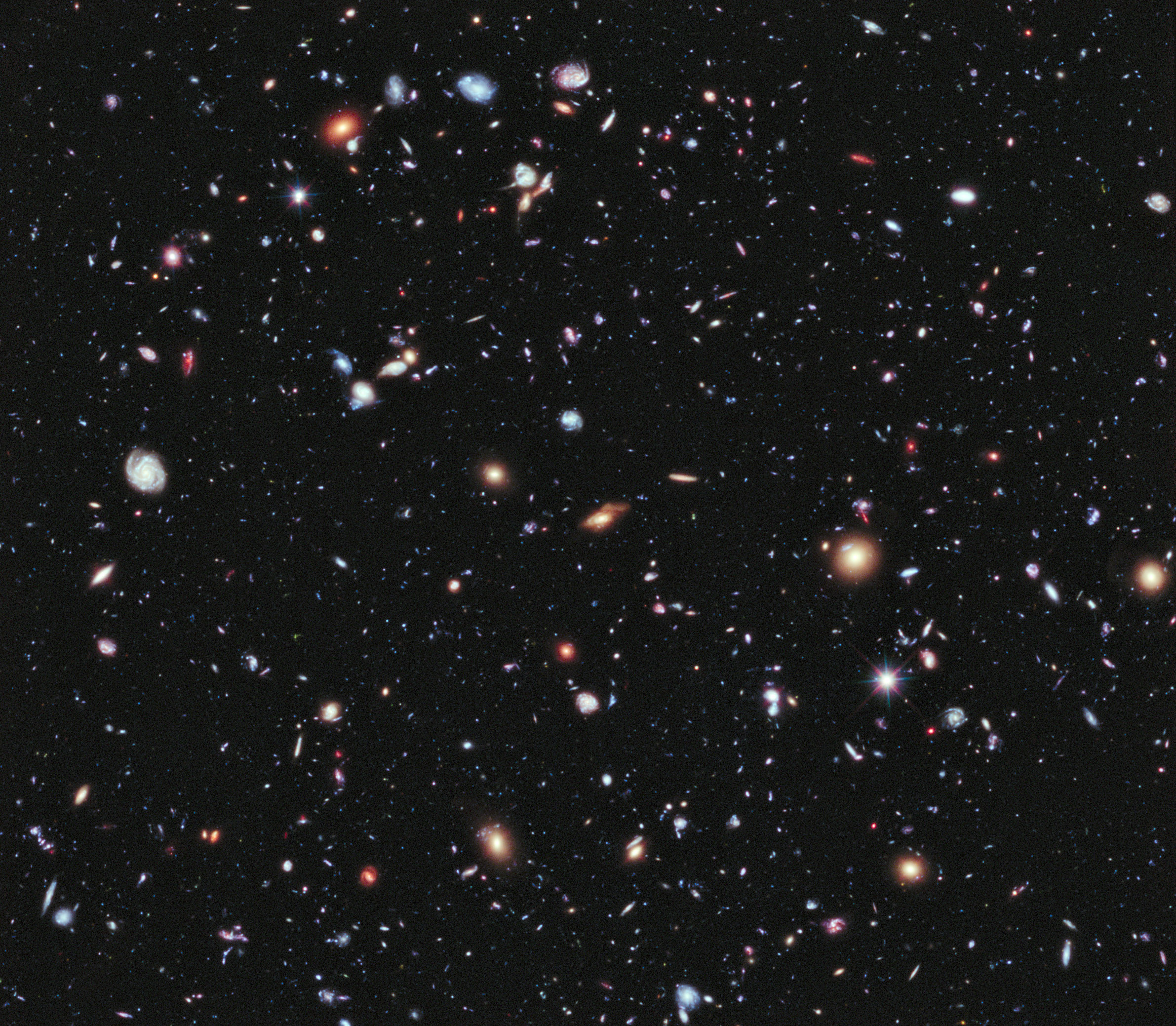
When astronomers observe a galaxy one billion light-years away, they see it as it existed one billion years ago.
When they observe galaxies more than ten billion light-years away, they are seeing them during the early history of the universe.
There is a limit to how far we can see because the universe has existed for a finite amount of time. That limit creates a kind of “cosmic horizon.”
This horizon is not a wall. It is simply the greatest distance from which light has been able to reach us.
Why the Observable Universe Is So Much Larger Than 13.8 Billion Light-Years
At first glance, you might think the observable universe should have a radius of 13.8 billion light-years because the universe is about 13.8 billion years old.
The reality is much more surprising.
While light has been traveling toward us for billions of years, space itself has been expanding the entire time. As a result, the galaxies that emitted that ancient light are now much farther away than they were when the light began its journey.
Today, the observable universe has a radius of approximately 46.5 billion light-years, making its diameter about 93 billion light-years.
This enormous size is one of the remarkable consequences of cosmic expansion.
Is the Observable Universe the Entire Universe?
Probably not.
Most cosmologists believe the observable universe is only a small part of the entire universe.
Imagine standing in the middle of a vast desert. You can only see as far as the horizon, but you know the desert continues beyond what your eyes can reach.
The observable universe is similar. Our cosmic horizon limits what we can observe, not necessarily what exists.
Beyond that horizon, there may be countless additional galaxies, stars, and cosmic structures that remain forever invisible to us simply because their light has not had enough time to arrive.
Does the Universe Have a Physical Edge?
According to current scientific evidence, there is no known physical edge where the universe suddenly ends.
If you could somehow travel across space indefinitely, you would not necessarily encounter a giant wall, cliff, or boundary marking the end of existence.
Instead, space would simply continue.
Scientists have found no observations suggesting that the universe has a border where the laws of physics stop working or where space suddenly disappears.
This idea can seem strange because almost everything we encounter in everyday life has boundaries.
The universe may be different.
The Universe May Be Infinite
One possibility is that the universe is truly infinite.
An infinite universe would have no edge because it would extend forever in every direction.
If this is true, no matter how far someone traveled, there would always be more space ahead.
An infinite universe also means there would be no center.
Every observer, no matter where they are located, would see themselves surrounded by space extending in every direction.
Although many cosmological models allow for an infinite universe, scientists cannot yet prove that the universe is actually infinite because we can observe only a limited portion of it.
A Finite Universe Without an Edge
Another fascinating possibility is that the universe is finite but has no boundary.
This sounds impossible at first, but there is a simple analogy.
Imagine living on the two-dimensional surface of Earth.
If you travel in one direction long enough, you eventually return to your starting point.
The Earth’s surface has a finite area, yet it has no edge where someone could fall off.
Similarly, our three-dimensional universe might be curved in a way that allows it to be finite without having any physical boundary.
In such a universe, traveling continuously in one direction could, in principle, eventually bring you back to where you started, although the actual geometry of our universe remains uncertain.
The Shape of the Universe
One of the biggest questions in cosmology concerns the shape of space itself.
Measurements of the cosmic microwave background—the faint glow left over from the Big Bang—suggest that the observable universe is extremely close to being geometrically flat.
A flat universe can still be infinite, but it might also be finite depending on its overall topology, which is the way space is connected on the largest scales.
Current observations have not yet determined the universe’s complete shape.
Scientists continue searching for subtle clues that might reveal its true geometry.
What Happens Beyond the Observable Universe?
No one knows for certain.
Everything beyond the observable universe lies outside our current ability to observe directly.
However, according to the cosmological principle—which states that the universe is generally similar in all directions and locations—scientists expect that regions beyond our cosmic horizon probably contain galaxies, stars, planets, and the same physical laws found within the observable universe.
There is no scientific evidence suggesting that entirely different laws of physics suddenly begin beyond the observable horizon.
Instead, the unseen universe is thought to resemble the part we can observe, at least on large scales.
Why Can’t We See Beyond the Cosmic Horizon?
The main reason is the finite speed of light.
The universe has existed for about 13.8 billion years.
If light from an object has not yet had enough time to reach Earth, that object remains invisible to us.
Cosmic expansion makes this situation even more dramatic.
Some distant galaxies are moving away from us because space itself is expanding. In certain cases, the expansion is so rapid that light emitted today from those galaxies may never reach Earth.
This does not violate Einstein’s theory of relativity because the galaxies are not traveling through space faster than light. Instead, the space between us is stretching.
Is There Anything Outside the Universe?
This question is surprisingly difficult.
According to modern cosmology, asking what is “outside” the universe may not have a meaningful answer.
The universe includes all of space.
If space itself is part of the universe, then there may be no external location where the universe sits.
An analogy often used is asking, “What is north of the North Pole?”
The question assumes the existence of something beyond a point where the concept itself no longer applies.
Similarly, “outside the universe” may not correspond to any physical place.
However, some speculative theories, such as certain models of eternal inflation or the multiverse, propose that our universe could be one of many universes.
These ideas remain hypothetical and currently lack direct observational evidence.
The Expanding Universe
One of the greatest discoveries in modern astronomy is that the universe is expanding.
Nearly every distant galaxy is moving away from us because space itself is stretching.
This expansion was first recognized in the 1920s through observations showing that distant galaxies exhibit redshift, meaning the wavelengths of their light become longer as space expands.
Importantly, galaxies are generally not flying away from a central point through empty space.
Instead, the space between galaxies is growing.
An often-used analogy is raisins inside rising bread dough.
As the dough expands, every raisin moves farther away from every other raisin, not because the raisins are moving through the dough, but because the dough itself is expanding.
Similarly, every distant galaxy observes other distant galaxies moving away.
This does not mean Earth occupies a special central position.
Could We Ever Reach the Edge?
If the universe truly has no edge, then there is no destination to reach.
Even if the universe is finite, reaching every part of it would likely be impossible.
The universe is expanding, and many distant regions are receding from us because of cosmic expansion.
Furthermore, the enormous distances involved far exceed what current or foreseeable technology could overcome.
Even traveling at the speed of light—which objects with mass cannot achieve—would not allow us to explore the entire observable universe within a human lifetime.
The universe is simply too vast.
The Cosmic Microwave Background: Seeing the Earliest Light
The oldest light astronomers can observe is the cosmic microwave background, often called the afterglow of the Big Bang.
This faint microwave radiation was released approximately 380,000 years after the Big Bang, when the universe cooled enough for light to travel freely through space.
Looking at the cosmic microwave background allows scientists to study one of the earliest observable stages of cosmic history.
Beyond this point, the universe was filled with hot, dense plasma that prevented light from traveling freely.
To investigate even earlier times, scientists rely on theoretical physics and indirect evidence rather than direct observation.
Why the Idea of an Edge Is So Difficult to Imagine
Our everyday experiences shape the way we think.
Every room has walls.
Every road ends somewhere.
Every object occupies a limited space.
The universe challenges these intuitions.
Space itself may continue forever.
It may curve back on itself.
It may be vastly larger than anything we can ever observe.
Our brains evolved to understand landscapes measured in kilometers, not cosmic distances measured in billions of light-years.
That is why cosmology often feels both beautiful and deeply mysterious.
What Scientists Are Still Trying to Discover
Despite remarkable advances, many questions remain unanswered.
Scientists continue studying whether the universe is truly infinite or merely extraordinarily large.
They hope to determine its overall shape with greater precision.
They seek to understand dark matter and dark energy, which together make up about 95 percent of the universe’s total energy and matter content yet remain poorly understood.
Researchers also continue exploring whether our universe is unique or part of a larger multiverse.
Future telescopes, improved observations, and new theories may reveal answers that today remain beyond our reach.
Conclusion
The universe, as far as modern science can tell, does not appear to have a physical edge like the border of a map or the wall of a room. The only boundary we currently know is the edge of the observable universe—the limit of how far light has been able to travel to us since the universe began. Beyond that horizon, the cosmos almost certainly continues, although we cannot yet observe it directly.
Whether the universe is infinite or finite without an edge remains one of the greatest unanswered questions in cosmology. What makes this mystery so captivating is that every new observation expands not only our knowledge but also our sense of wonder. As our telescopes peer deeper into space and further back in time, they remind us that the universe is far larger, stranger, and more extraordinary than anyone once imagined—and that its greatest discoveries may still lie beyond the horizon we can see today.