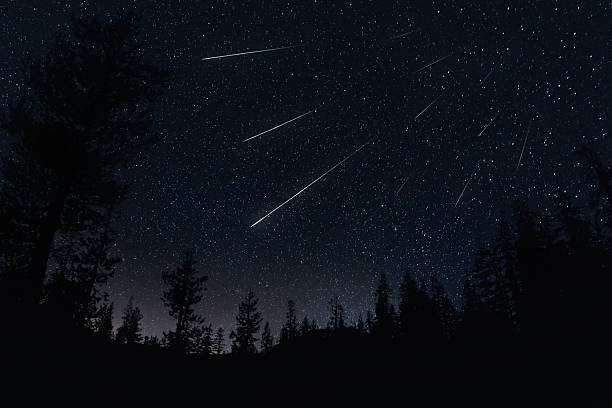
On a clear, dark night, you may suddenly notice a bright streak of light racing across the sky. It appears for only a second or two before vanishing into the darkness, often leaving people amazed by its beauty. Many call it a “shooting star” or a “falling star,” but despite the name, it is not a star at all. What you have witnessed is a meteor—one of nature’s most spectacular and fascinating celestial events.
Meteors have inspired myths, wishes, and legends for thousands of years. Today, science has revealed the true story behind these brilliant flashes of light. They are not magical objects but tiny pieces of rock or metal from space that briefly blaze as they pass through Earth’s atmosphere. Although most meteors disappear before ever reaching the ground, they play an important role in helping scientists understand the history of our Solar System.
Understanding What a Meteor Is
A meteor is the bright streak of light produced when a small piece of space debris enters Earth’s atmosphere at extremely high speed and becomes intensely heated. The glowing trail we see is caused by the object and the surrounding air becoming hot enough to emit light.
It is important to understand that the meteor is not the rock itself. The meteor is the visible flash of light created as the object burns and glows while traveling through the atmosphere.
Most meteors last only a fraction of a second to a few seconds before fading away.
Meteoroid, Meteor, and Meteorite: What’s the Difference?
The words meteoroid, meteor, and meteorite are closely related, but they describe different stages of the same object.
A meteoroid is a small rocky or metallic object traveling through space. These objects range in size from tiny grains of dust to rocks several meters across.
When a meteoroid enters Earth’s atmosphere and produces a glowing streak of light, it becomes a meteor.
If part of the object survives its fiery journey and lands on Earth’s surface, the remaining piece is called a meteorite.
This distinction is important because many people mistakenly use these terms interchangeably.
Where Do Meteors Come From?
Most meteors begin their journey as fragments left behind by asteroids or comets.
Asteroids are rocky bodies that mainly orbit the Sun within the asteroid belt located between Mars and Jupiter. Over millions of years, collisions between asteroids create countless smaller fragments that drift through the Solar System.
Comets, on the other hand, are icy bodies made of frozen gases, dust, and rock. As a comet approaches the Sun, its ice heats up and turns directly into gas, releasing dust and small rocky particles into space. These particles spread along the comet’s orbit, forming long streams of debris.
When Earth passes through one of these debris streams, many particles enter our atmosphere, producing a meteor shower.
How Does a Meteor Form?
The process begins when a meteoroid approaches Earth.
Earth’s gravity pulls the object toward the planet, causing it to enter the atmosphere at tremendous speeds. Most meteors travel between about 11 kilometers per second (25,000 miles per hour) and 72 kilometers per second (161,000 miles per hour), depending on their paths through the Solar System.
As the meteoroid races through the atmosphere, it compresses the air in front of it. This compression heats both the surrounding air and the surface of the meteoroid to extremely high temperatures.
The intense heat causes the object’s outer layers to vaporize and release glowing gas and tiny particles. This process, known as ablation, creates the brilliant streak of light we recognize as a meteor.
Most meteoroids completely vaporize before reaching the ground.
Why Do Meteors Glow?
Many people think meteors glow because they are simply “burning,” much like wood burning in a fire. In reality, the process is more complex.
The tremendous speed of the meteoroid compresses the air in front of it so rapidly that the air becomes extremely hot. The heated gases become ionized, meaning some of their electrons are stripped away. As these particles return to lower energy states, they emit light.
At the same time, the meteoroid’s surface melts and vaporizes, adding glowing material to the trail.
Together, these effects create the brilliant flash visible from Earth.
How Big Are Meteoroids?
One surprising fact about meteors is that most are incredibly small.
Many visible meteors are produced by particles no larger than grains of sand or small pebbles.
Even objects weighing only a few grams can produce bright streaks because they travel so fast.
Larger meteoroids can create much brighter displays and occasionally produce fireballs visible over wide areas.
Very large meteoroids, although much rarer, may survive their descent and become meteorites.
What Is a Fireball?
Not all meteors shine with the same brightness.
An exceptionally bright meteor is called a fireball. Fireballs are significantly brighter than the planet Venus, the brightest natural object in the night sky after the Moon.
Some fireballs become so brilliant that they can be seen during daylight.
Large fireballs sometimes fragment into multiple glowing pieces before disappearing. If any fragments survive and reach the ground, they become meteorites.
What Is a Bolide?
A particularly dramatic type of fireball is called a bolide.
A bolide is a very bright meteor that often explodes while passing through the atmosphere. These explosions can produce loud sonic booms, shock waves, and flashes visible across hundreds of kilometers.
One famous example occurred over Chelyabinsk, Russia, in 2013. A meteoroid about 20 meters wide entered Earth’s atmosphere and exploded high above the ground. The resulting shock wave damaged thousands of buildings and injured many people, mostly from shattered glass.
Fortunately, events of this size are uncommon.
Why Are Meteors So Fast?
Meteors move much faster than any airplane or bullet.
Their high speed comes from two factors.
First, meteoroids already orbit the Sun at high velocities.
Second, Earth’s gravity accelerates them further as they approach the planet.
The combination of these effects causes meteors to streak across the sky in the blink of an eye.
What Is a Meteor Shower?
Sometimes dozens—or even hundreds—of meteors appear within a single hour. This event is known as a meteor shower.
Meteor showers occur when Earth passes through streams of dust and debris left behind by comets or, less commonly, certain asteroids.
Each tiny particle enters the atmosphere independently, producing its own meteor.
Because the particles travel along similar paths, the meteors appear to radiate from a particular point in the sky called the radiant. This is simply a perspective effect, similar to railroad tracks appearing to meet in the distance.
Famous Meteor Showers
Several meteor showers occur every year and can often be predicted with remarkable accuracy.
The Perseids, visible each August, are among the most popular because they produce many bright meteors during warm summer nights in the Northern Hemisphere.
The Geminids, active each December, are known for their bright, colorful meteors and unusually high activity. Unlike most showers, they originate from an asteroid-like object rather than a traditional comet.
The Leonids are famous for occasionally producing spectacular meteor storms, during which thousands of meteors may appear each hour under ideal conditions.
The Quadrantids, Orionids, Eta Aquariids, and Lyrids are other well-known annual meteor showers enjoyed by skywatchers around the world.
What Colors Can Meteors Be?
Although many meteors appear white, they can display beautiful colors.
Different elements inside the meteoroid emit different colors as they become heated.
Sodium may produce yellow-orange light.
Magnesium often creates a bluish-green glow.
Iron commonly contributes yellow or golden colors.
Calcium can produce violet hues.
Atmospheric gases also influence the colors seen in the meteor’s trail.
The exact appearance depends on the meteoroid’s composition, speed, and altitude.
At What Height Do Meteors Appear?
Most meteors become visible at altitudes of roughly 120 kilometers (75 miles) above Earth’s surface.
As they descend, they gradually lose material through ablation.
Most disappear between 70 and 80 kilometers (43 to 50 miles) above the ground.
Only the largest and strongest meteoroids survive to lower altitudes.
Can Meteors Reach the Ground?
Most cannot.
The overwhelming majority of meteoroids are too small and completely vaporize before reaching Earth’s surface.
Only larger, denser objects survive long enough to become meteorites.
Scientists estimate that thousands of meteorites reach Earth each year, but because oceans cover most of the planet and many land in remote regions, only a relatively small number are recovered.
What Are Meteorites Made Of?
Meteorites come in several types.
Some consist mainly of rock and resemble ordinary Earth rocks, although they usually contain minerals that formed under very different conditions.
Others contain large amounts of iron and nickel, making them unusually heavy.
Some meteorites contain both rocky and metallic materials.
A few rare meteorites even originate from the Moon or Mars. These were blasted into space by ancient asteroid impacts before eventually falling to Earth.
Why Are Meteorites Important?
Meteorites are valuable scientific treasures.
Many formed more than 4.5 billion years ago, around the time the Solar System itself was born.
Unlike Earth’s rocks, which have been altered by weather, plate tectonics, and volcanic activity, many meteorites have remained relatively unchanged for billions of years.
By studying meteorites, scientists learn about the formation of planets, the chemistry of the early Solar System, and the processes that shaped our cosmic neighborhood.
Some meteorites even contain tiny grains that formed before the Sun existed, making them older than our Solar System.
Can Meteors Be Dangerous?
Most meteors are completely harmless.
Because they burn up high in the atmosphere, they never reach the ground.
However, larger objects can occasionally pose hazards.
Very large meteoroids may produce powerful airbursts or impact the Earth’s surface.
Fortunately, such events are rare.
Scientists around the world actively monitor larger near-Earth objects to better understand any potential future risks.
How Scientists Observe Meteors
Modern technology allows scientists to study meteors in remarkable detail.
Specialized cameras automatically record meteor trails throughout the night.
Radar systems detect meteors even during daylight or cloudy weather.
Spectrographs analyze the colors emitted by meteors, revealing their chemical composition.
Networks of observation stations can calculate a meteor’s path through the atmosphere and predict where surviving meteorites may have landed.
These observations help scientists understand both individual meteors and the broader population of small objects moving through the Solar System.
Meteors in History and Culture
Long before people understood what meteors were, these mysterious flashes inspired wonder and imagination.
Many cultures believed they were messages from the heavens, signs from the gods, or symbols of important events.
The popular tradition of making a wish upon seeing a shooting star continues in many parts of the world today.
Although science has explained the physical processes behind meteors, their beauty and emotional impact remain just as powerful as ever.
Can You See Meteors Without a Telescope?
Absolutely.
Unlike many astronomical objects, meteors are best observed with the unaided eye.
A telescope shows only a tiny portion of the sky, making it difficult to catch fast-moving meteors.
The best viewing conditions are a dark location away from city lights, clear skies, and patience.
Allowing your eyes about 20 to 30 minutes to adapt to the darkness can greatly improve your chances of seeing faint meteors.
Meteor showers are often most active after midnight, when the side of Earth facing the direction of its orbit encounters more incoming debris.
Meteors and Earth’s Atmosphere
Earth’s atmosphere acts as a natural protective shield.
Without it, countless meteoroids would strike the surface every day.
Instead, atmospheric friction and compression destroy nearly all incoming space debris before it can reach the ground.
This protective role has helped make Earth’s surface a safer environment for life over billions of years.
Conclusion
A meteor is one of the most beautiful reminders that Earth is part of a much larger cosmic environment. What appears as a brief streak of light is actually the dramatic final journey of a tiny piece of space rock traveling millions or even billions of kilometers before meeting Earth’s atmosphere. Though most meteors vanish within seconds, they reveal important clues about the formation of planets, asteroids, comets, and the early history of our Solar System.
Every meteor that flashes across the night sky tells a scientific story—a story of gravity, motion, heat, and the ancient materials from which our planetary neighborhood was formed. The next time you see what people call a “shooting star,” you will know that you are witnessing not a falling star, but a small visitor from space lighting up the atmosphere in one of nature’s most breathtaking displays.