Every morning, millions of people witness one of nature’s most beautiful spectacles. The eastern sky slowly changes from deep blue to shades of orange, pink, and gold. Birds begin to sing, flowers open their petals, and the Sun appears on the horizon, marking the beginning of a new day. It is such a familiar event that we rarely stop to ask one simple question:
Why does the Sun always rise in the east?
At first glance, it seems obvious that the Sun moves across the sky from east to west. After all, that is exactly what our eyes tell us. But appearances can be deceiving. In reality, the Sun is not traveling around Earth every day. Instead, our own planet is spinning, and that rotation creates the illusion of the Sun moving across the sky.
The answer lies in one of the most fundamental motions of our planet—a motion so constant that we hardly notice it, even though it is happening every second of our lives.
The Sun Is Not Really Moving Across the Sky
If you spend an entire day watching the sky, you will see the Sun rise in the east, climb higher during the morning, reach its highest point around midday, and then slowly descend before disappearing below the western horizon.
For thousands of years, people naturally believed that the Sun revolved around Earth. After all, it certainly looks that way.
Modern astronomy has shown that this is an illusion.
The Sun remains nearly in the same position relative to Earth over the course of a single day. Instead, it is Earth that is rotating. Just as a person riding a merry-go-round sees the surroundings appear to move, we experience the sky as moving because we are standing on a rotating planet.
This apparent motion of the Sun is called its daily or apparent motion, and it is caused entirely by Earth’s rotation.
Earth Spins Like a Giant Top
Earth is not standing still in space.
It is constantly spinning around an imaginary line called its axis. This axis passes through the North Pole and the South Pole.
One complete rotation takes about 23 hours, 56 minutes, and 4 seconds relative to distant stars. This period is known as a sidereal day. However, because Earth is also moving around the Sun, it takes about 24 hours for the Sun to return to the same position in our sky, creating what we know as a solar day.
Even though Earth is enormous, it rotates smoothly and steadily.
At the equator, Earth’s surface moves at about 1,670 kilometers (1,040 miles) per hour due to this rotation. Yet we do not feel this incredible speed because everything around us—including the atmosphere—is moving with Earth.
Why East Comes First
The key to understanding sunrise lies in the direction of Earth’s rotation.
Earth rotates from west to east.
Imagine looking down on Earth from above the North Pole. You would see the planet spinning in a counterclockwise direction.
Because Earth turns eastward, any location on its surface gradually rotates toward the Sun. As your location faces the Sun, sunlight begins to reach you, creating sunrise.
Later, as Earth continues rotating, your location turns away from the Sun, leading to sunset.
This is why the Sun appears to rise in the east and set in the west every day.
The Sun itself has not changed position significantly during those hours. Instead, Earth has carried you into and then out of sunlight.
A Simple Way to Imagine It
Imagine sitting in a chair that slowly rotates inside a room with a bright lamp placed in one fixed position.
The lamp never moves.
As your chair turns, you eventually face the lamp, making it appear as though the lamp has “come into view.”
Later, your chair continues rotating until the lamp disappears behind you.
The lamp never traveled around the room.
You moved.
The relationship between Earth and the Sun works in much the same way.
Earth rotates while the Sun remains nearly fixed relative to our daily experience, producing the familiar cycle of sunrise and sunset.
Why Doesn’t the Sun Rise in the West?
This question has a surprisingly simple answer.
The Sun would rise in the west only if Earth rotated in the opposite direction.
If Earth spun from east to west instead of west to east, every familiar pattern in the sky would reverse.
The Sun would rise in the west.
It would travel across the southern or northern sky, depending on your location.
It would then set in the east.
Everything we associate with sunrise and sunset would happen in reverse.
The direction of Earth’s rotation determines the apparent direction of the Sun’s movement.
Why Earth Rotates This Way
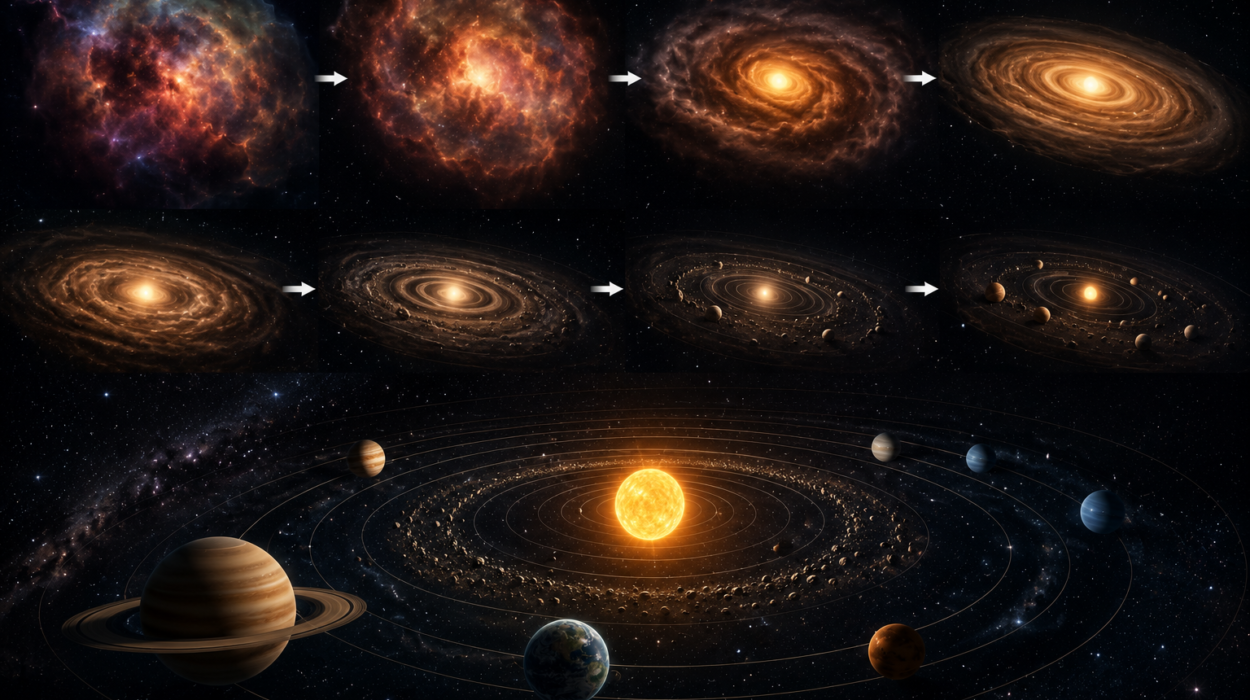
Earth’s rotation dates back more than 4.5 billion years, when the Solar System formed from a vast cloud of gas and dust.
As gravity pulled this material together, the cloud began spinning. This spinning motion, known as angular momentum, was preserved as the cloud collapsed to form the Sun and the planets.
The young Earth inherited this rotation.
Because there is very little in space to slow the planet down, Earth has continued spinning in nearly the same direction ever since.
Although the rotation is gradually slowing over extremely long periods because of tidal interactions with the Moon, the change is tiny—only about 1.7 milliseconds per century on average.
Is the Sun Always Exactly Due East?
Many people imagine the Sun rising at the exact eastern point every morning.
In reality, this happens only on two special days each year.
During the March equinox and the September equinox, the Sun rises almost exactly due east and sets almost exactly due west for observers around most of the world.
On all other days, the sunrise point shifts slightly.
This happens because Earth’s axis is tilted by about 23.5 degrees relative to its orbit around the Sun.
As Earth travels around the Sun, this tilt changes the Sun’s apparent path across the sky.
During summer in the Northern Hemisphere, the Sun rises north of east.
During winter, it rises south of east.
The opposite occurs in the Southern Hemisphere.
Although the exact position changes throughout the year, it always remains generally in the eastern half of the horizon.
Why the Seasons Do Not Affect Earth’s Rotation
Many people wonder whether Earth spins differently in summer and winter.
It does not.
Earth rotates at nearly the same rate throughout the year.
What changes is the angle at which sunlight reaches different parts of the planet.
Because Earth’s axis is tilted, different hemispheres receive varying amounts of sunlight during different times of the year.
This changing angle affects the length of the day, the height of the Sun in the sky, and the position of sunrise and sunset.
The rotation itself remains essentially constant.
What Happens at the Poles?
Near Earth’s poles, sunrise behaves very differently.
At the North Pole and the South Pole, there may be only one sunrise and one sunset each year.
As Earth orbits the Sun, one pole gradually tilts toward the Sun while the other tilts away.
When a pole tilts toward the Sun, daylight can last for several months without interruption.
When it tilts away, darkness can continue for months.
Instead of rising and setting every day, the Sun slowly circles the horizon.
These remarkable phenomena are known as the midnight Sun and the polar night.
They occur because of Earth’s axial tilt, not because its rotation changes.
Why Sunrise Looks Different Every Day
Even though the basic cause of sunrise is always Earth’s rotation, no two sunrises are exactly alike.
Clouds scatter sunlight into brilliant colors.
Dust particles can make the sky appear deep red or orange.
Moisture in the atmosphere creates soft pinks and purples.
Volcanic eruptions can produce unusually vivid sunrises by injecting tiny particles high into the atmosphere.
The colors themselves arise because Earth’s atmosphere scatters shorter blue wavelengths of sunlight more strongly than longer red wavelengths. During sunrise, sunlight travels through a much thicker layer of atmosphere before reaching our eyes, allowing reds and oranges to dominate the sky.
This is why sunrise is not only a daily astronomical event but also one of nature’s greatest displays of color.
Why Sunrise Times Change Throughout the Year
If Earth took exactly 24 hours to rotate relative to the Sun every day and followed a perfectly circular orbit, sunrise would occur at the same clock time every day.
But Earth’s orbit is slightly elliptical, and its axis is tilted.
These factors cause the exact timing of sunrise to shift throughout the year.
In summer, days become longer in your hemisphere, so the Sun rises earlier.
In winter, days become shorter, and sunrise occurs later.
These seasonal changes are completely natural consequences of Earth’s orbit and tilt.
Does the Sun Ever Actually Move?
Yes—but not in the way we observe each day.
The Sun is far from stationary in the universe.
It rotates on its own axis approximately once every 25 to 35 days, depending on latitude.
It orbits the center of the Milky Way Galaxy at roughly 220 kilometers per second, taking about 225 to 250 million years to complete one galactic orbit.
The Milky Way itself is moving through space, and the entire universe continues to evolve.
However, these motions are so slow or distant compared to Earth’s daily rotation that they do not affect where we see the Sun rise each morning.
How Ancient People Explained Sunrise
Long before modern astronomy, nearly every civilization created stories to explain the daily journey of the Sun.
Ancient Egyptians believed the Sun god Ra sailed across the sky in a solar boat.
In Greek mythology, Helios drove the Sun in a golden chariot from east to west.
Many cultures viewed sunrise as a symbol of rebirth, hope, and renewal.
These stories reflected careful observations of nature, even though they did not correctly identify Earth’s rotation as the underlying cause.
The scientific explanation emerged gradually through the work of astronomers such as Nicolaus Copernicus, Galileo Galilei, Johannes Kepler, and Isaac Newton, whose discoveries transformed humanity’s understanding of the Solar System.
Can Earth Ever Stop Rotating?
This is a fascinating thought experiment.
If Earth suddenly stopped rotating, the consequences would be catastrophic.
Everything on the surface—including oceans and the atmosphere—would continue moving eastward at tremendous speeds because of inertia.
Powerful winds and massive tsunamis would devastate the planet.
Fortunately, such a sudden stop is not physically realistic.
Earth’s rotation changes only very gradually over millions of years.
The slowing caused by the Moon’s gravitational pull is so tiny that it has almost no effect on our daily lives.
Sunrise will continue to greet us from the east for an unimaginably long time.
Why Understanding Sunrise Matters
The simple question of why the Sun rises in the east opens the door to understanding some of the most important ideas in astronomy and physics.
It teaches us that appearances can be misleading.
It reminds us that we live on a rotating planet traveling through space.
It connects everyday experience with the remarkable motions of the Solar System.
Understanding sunrise also helps explain time zones, seasons, navigation, satellite orbits, and many other aspects of modern science.
A familiar daily event becomes evidence of Earth’s continuous motion through the cosmos.
A Daily Reminder That We Live on a Moving Planet
Every sunrise is far more than the beginning of a new day. It is a quiet reminder that Earth has completed another rotation, carrying us through space with extraordinary precision. While the Sun appears to climb above the eastern horizon, it is actually our planet turning to face its star, just as it has done for more than four billion years.
This simple yet profound motion shapes our days, our calendars, our seasons, and our understanding of the universe. The next time you watch the first rays of sunlight brighten the morning sky, remember that you are witnessing one of nature’s greatest illusions—and one of its most elegant realities. The Sun seems to rise in the east not because it circles Earth, but because our remarkable planet never stops turning.