The night sky has fascinated humanity for thousands of years. Bright stars sparkle across the darkness, planets slowly wander through the heavens, and occasionally a streak of light flashes overhead as a meteor burns through Earth’s atmosphere. Yet beyond what we can easily see lies a vast population of rocky worlds silently orbiting the Sun. These objects, known as asteroids, are among the oldest surviving remnants of the early solar system. They are cosmic time capsules that preserve clues about how the planets—including Earth—came into existence more than 4.5 billion years ago.
Although asteroids are often portrayed in movies as giant space rocks threatening Earth, the reality is far more interesting. Most asteroids quietly orbit the Sun without coming anywhere near our planet. Scientists study them not only because they reveal our solar system’s history but also because some may one day provide valuable resources for future space exploration.
Understanding asteroids helps us understand our own origins, making these ancient rocks some of the most important objects in modern astronomy.
Understanding the Definition of an Asteroid
An asteroid is a naturally occurring rocky, metallic, or sometimes carbon-rich object that orbits the Sun. Unlike planets, asteroids are much too small to become spherical under their own gravity in most cases, and unlike comets, they contain relatively little ice near their surfaces.
Asteroids belong to a category of objects called small Solar System bodies. They formed during the birth of the solar system approximately 4.6 billion years ago, when countless pieces of dust and rock surrounded the young Sun.
While many of these materials combined to form planets, some pieces never became part of a planet. Instead, they remained as individual objects, continuing to orbit the Sun for billions of years. These surviving fragments are the asteroids we observe today.
Scientists estimate that millions of asteroids exist throughout the solar system, ranging from tiny rocks only a few meters across to giant bodies hundreds of kilometers wide.
How Asteroids Formed
To understand asteroids, we first need to travel back to the beginning of the solar system.
About 4.6 billion years ago, a massive cloud of gas and dust called the solar nebula began collapsing under gravity. Most of the material collected at the center, forming the Sun. The remaining dust and gas flattened into a spinning disk surrounding the newborn star.
Within this disk, tiny grains of dust collided and stuck together. Over millions of years, these particles grew into larger rocks known as planetesimals. Many planetesimals continued colliding and merging, eventually becoming the planets.
However, not every planetesimal completed this journey.
In regions where Jupiter’s powerful gravity stirred the material too strongly, many objects could not combine into a planet. Instead, they remained as countless individual rocky bodies. These became the asteroids that still orbit the Sun today.
Because many asteroids have changed very little since their formation, they preserve information about conditions that existed before the planets fully developed.
Where Are Most Asteroids Found?
The majority of known asteroids orbit the Sun in a region called the asteroid belt, located between the orbits of Mars and Jupiter.
Despite how movies often portray it, the asteroid belt is not a crowded field where spacecraft constantly dodge giant rocks. The asteroids are spread across an enormous volume of space, with vast distances separating most of them. A spacecraft can safely travel through the asteroid belt without encountering an asteroid unless it intentionally flies close to one.
The asteroid belt contains millions of rocky objects of various sizes. Together, however, their total mass is only a small fraction of Earth’s Moon.
Beyond the asteroid belt, asteroids can also be found in other parts of the solar system. Some travel close to Earth, while others share orbits with planets or even move far beyond Jupiter.
The Different Types of Asteroids
Not all asteroids are alike. Scientists classify them according to their composition, which can be determined by studying the light they reflect.
Some asteroids are rich in carbon and other dark materials. These carbonaceous asteroids are among the oldest and most primitive objects in the solar system, preserving ancient minerals that formed before the planets existed.
Other asteroids contain large amounts of silicate rock and minerals similar to those found on Earth. These rocky asteroids are relatively bright and make up a significant portion of the asteroid population.
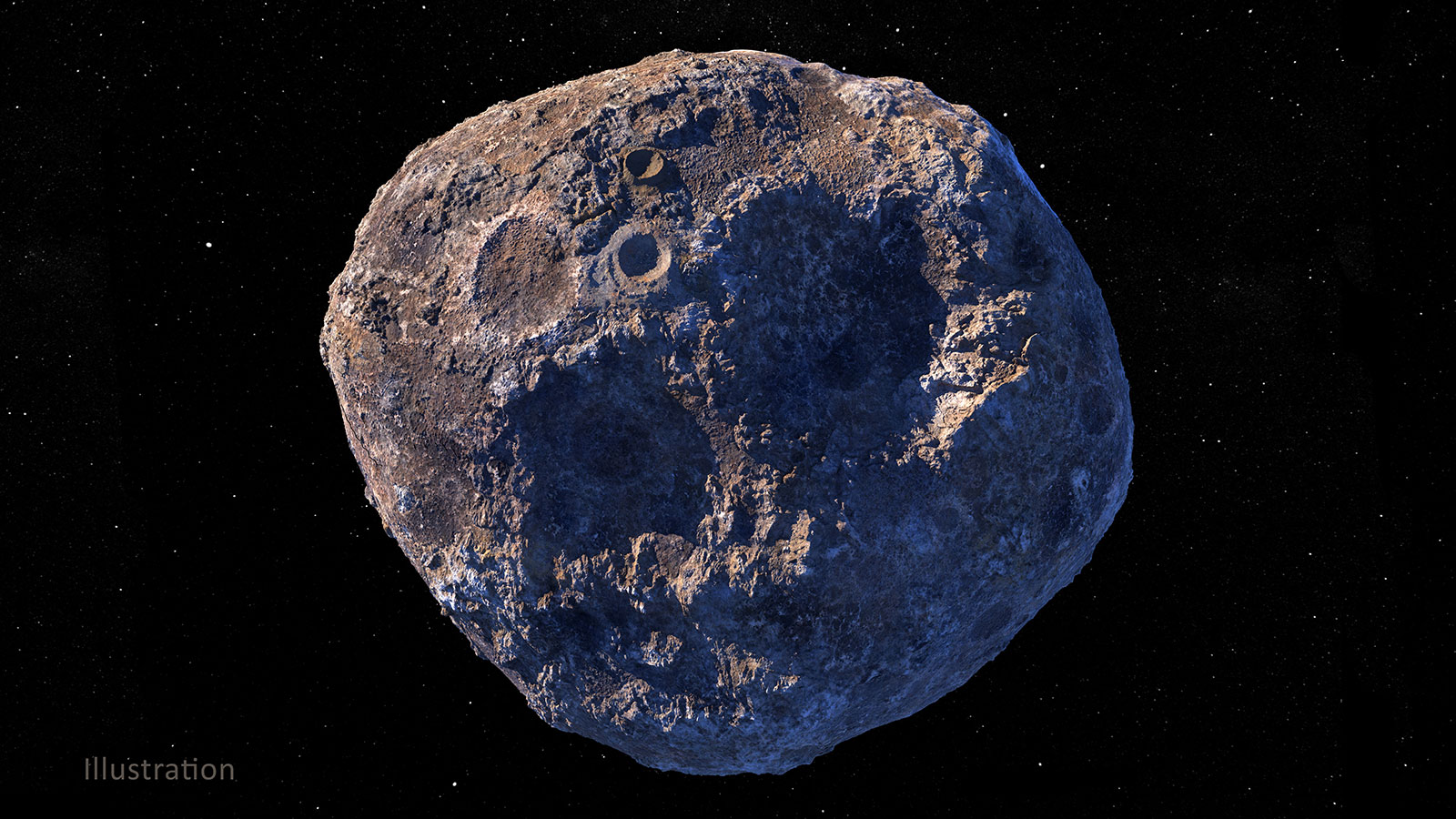
A third group consists largely of metallic iron and nickel. These metallic asteroids may be fragments of larger bodies whose outer rocky layers were stripped away during ancient collisions, exposing their metal-rich interiors.
Each type offers unique clues about the processes that shaped the early solar system.
How Big Can an Asteroid Be?
Asteroids vary enormously in size.
Some are no larger than a pebble.
Others measure just a few meters across, similar to the size of a small house.
Many are several kilometers wide.
The largest known asteroid is Ceres, which has a diameter of about 940 kilometers (584 miles). Because its gravity pulled it into a nearly spherical shape, Ceres is now classified as a dwarf planet rather than an asteroid, although it remains the largest object in the asteroid belt.
Several other large asteroids, including Vesta, Pallas, and Hygiea, are hundreds of kilometers across.
At the opposite extreme, tiny asteroid fragments only a few centimeters wide are also common throughout the solar system.
What Shapes Do Asteroids Have?
Unlike planets, most asteroids are not perfectly round.
Because they are relatively small, their gravity is usually too weak to pull them into spherical shapes.
Many resemble irregular rocks with rough surfaces.
Some are elongated like potatoes.
Others are flattened, lumpy, or oddly shaped due to billions of years of collisions.
Several asteroids consist not of one solid rock but of many pieces loosely held together by gravity. Scientists call these rubble-pile asteroids. They formed after larger asteroids shattered during collisions, with gravity slowly pulling the fragments back together.
These loosely connected bodies can contain empty spaces between rocks, making them surprisingly fragile.
What Are Asteroids Made Of?
Asteroids contain a remarkable variety of materials.
Many consist mainly of silicate rocks similar to Earth’s crust.
Others contain abundant metals such as iron and nickel.
Some preserve carbon compounds, organic molecules, and minerals that formed in the earliest days of the solar system.
Scientists have also discovered hydrated minerals within certain asteroids, indicating that water interacted with their rocks long ago. Some carbon-rich asteroids may even contain significant amounts of water locked inside minerals.
Studying asteroid composition helps researchers understand how water and organic compounds may have been delivered to the early Earth.
How Do Asteroids Move?
Every asteroid follows its own orbit around the Sun.
Some travel in nearly circular paths.
Others follow highly elliptical orbits that carry them closer to or farther from the Sun during each revolution.
The speed of an asteroid depends on its distance from the Sun. Those closer to the Sun generally move faster than those farther away.
Gravity from planets—especially Jupiter—can gradually alter asteroid orbits over long periods.
Occasionally, these gravitational interactions send asteroids into new orbits that cross Earth’s path.
Near-Earth Asteroids
A small percentage of asteroids travel relatively close to Earth. These are known as Near-Earth Asteroids (NEAs).
An asteroid receives this classification if its orbit brings it into Earth’s neighborhood.
Most near-Earth asteroids never pose any danger.
Astronomers continuously monitor thousands of these objects using ground-based telescopes and space missions. Their positions and future orbits are calculated with remarkable precision.
A much smaller group consists of potentially hazardous asteroids, whose orbits come relatively close to Earth and whose sizes are large enough that an impact could cause significant regional or global effects. However, “potentially hazardous” simply means their orbits deserve careful monitoring—it does not mean a collision is expected.
Continuous observations allow scientists to refine predictions decades or even centuries into the future.
Do Asteroids Ever Hit Earth?
Yes, asteroids occasionally collide with Earth, although large impacts are extremely rare.
Every day, tiny pieces of asteroid material enter Earth’s atmosphere. Most are no larger than grains of sand and burn up completely, producing faint meteors.
Slightly larger rocks may create bright fireballs.
Objects several meters across sometimes explode high in the atmosphere before reaching the ground.
Very large asteroid impacts occur far less frequently, often separated by hundreds of thousands or millions of years.
The best-known ancient impact is the one associated with the Chicxulub crater in present-day Mexico. About 66 million years ago, an asteroid approximately 10 kilometers wide struck Earth. Scientific evidence strongly indicates that this impact contributed to the mass extinction that eliminated all non-avian dinosaurs and many other species.
Events of this size are exceptionally uncommon.
How Scientists Detect Asteroids
Modern astronomy uses powerful telescopes to search for asteroids.
Observatories repeatedly photograph the same region of the sky.
Stars remain fixed in their positions, while asteroids slowly move between images.
Computers identify these moving points of light and calculate their orbits.
Once an asteroid is discovered, astronomers around the world continue tracking it to improve knowledge of its future motion.
Space telescopes also help detect asteroids, especially those difficult to observe from Earth’s surface.
Thanks to decades of international cooperation, scientists have cataloged well over a million asteroids, and new discoveries continue every year.
Space Missions to Asteroids
Asteroids have become important destinations for robotic space missions.
Rather than simply observing them from afar, spacecraft now orbit, photograph, land on, and even collect samples from these ancient worlds.
NASA’s NEAR Shoemaker mission became the first spacecraft to land on an asteroid.
Japan’s Hayabusa and Hayabusa2 missions successfully collected samples from two different asteroids and returned them to Earth.
NASA’s OSIRIS-REx mission collected material from the near-Earth asteroid Bennu and safely delivered samples back to Earth in 2023, allowing scientists to study pristine asteroid material in laboratories.
These missions reveal details impossible to learn using telescopes alone, including surface composition, internal structure, and geological history.
What Can Asteroids Teach Us?
Asteroids act like preserved fossils from the birth of the solar system.
Unlike Earth, whose geology constantly reshapes its surface through volcanoes, erosion, plate tectonics, and weather, many asteroids have remained relatively unchanged for billions of years.
By studying them, scientists can learn:
How planets formed.
How water reached Earth.
How organic molecules developed in space.
How collisions shaped the solar system.
How the early Sun influenced planetary evolution.
Some asteroid samples even contain organic compounds that formed before Earth itself existed, providing valuable insight into the chemistry that preceded the emergence of life.
Asteroids and the Search for Resources
Asteroids may also play an important role in humanity’s future beyond Earth.
Many contain valuable metals such as iron, nickel, cobalt, and platinum-group elements.
Others contain water trapped within minerals.
Water is especially valuable in space because it can support astronauts and also be separated into hydrogen and oxygen to produce rocket fuel.
Although asteroid mining remains largely a future possibility, scientists and engineers continue studying whether these resources could someday support long-term exploration of the Moon, Mars, and beyond.
Asteroids, Meteoroids, Meteors, and Meteorites
These terms are often confused, but they describe different stages of similar objects.
An asteroid is a rocky object orbiting the Sun.
A much smaller fragment, usually broken from an asteroid or comet, is called a meteoroid.
When a meteoroid enters Earth’s atmosphere and produces a streak of light, it becomes a meteor.
If part of the object survives its fiery journey and reaches the ground, it is called a meteorite.
Understanding these distinctions helps explain many spectacular events observed in the night sky.
How Asteroids Differ From Comets
Asteroids and comets both orbit the Sun, but they differ significantly in composition and appearance.
Asteroids are primarily made of rock and metal.
Comets contain abundant ice mixed with dust and rocky material.
As a comet approaches the Sun, its ice heats up and changes directly into gas, releasing dust that forms a glowing atmosphere called a coma and often a long tail pointing away from the Sun.
Asteroids generally do not develop such tails because they contain much less easily vaporized ice near their surfaces.
While both objects preserve ancient solar system material, they formed in somewhat different regions and under different conditions.
Could an Asteroid Threaten Earth?
Planetary defense has become an active area of scientific research.
Astronomers continuously search for near-Earth asteroids to identify any future risks as early as possible.
Early detection is the most important factor because it provides decades of warning if action ever becomes necessary.
Scientists have also begun testing methods that could alter an asteroid’s orbit.
In 2022, NASA’s Double Asteroid Redirection Test (DART) successfully changed the orbit of a small asteroid moon by deliberately crashing a spacecraft into it. This mission demonstrated that kinetic impact could become one useful technique for planetary defense if a future hazardous asteroid were discovered with sufficient warning.
Fortunately, no known large asteroid poses a significant impact threat to Earth in the foreseeable future based on current observations.
Why Asteroids Matter
At first glance, asteroids may appear to be little more than drifting rocks in space. Yet they are among the most scientifically valuable objects in the solar system. They preserve the raw ingredients from which planets formed, record billions of years of cosmic history, and offer clues about the origins of water, organic molecules, and possibly even the conditions that made life on Earth possible.
They also remind us that our planet is part of a dynamic solar system where gravity, collisions, and time continually shape the worlds around us.
Conclusion
Asteroids are ancient rocky bodies that orbit the Sun, preserving a record of the solar system’s earliest history. Formed more than 4.5 billion years ago from material that never became part of a planet, they range from tiny fragments to objects hundreds of kilometers across. Most reside in the asteroid belt between Mars and Jupiter, while others travel throughout the solar system, including near Earth’s orbit.
Far from being mere space debris, asteroids are scientific treasures. They reveal how planets formed, how water and organic compounds may have reached Earth, and how the solar system evolved over billions of years. As scientists continue exploring these remarkable worlds through telescopes, robotic spacecraft, and returned samples, asteroids remain vital keys to understanding both our cosmic past and humanity’s future in space.